
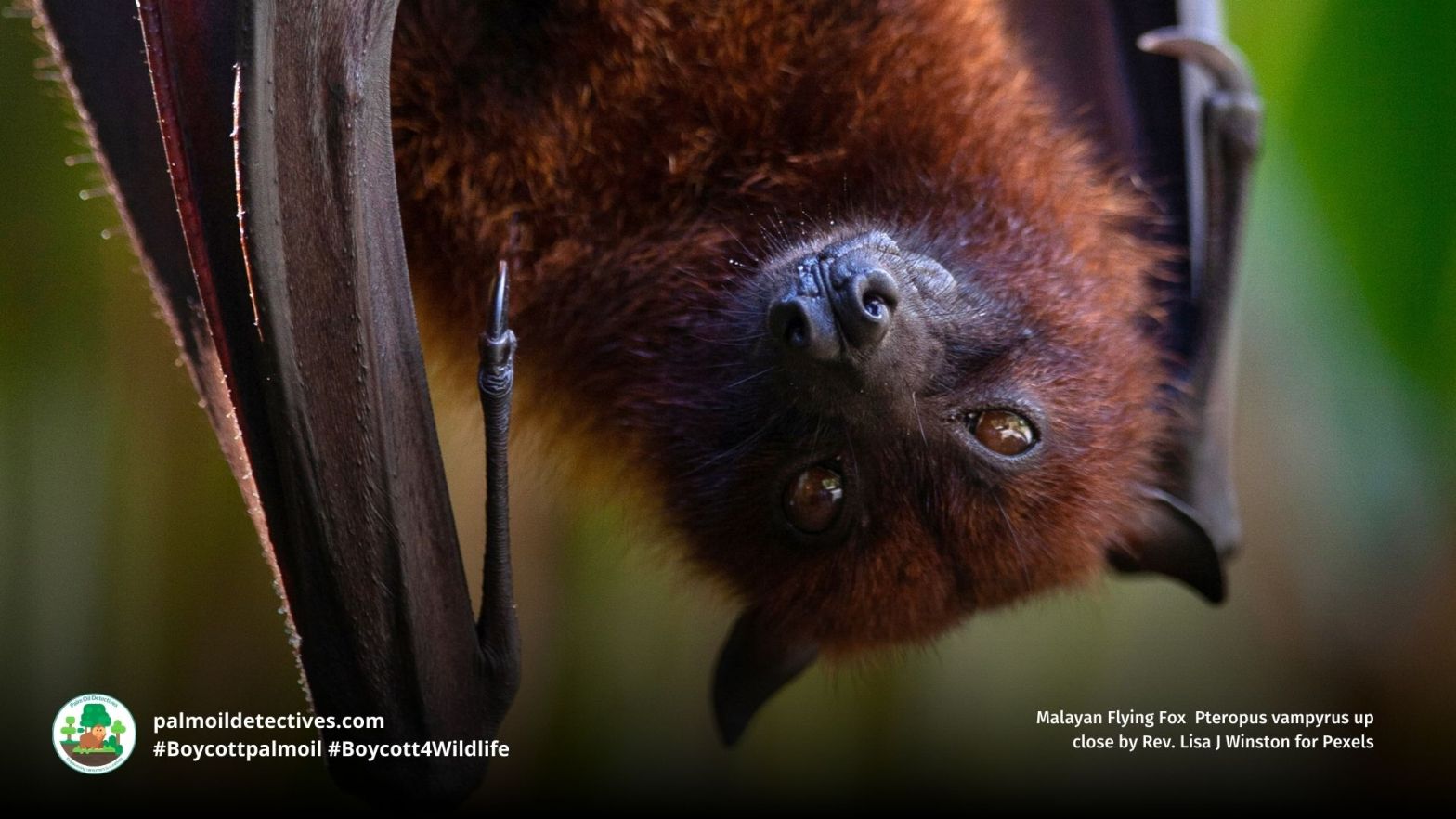
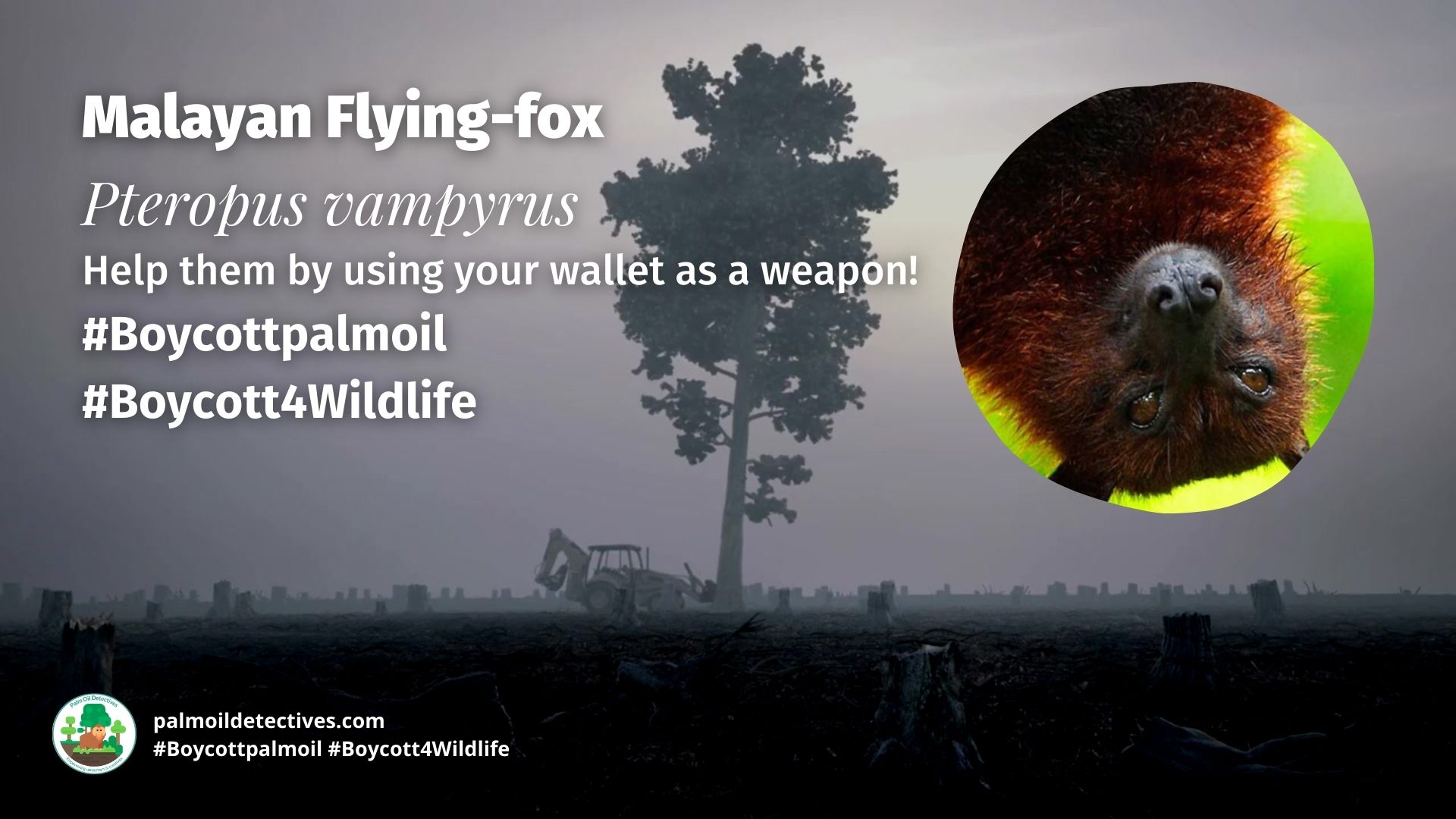
Malayan Flying Fox Pteropus vampyrus
IUCN Red List Status: Endangered
Location: The Malayan Flying Fox is found across South and Southeast Asia, including India, Sri Lanka, Myanmar, Thailand, Cambodia, Laos, Vietnam, Malaysia, Indonesia, and the Philippines.
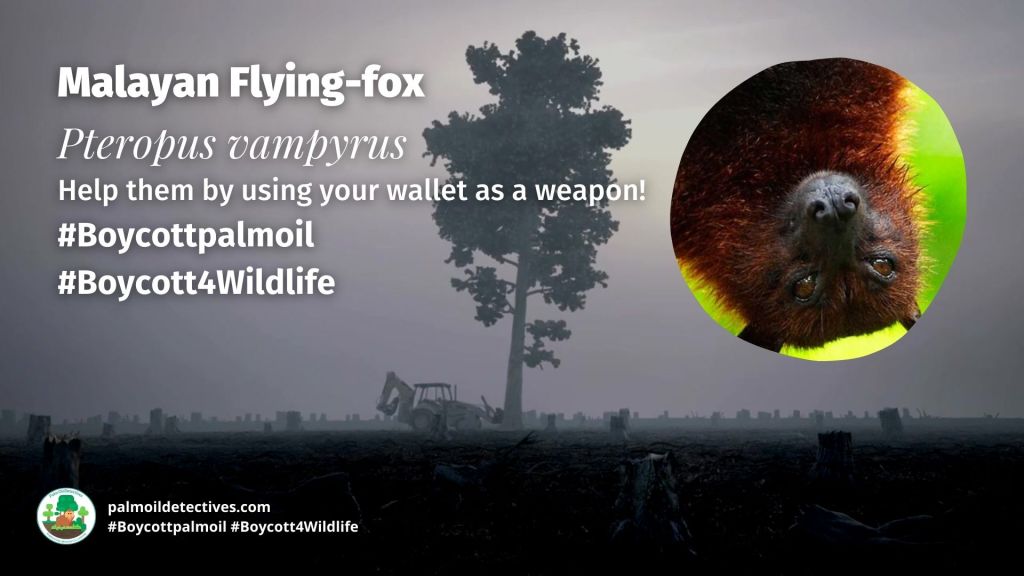
The Malayan Flying Fox, known also as the Large Flying Fox, Giant Fruit Bat, or Kalong, is an ethereal creature of the tropical Asian night. With wingspans reaching 1.7 metres, they are the largest bats in the world and glide silently through the darkness, a graceful presence in South East Asia’s moonlit forests. Their foxy almond shaped eyes and expressive faces are framed by glossy black fur and golden and russet collars, lend them a warm and mythical aura, while their immense wings are awe-inspiring to see in flight.
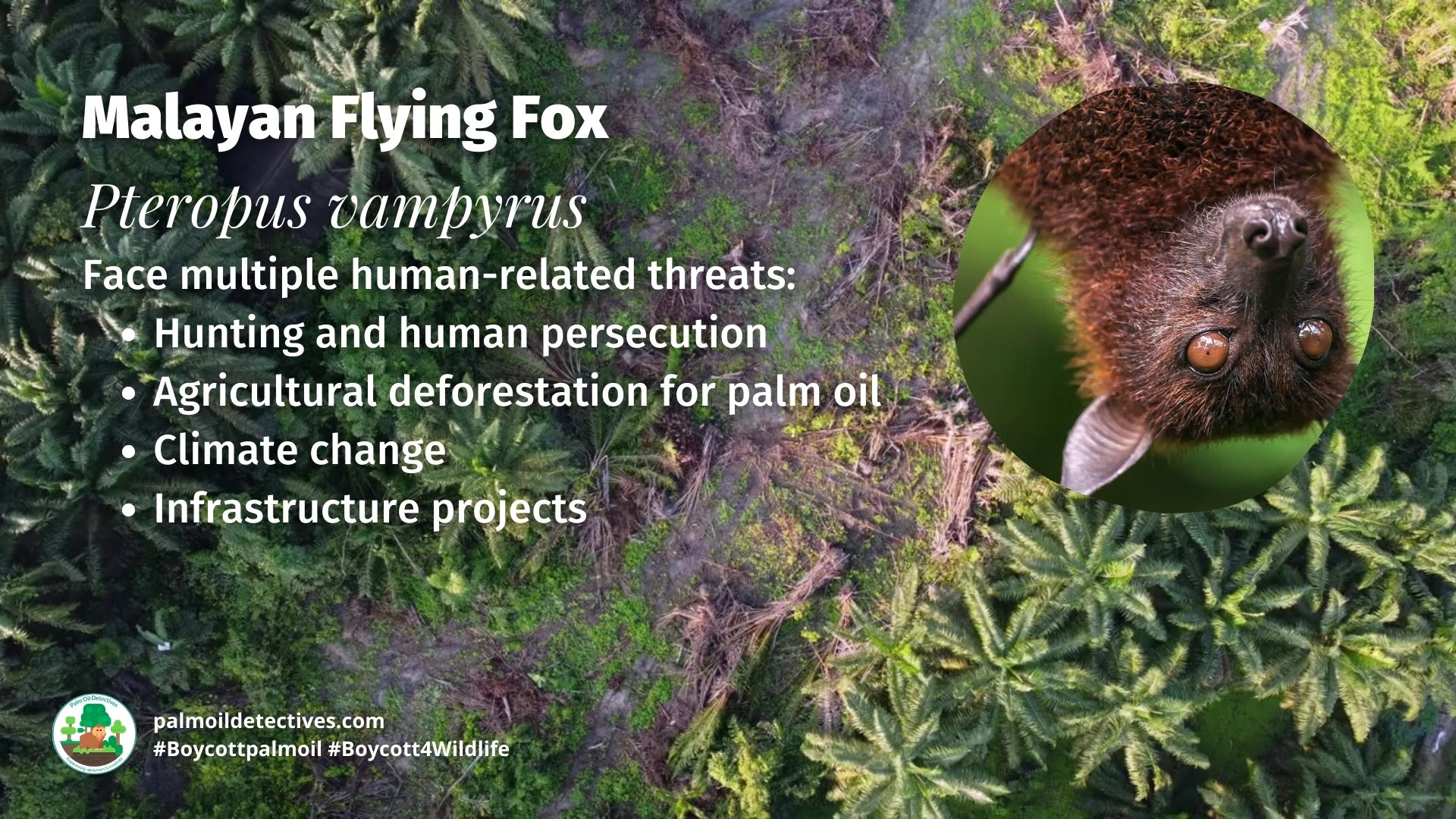
These nocturnal giants are the architects of tropical forests, scattering seeds and pollinating flowers as they journey across vast landscapes. Yet, despite their importance to ecosystems, they are under siege—hunted mercilessly and displaced by forests that vanish due to palm oil. Their story is a call to action: protect the guardians of the night before it is too late. #BoycottPalmOil #Boycott4Wildlife
The largest #bat 🦇🌎 in the world has a 1.7m wingspan and hangs out in S.E. #Asia’s #forests, the Malayan Flying Fox is #endangered by hunting and #palmoil 🌴🔥#deforestation. Help them survive and #Boycottpalmoil 🌴💩🧐 #Boycott4Wildlife @palmoildetect https://wp.me/pcFhgU-9Zm
Known locally as #Kalong the Malayan #FlyingFox of #Malaysia #Indonesia has a bad reputation but plays an outsized role in keeping #rainforests alive. #Endangered by #palmoil. Use your wallet as a weapon 🌴⛔️#Boycottpalmoil #Boycott4Wildlife @palmoildetect https://wp.me/pcFhgU-9Zm
Appearance & Behaviour
The Malayan Flying Fox is a marvel of the natural world, both striking and otherworldly. Their velvety fur ranges from glossy black to a rich reddish-gold that glows in the dappled sunlight of their treetop roosts. Their expansive wings, often veined and translucent, are masterpieces of natural engineering, allowing them to soar effortlessly, sometimes for over 50 km in a single night. Weighing between 0.65 and 1.1 kilograms, they are among the largest bat species in the world.
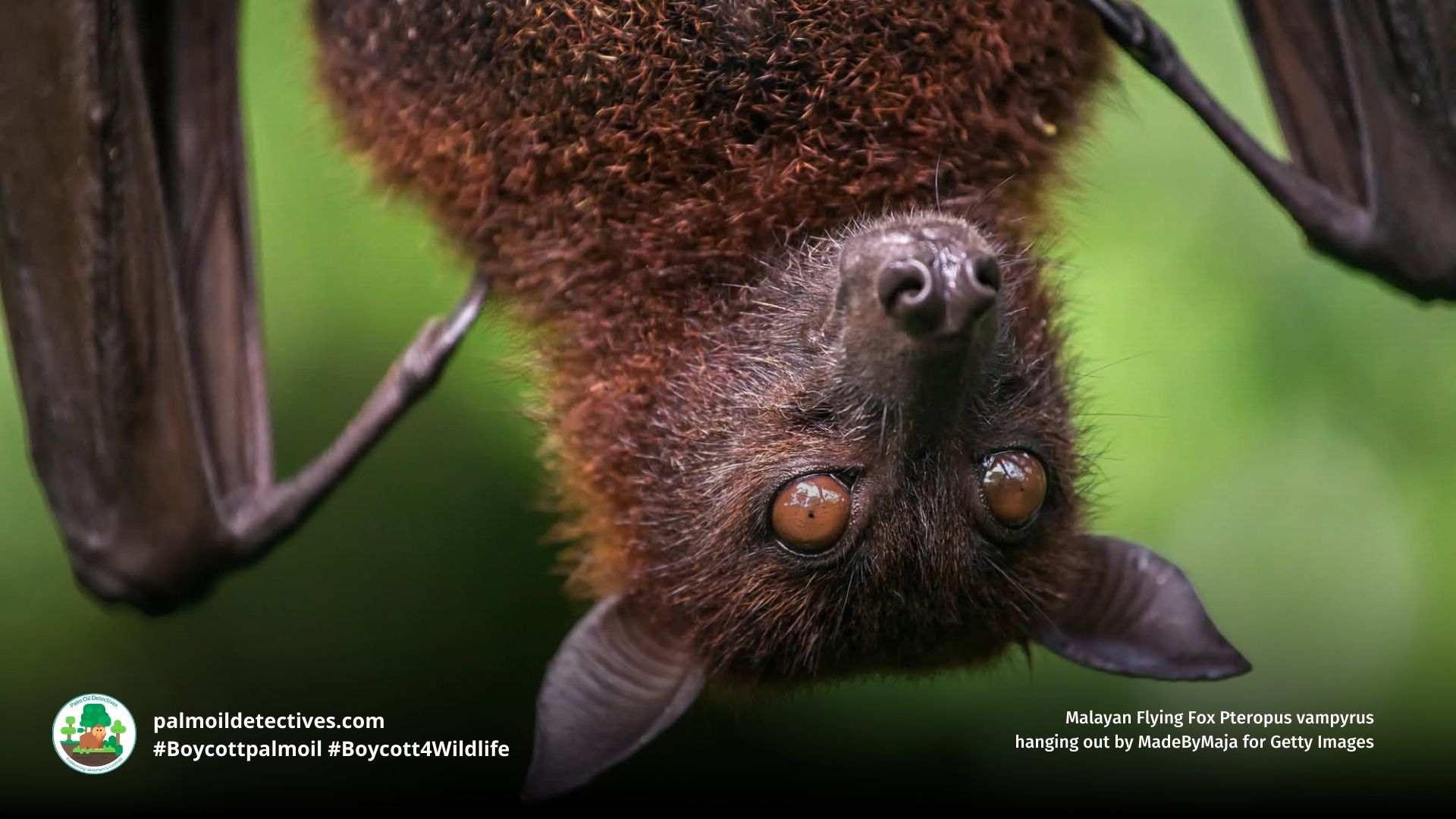
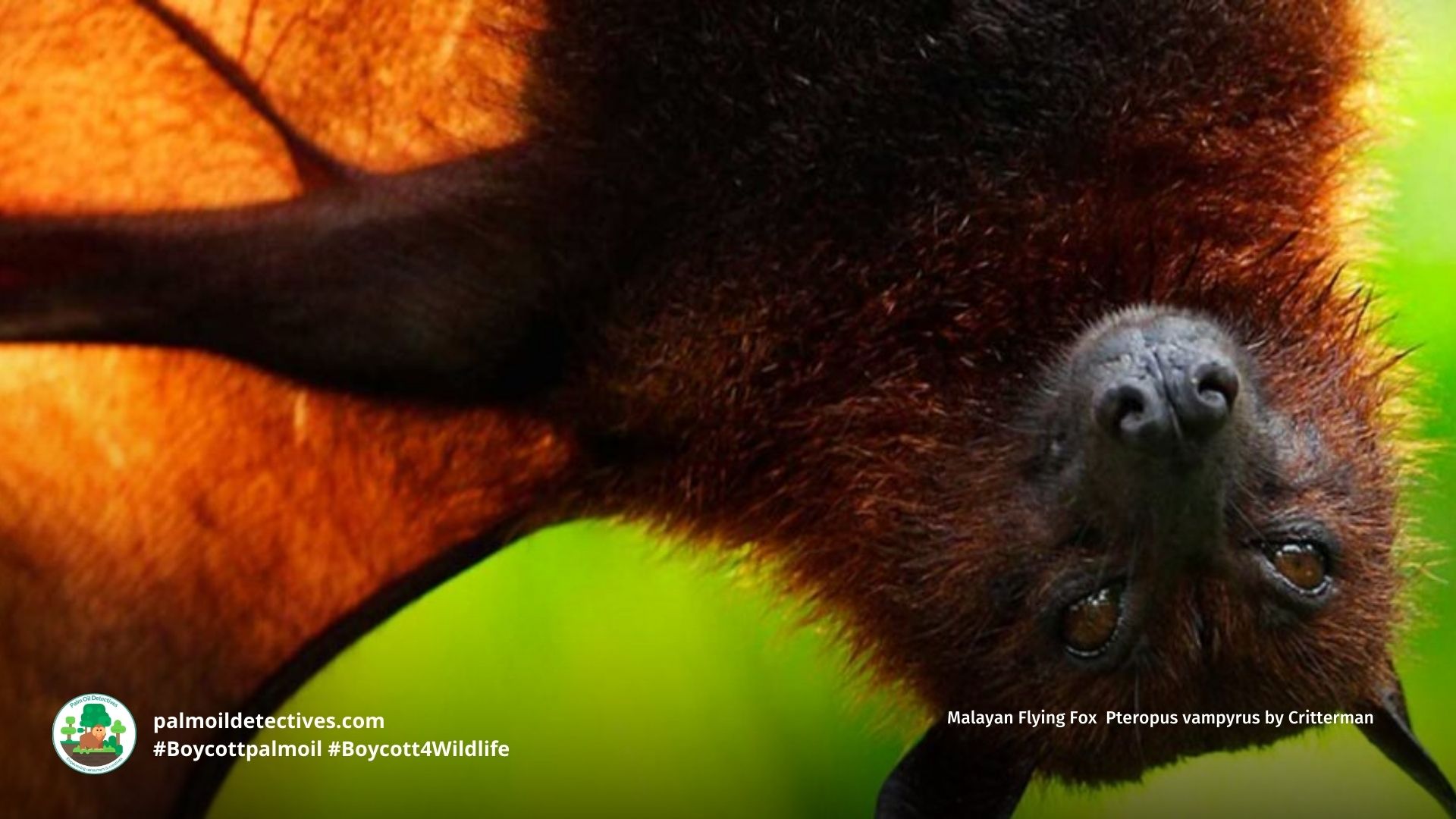
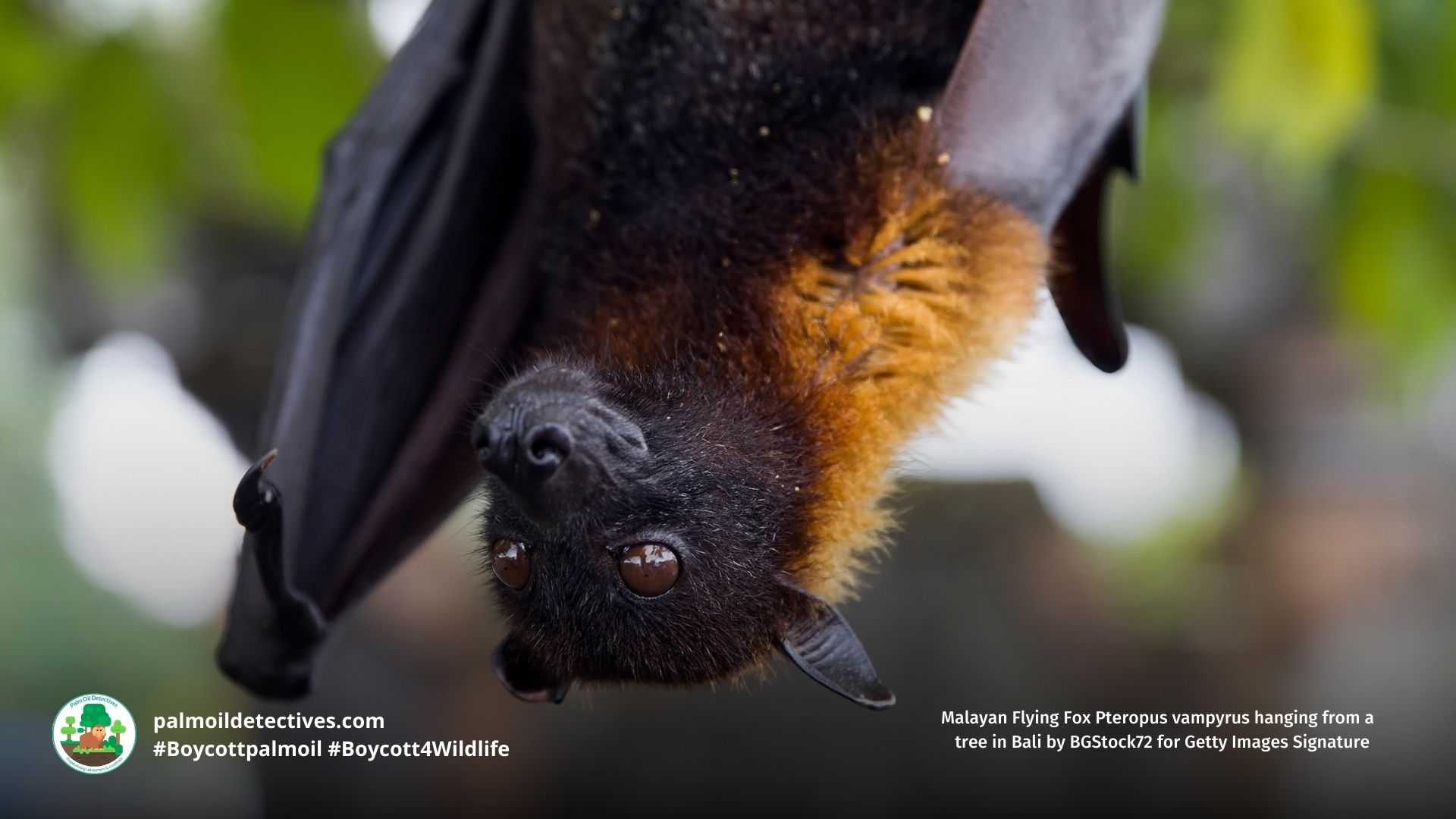
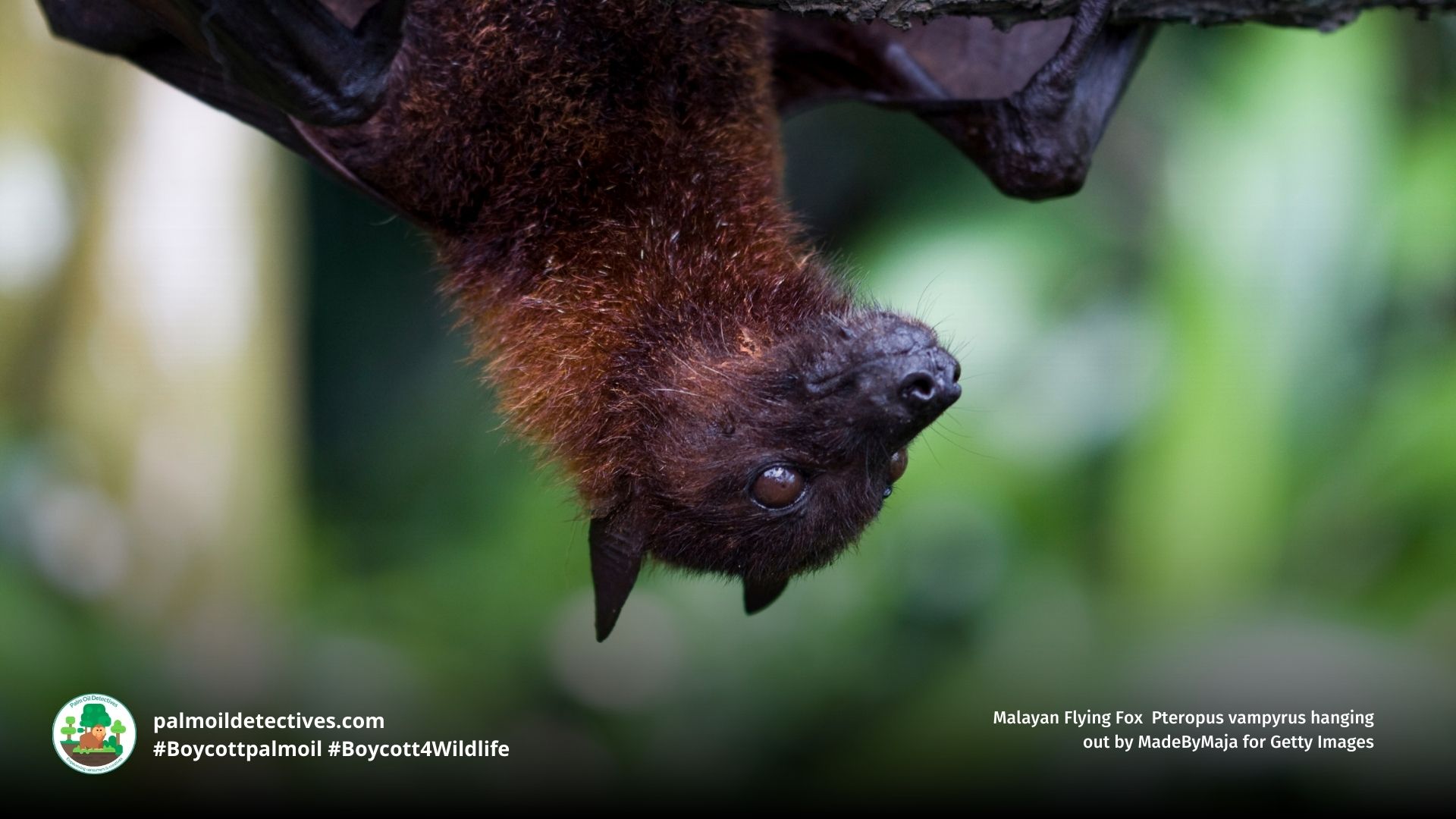
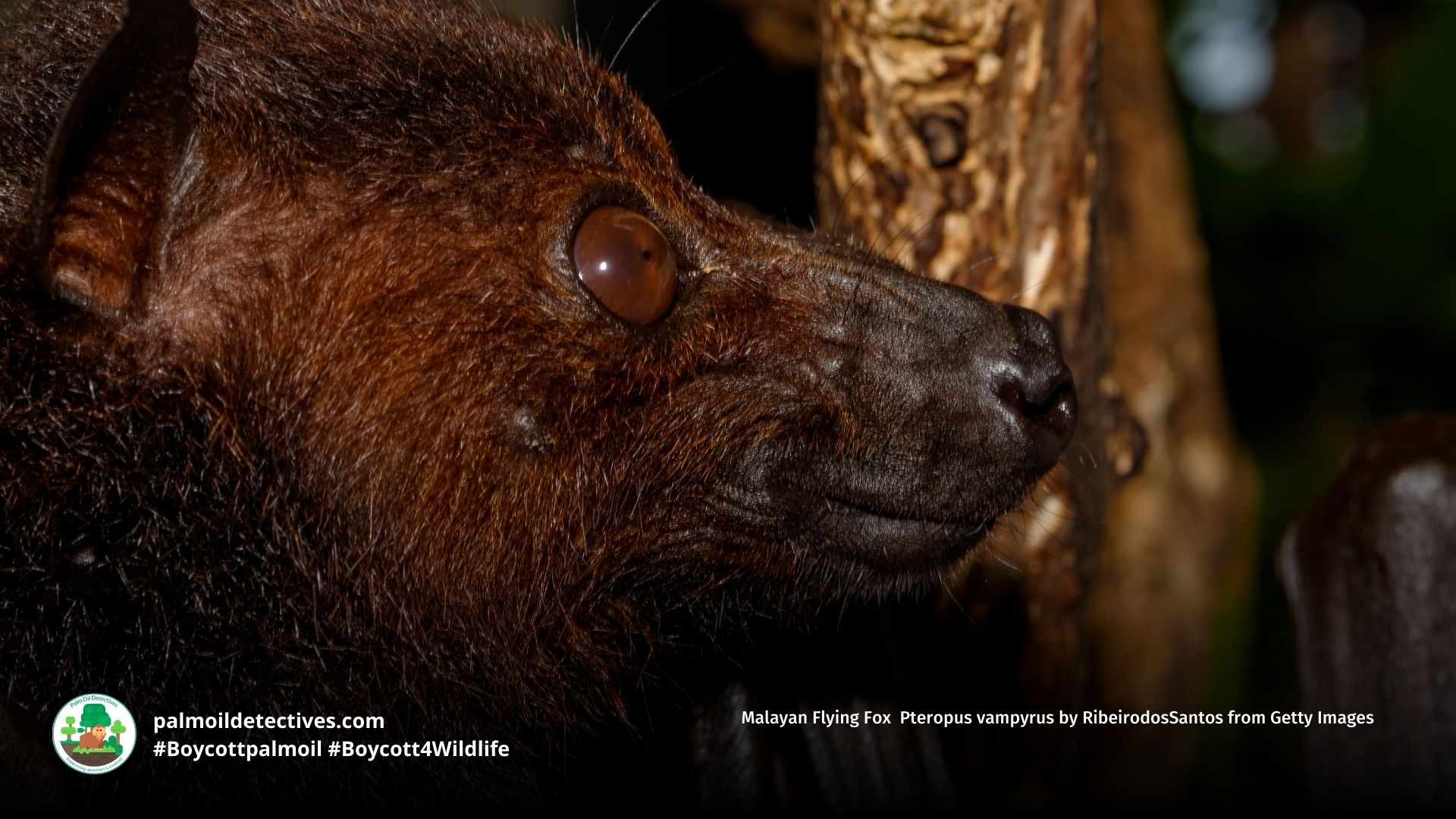
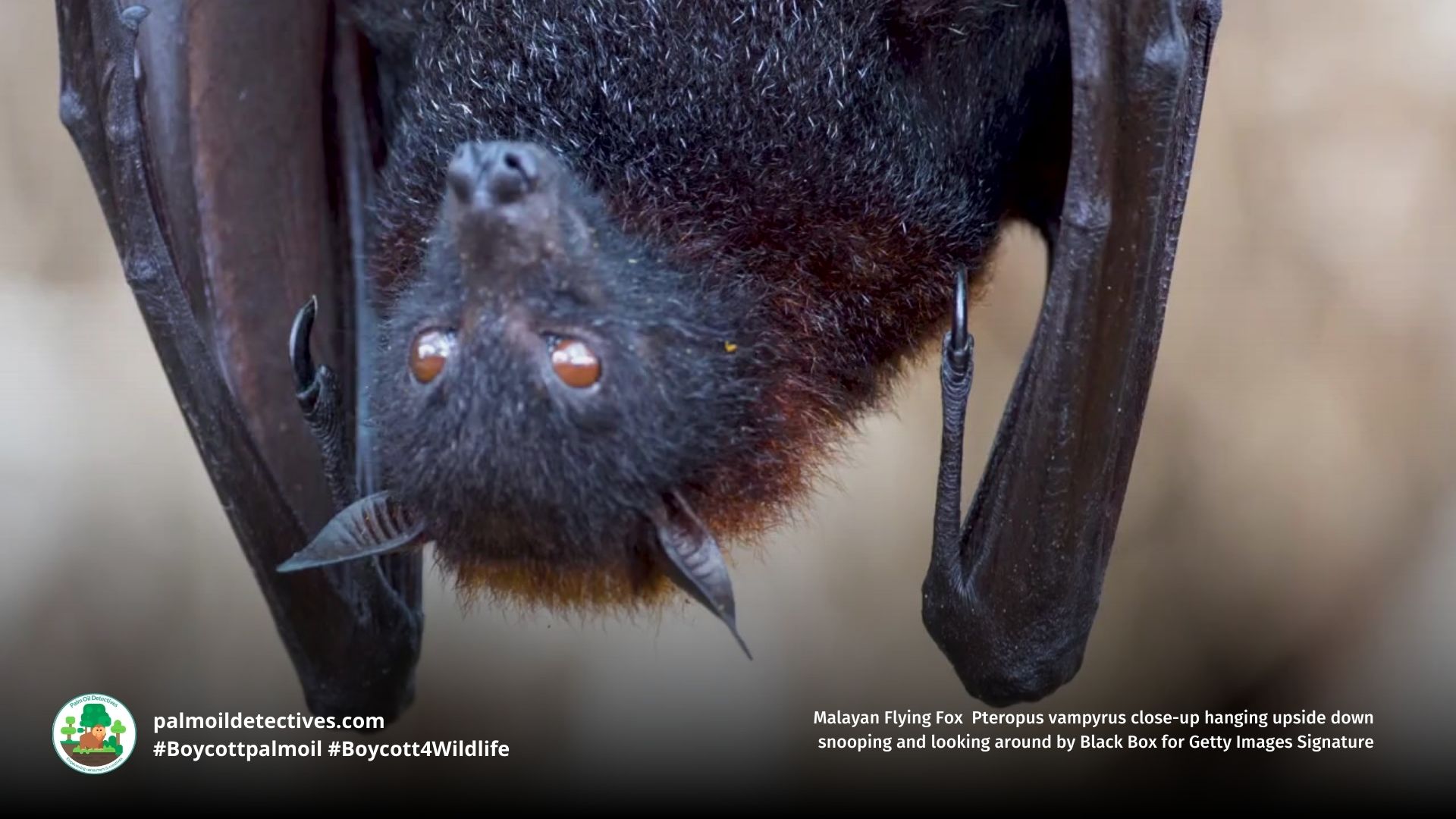
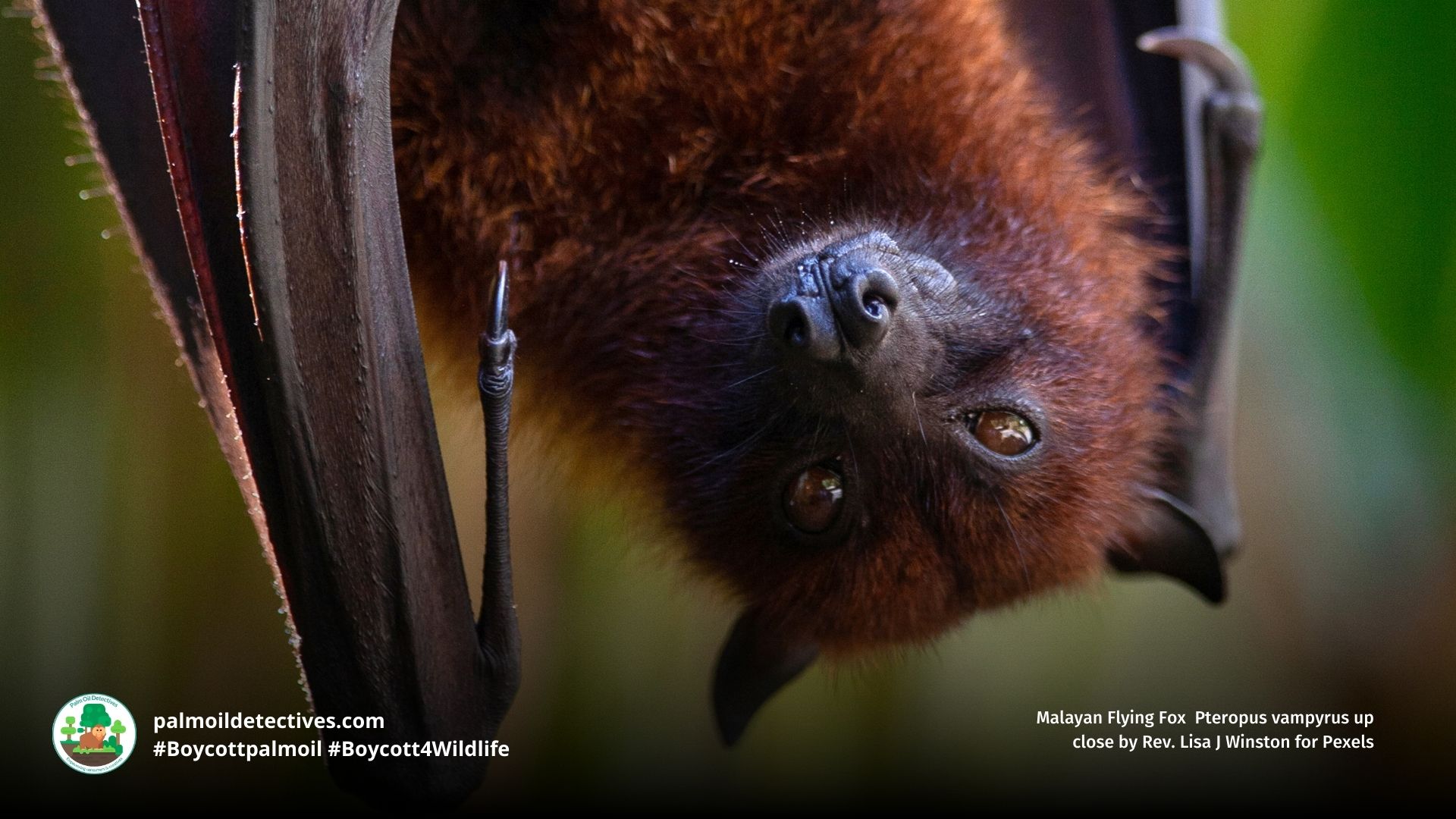
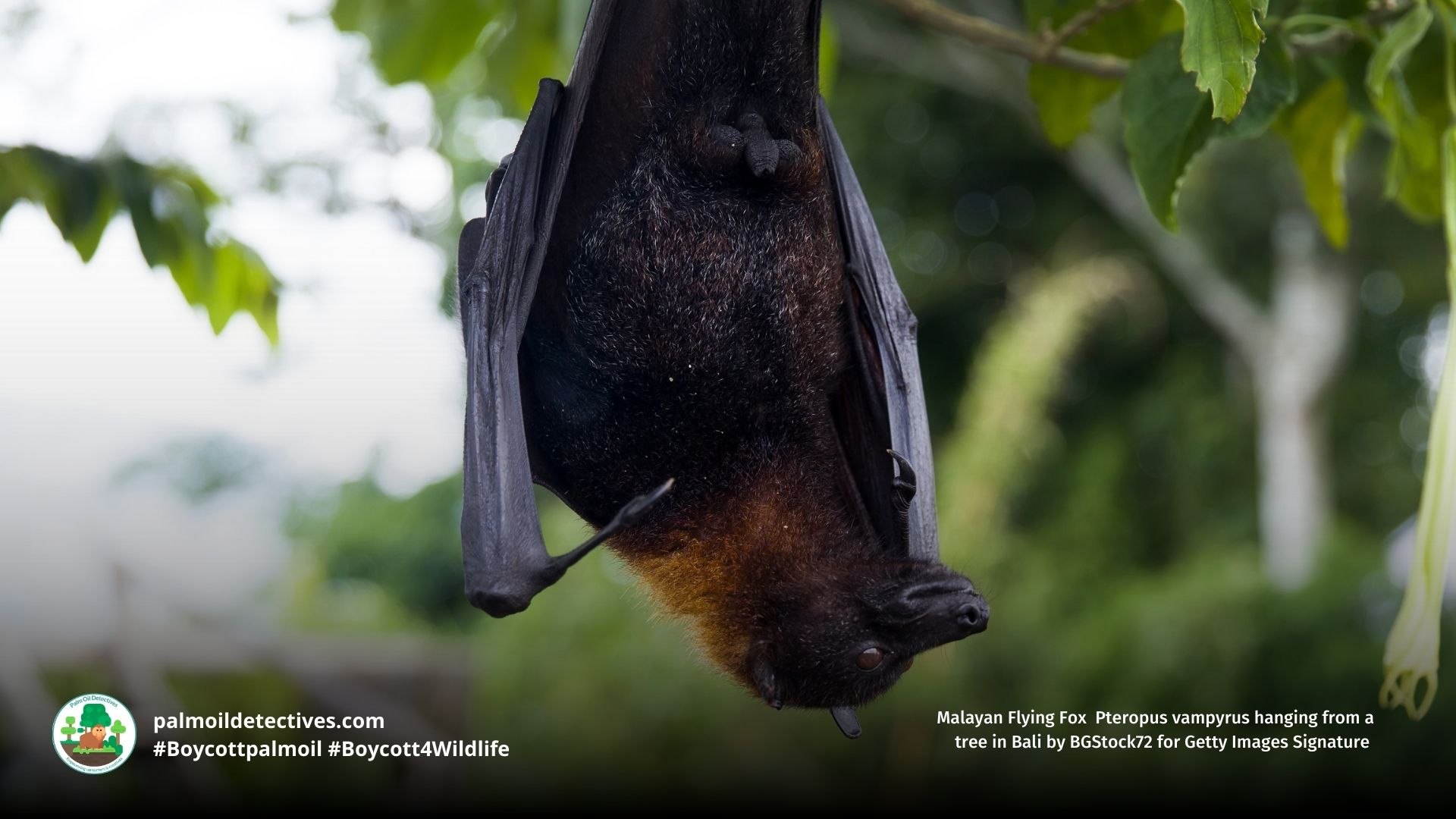
Their glossy, woolly fur varies between individuals and ages, with mature males often sporting thicker, slightly stiffer coats. Colouration ranges from mahogany-red and orange-ochre on the head to chocolate-brown and silver tinges on their undersides. Their golden or orange mantles form a regal collar, while immature bats are duller, with greyish-brown hues that brighten as they age. They have no tail, and their fox-like faces, complete with pointed ears, add to their unique charm.
The Malayan Flying Fox’s haunting, intelligent eyes seem to observe the world with a quiet wisdom, reflecting their keen reliance on sight over echolocation. In their colonies—sometimes numbering tens of thousands—they are lively, social creatures.
Their wing membranes, mostly hairless, are rounded at the tips, granting them exceptional manoeuvrability in flight. Malayan Flying Foxes display a fascinating array of behaviours. At roost, they hang upside down, often fanning themselves with their wings to stay cool in tropical heat. They groom one another, squabble over perches with flurries of deep growls and impressive wing displays. They cradle their young tenderly in their wings.
By carrying seeds far and wide, they regenerate ecosystems across Southeast Asia’s fragile tropical ecosystems, ensuring the survival of countless other plants and animal species.
Threats
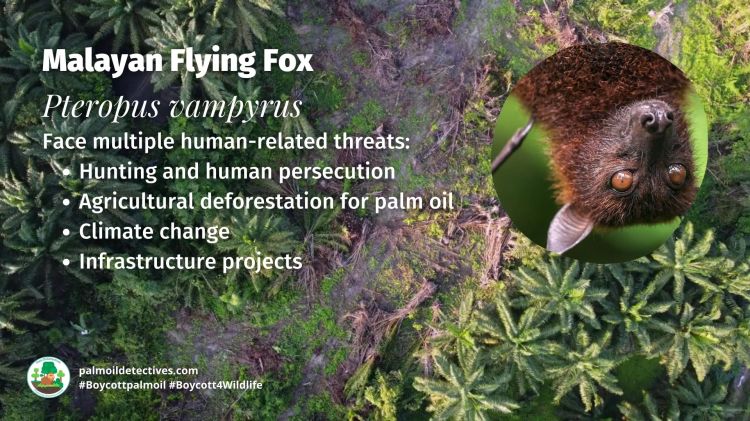
Deforestation and Habitat Loss
The Malayan Flying Fox faces relentless habitat destruction. Mangroves, lowland forests, and coastal trees, which they rely on for roosting and foraging, are being cleared for agriculture, particularly timber and palm oil plantations. In places like East Kalimantan, mangrove habitats have been replaced by shrimp farms, leaving once-thriving colonies displaced and fragmented.
Hunting and Human Persecution
These bats are hunted across their range for bushmeat, traditional medicine, and sport. In some areas, thousands are killed in a single night. Hunters target roost sites, causing devastating ripple effects on entire colonies. Farmers, frustrated by perceived crop damage, trap and poison them, unaware of their critical ecological role.
Climate Change and Extreme Weather
Climate change has intensified weather systems. Rising sea levels and intensifying typhoons ravage the mangroves and coastal forests these bats call home. Heatwaves have caused mass deaths from heatstroke, while the increasing frequency of extreme weather events further strains already vulnerable populations.
Human-Wildlife Conflict
As forests vanish, these gentle giants are forced into closer proximity to humans. Misguided fears have linked these bats to disease outbreaks, such as COVID-19. This has escalated culling and persecution activities in many countries, compounding the threats they already face.
Habitat and Geographic Range
The Malayan Flying Fox spans South and Southeast Asia, inhabiting countries like India, Malaysia, Indonesia, and the Philippines. Their range includes mangroves, lowland rainforests, and coastal forests. Roosting in tall trees, they depend on large, intact forest canopies for shelter and sustenance.
Diet
Large Flying Foxes are frugivores and nectarivores, with their diet focused on fruits, flowers, and nectar. They are particularly fond of figs, bananas, mangoes, and durian flowers, consuming the pulp of the fruit and licking nectar from blossoms without damaging them. They also feed on rambutan and langsat fruits.
At night, these bats fly up to 50 kilometres from their roosts to forage, guided by their exceptional eyesight. Upon landing on fruiting trees, they often choose the tips of branches, hanging upside down to feed. Their feeding aggregations are noisy and energetic, with flocks forming smaller family or feeding groups at foraging sites.
This diet makes them crucial for pollination and seed dispersal, ensuring the regeneration of tropical ecosystems across their range.
Mating and Reproduction
Malayan Flying Foxes are polygynous, with dominant males maintaining harems of up to 10 females. Courtship displays involve wing flutters and vocalisations. Females give birth to a single pup after a gestation of up to 190 days, usually timed with the abundance of fruiting trees.
Mating in Large Flying Foxes typically occurs in the autumn, with females giving birth to a single pup after a gestation of approximately six months. Gestation peaks vary by region: in Peninsular Malaysia, births are most common between November and January; in the Philippines, they occur in April and May.
Newborns cling tightly to their mothers as they forage, learning to navigate the vast night skies. Weaning occurs at around three months, but the bond between mother and pup often lasts much longer, a testament to the deep care these animals show their young. Pups remain dependent on their mothers until they develop the strength to join nightly foraging flights.
Their slow reproduction rate—female bats usually produce just one pup annually—makes the species especially vulnerable to population declines caused by hunting and habitat destruction.
FAQs
What are some unusual facts about flying foxes?
Malayan Flying Foxes are highly social, forming colonies of up to 20,000. They are skilled navigators, flying 30 miles nightly for food. Unlike most bats, they depend on sharp eyesight rather than echolocation, and as pollinators and seed dispersers, they are keystone species of tropical ecosystems.
Why are Malayan Flying Foxes important?
These bats are nature’s forest gardeners—ensuring tropical ecosystem regeneration by dispersing seeds and pollinating flowers. Without them, forests would suffer irreversible damage, threatening countless other species.
Are large flying foxes good pets?
Absolutely not. Keeping Malayan Flying Foxes as pets is cruel, contributes to their decline, and often involves illegal capture and colony disruption. If you care about these bats, do not support their trade as exotic pets.
Take Action!
The Malayan Flying Fox is a keystone species, essential for the health of tropical forests. Protect them by boycotting products linked to deforestation and advocating for stronger protections: #BoycottPalmOil #Boycott4Wildlife.
Support the Malayan Flying Fox by going vegan and boycotting palm oil in the supermarket, it’s the #Boycott4Wildlife
Support the conservation of this species
This animal has no protections in place. Read about other forgotten species here. Create art to support this forgotten animal or raise awareness about them by sharing this post and using the #Boycottpalmoil #Boycott4Wildlife hashtags on social media. Also you can boycott palm oil in the supermarket.
Further Information
Cambridge University Press. (2021). Intensive hunting of Large Flying Foxes in Central Kalimantan, Indonesian Borneo. Retrieved from https://www.cambridge.org/core/journals/oryx/article/intensive-hunting-of-large-flying-foxes
Critter Science. (n.d.). The Giant Malayan Flying Fox. Retrieved from https://critter.science/the-giant-malayan-flying-fox/
Hengjan, Y., et al. (2017). Daytime behaviour of Pteropus vampyrus in a natural habitat: The driver of viral transmission. Journal of Veterinary Medical Science, 79(6), 1125–1133. https://doi.org/10.1292/jvms.16-0643
Mildenstein, T., Abdul Aziz, S., Paguntalan, L., Jakosalem, P.G., Mohd-Azlan, J., Tagtag, A., Bansa, L., Reintar, A.R., Struebig, M., Fredriksson, G., Lee, B., Thong, V.D. & Sheherazade. 2022. Pteropus vampyrus. The IUCN Red List of Threatened Species 2022: e.T18766A22088824. https://dx.doi.org/10.2305/IUCN.UK.2022-2.RLTS.T18766A22088824.en. Accessed on 27 January 2025.

How can I help the #Boycott4Wildlife?
Take Action in Five Ways
1. Join the #Boycott4Wildlife on social media and subscribe to stay in the loop: Share posts from this website to your own network on Twitter, Mastadon, Instagram, Facebook and Youtube using the hashtags #Boycottpalmoil #Boycott4Wildlife.
2. Contribute stories: Academics, conservationists, scientists, indigenous rights advocates and animal rights advocates working to expose the corruption of the palm oil industry or to save animals can contribute stories to the website.





3. Supermarket sleuthing: Next time you’re in the supermarket, take photos of products containing palm oil. Share these to social media along with the hashtags to call out the greenwashing and ecocide of the brands who use palm oil. You can also take photos of palm oil free products and congratulate brands when they go palm oil free.
4. Take to the streets: Get in touch with Palm Oil Detectives to find out more.
5. Donate: Make a one-off or monthly donation to Palm Oil Detectives as a way of saying thank you and to help pay for ongoing running costs of the website and social media campaigns. Donate here
Learn about other animals endangered by palm oil and other agriculture
Learn about “sustainable” palm oil greenwashing
Read more about RSPO greenwashing
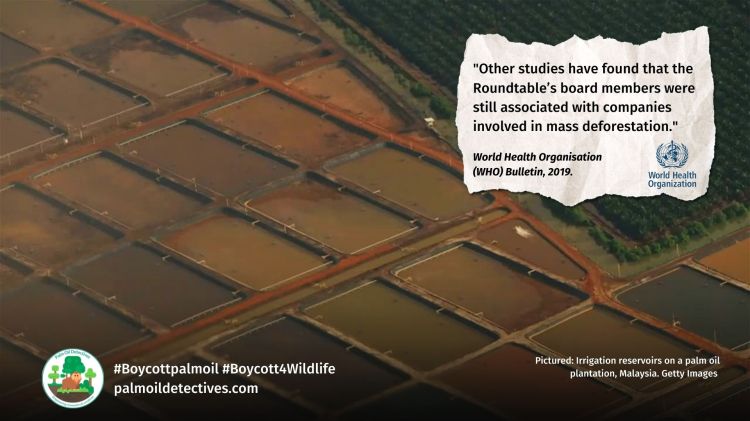
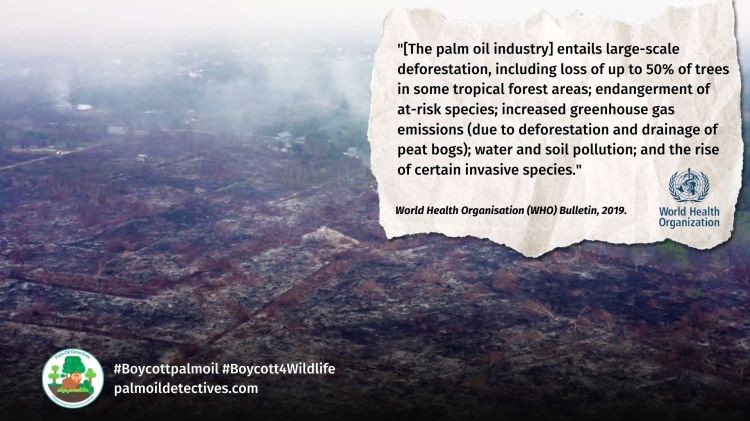
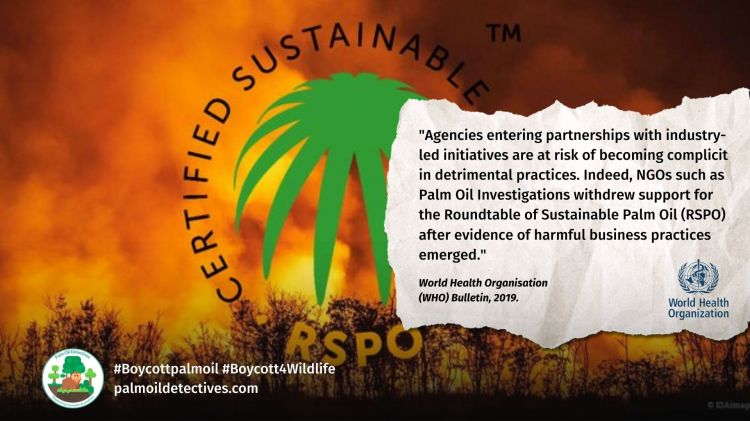
A 2019 World Health Organisation (WHO) report into the palm oil industry and RSPO finds extensive greenwashing of palm oil deforestation and the murder of endangered animals (i.e. biodiversity loss)


Discover more from Palm Oil Detectives
Subscribe to get the latest posts sent to your email.
 Palm Oil Detectives
One thought on “Malayan Flying Fox Pteropus vampyrus”