
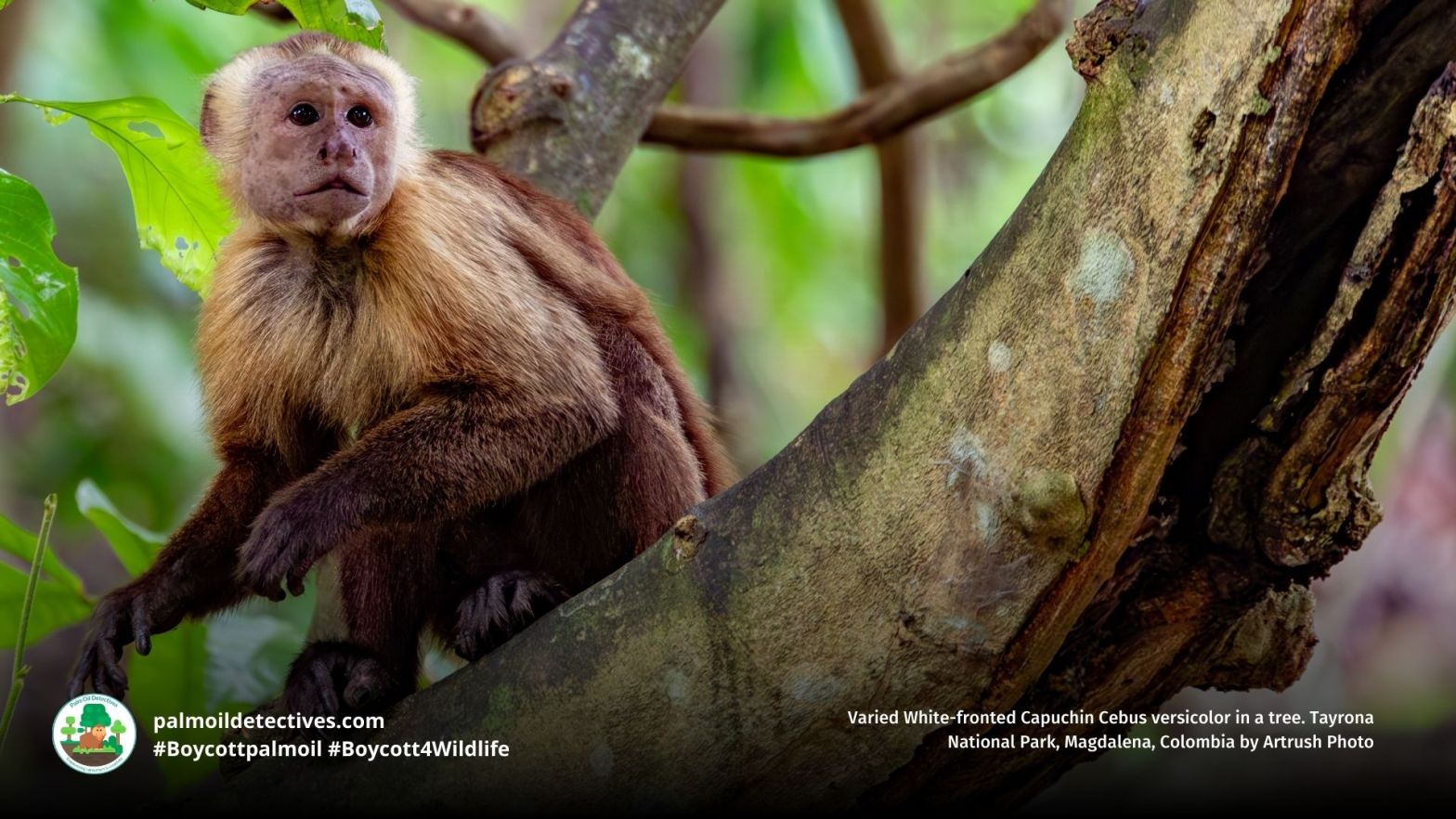
Varied White-fronted Capuchin Cebus versicolor
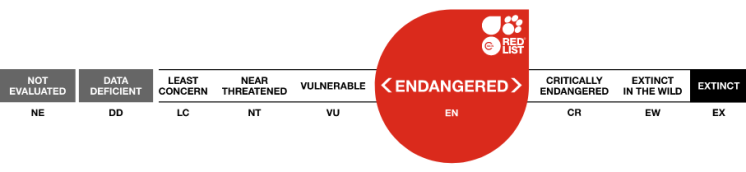
IUCN Status: Endangered
Locations: Colombia, primarily in the Magdalena Valley and Serranía de San Lucas.
The Varied White-Fronted Capuchin Cebus versicolor is an intelligent, tenacious and resourceful small primate endemic to the forests of Colombia. With their pale white faces, reddish-gold coats, they are both striking in appearance and crucial to their ecosystems. These capuchins play an essential role in seed dispersal, ensuring the health and regeneration of their forest homes.
Tragically, their populations are declining due to deforestation, hunting, and the illegal wildlife trade. Protecting these forests is critical to their survival. Support indigenous-led conservation, adopt a vegan lifestyle and #BoycottPalmOil and #Boycott4Wildlife to take meaningful action for these incredible primates.
Tenacious and resourceful Varied White-fronted Capuchins 🐵🐒 of #Colombia 🇨🇴 are #endangered due to #meat 🥩 and #palmoil #deforestation, hunting and the pet trade ☠️. Help them survive, be #vegan 🥦 #BoycottPalmOil 🌴⛔️ #Boycott4Wildlife @palmoildetect https://palmoildetectives.com/2021/06/19/varied-white-fronted-capuchin-cebus-versicolor/
Varied White-fronted #Capuchins are great mums, the whole troop of #monkeys also teach infants 🩷🐒🌳 Yet their great parenting doesn’t stop #palmoil and #meat expansion in #Colombia 🇨🇴 #BoycottMeat be #vegan #BoycottPalmOil ☠️🥩🌴🪔⛔️☠️ #Boycott4Wildlife https://palmoildetectives.com/2021/06/19/varied-white-fronted-capuchin-cebus-versicolor/


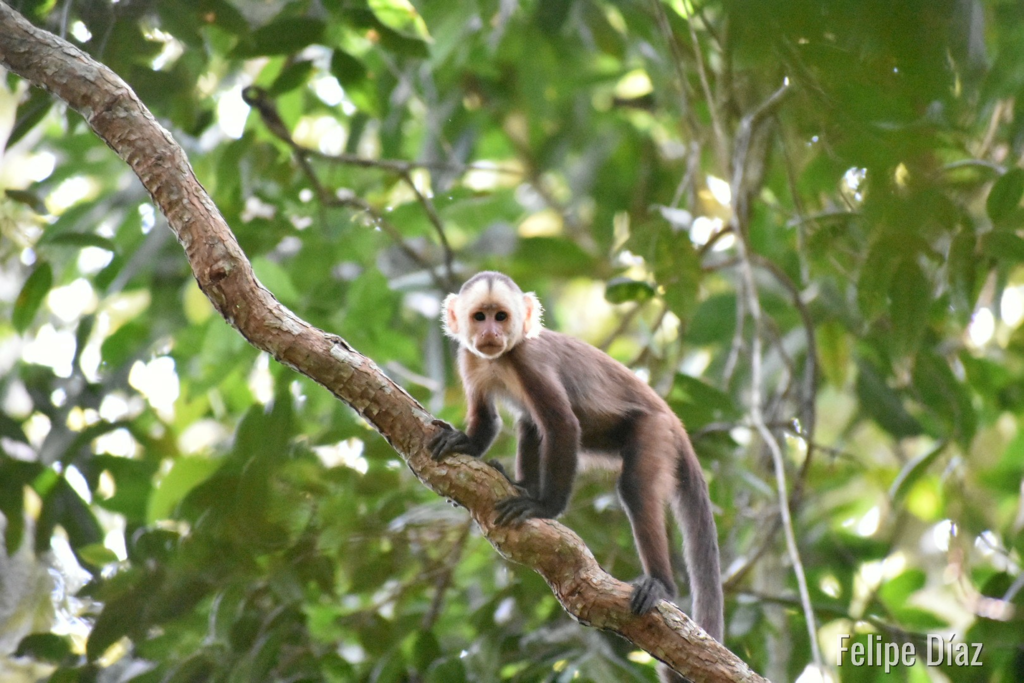


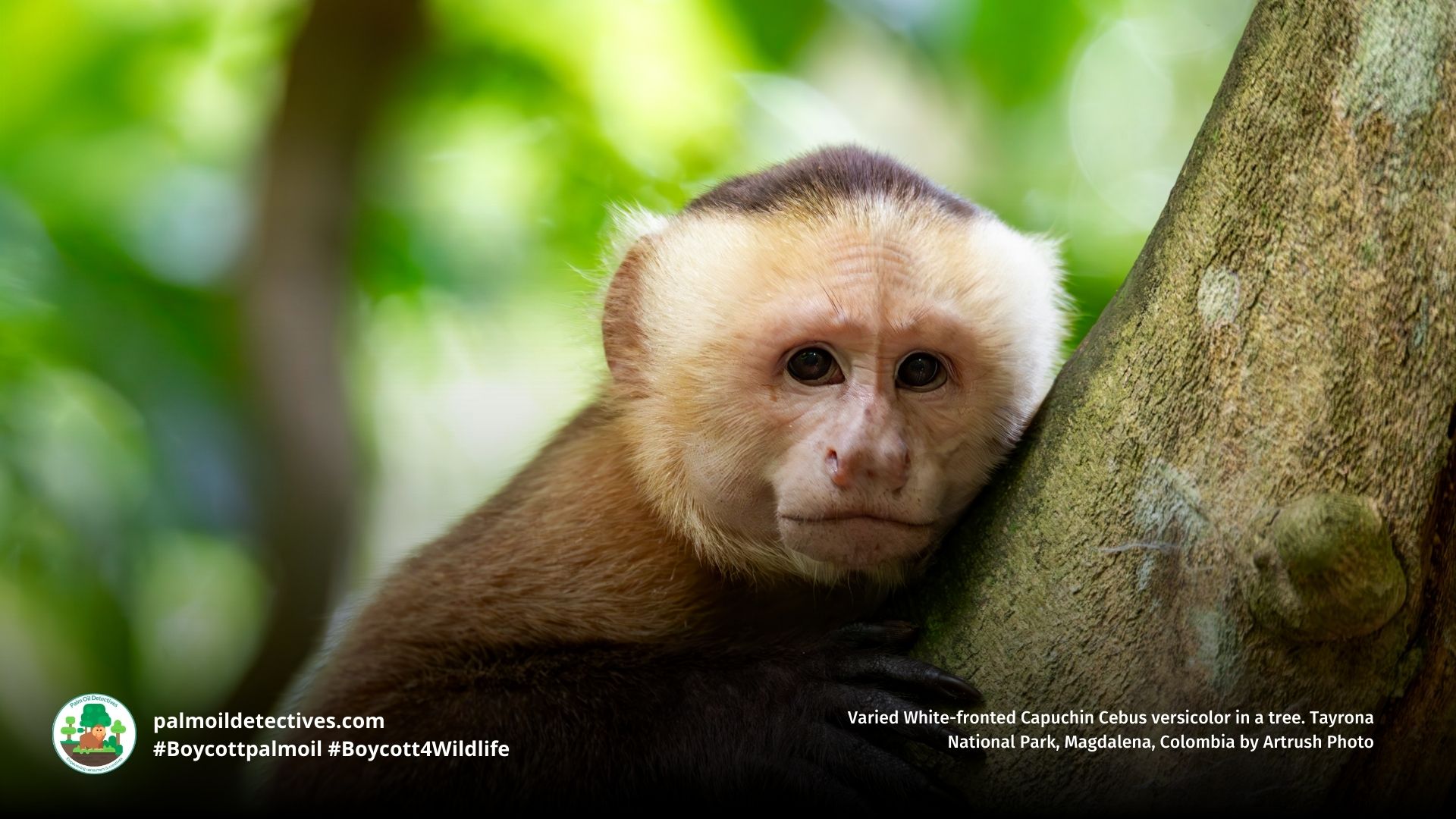

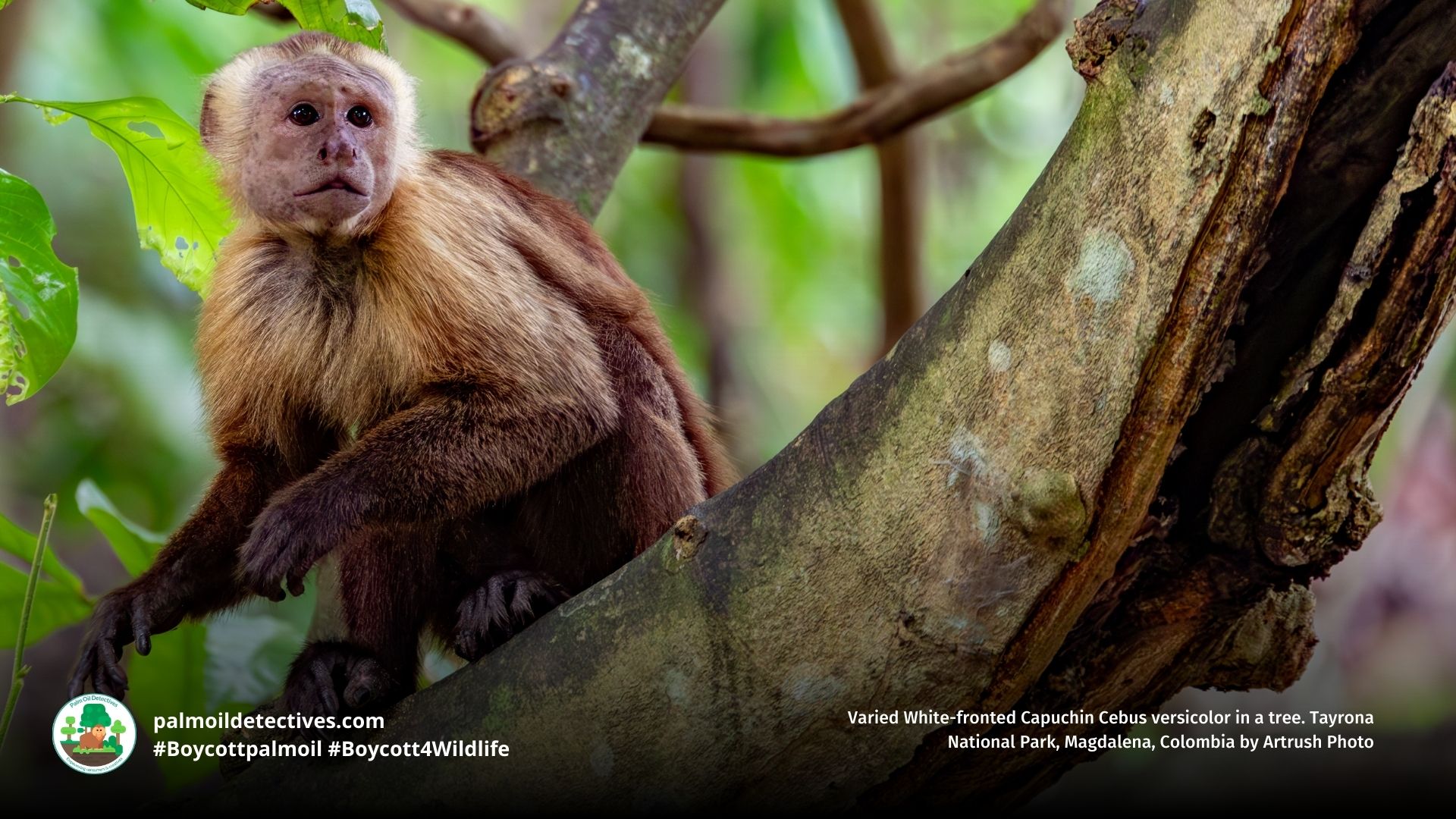
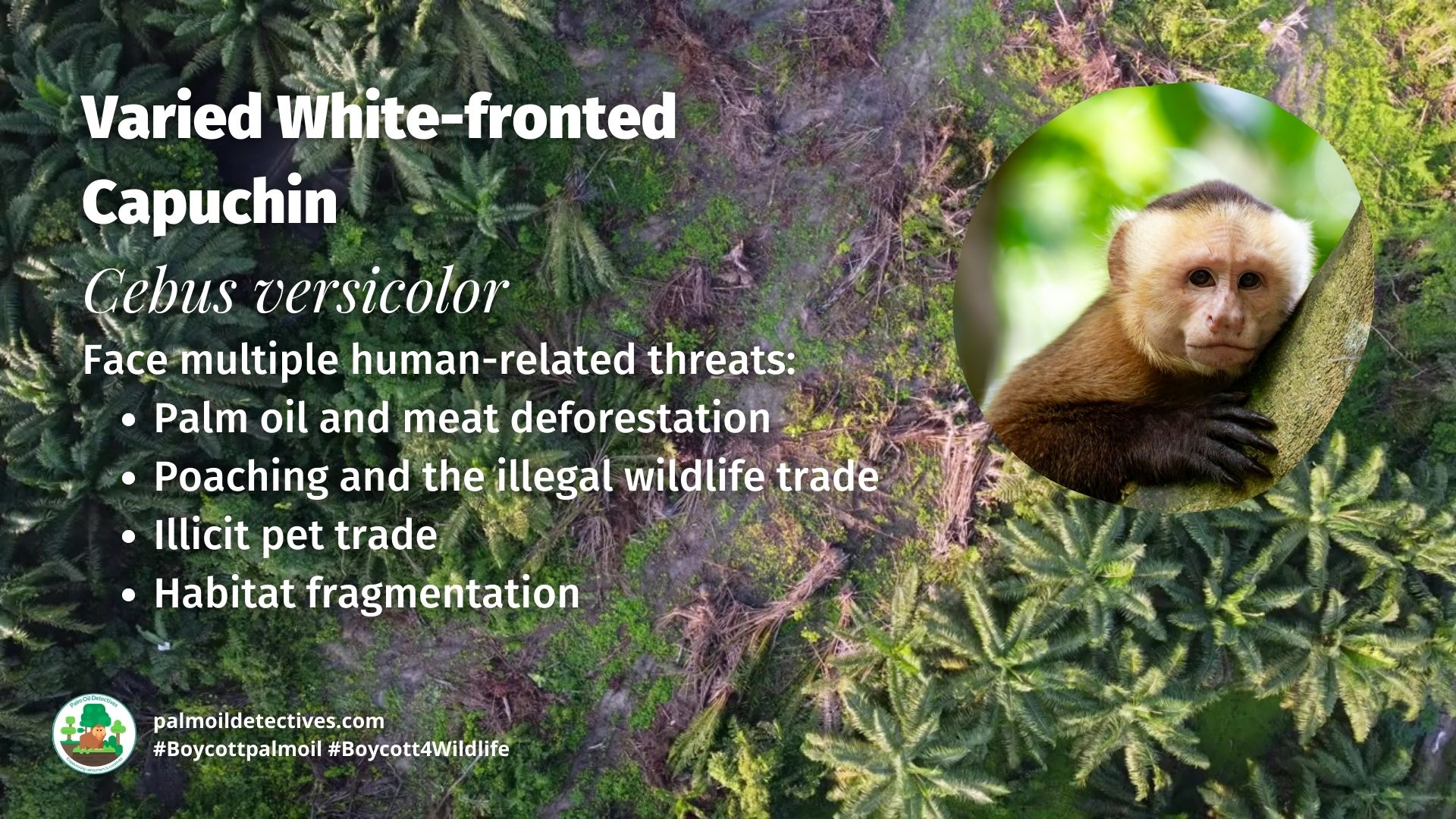
Most of the natural ecosystems within its historical distribution area have been transformed and less than 20% of its habitat remains in the lowland forests and wetlands of the Magdalena River basin (Link et al. 2013). Pet trade, human-animal conflict due to crop foraging and subsistence hunting also pose imminent threats to wild populations of varied white-fronted capuchin monkeys.
IUCN RED LIST
Appearance and Behaviour
The Varied White-Fronted Capuchin is a small, agile primate, weighing between 2 and 4 kg, with a body length of 30–45 cm. Their reddish-gold coat contrasts beautifully with their pale white face, chest, and a dark crown atop their head. Their prehensile tail, often matching their body length, allows them to navigate their forested habitat with grace and precision.
These social primates live in groups of 10–30 individuals, led by a dominant alpha male member and multiple males and multiple females of varying ages. They are territorial and actively defend their territories against neighbouring troops.
They communicate using a combination of vocalisations, facial expressions, and gestures. Known for their intelligence, these capuchins have been observed using tools to access food and solve problems, showcasing their adaptability and resourcefulness.
Threats

The main threats to this capuchin are agriculture, urban sprawl, deforestation, increasing energy matrix, increasing road matrix habitat fragmentation, habitat reduction, hunting, harvesting and extensive areas of monoculture eucalyptus and pine.The Varied White-fronted Capuchin is highly threatened in the middle Magdalena region in Colombia partly due to the pervasive habitat loss to large scale cattle ranching, palm oil agro-industries and mining.
IUCN red list
Habitat loss for palm oil and meat agriculture
Deforestation poses the greatest threat to the Varied White-Fronted Capuchin. Over 95% of the original forest in Colombia’s Magdalena Valley has been destroyed, largely due to cattle ranching, palm oil plantations, and monoculture agriculture (IUCN, 2021). The loss of forest cover leaves capuchins with limited resources and isolates populations, reducing their ability to survive and reproduce.
Mining and Oil Extraction
Illegal gold mining and oil exploration are degrading capuchin habitats at an alarming rate. These activities clear vast areas of forest and pollute rivers with mercury and other toxins, destroying essential food and water sources. Roads built to support mining operations bring increased human activity into previously untouched areas, amplifying threats to these primates (Link et al., 2021).
Illegal Hunting
The Varied White-Fronted Capuchin is frequently targeted by hunters, primarily for bushmeat. In many regions of Colombia, subsistence hunting is driven by local communities’ reliance on wildlife for food. However, the scale of hunting has increased with growing human populations and access to previously remote areas through deforestation and mining-related infrastructure (Link et al., 2022). Hunting adult capuchins disrupts the species’ tightly bonded social groups, as these primates depend on cooperation for survival. The loss of key individuals, particularly group leaders or mothers, has severe consequences for their population stability.
The Illegal Wildlife and Pet Trade
The illegal pet trade poses an equally devastating threat to the Varied White-Fronted Capuchin. Infants are captured and the mothers killed. Infants are sold as exotic pets internationally, often via criminal networks and alongside illicit drugs and other criminal activities.
Diet
The Varied White-Fronted Capuchin is a tenacious and highly adaptable forager with a highly varied diet, feeding on fruits, seeds, insects, small vertebrates, and bird eggs. They regularly use tools to extract and manipulate food sources. This adaptability allows them to survive in different habitats and seasons. They are vital to their ecosystems, acting as seed dispersers that promote forest regeneration. However, deforestation reduces access to fruiting trees and other food sources, making survival increasingly challenging for this species.
Reproduction and Mating
These capuchins live in complex social groups where cooperation plays a key role in raising young. Females typically give birth to a single infant after a gestation period of about 160 days. Mothers are the primary caregivers, but other group members often assist with caring for infants, a behaviour known as alloparenting. This social structure is vital to the group’s cohesion and the survival of offspring. However, hunting and habitat destruction disrupt these dynamics, making population recovery more difficult.
Geographic Range
The Varied White-Fronted Capuchin is found exclusively in Colombia, with populations concentrated in the Magdalena Valley and Serranía de San Lucas. Historically, their range extended across vast lowland and montane forests. Today, extensive deforestation and human activity have confined them to fragmented forest patches, leaving them vulnerable to extinction.
FAQ
When was the Varied White-Fronted Capuchin identified as a separate species?
The Varied White-Fronted Capuchin was identified as a distinct species in 2012 following genetic analysis. Significant differences in mitochondrial DNA separated them from the White-Fronted Capuchin (Cebus albifrons), underscoring their unique ecological role and conservation needs.
What are the threats to the Varied White-Fronted Capuchin?
The Varied White-Fronted Capuchin is threatened by habitat los, hunting, and the illegal pet trade. Deforestation for agriculture, palm oil plantations, and cattle ranching has destroyed most of their habitat. Hunting for bushmeat and capturing infants for the pet trade further endanger their populations.
What is the Varied White-Fronted Capuchin’s conservation status?
The Varied White-Fronted Capuchin is listed as Endangered by the International Union for Conservation of Nature (IUCN). This classification reflects their high risk of extinction due to habitat destruction and population fragmentation.
What is the Varied White-Fronted Capuchin’s physical appearance?
The Varied White-Fronted Capuchin has a reddish-gold coat, a light chest, and a dark crown on their head. Their expressive brown eyes and flattened nose enhance their distinct appearance. Their prehensile tail, matching their body length, is critical for navigating their arboreal habitat.
Where does the Varied White-Fronted Capuchin live?
The Varied White-Fronted Capuchin lives in Colombia, primarily in the Río Magdalena Valley and Serranía de San Lucas. They inhabit lowland moist forests and palm swamps, but habitat destruction has confined them to fragmented patches, making their survival increasingly precarious.
Take Action!
Help protect the Varied White-Fronted Capuchin by supporting indigenous-led conservation initiatives. Boycott products linked to deforestation, such as palm oil, and consider adopting a #vegan lifestyle to reduce habitat destruction. Your choices can make a difference — #BoycottPalmOil #Boycott4Wildlife.
You can support this beautiful animal
There are no known conservation activities for this animal. Share out this post to social media and join the #BoycottPalmOil #Boycott4Wildlife on social media to raise awareness
Further Information
Donate to help orphaned capuchins that are rescued from traffickers. At Merazonia Wildlife Sanctuary
Link, A., Boubli, J.P. & Lynch Alfaro, J.W. 2021. Cebus versicolor. The IUCN Red List of Threatened Species 2021: e.T39952A81282279. https://dx.doi.org/10.2305/IUCN.UK.2021-1.RLTS.T39952A81282279.en. Downloaded on 06 June 2021.
De Aquino, I., González-Santoyo, I., Link, A., & Muñoz-Delgado, J. (2022). An exploratory study of cooperation: Food-sharing behaviour in wild varied white-fronted capuchin monkeys (Cebus versicolor) in Central Colombia. Behaviour, 159(13-14), 1285–1300. https://doi.org/10.1163/1568539X-bja10180
Link, A., et al. (2022). Primate diversity and population status in the Serranía de San Lucas, Colombia: A priority area for primate conservation in northern South America. Primate Conservation, 36, 63–73. Retrieved from http://www.primate-sg.org/storage/pdf/PC36_Link_et_al_Serrania_de_San_Lucas.pdf.
Wikipedia contributors. (n.d.). Varied White-Fronted Capuchin. In Wikipedia. Retrieved from https://en.wikipedia.org/wiki/Varied_white-fronted_capuchin
World Land Trust. (n.d.). Varied White-Fronted Capuchin. Retrieved from https://www.worldlandtrust.org/species/mammals/varied-white-fronted-capuchin/.

How can I help the #Boycott4Wildlife?
Take Action in Five Ways
1. Join the #Boycott4Wildlife on social media and subscribe to stay in the loop: Share posts from this website to your own network on Twitter, Mastadon, Instagram, Facebook and Youtube using the hashtags #Boycottpalmoil #Boycott4Wildlife.
2. Contribute stories: Academics, conservationists, scientists, indigenous rights advocates and animal rights advocates working to expose the corruption of the palm oil industry or to save animals can contribute stories to the website.



3. Supermarket sleuthing: Next time you’re in the supermarket, take photos of products containing palm oil. Share these to social media along with the hashtags to call out the greenwashing and ecocide of the brands who use palm oil. You can also take photos of palm oil free products and congratulate brands when they go palm oil free.
4. Take to the streets: Get in touch with Palm Oil Detectives to find out more.
5. Donate: Make a one-off or monthly donation to Palm Oil Detectives as a way of saying thank you and to help pay for ongoing running costs of the website and social media campaigns. Donate here
Discover more from Palm Oil Detectives
Subscribe to get the latest posts sent to your email.
 Palm Oil Detectives
Thank you so much for sharing my posts about palm oil and these beautiful South American animals Barbara! Here are some ways to help all of the animals. The #Boycott4Wildlife is a boycott on supermarket brands that are RSPO members and yet still continue with illegal land-grabbing from indigenous peoples and also deforestation. Here are the brands to boycott – they are the biggest food brands in the world. It’s great to meet you and thank you for helping the movement! https://palmoildetectives.com/2021/02/09/brands-using-deforestation-palm-oil/
LikeLike