
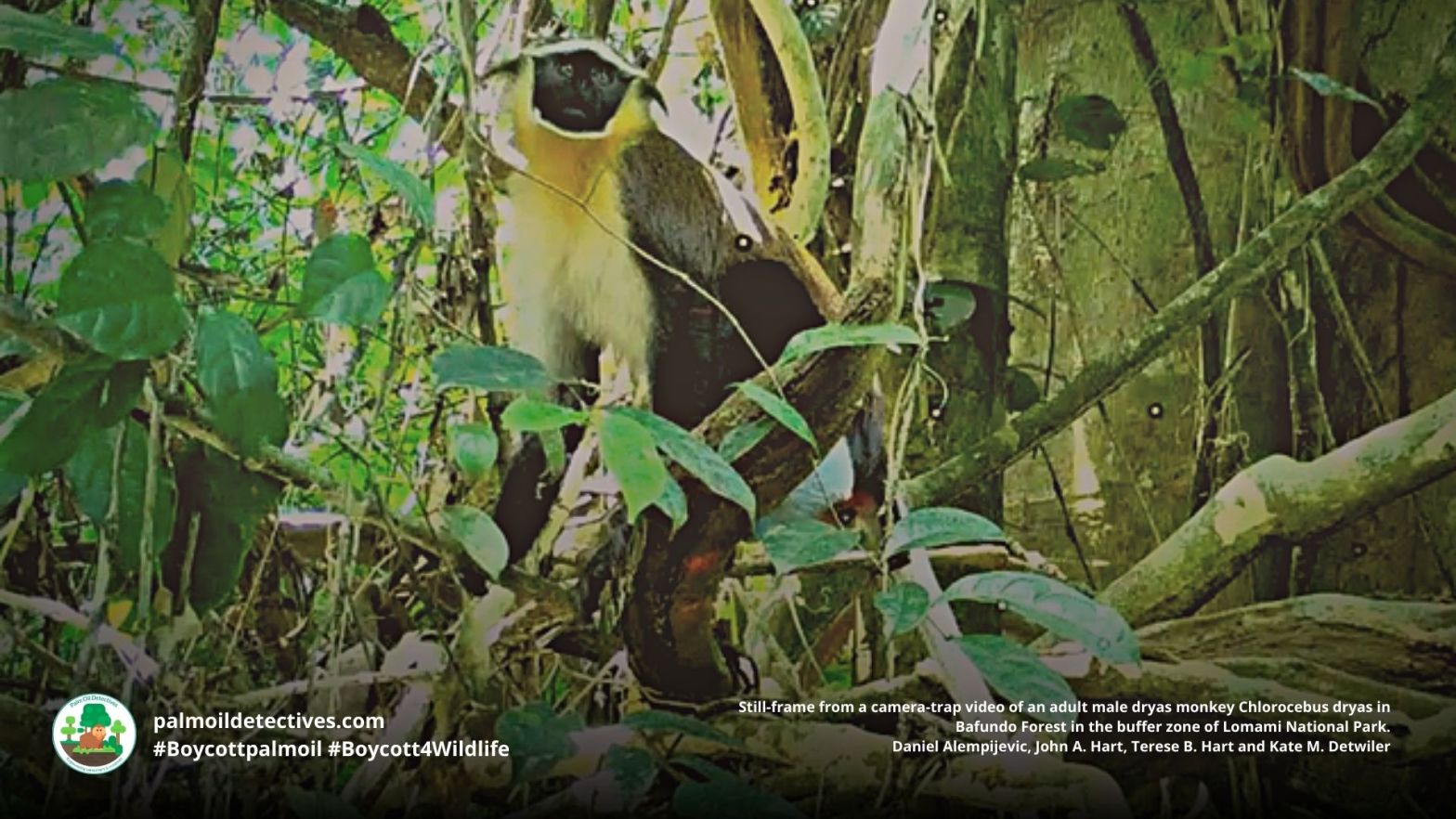
Dryas Monkey Chlorocebus dryas
Formerly known as Cercopithecus dryas.
Red List Status: Endangered
Extant (resident): The Democratic Republic of the Congo
Dryas #Monkeys are secretive and vividly colourful monkeys who hang on to survival in the forests of the #Congo. Tragically, there is estimated to only be 100-250 individual monkeys still alive. They are fruit-eaters and play a critical role in ensuring the dispersion of seeds and therefore the future health of the DRC’s #rainforests. They are preyed upon by leopards in the Congo basin. However, the main threat they face is the illegal poaching and hunting by humans for #bushmeat, along with #deforestation for #palmoil, #mining and other commodities. Fight for their survival every time you shop, be #vegan and #BoycottPalmOil #Boycott4Wildlife
Vividly coloured and social Dryas #Monkeys 🌈😎🐵🐒🧐 hang to survival in #Congo 🇨🇩 #DRC #Africa. There are only 100-250 of them left 😿 Help save them each time you shop @palmoildetect #Boycottpalmoil #Boycott4Wildlife 🌴🪔💩☠️🚜🔥⛔️https://palmoildetectives.com/2023/06/11/dryas-monkey-chlorocebus-dryas/
Dryas #Monkeys are secretive colourful monkeys in #Congo #Africa 🇨🇩🇨🇬🐒🐵🙉 They are endangered by #palmoil 🌴🔥 and #mining 🪔🔥 #deforestation. Fight for them and use your wallet as a weapon #Boycottpalmoil 🌴🧐⛔️ #Boycott4Wildlife @palmoildetect https://palmoildetectives.com/2023/06/11/dryas-monkey-chlorocebus-dryas/
Appearance & Behaviour
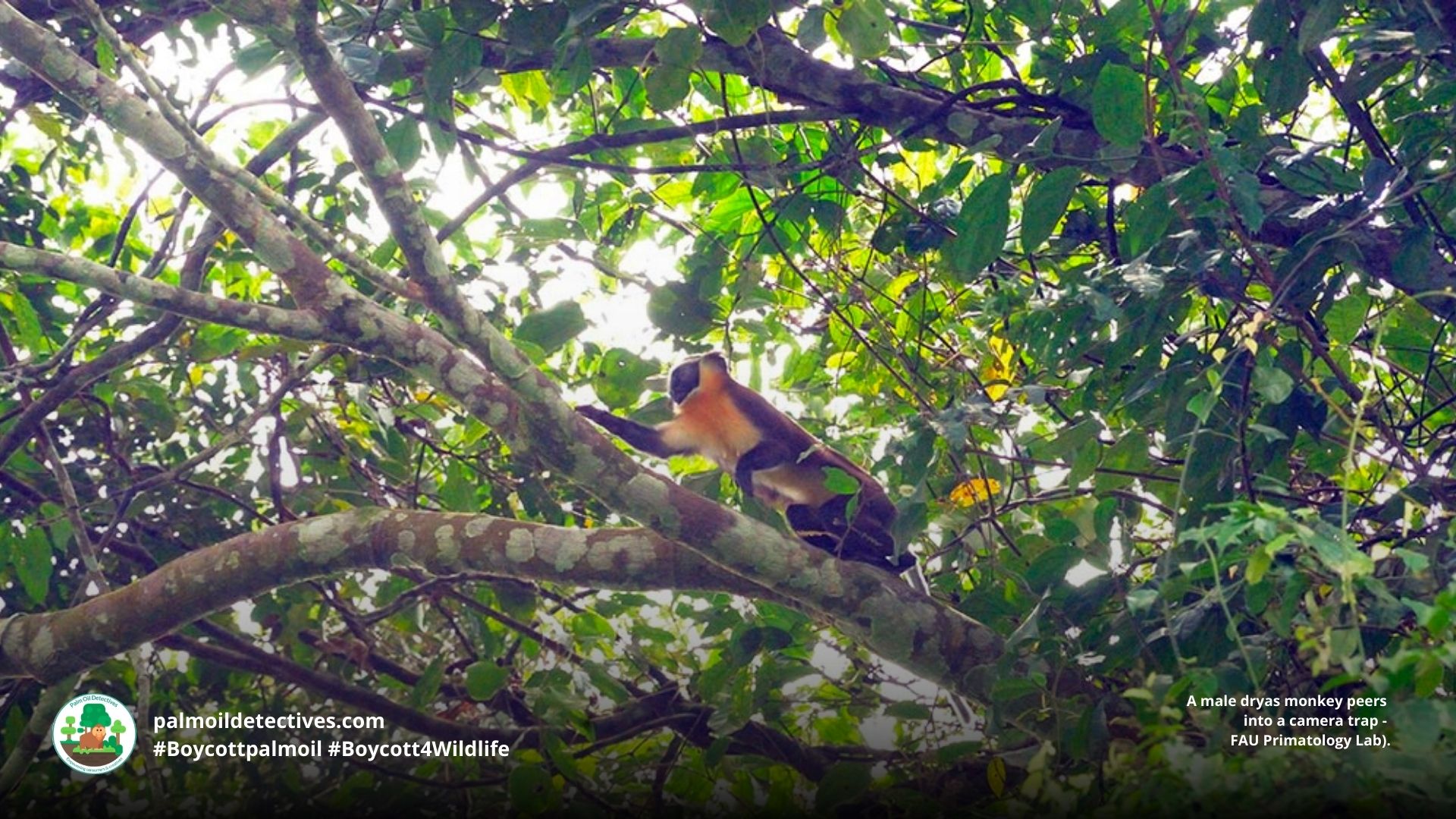
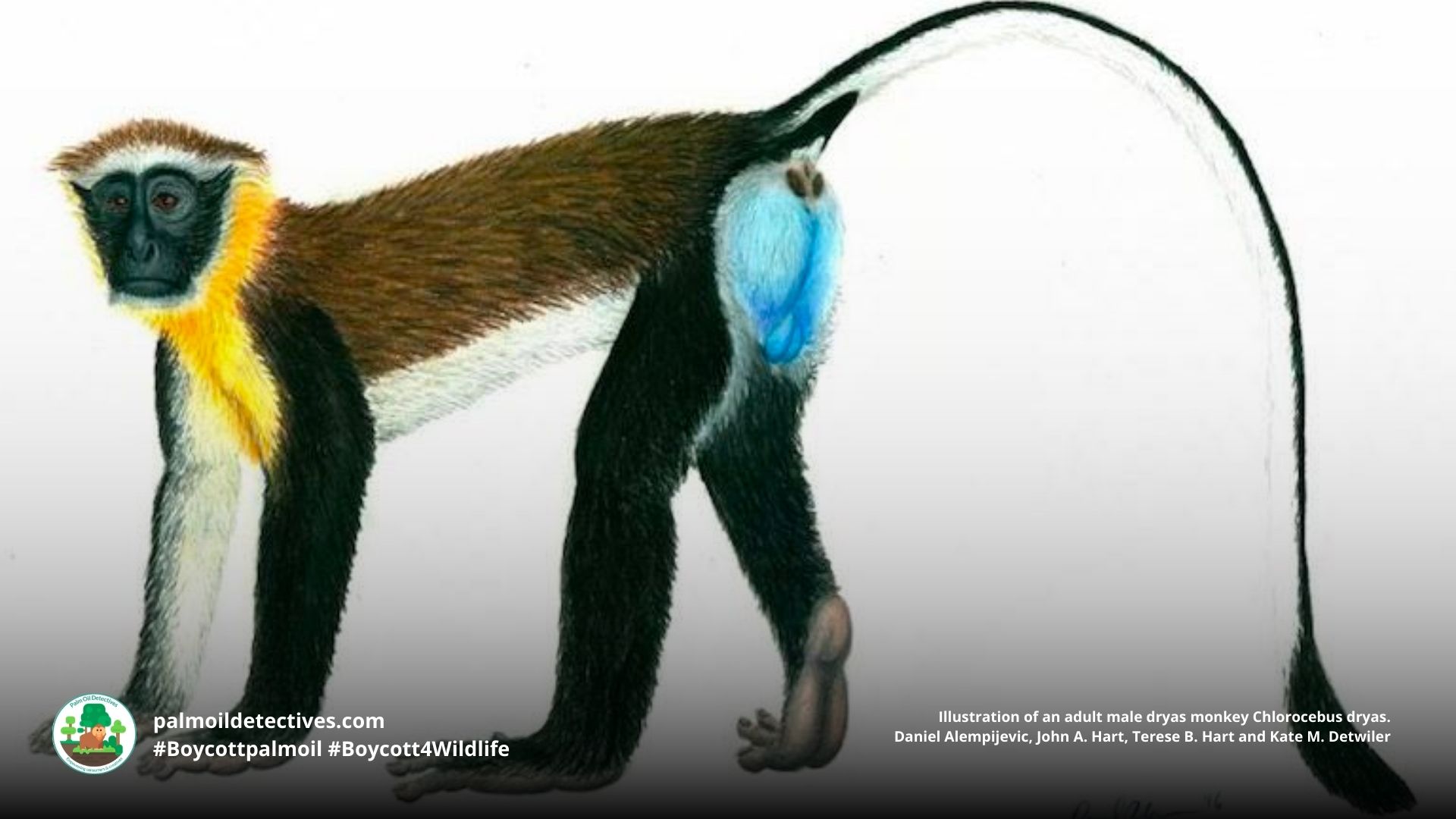
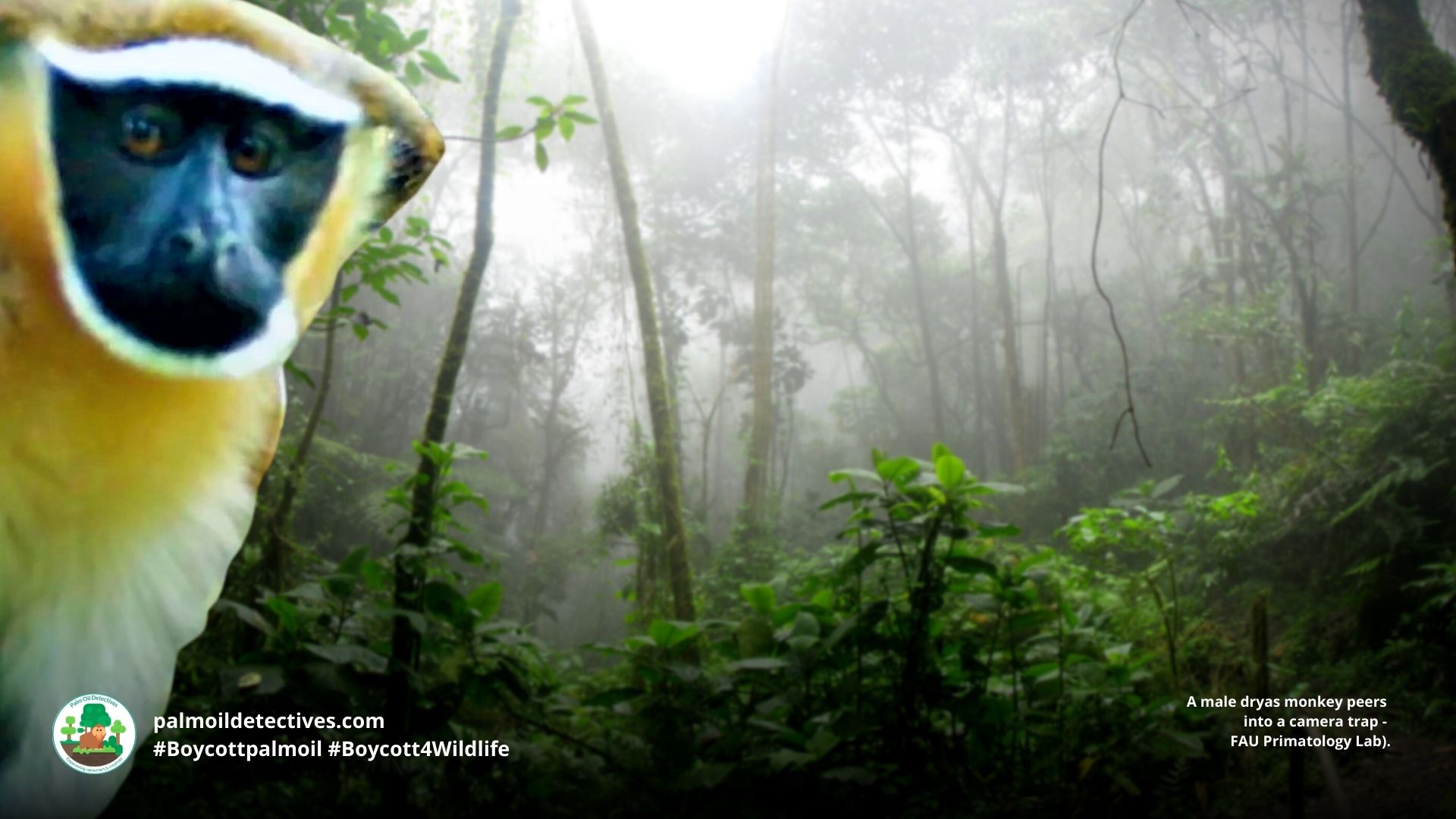
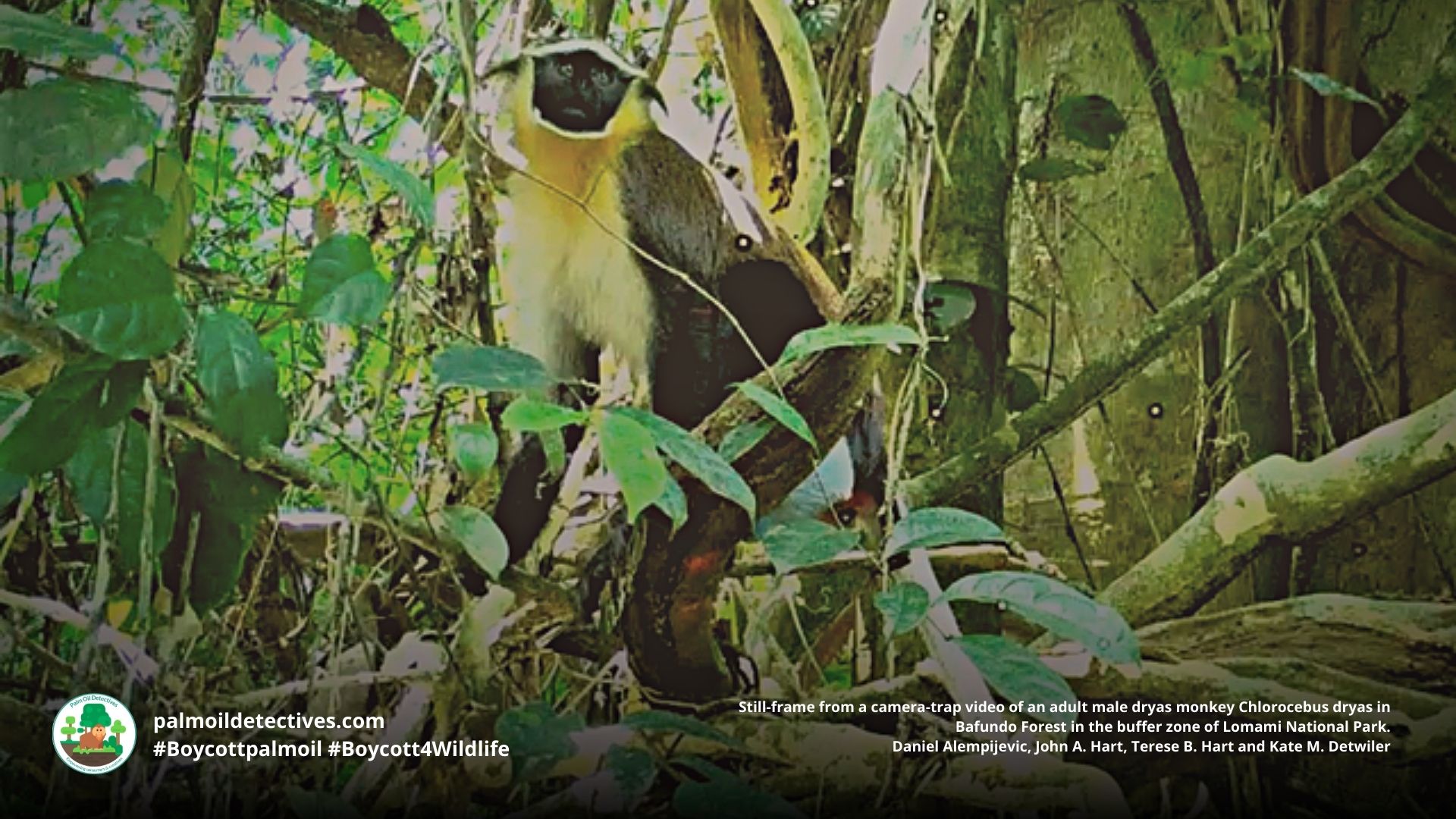
Stunning and striking colourations are the signature of the Dryas Monkey. They have black mask-like faces that are ringed with white and surrounded by a vivid orange or yellow necks and chests. Their backs are dark brown and their limbs are black. Their bellies and the inside of their arms and legs are a pale cream colour. Males have a vividly blue scrotum and anogenital region. Not all males have this and it’s thought to be related to age, health and status of the monkey in the troop. Females also have a blue rear end that is not as bright as males.
Gregarious and highly social, Dryas Monkeys live in groups of between 5 to 30 individuals of their own species and mixed multi-species groups as well, with red-tailed monkeys (C. ascanius). They communicate visually and through vocalisations with their own kind and with other species. They make chirps, murmurs, and chuckles to each other, they are considered to be quieter than other primates and their booming calls and screams.
Troops typically contain many young monkeys and females but only one male. Although occasionally groups with multiple males are found.
Staring is a form of intensive threat display that is used by Dryas Monkeys to intimidate others in a troop. During a staring contest – their eyes will stay fixed and focused while their eyebrows and forehead is retracted backwards.
They will often stare with an open-mouthed expression and bob their heads – this is also considered to be a threat and intimidation display, although more aggressive.
When females come into oestrus during the mating season, they will exhibit presenting behaviour to indicate to males that they are ready to mate.
Threats
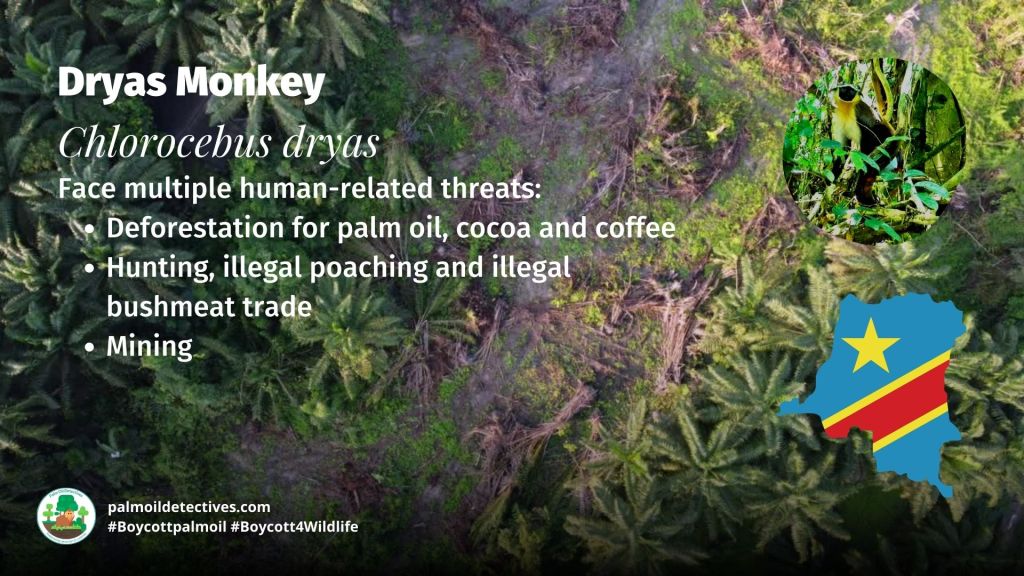
Dryas Monkeys face several human-related threats:
- Illegal hunting and poaching: it is difficult to assess how many people hunt and eat these monkeys as they are eaten locally and not traded in bush meat markets.
- Palm oil, coffee and cocoa deforestation: habitat fragmentation due to agriculture
- Mining: disruption to their range from increased mining activity in the Congo
Dryas Monkeys were listed as critically endangered, however their status was changed to endangered after they were found in eight locations in Lomami National Park indicating that their population is larger than once thought. Although their survival is still fragile and is threatened by increased deforestation throughout their range.
Habitat
There is much that still needs to be uncovered about the behaviour, habits and culture of the Dryas Monkey. They are also known as the Salonga monkey, ekele, inoko, Dryad monkey, Dryas guenon and Salonga guenon. They live in the heart of the Congo Basin – the second largest remaining rainforest in the world after the Amazon. They live in two regions: the Kokolopori-Wamba area and the Lomami-Lualaba area.
Dryas monkeys prefer secondary lowland forest and swampland that has been disturbed by elephants, wind or floods.
Although they prefer to remain hidden and are cautious about human contact, they nevertheless live close to the edge of villages, homes and people’s gardens.
Diet
These monkeys prefer a diet of fruit, young leaves and flowers. However, food scarcity in different seasons of the year mean that they will eat invertebrates like insects as a supplement.
Mating and breeding
Dryas monkeys are likely polygynous, with each male mating with multiple females. Pregnancy lasts for approximately five months and mothers will only birth one baby and care for them after birth. Females reach sexual maturity at age five and males take a bit longer and will reach maturity at about six years old. Their expected lifespan in the wild is 10-15 years old. It is not known how long they would live in captivity, as to date no Dryas Monkeys are kept in captivity.
Support Dryas Monkeys by going vegan and boycotting palm oil in the supermarket, it’s the #Boycott4Wildlife
You can support this beautiful animal
Support the conservation of this species
This animal has no protections in place. Read about other forgotten species here. Create art to support this forgotten animal or raise awareness about them by sharing this post and using the #Boycottpalmoil #Boycott4Wildlife hashtags on social media. Also you can boycott palm oil in the supermarket.
Further Information
Ellis, S. & Talukdar, B. 2019. Rhinoceros unicornis. The IUCN Red List of Threatened Species 2019: e.T19496A18494149. https://dx.doi.org/10.2305/IUCN.UK.2019-3.RLTS.T19496A18494149.en. Accessed on 11 November 2022.
Dryas Monkey: New England Primate Conservancy
Dryas Monkey Chlorocebus dryas: Animalia.bio
Dryas Monkey Chlorocebus dryas: Wikipedia.
‘Secretive and colorful dryas monkey isn’t as rare as once thought’, Mongabay, 2019.

How can I help the #Boycott4Wildlife?
Take Action in Five Ways
1. Join the #Boycott4Wildlife on social media and subscribe to stay in the loop: Share posts from this website to your own network on Twitter, Mastadon, Instagram, Facebook and Youtube using the hashtags #Boycottpalmoil #Boycott4Wildlife.
2. Contribute stories: Academics, conservationists, scientists, indigenous rights advocates and animal rights advocates working to expose the corruption of the palm oil industry or to save animals can contribute stories to the website.



3. Supermarket sleuthing: Next time you’re in the supermarket, take photos of products containing palm oil. Share these to social media along with the hashtags to call out the greenwashing and ecocide of the brands who use palm oil. You can also take photos of palm oil free products and congratulate brands when they go palm oil free.
4. Take to the streets: Get in touch with Palm Oil Detectives to find out more.
5. Donate: Make a one-off or monthly donation to Palm Oil Detectives as a way of saying thank you and to help pay for ongoing running costs of the website and social media campaigns. Donate here
Discover more from Palm Oil Detectives
Subscribe to get the latest posts sent to your email.
 Palm Oil Detectives