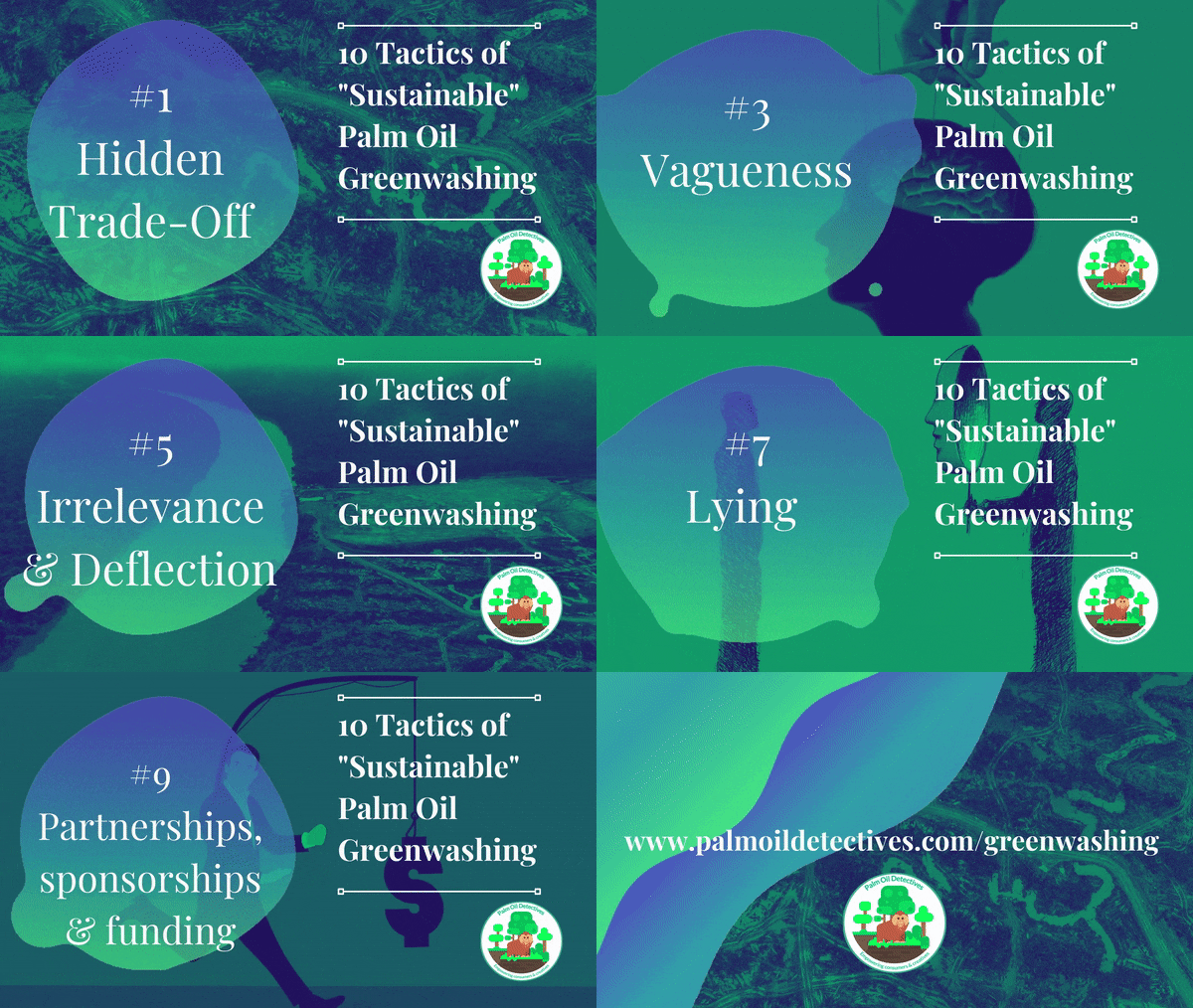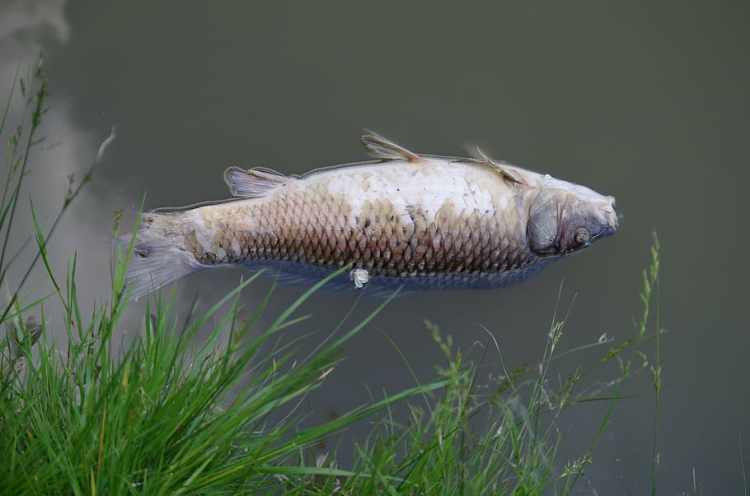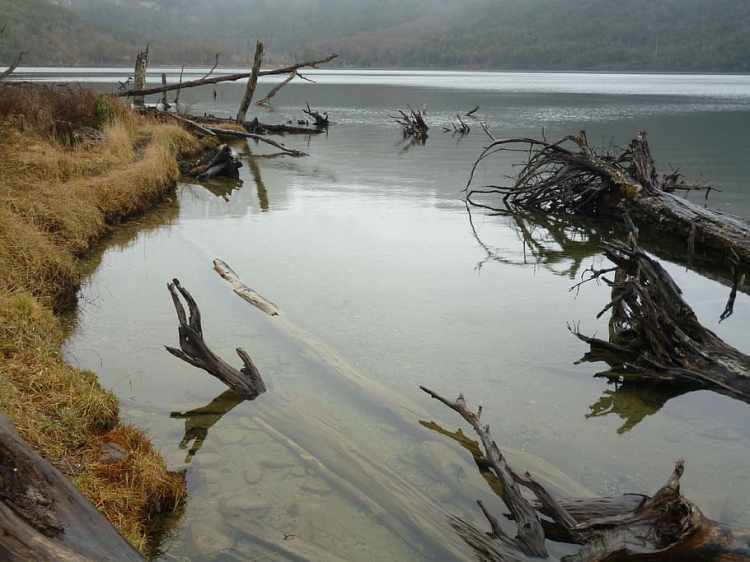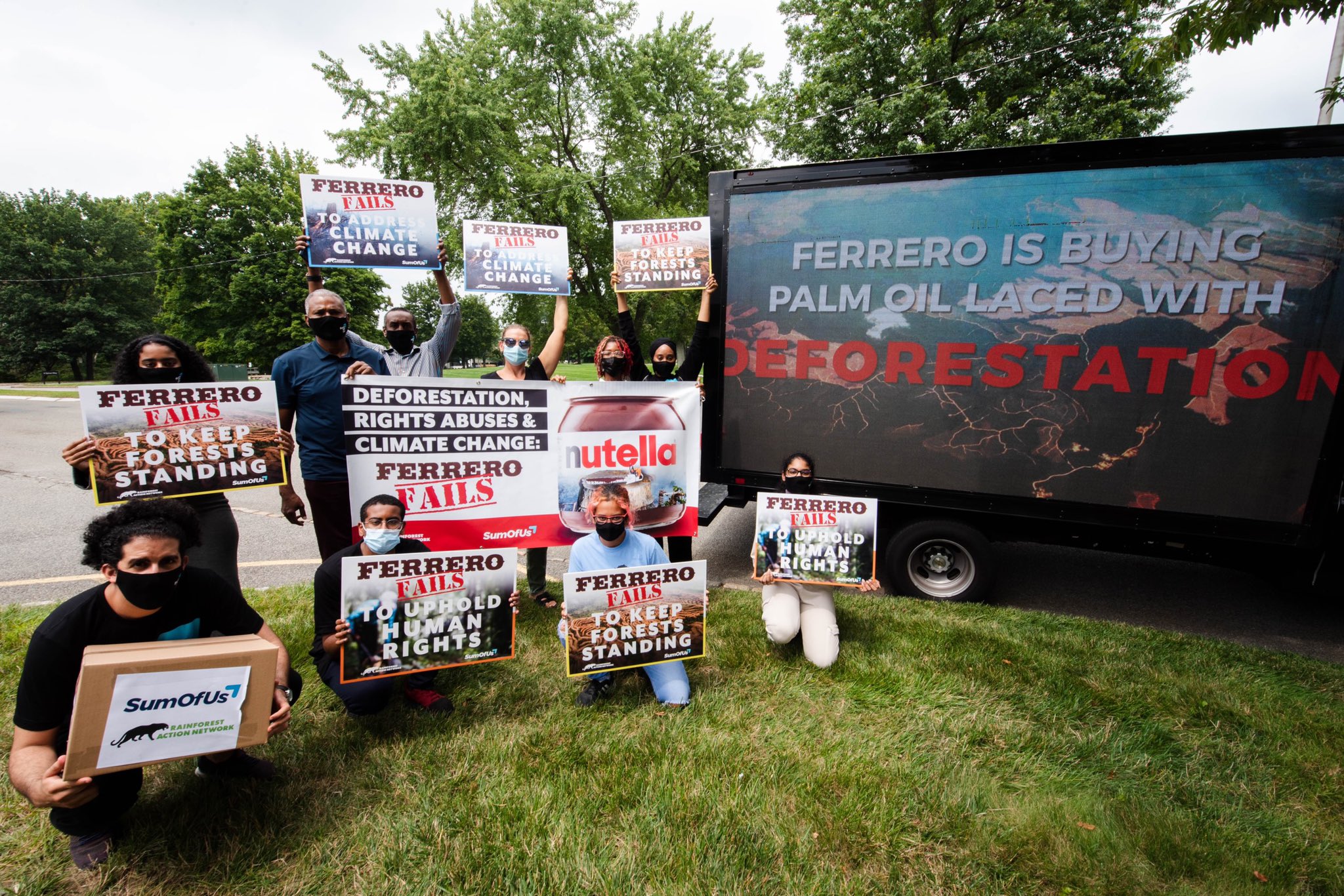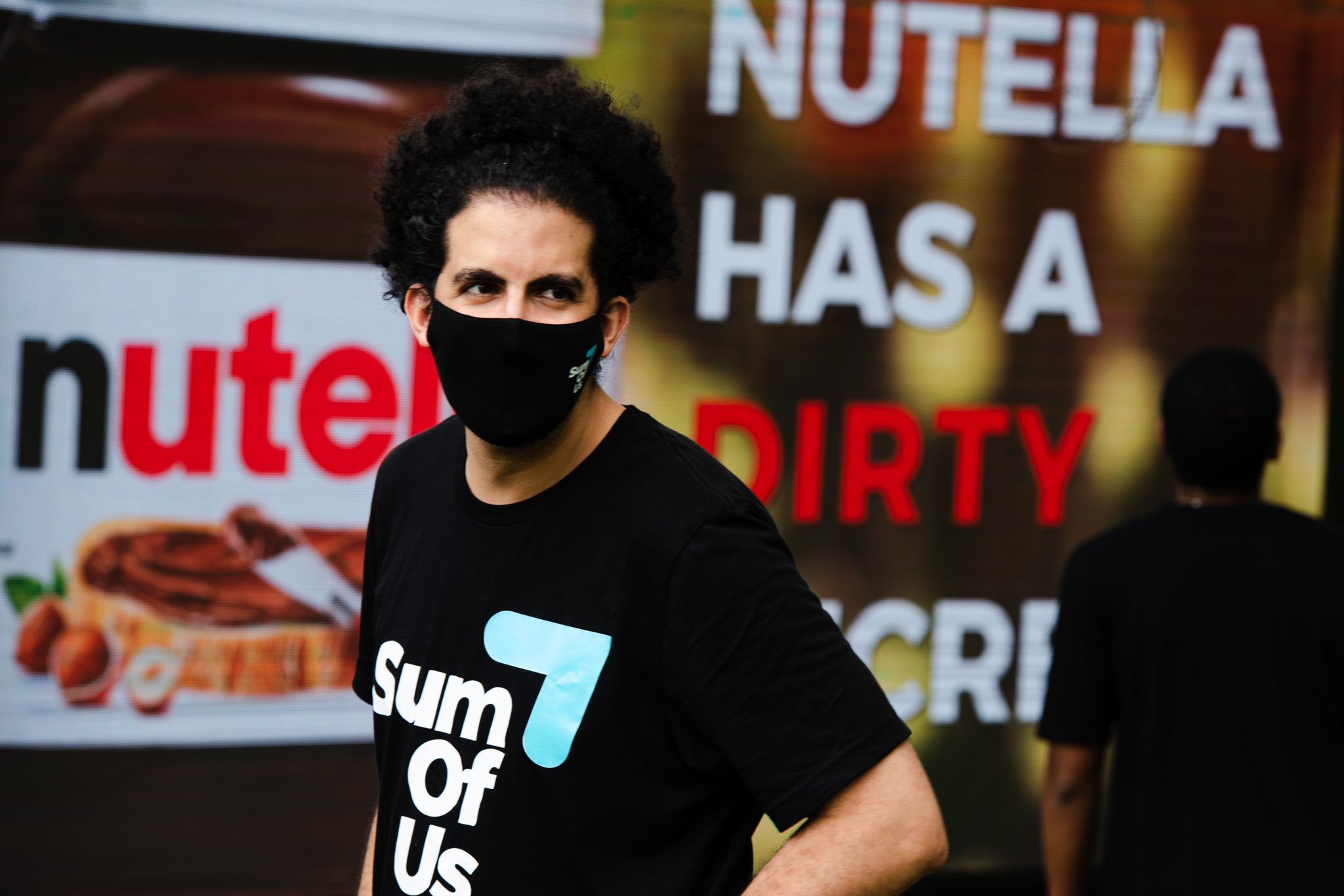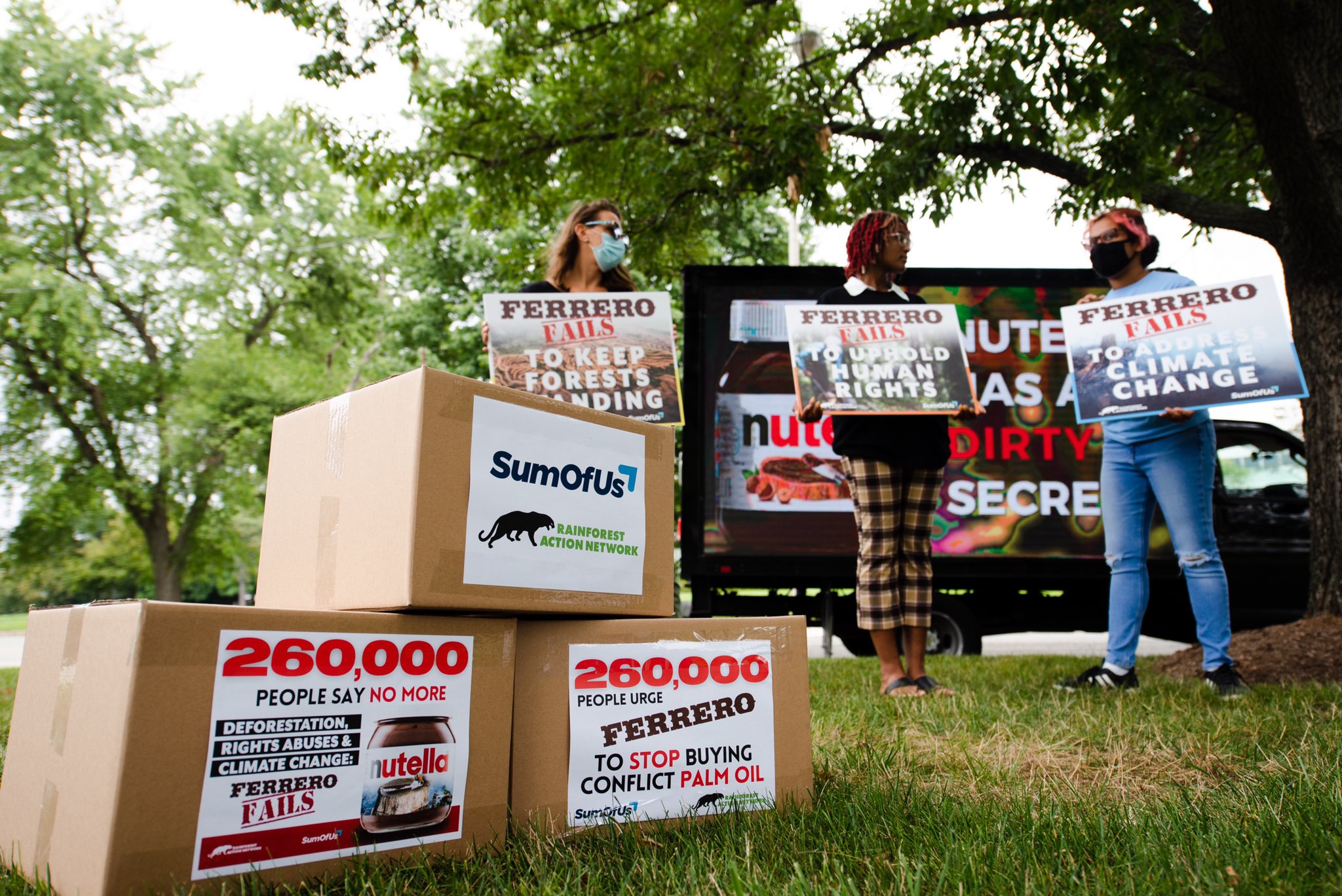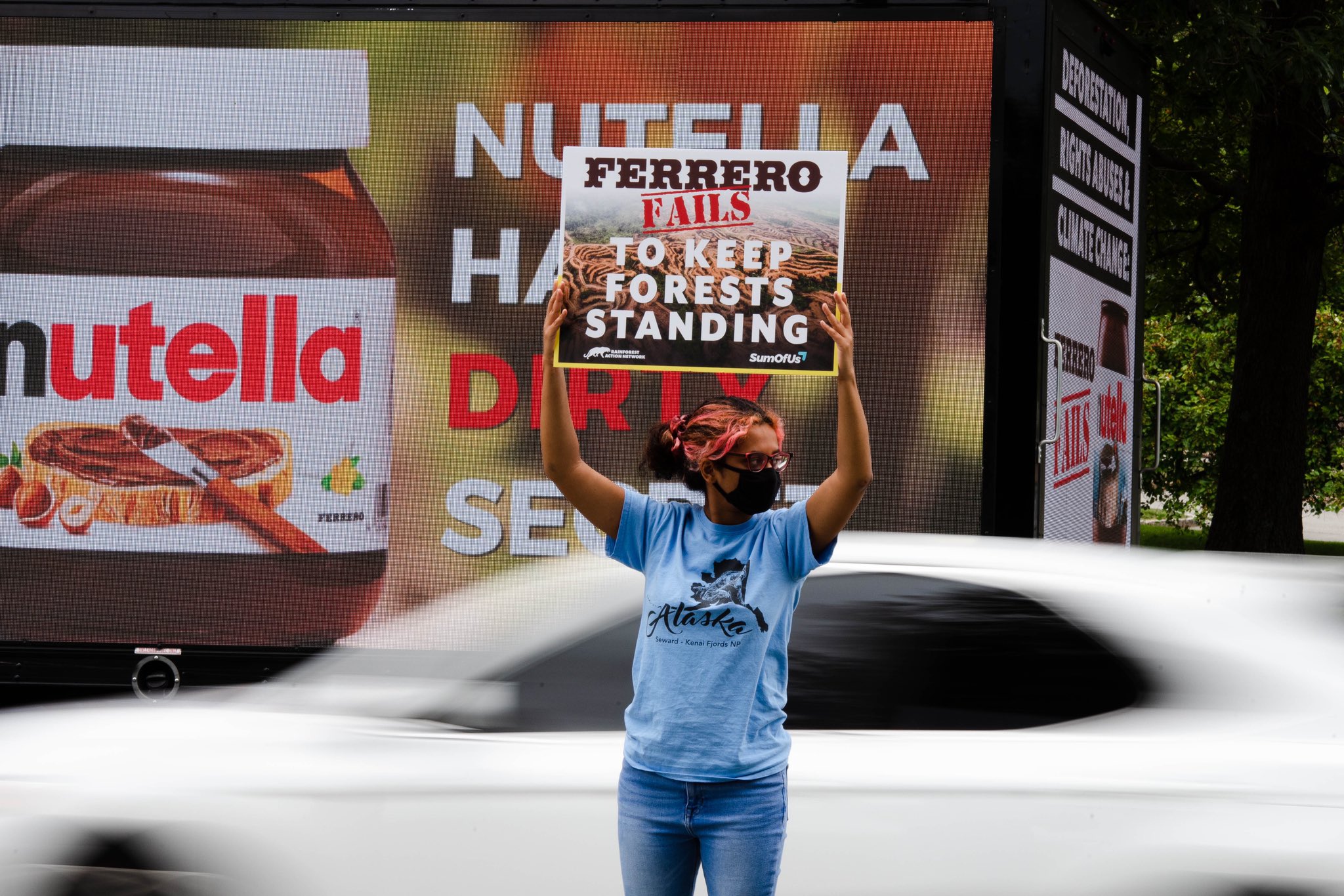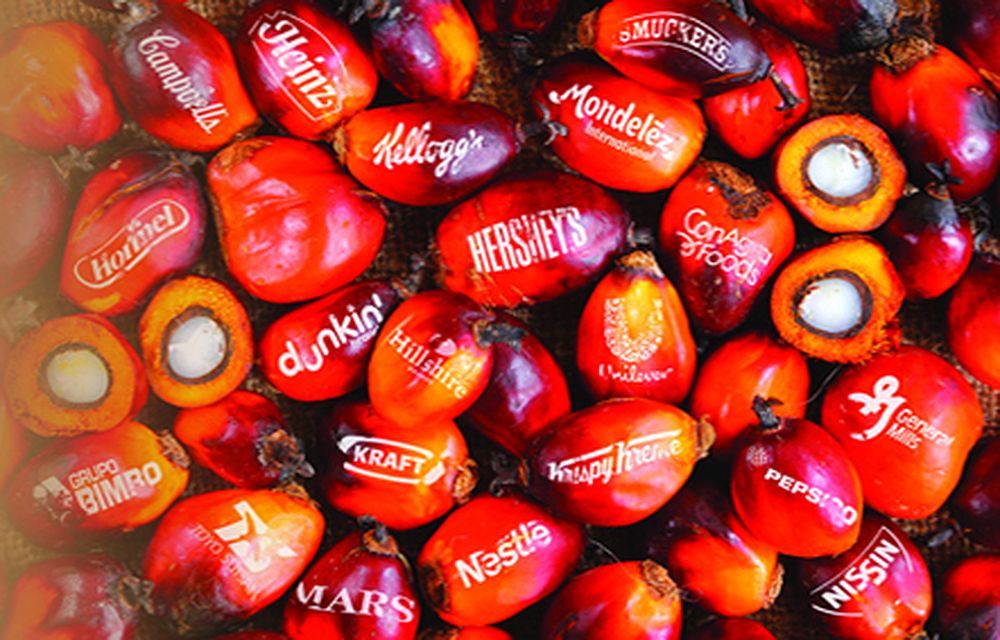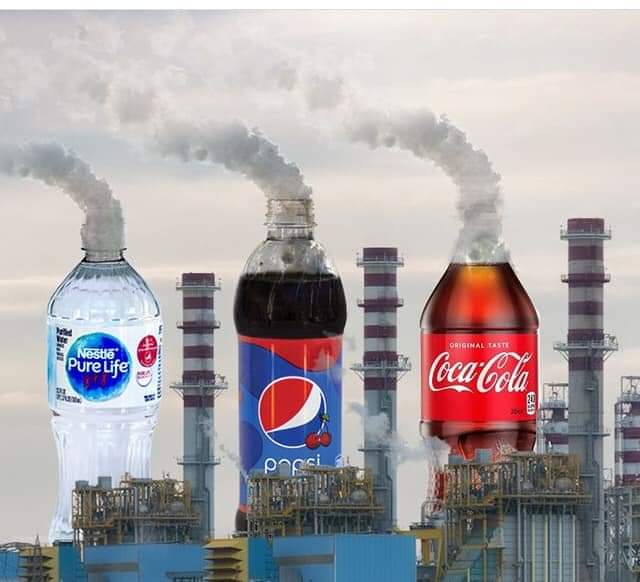
Greenwashing Tactic #6: The Lesser of Two Evils


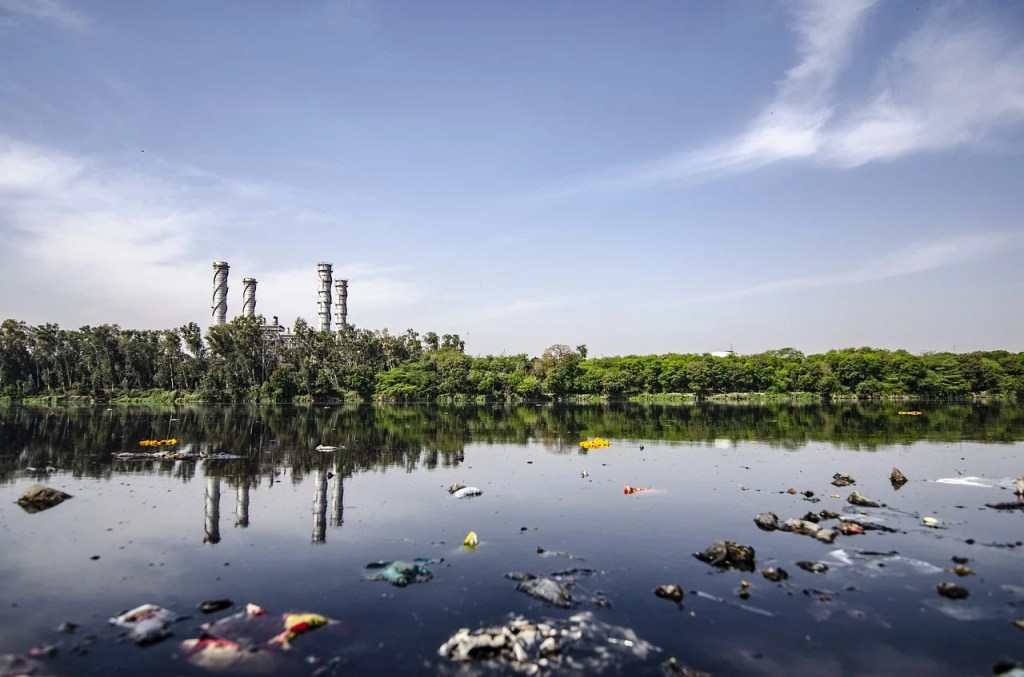
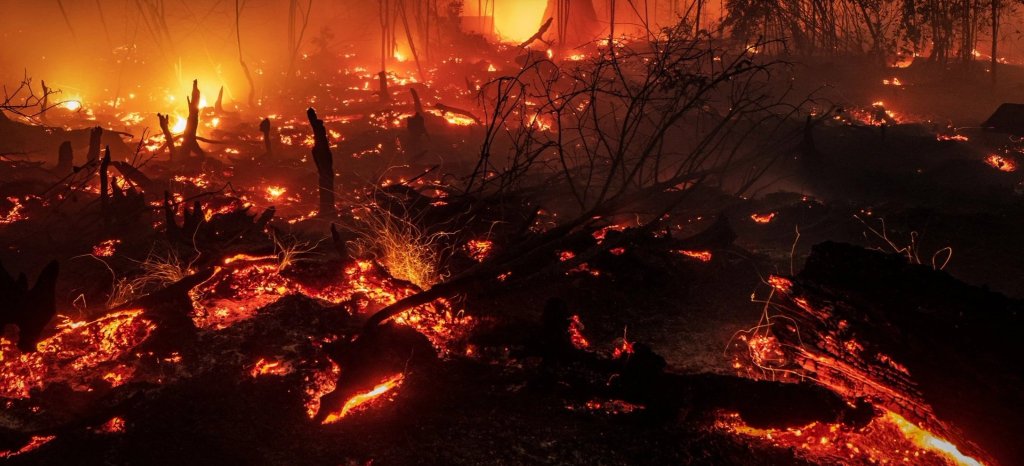
Claiming that a brand, commodity or industry is greener than others in the same category, in order to excuse ecocide, deforestation, human rights and animal rights abuses.


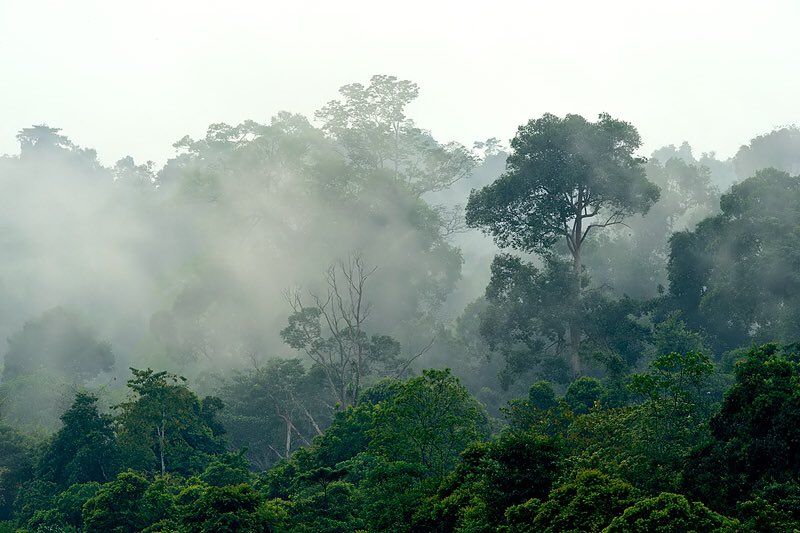
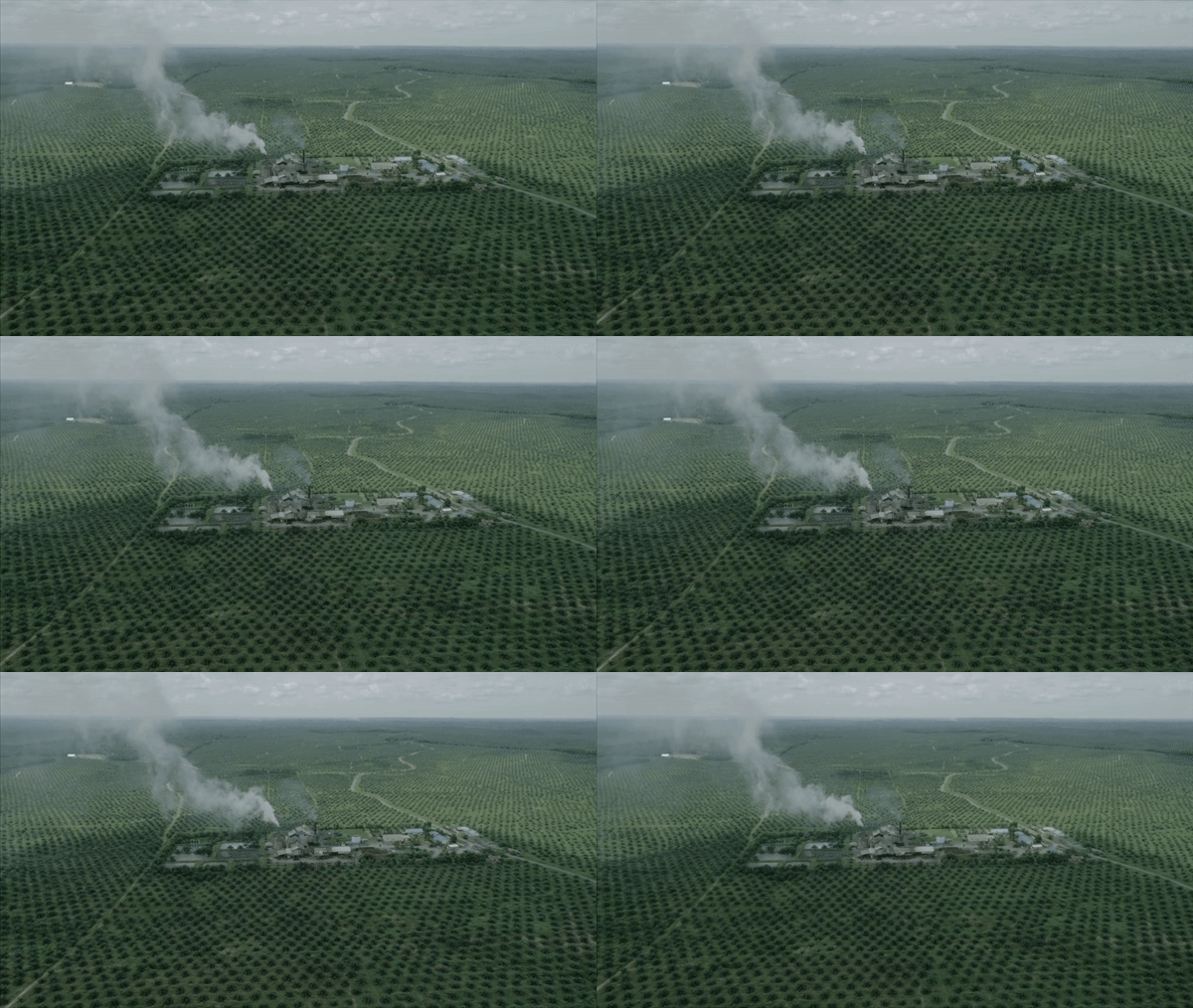
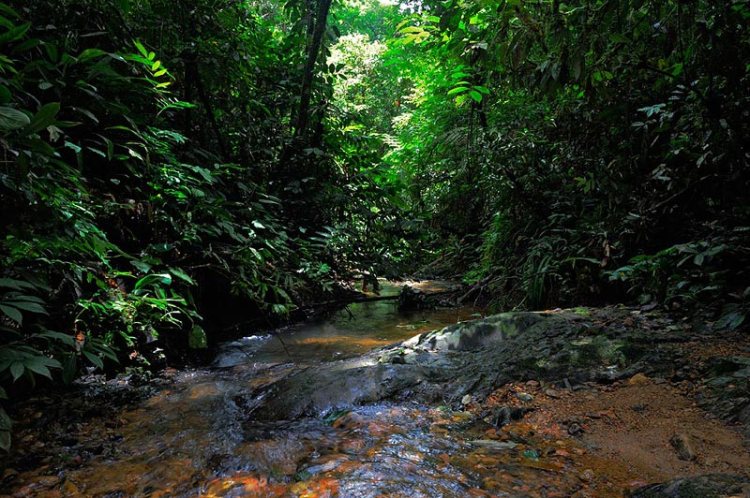
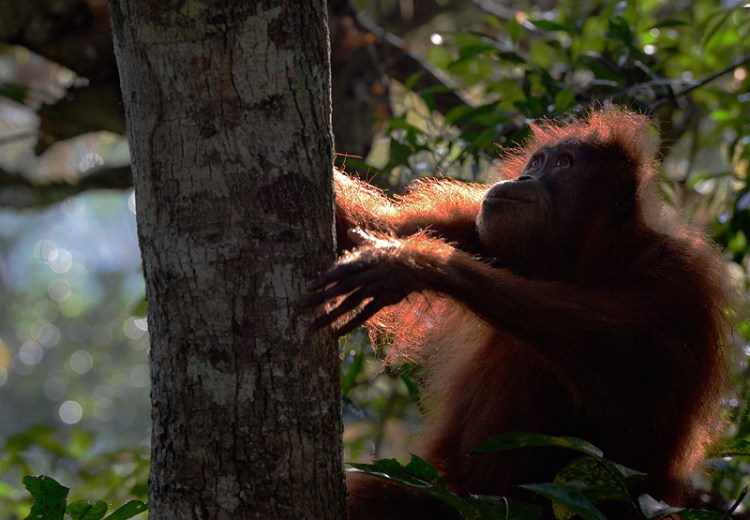
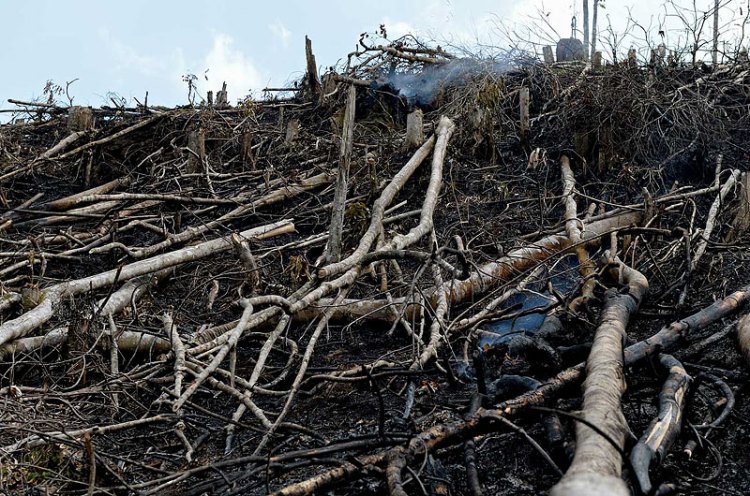
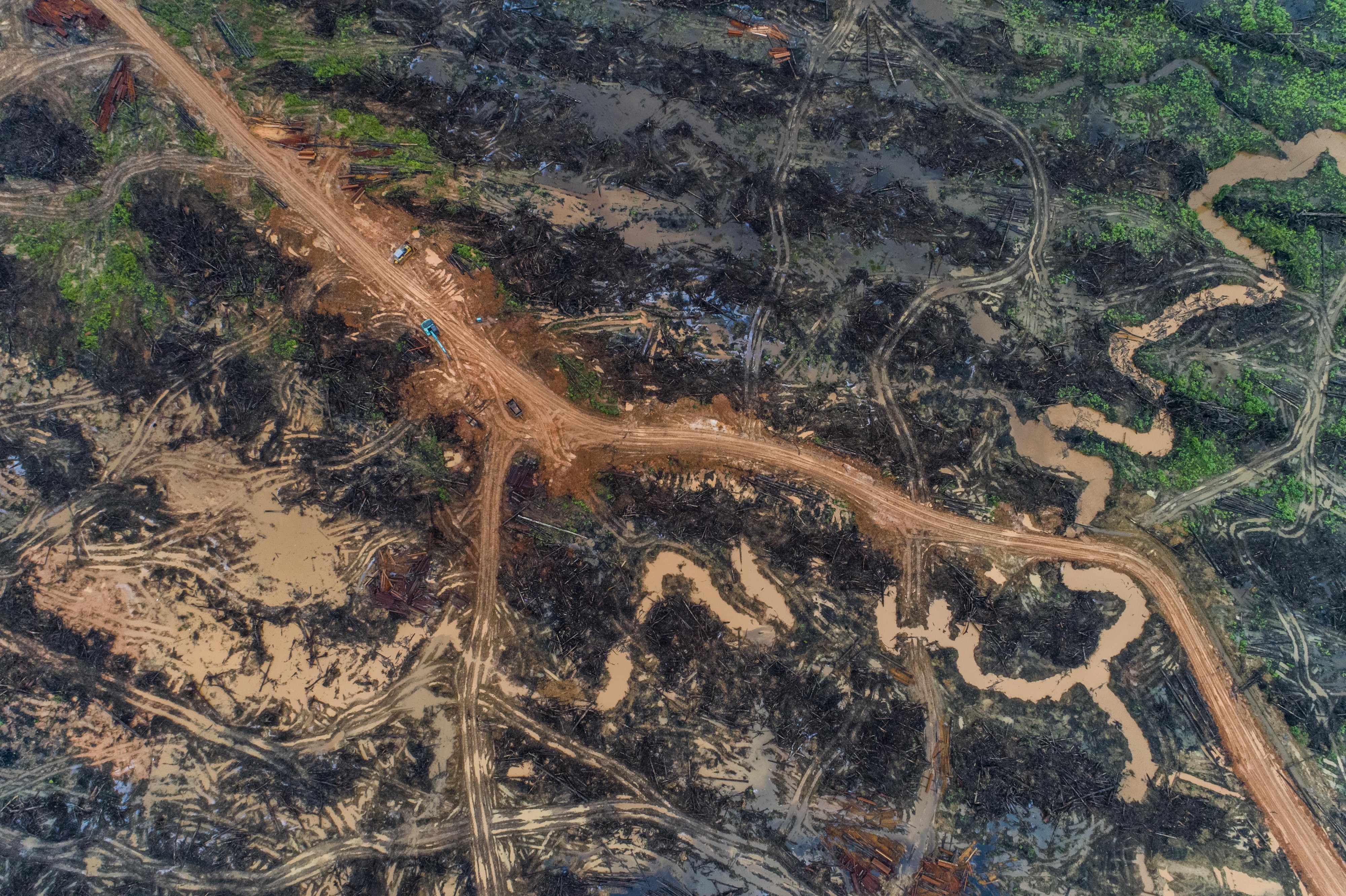
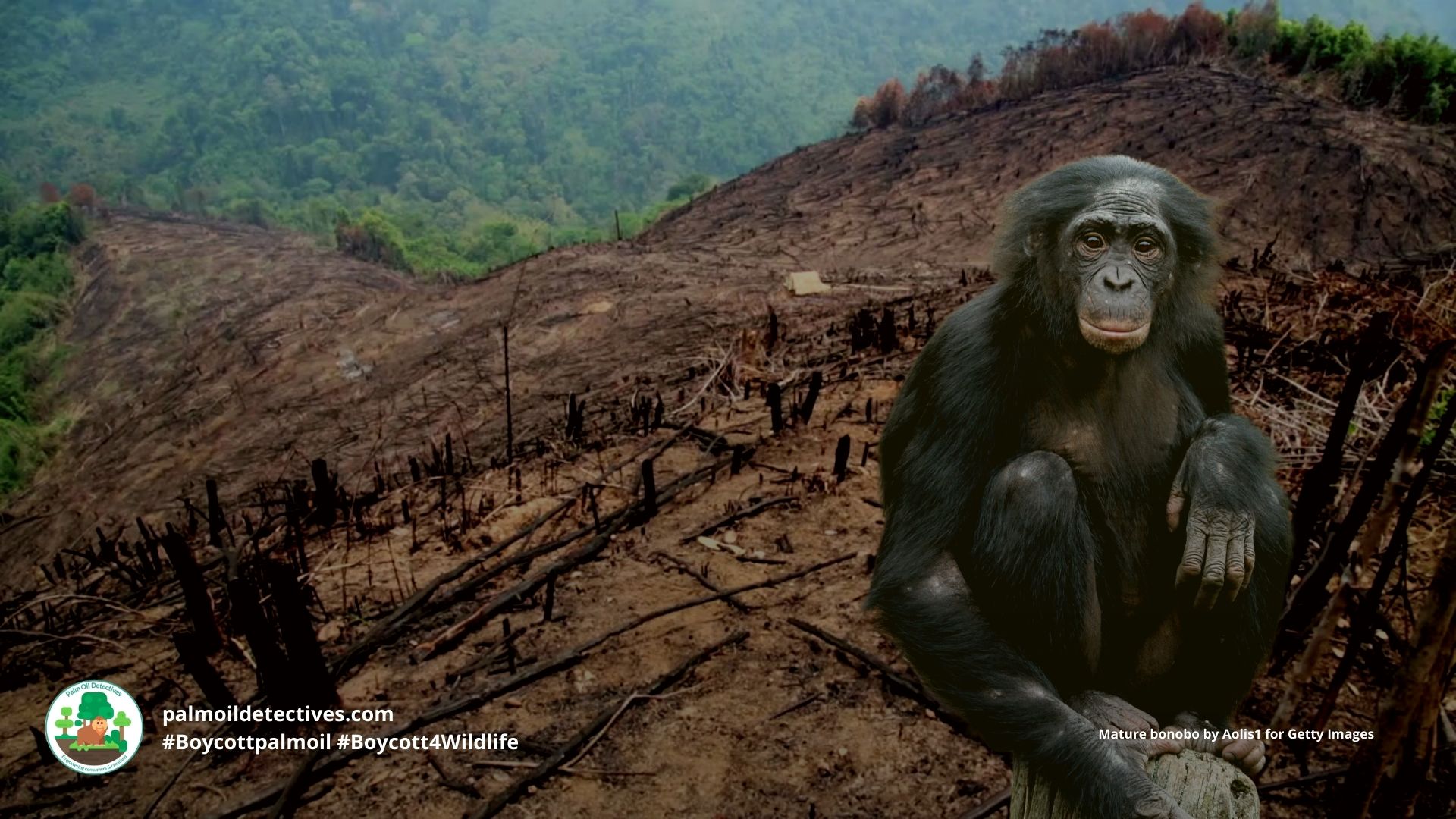
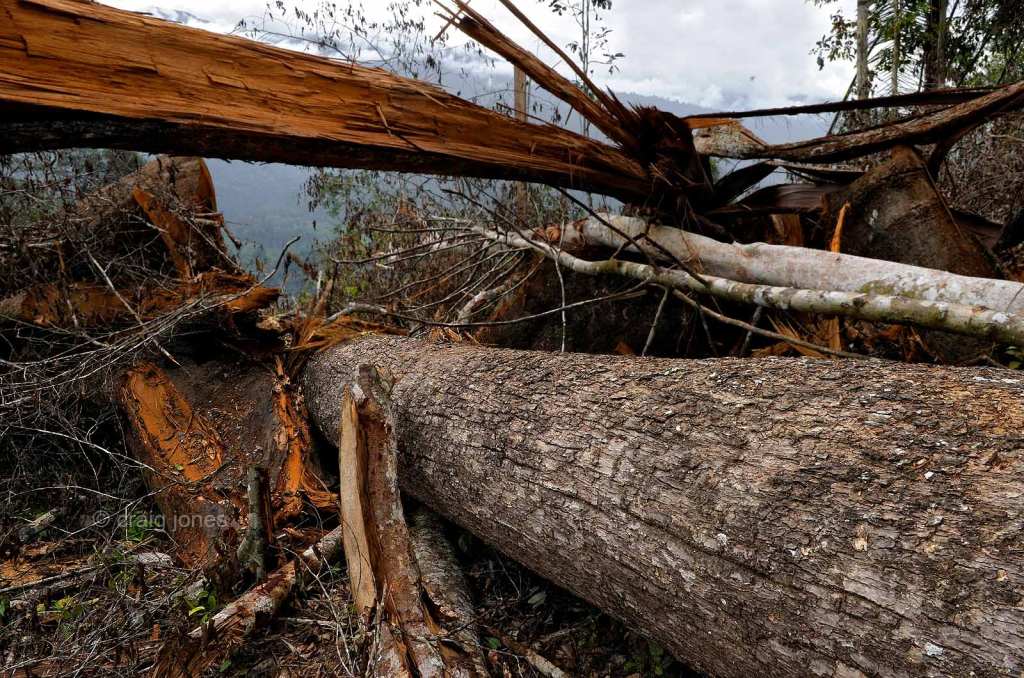
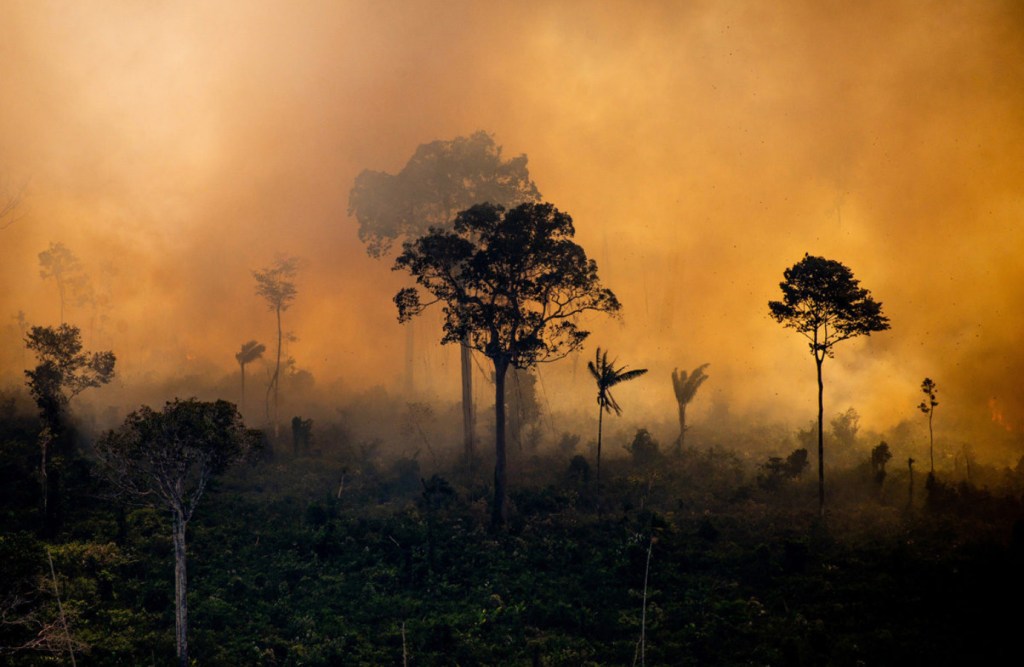
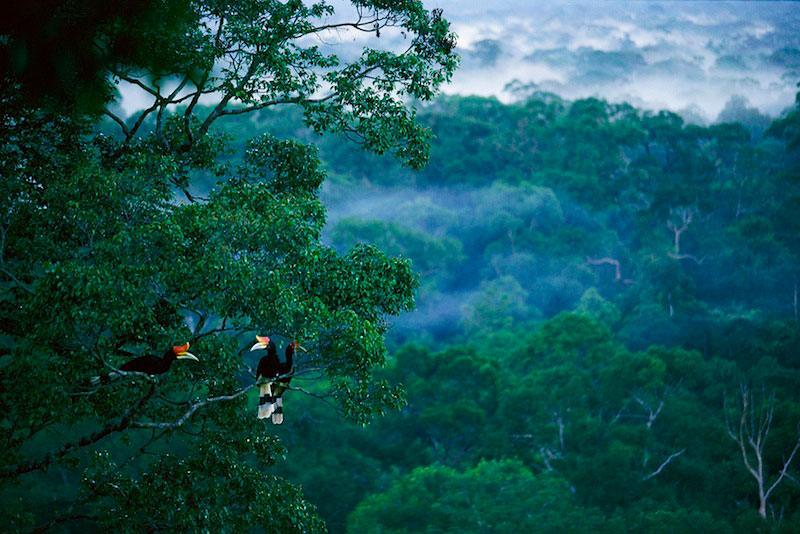
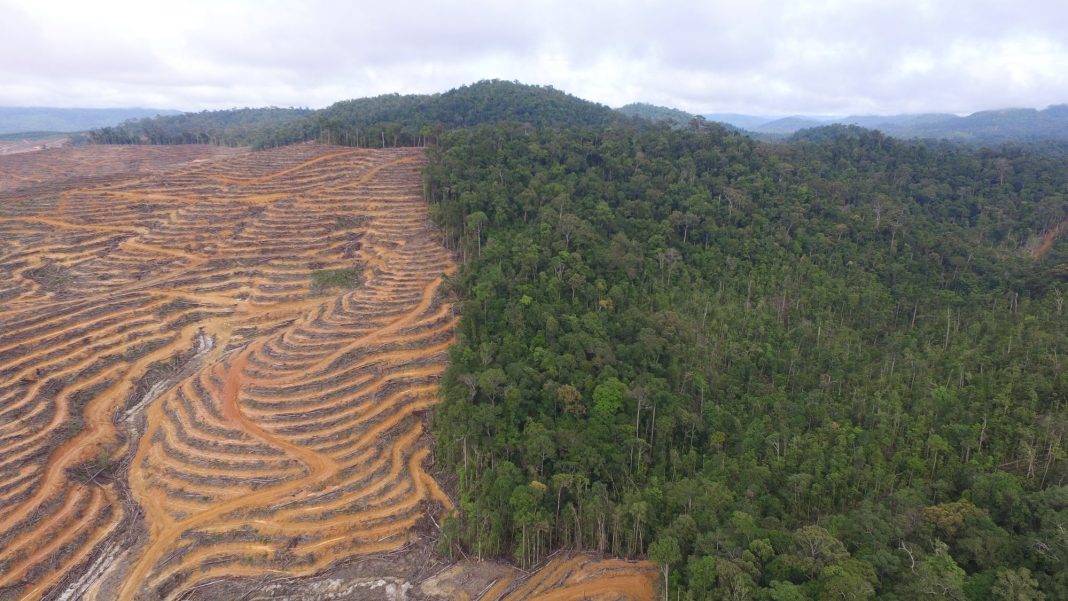
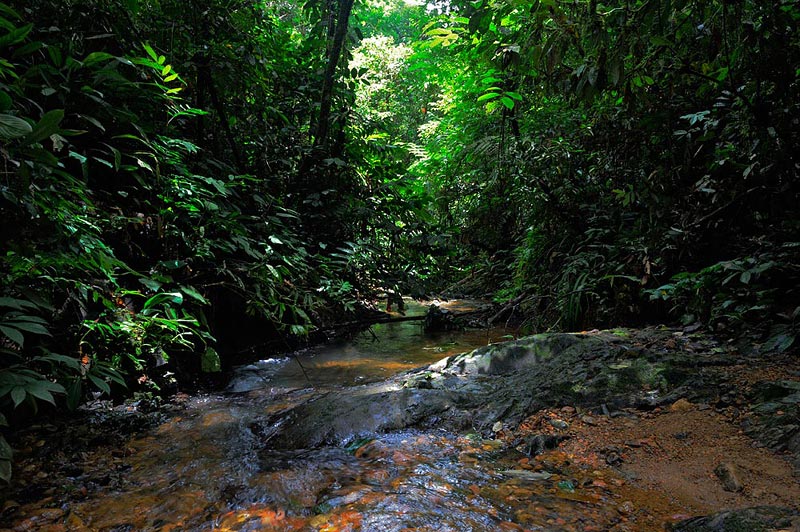
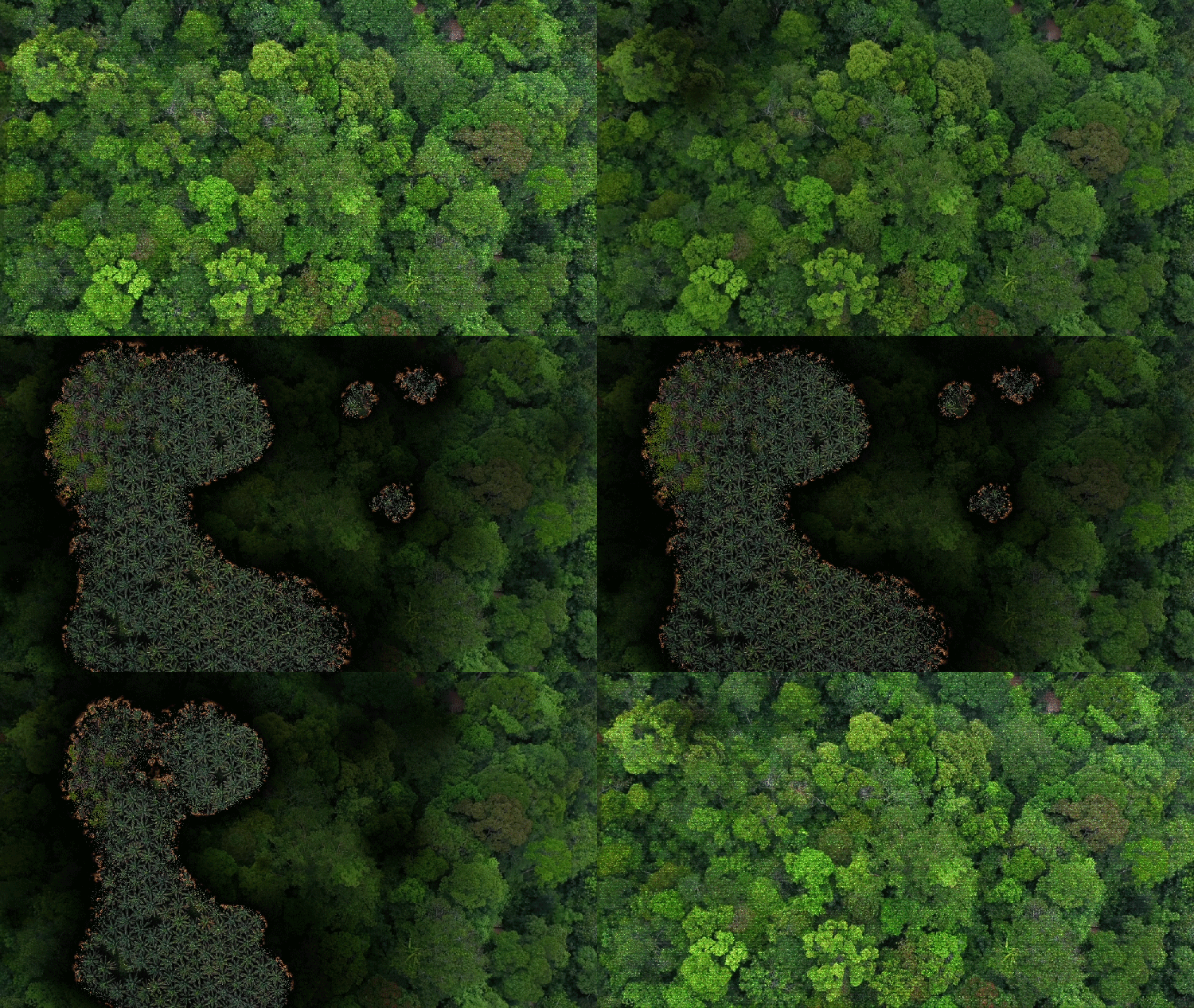
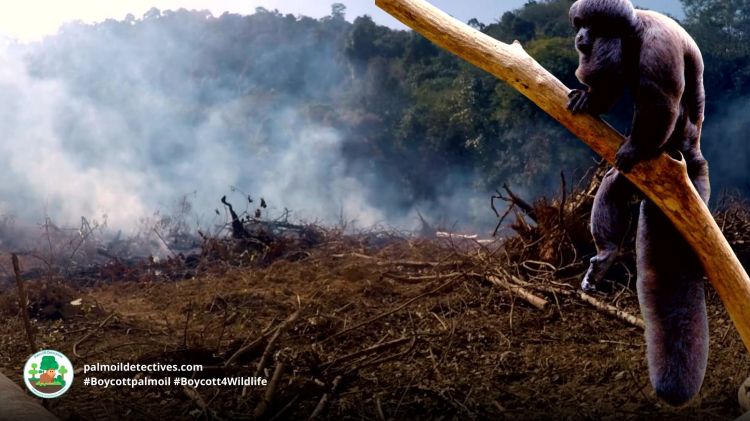
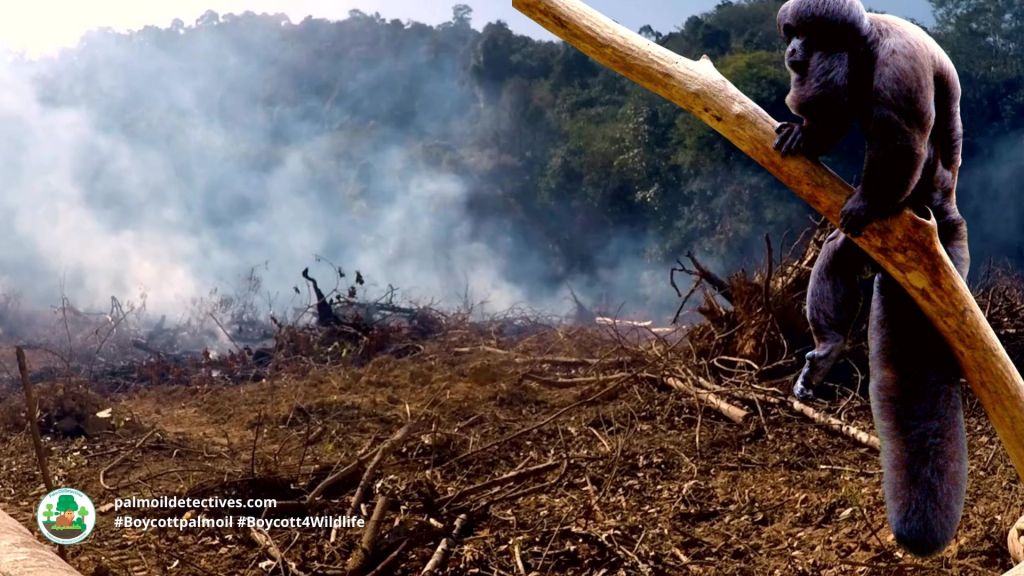
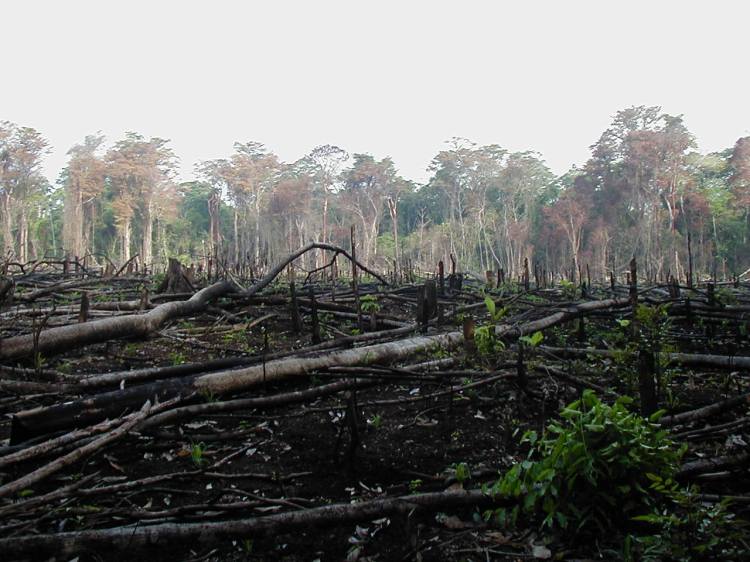
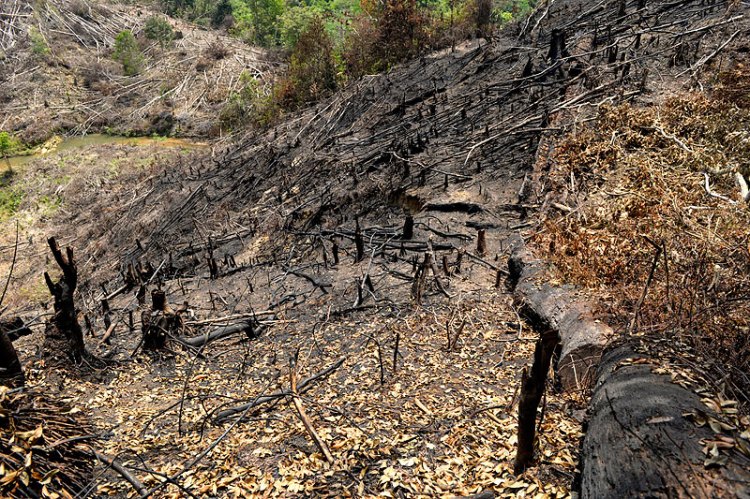
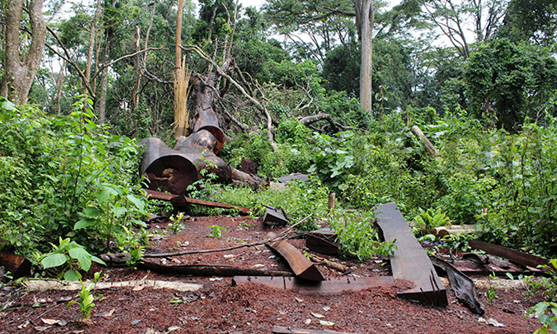
Deforestation - Craig Jones Wildlife Photography

The Lesser of Two Evils

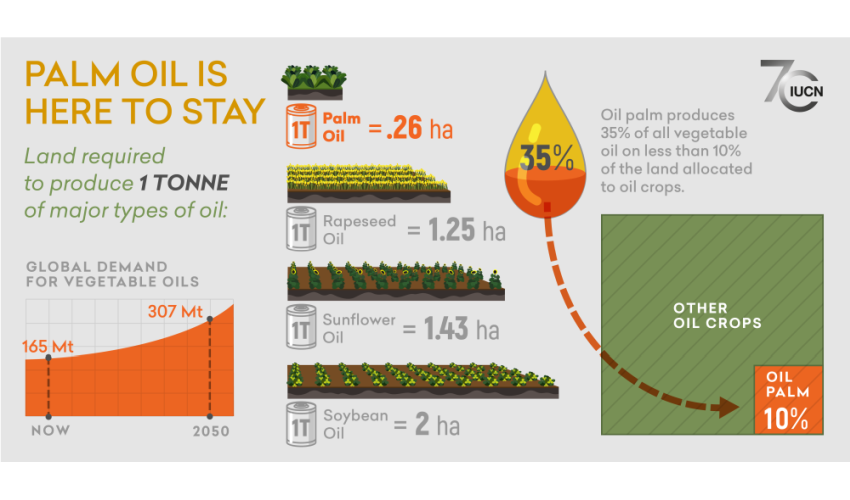
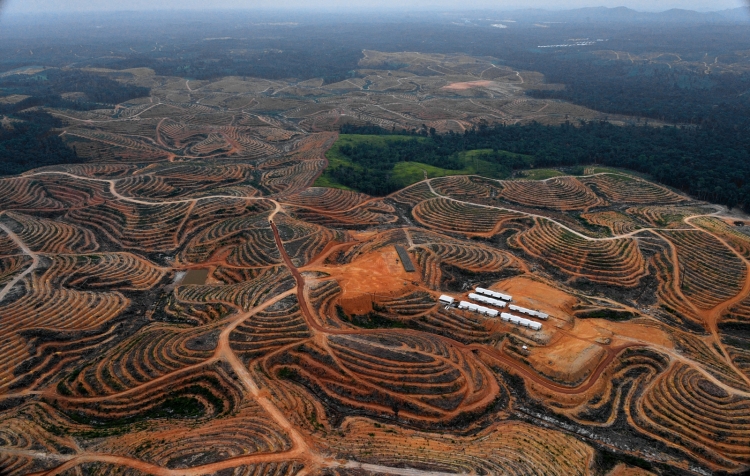
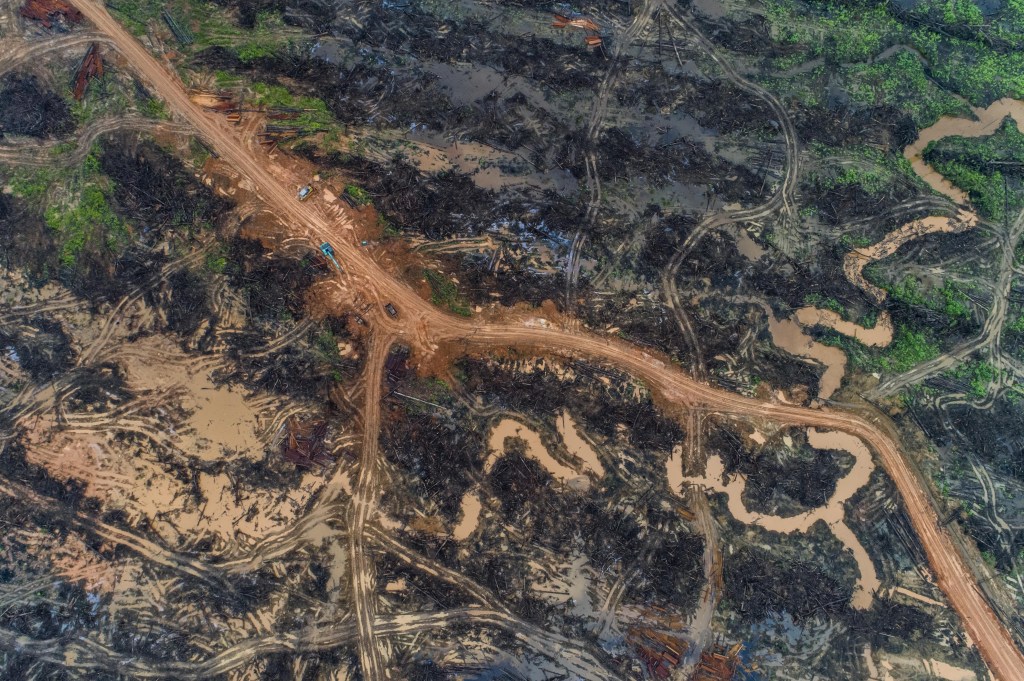
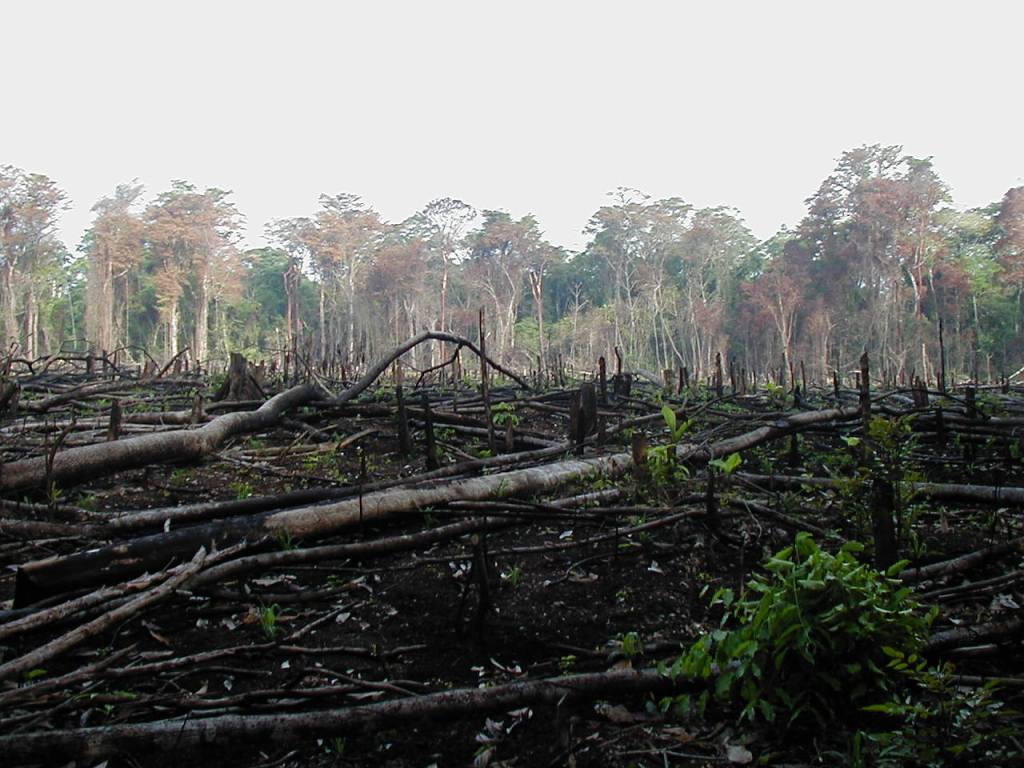
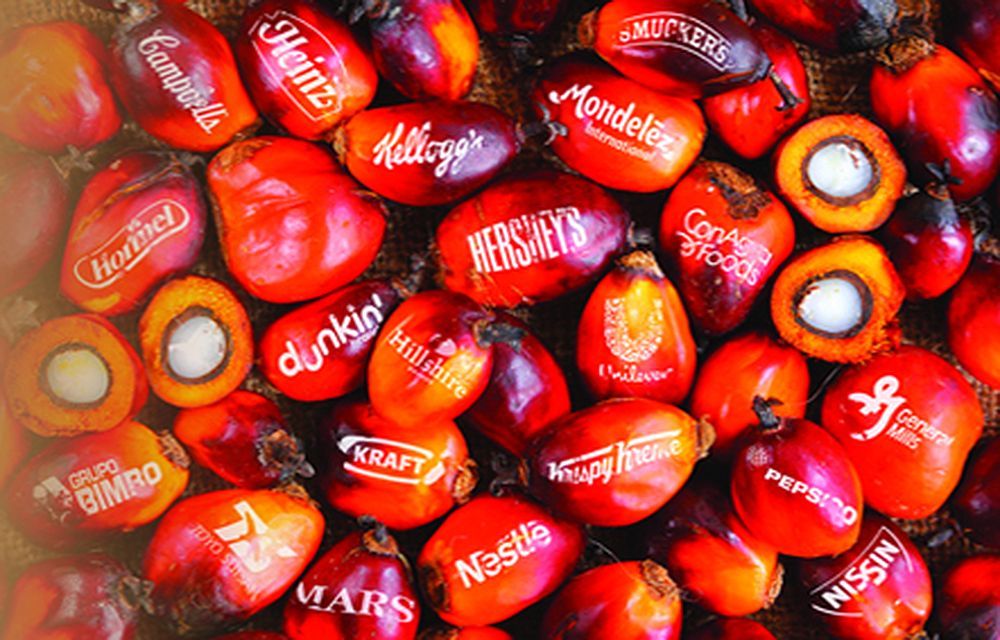
The main argument by palm oil lobbyists is that palm oil is better than other crops because it has a higher yield. This argument of a ‘lesser of two evils’ is used to justify and excuse the ecocide, deforestation and human rights abuses associated with ‘sustainable’ palm oil.


Tweet this…

#Greenwashing Tactic #6: Lesser of Two Evils: Claiming a commodity or industry is #greener than others in the same category, to excuse #ecocide #humanrights #animalrights abuses #Boycott4Wildlife #Boycottpalmoil #FightGreenwashing


Jump to section


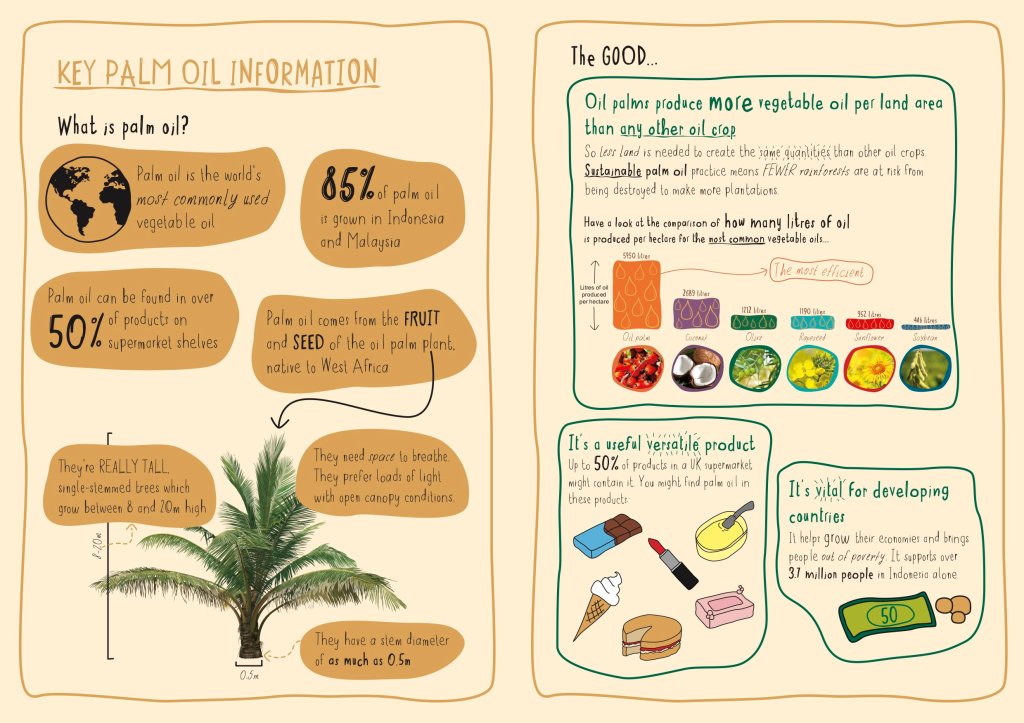
Greenwashing: Lesser of Two Evils: Palm Oil Uses Less Land Than Other Crops

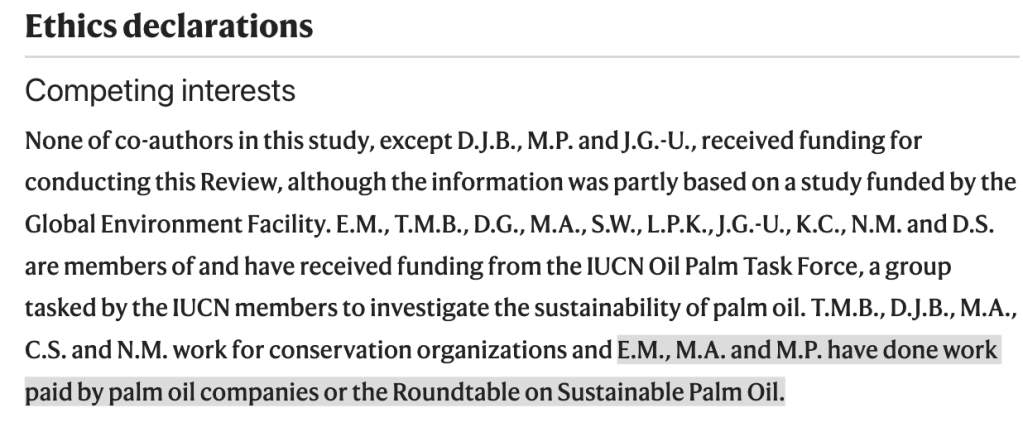
Greenwashing messaging is pervasive by researchers

Greenwashing messaging is pervasive on social media


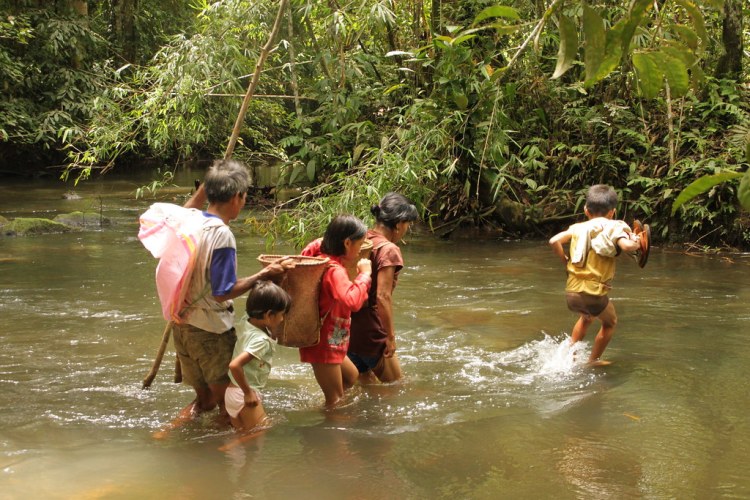
Reality: Human rights, deforestation, land-grabbbing and no difference to the livelihoods of workers on RSPO plantations

Reality: New technology would eliminate any need for deforestation

Palm oil lobbyists refuse to acknowledge the benefit of new technology


Explore the Series


Further reading: greenwashing and deceptive marketing


Say thanks for this guide by donating to my Ko-Fi


Greenwashing: Lesser of Two Evils

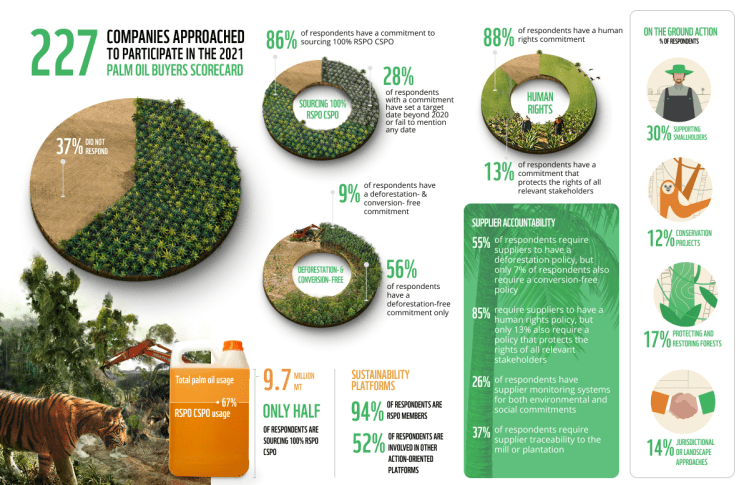
“Palm oil uses less land than other oil crops. Therefore, even though palm oil causes indigenous landgrabbing, deforestation, fires, species extinction and causing air and water pollution – it’s still better than other oils”

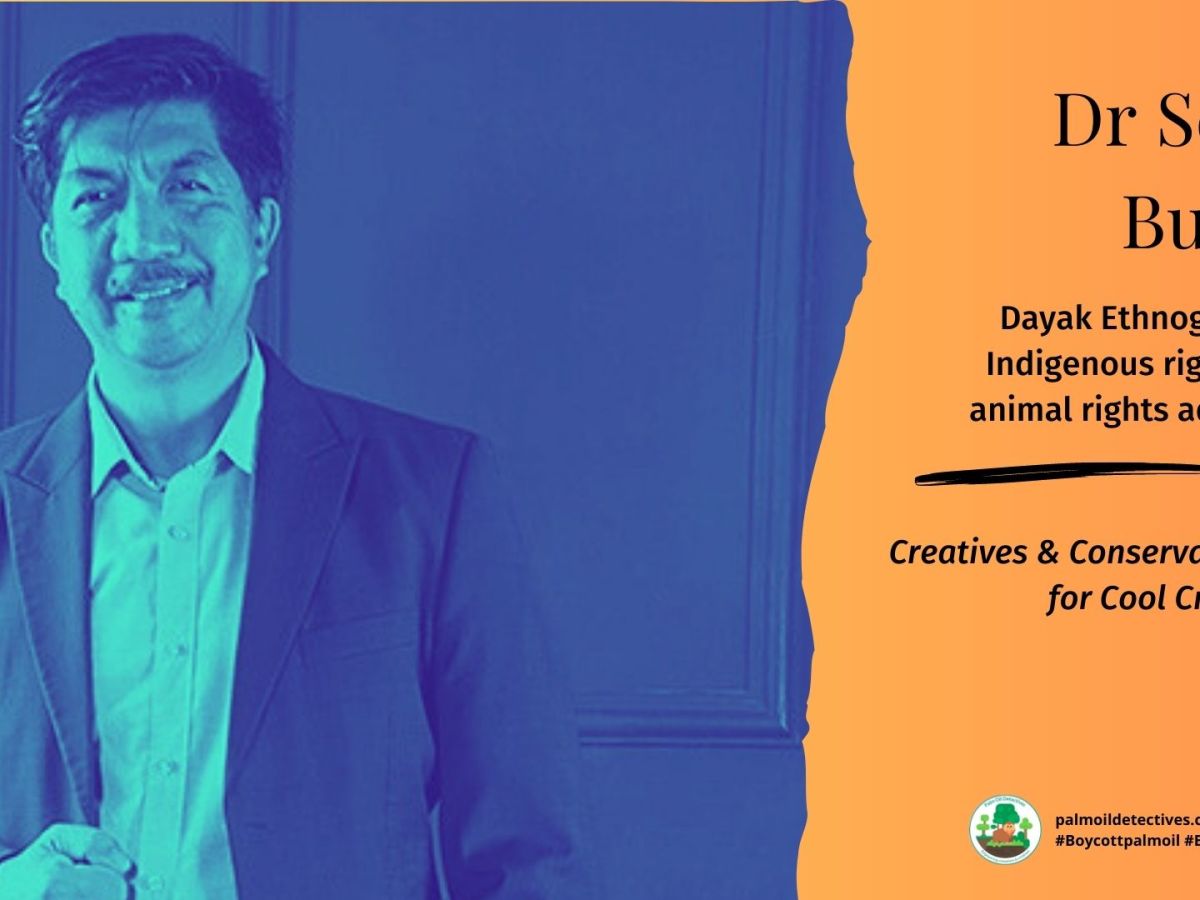
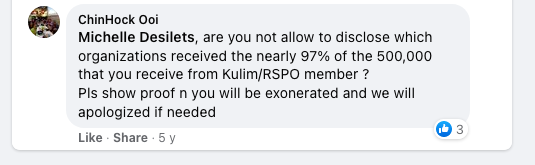
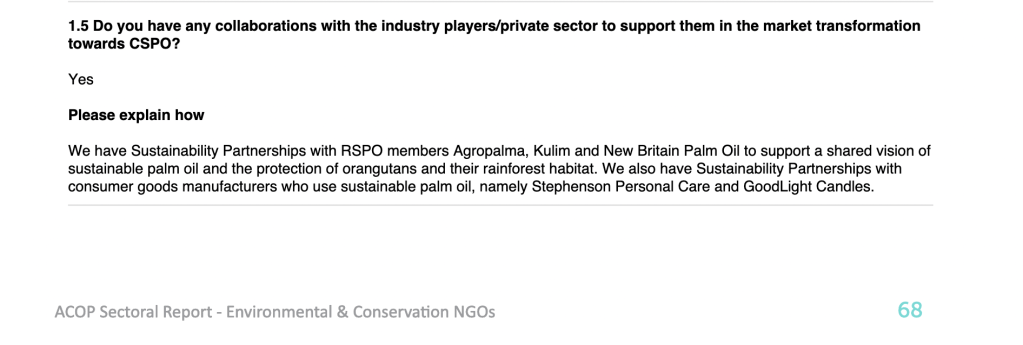
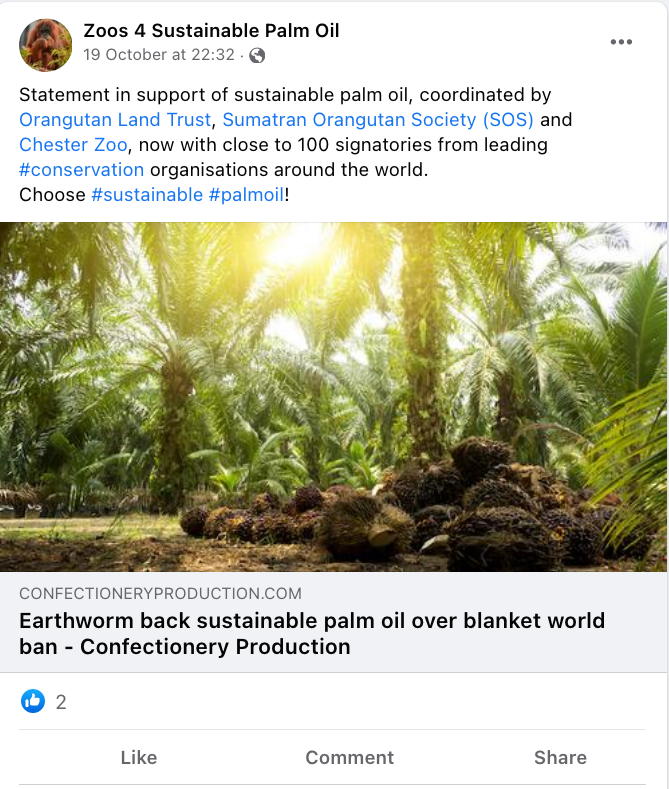
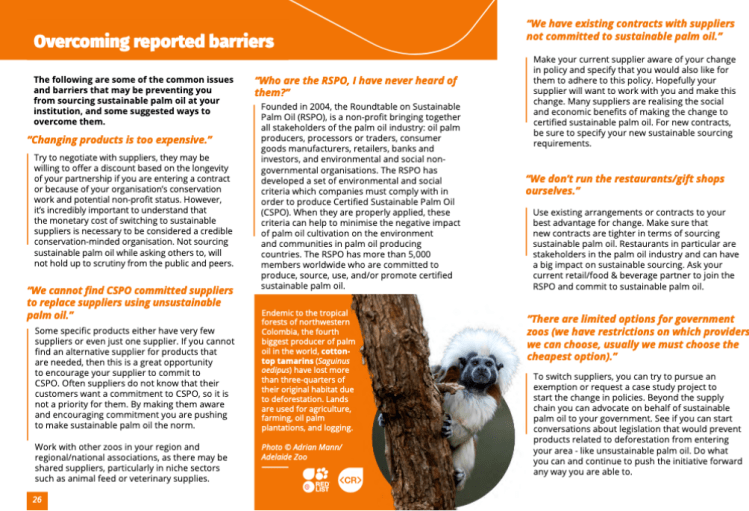
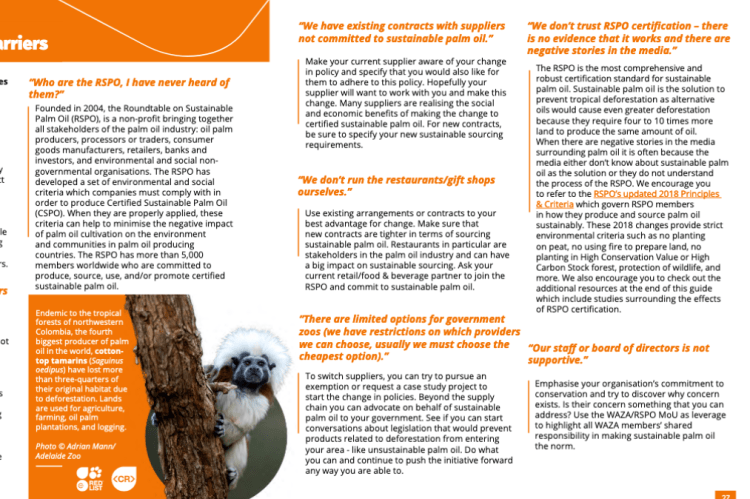
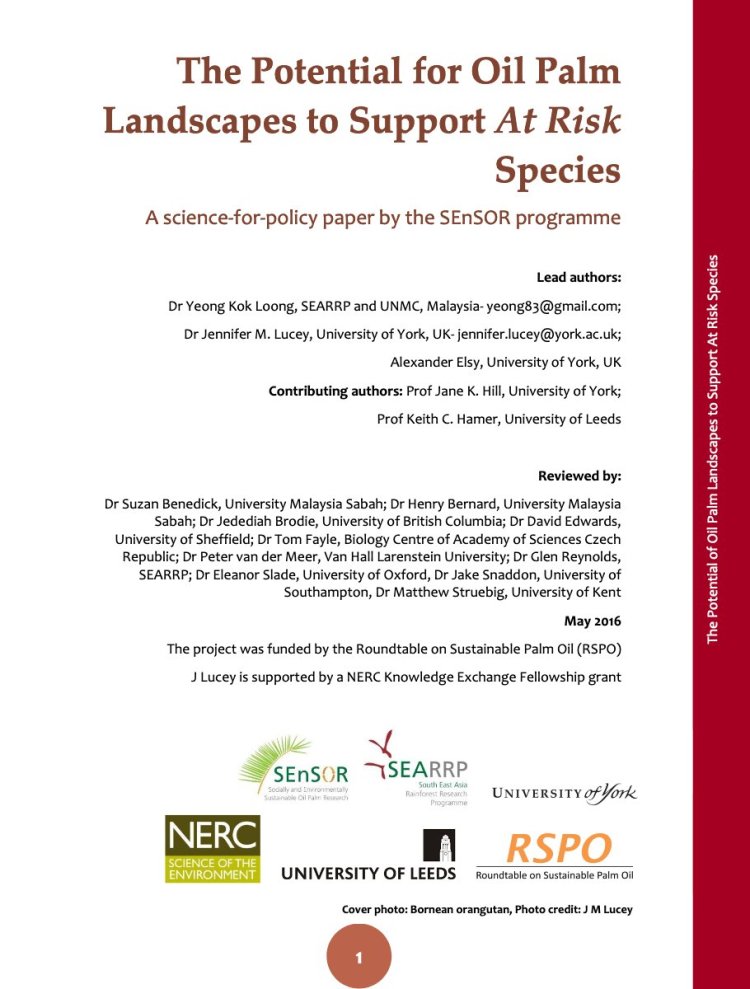
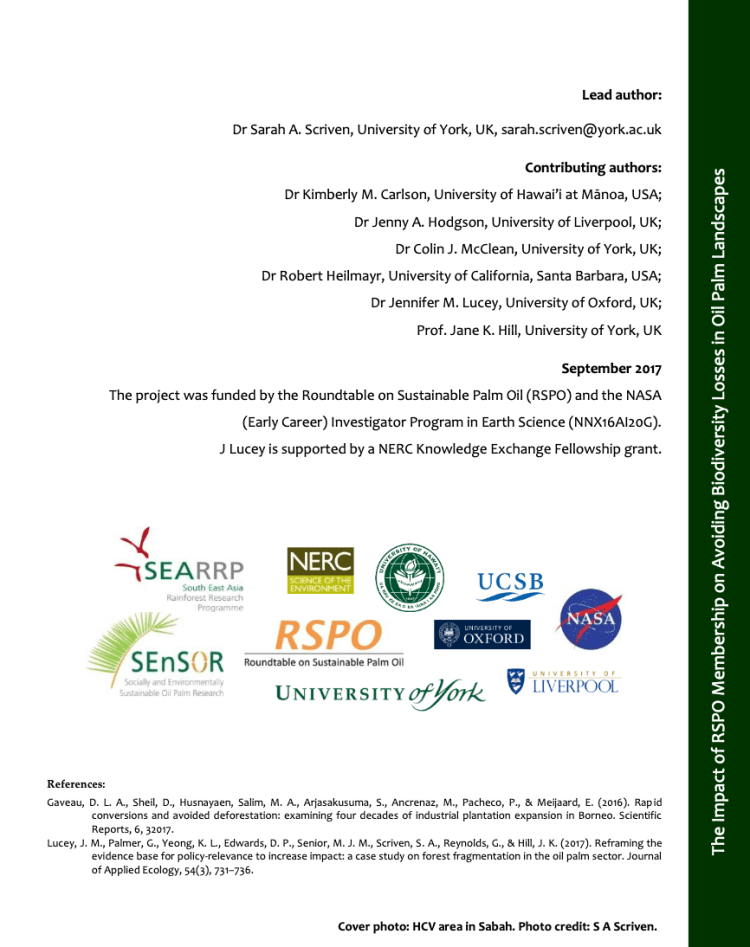
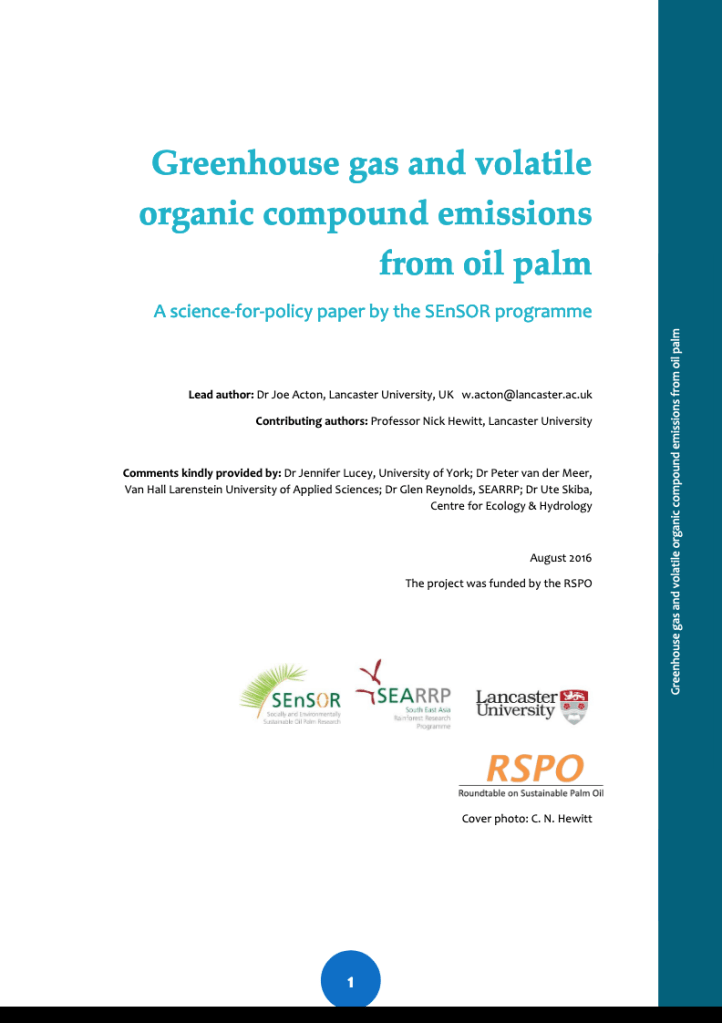
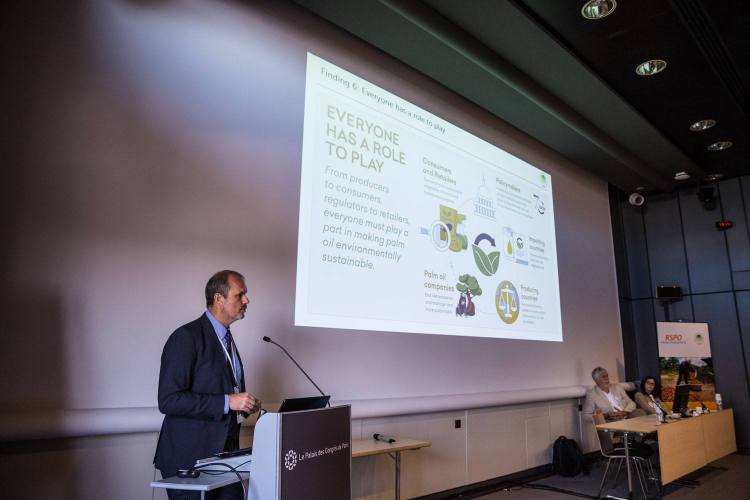
This ‘Lesser of Two Evils’ argument is supported by WWF and scientists who are part of the IUCN’s Palm Oil Task Force such as Dr Eric Meijaard and Mathew Streubig who are paid by RSPO members to produce favourable palm oil industry research. This argument for higher crop yield is used to maintain the status quo and dominance of palm oil over other oil crops, and also excuses the ecocide, deforestation, human rights abuses and tropical extinction that is ongoing for palm oil, and for so-called ‘sustainable’ palm oil.

Founding members of the RSPO along with WWF talking about why sustainable palm oil is important

Global demand for vegetable oils is projected to increase by 46% by 2050. Meeting this demand through additional expansion of oil palm versus other vegetable oil crops will lead to substantial differential effects on biodiversity, food security, climate change, land degradation and livelihoods.

Meijaard, E., Brooks, T.M., Carlson, K.M. et al. The environmental impacts of palm oil in context. Nat. Plants 6, 1418–1426 (2020). https://doi.org/10.1038/s41477-020-00813-w
Eric Meijaard pushing sustainable palm oil - lesser of two evils

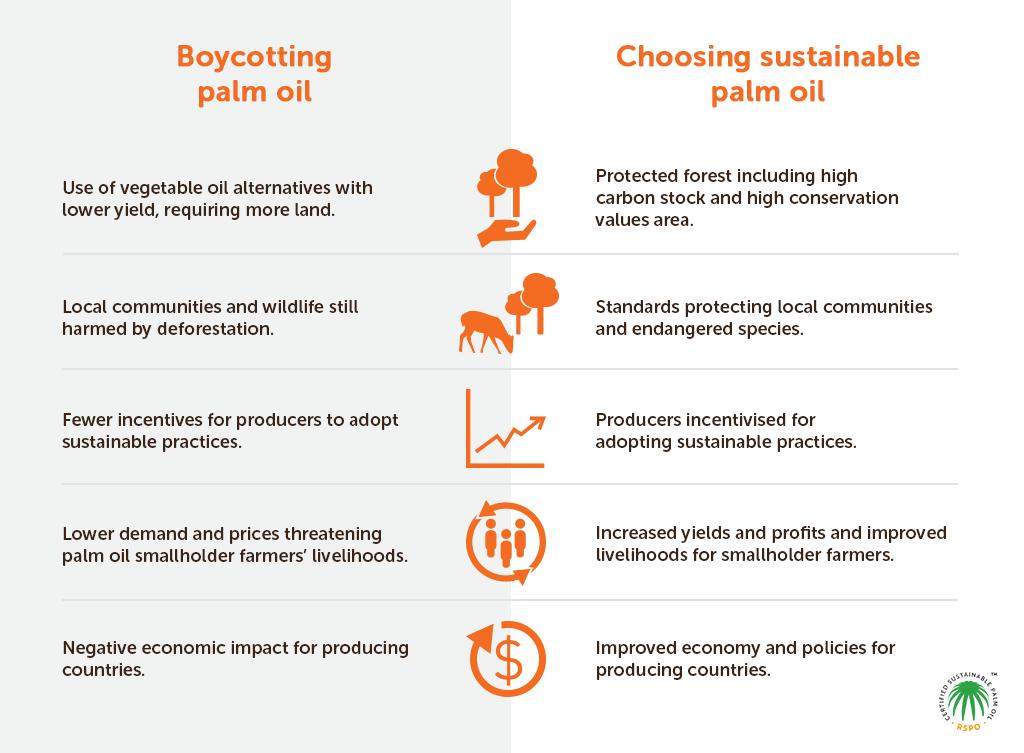
At it’s core, it is an economic argument, not an environmental one
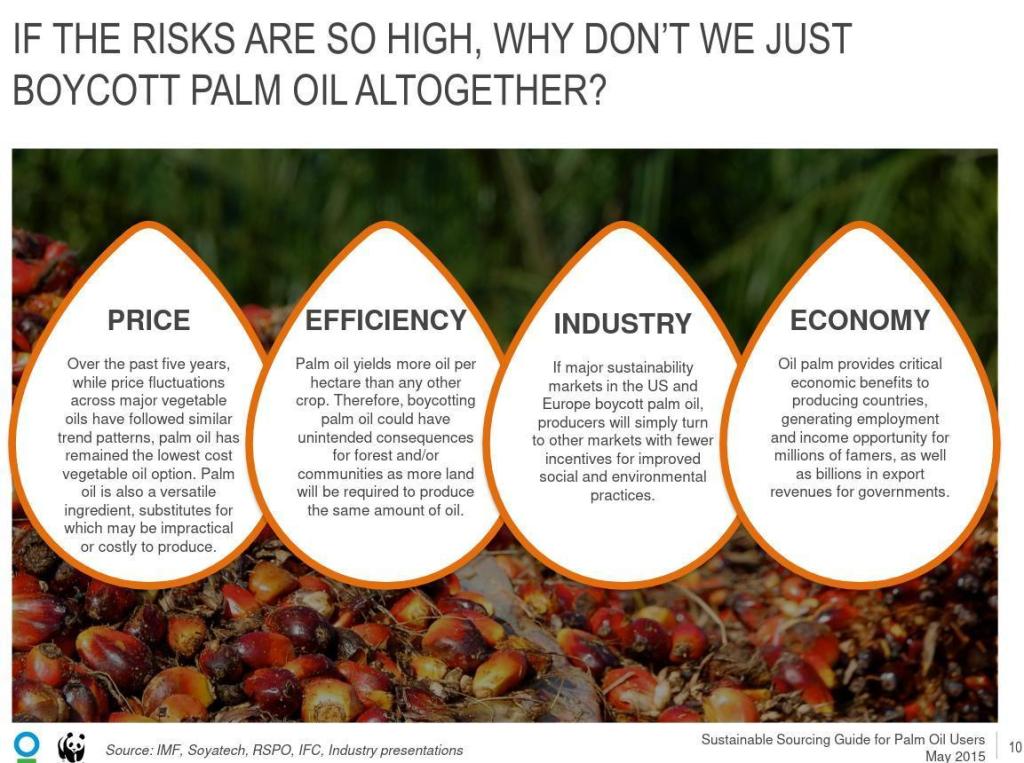

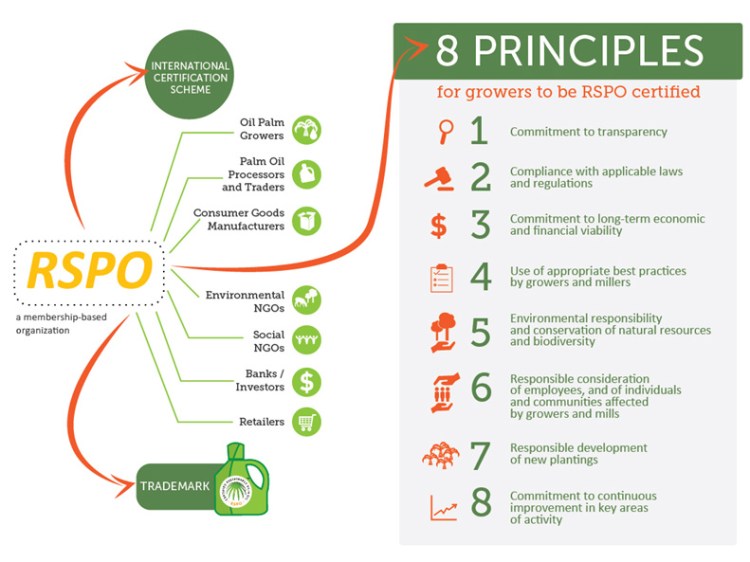
Source: WWF

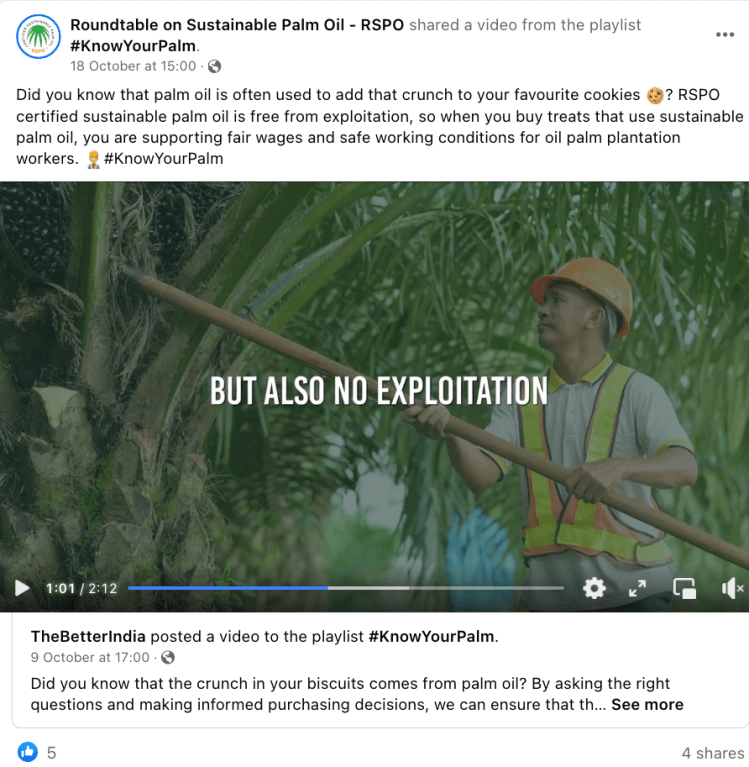
RSPO certified sustainable palm oil is only better than other oils if it stops deforestation, improves the income of workers, stops violence and human rights abuses and stops the extinction of animals. These problems are still ongoing after 17 years since the RSPO began. In fact, NO RSPO member can be 100% certain that their palm oil is free of deforestation and human rights abuses.


‘It’s because conventional palm oil is catastrophic that we need sustainable palm oil”


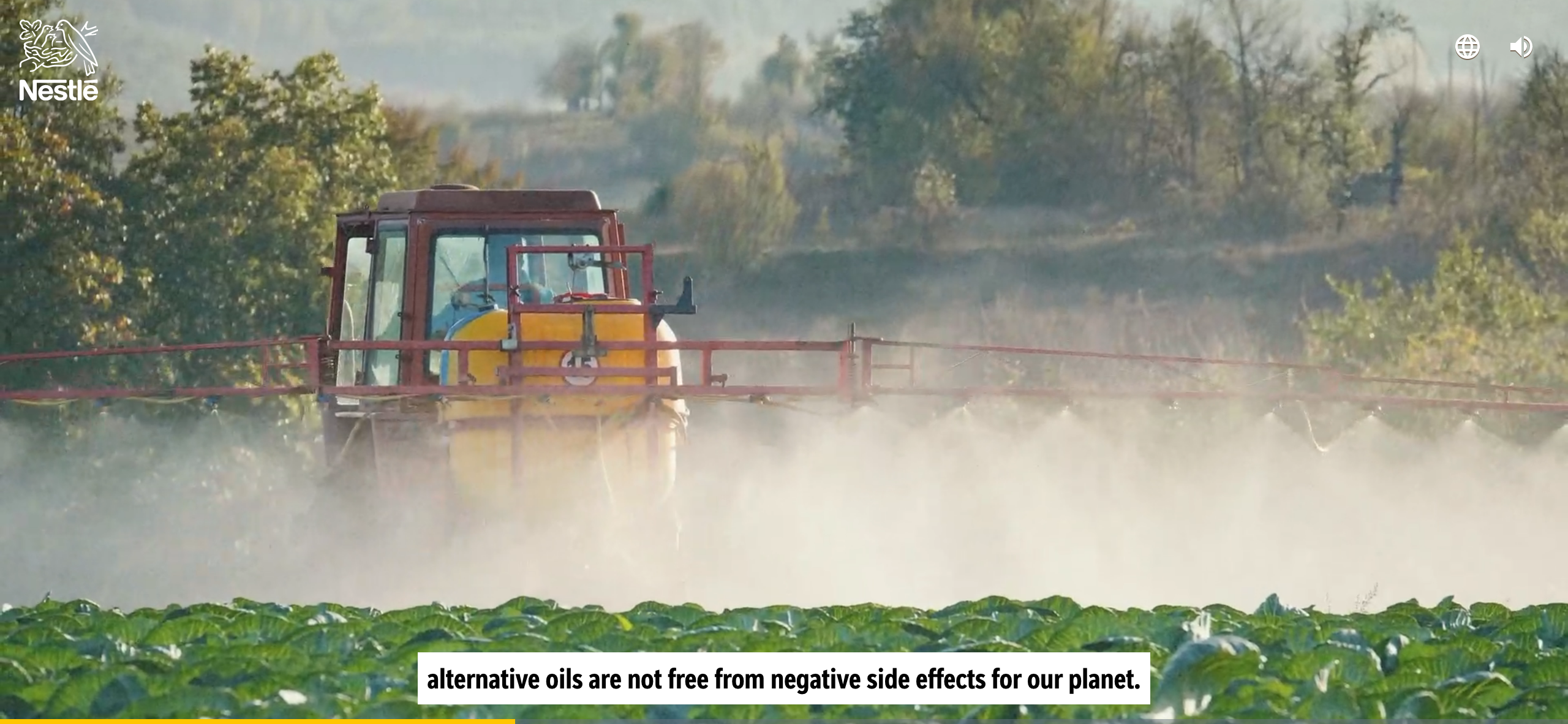
Slides: Nestle Palm Oil Interactive, IUCN Palm Oil Taskforce and RSPO promotional materials.
  • Greenwashing example - lesser of two evils argument - doesnt hold up under close analysis
  • Nestle - Beneath the surface, greenwashing interactive which offers false arguments
  • Nestle - Beneath the surface, greenwashing interactive which offers false arguments
  • Greenwashing example - Lesser of two evils
  • The IUCN Palm Oil Taskforcer features the same scientists who are paid by the RSPO to produce favourable research
  • Eric Meijaard pushing sustainable palm oil - lesser of two evils
  • eric meijaard rspo conference
  • eric meijaard rspo conference

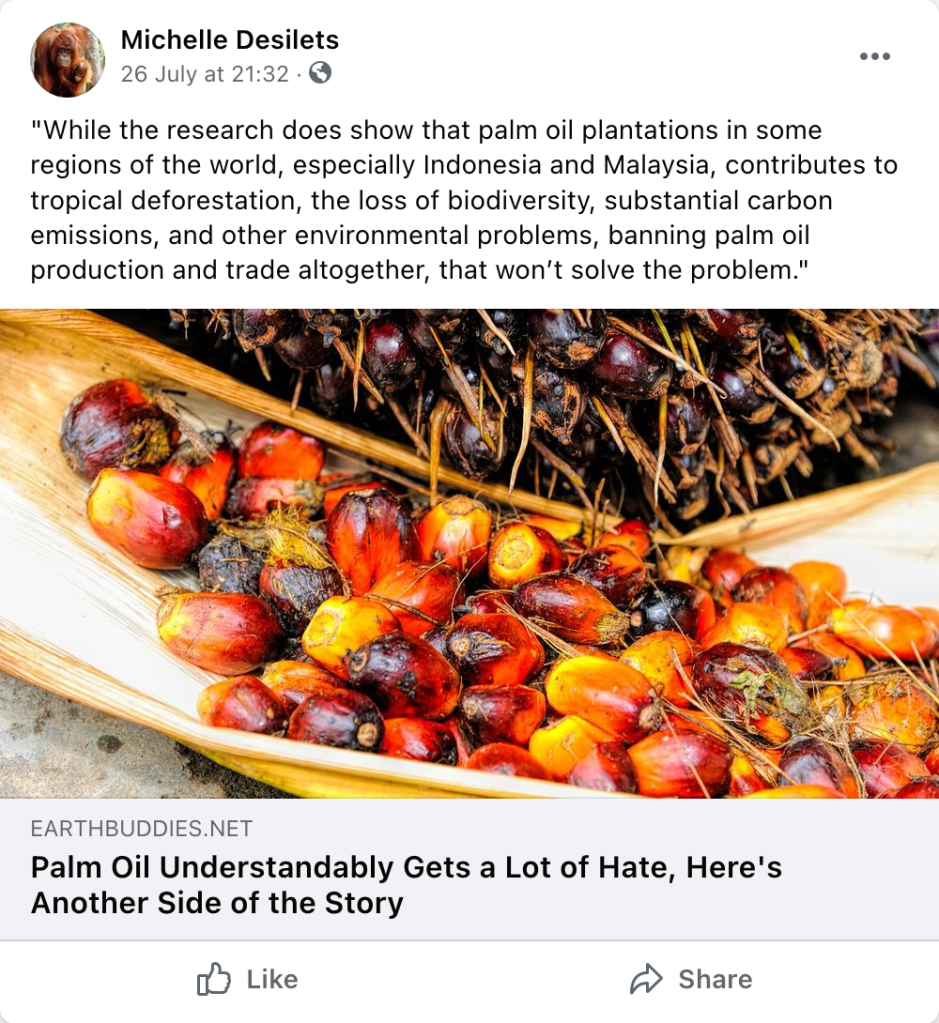
Greenwashing by researchers, lobbyists and ‘partner NGOs’ who are paid by RSPO members (supermarket brands) to convince the public of the merits of ‘sustainable’ palm oil – using the ‘Lesser of Two Evils’ argument

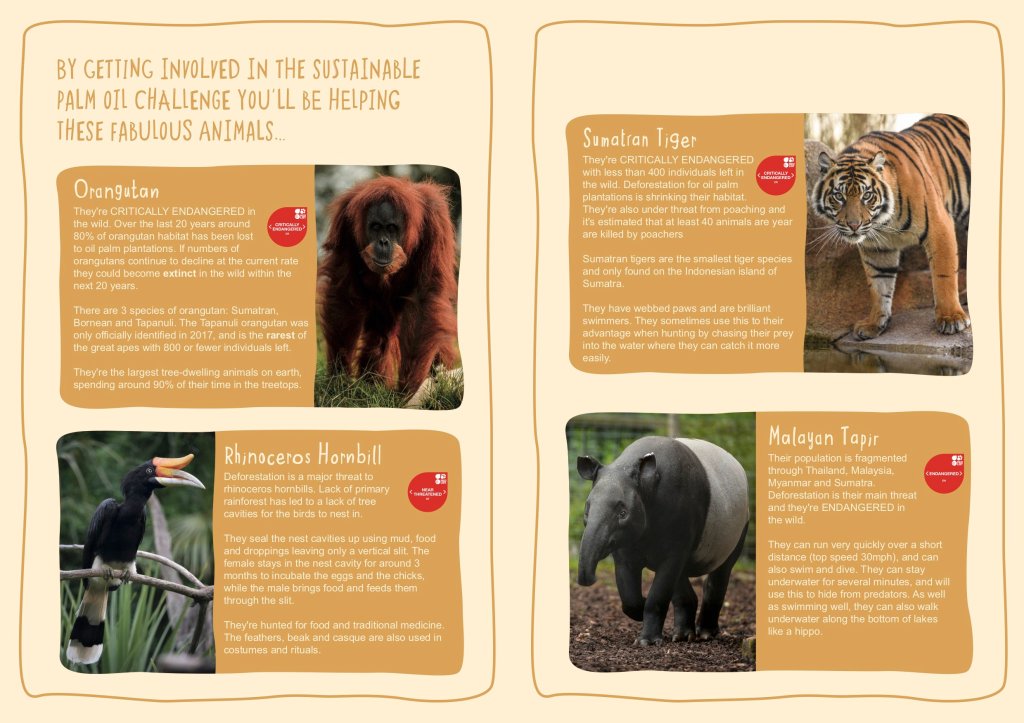
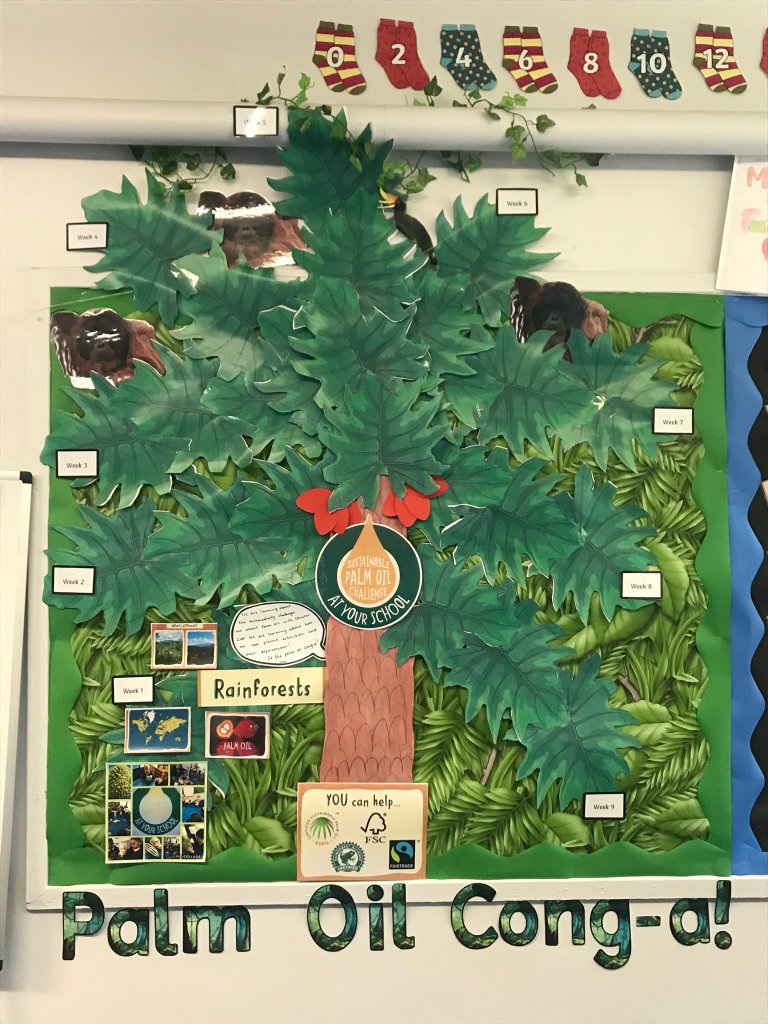
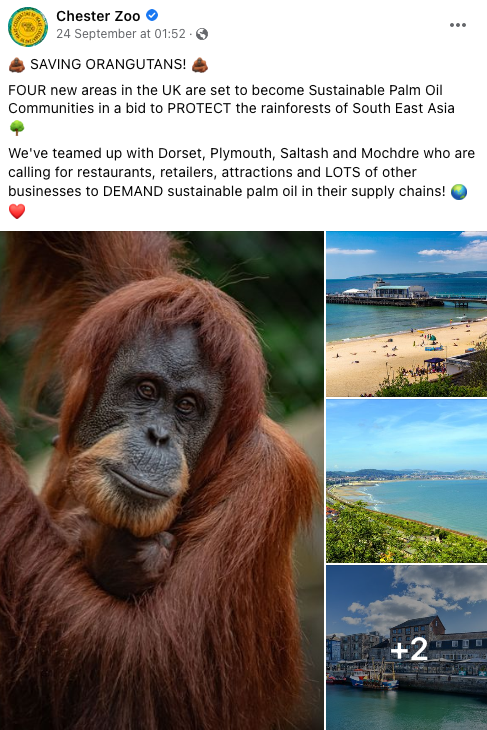
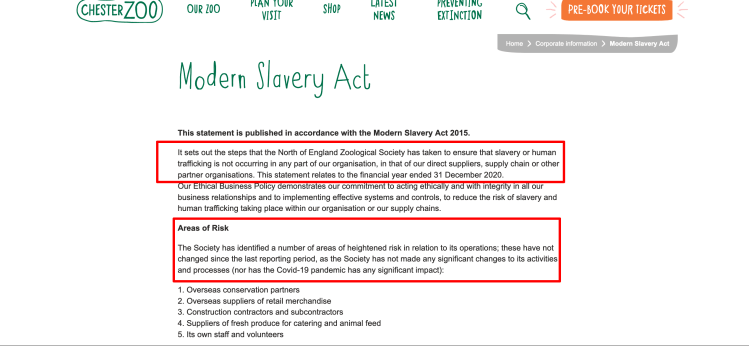
Chester Zoo Education

Reality:

Despite promises of sustainability, RSPO palm oil certification has not improved smallholder (worker) incomes in 17 years.

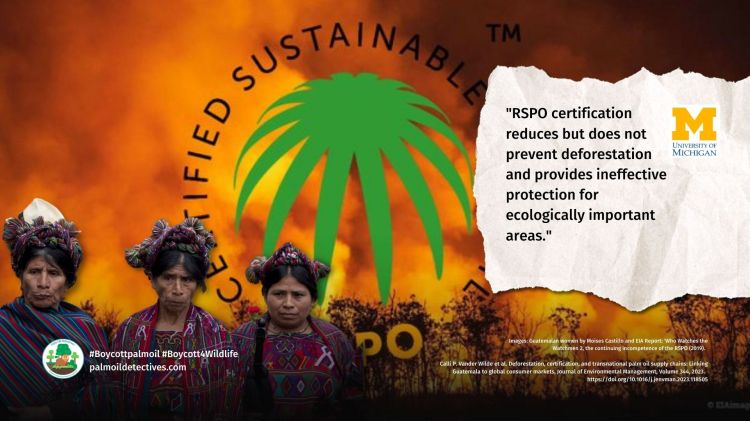
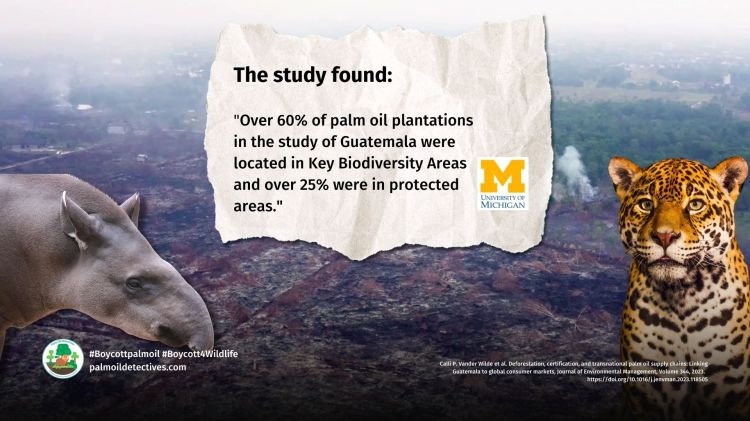
The RSPO has not stopped deforestation, fires and human rights abuses and illegal land-grabbing by RSPO members.

Certification had no causal impact on forest loss in peatlands or active fire detection rates.

Kimberly M. Carlson, Robert Heilmayr, Holly K. Gibbs, Praveen Noojipady et al. Effect of oil palm sustainability certification on deforestation and fire in Indonesia, PNAS January 2, 2018 115 (1) 121-126 https://doi.org/10.1073/pnas.1704728114

No significant difference was found between certified and non-certified plantations for any of the sustainability metrics investigated, however positive economic trends including greater fresh fruit bunch yields were revealed. To achieve intended outcomes, RSPO principles and criteria are in need of substantial improvement and rigorous enforcement.

Evaluating the effectiveness of palm oil certification in delivering multiple sustainability objectives. (2018)

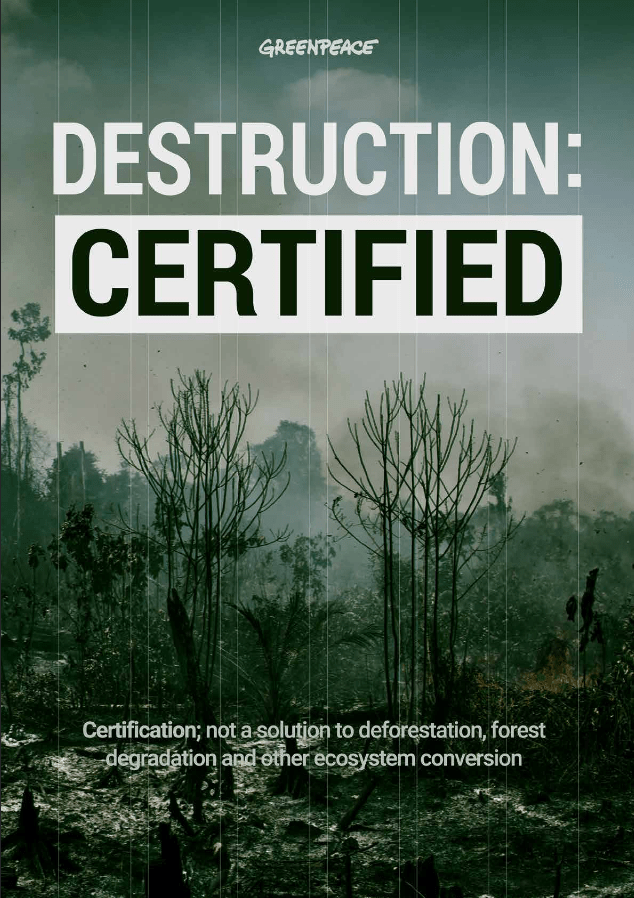
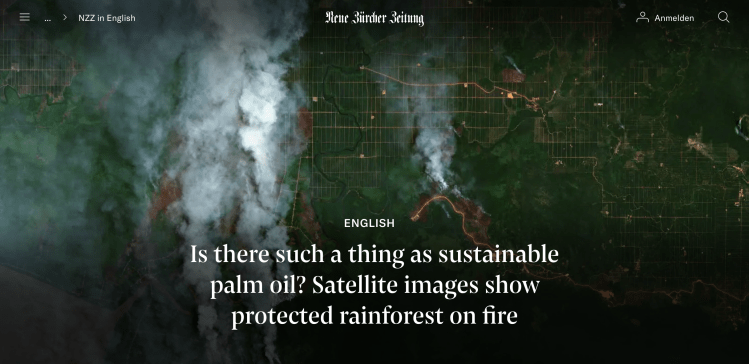
The Neue Zuercher Zeitung used several cases to highlight where slash-and-burn techniques continue on RSPO-certified land, and where new plantations are threatening important ecosystems. These examples are representative of the huge gap between the need for environmental protection and the ever-increasing global demand for palm oil.

Adina Renner, Conradin Zellweger, Barnaby Skinner. ‘Is there such a thing as sustainable palm oil? Satellite images show protected rainforest on fire’. Neue Zürcher Zeitung (May 2021) (In English)

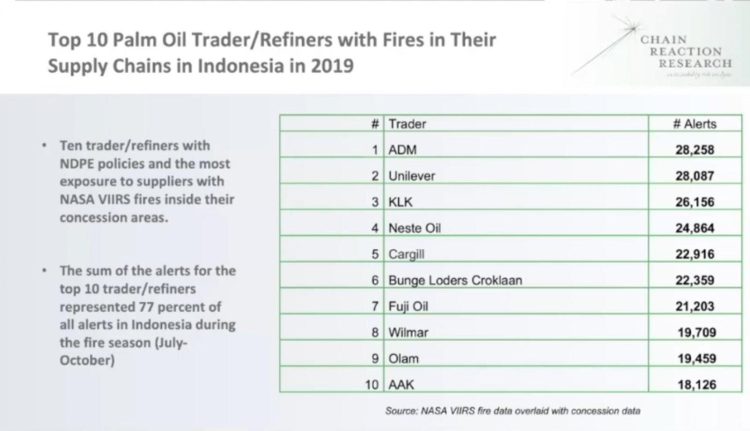
Swiss multinational Nestlé received hundreds of thousands of alerts of forest clearing near its palm oil suppliers in 2019 via satellite monitoring.

Nestlé identified over 1,000 cases of deforestation per day in palm oil areas. SwissInfo (2020).

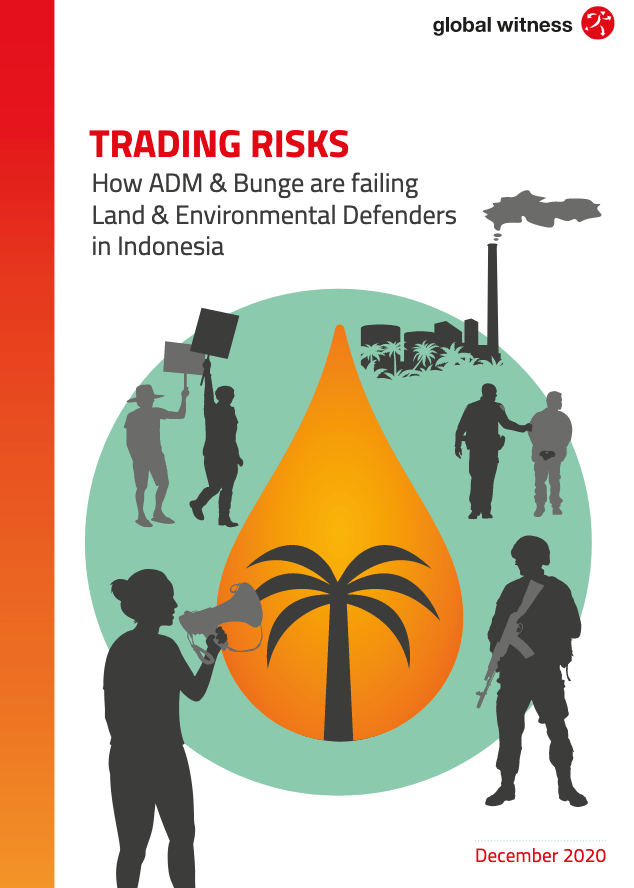
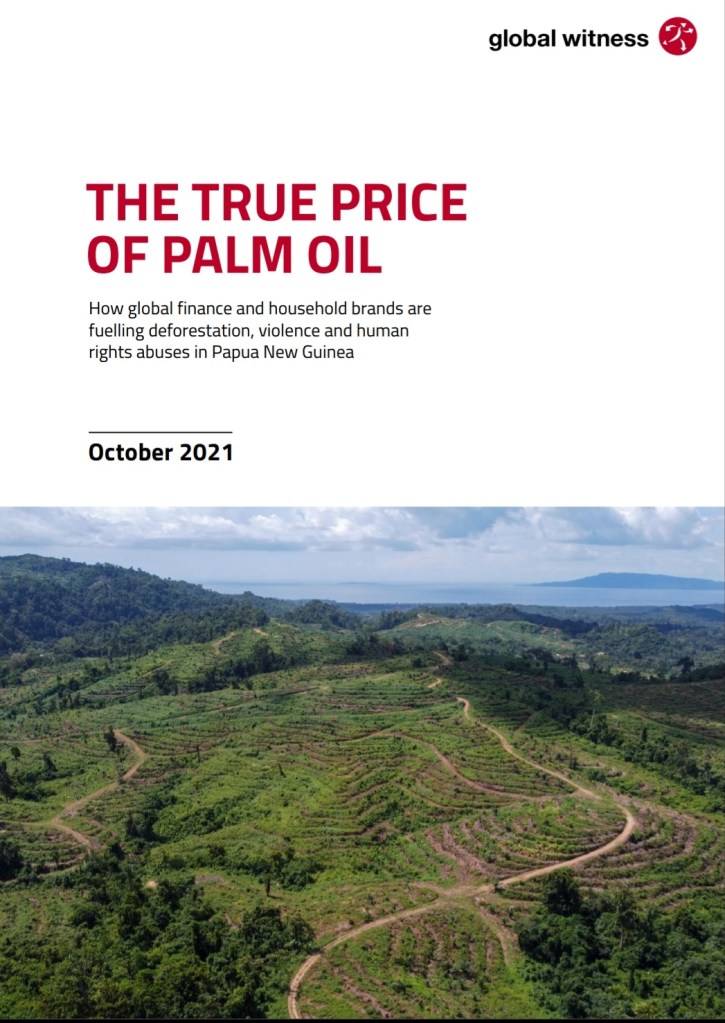
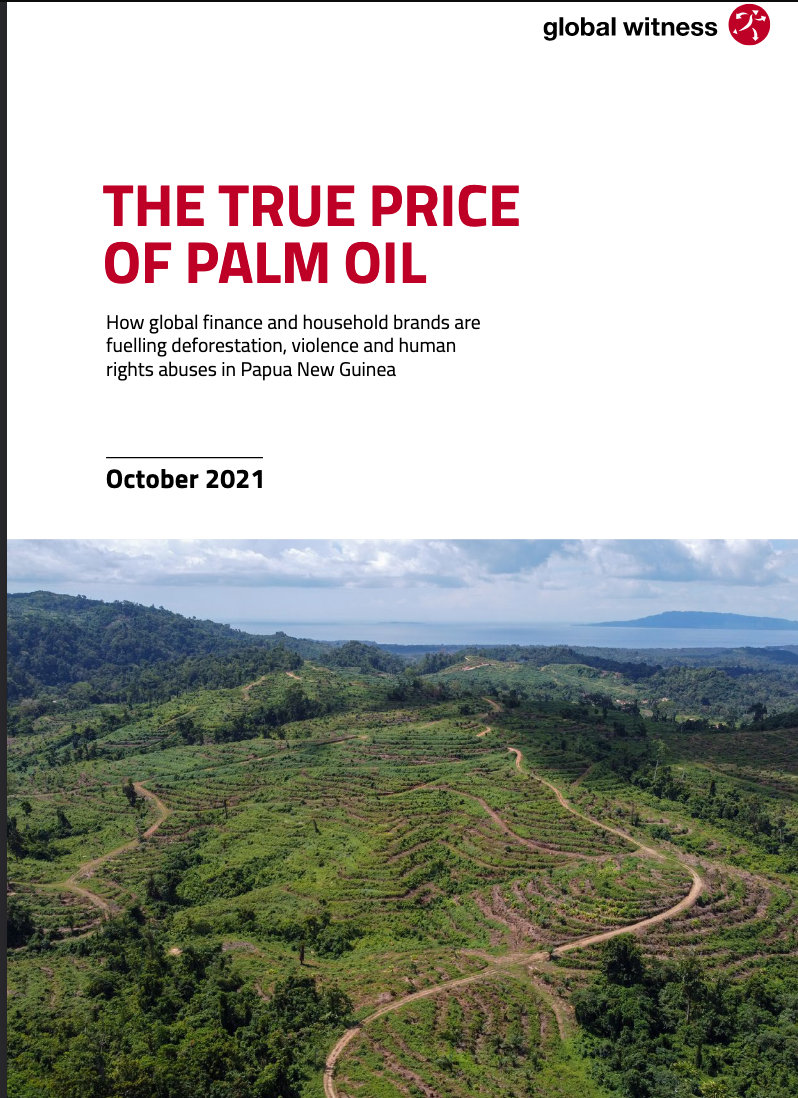
Global Witness October 2021 Report: Violence and death for palm oil connected to household supermarket brands (RSPO members)

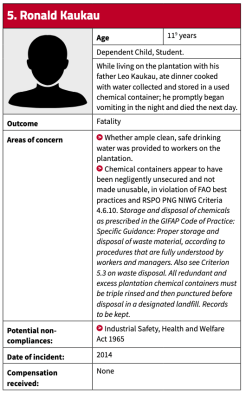
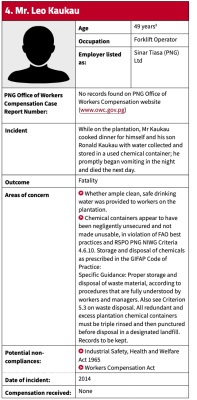
“One palm oil firm, Rimbunan Hijau, [Papua New Guinea] negligently ignored repeated and avoidable worker deaths and injuries on palm oil plantations, with at least 11 workers and the child of one worker losing their lives over an eight-year period.
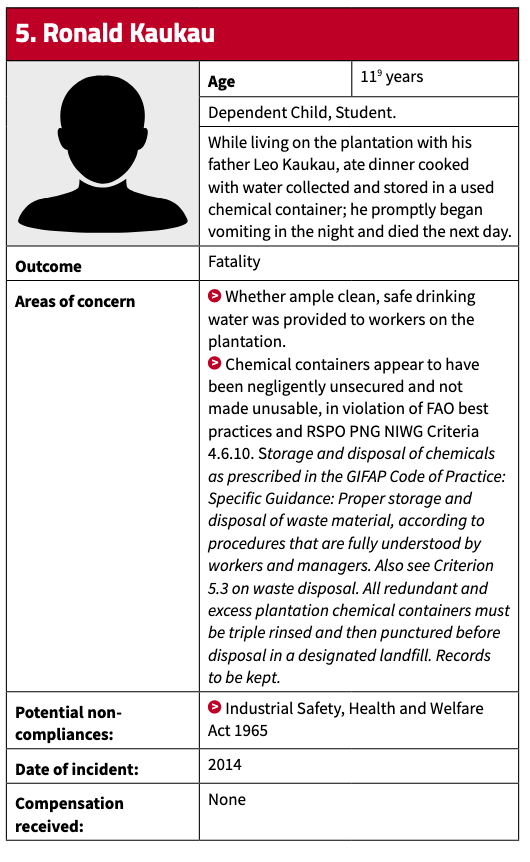
Papua New Guinea -landgrabbing for palm oil

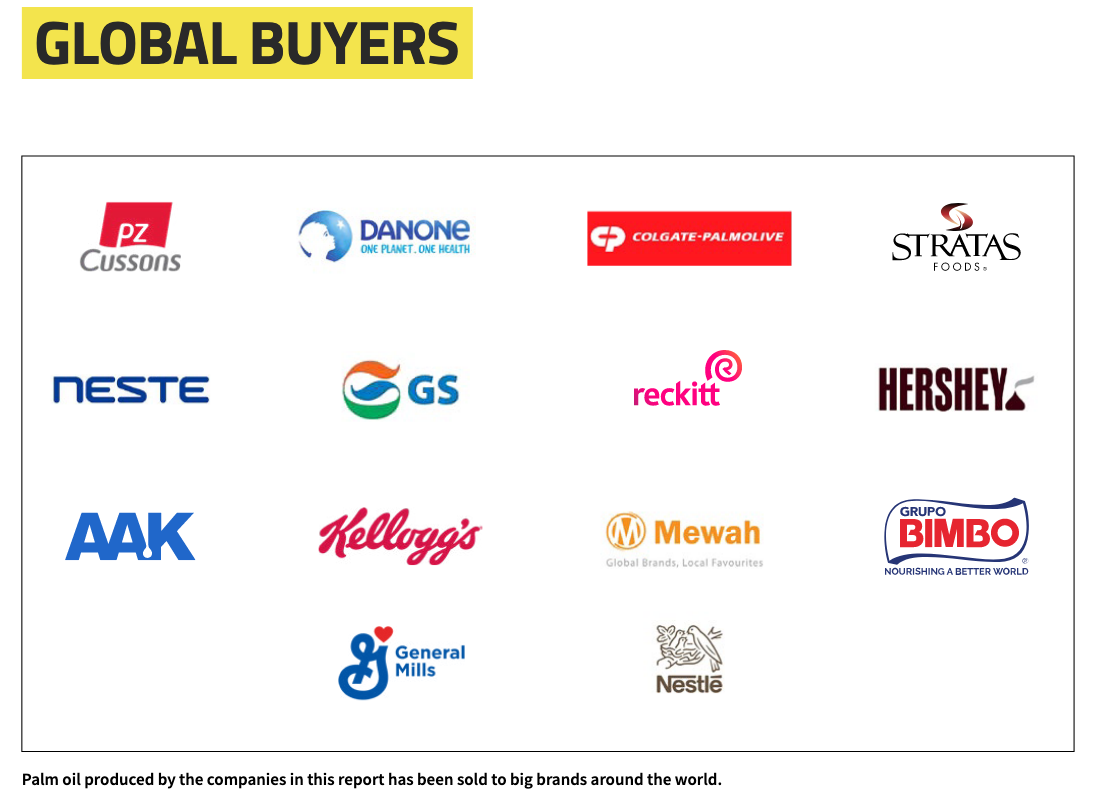
“Tainted palm oil from Papua New Guinea plantations was sold to household name brands, all of them RSPO members including Kellogg’s, Nestlé, Colgate, Danone, Hershey’s and PZ Cussons and Reckitt Benckiser”

The true price of palm oil: How global finance funds deforestation, violence and human rights abuses in Papua New Guinea – Global Witness, 2021

Reality

New technology currently in development will mean that palm oil can be made in a lab requiring no deforestation at all – from algae or from microbes.


Palm oil industry lobbyists refuse to endorse or support this new technology. Instead they provide weak excuses for the continuation of the destruction of rainforests including: a synthetic version is expensive to make, a synthetic version won’t contain the same vitamins as palm oil made from dead rainforests.


Ahmad Parveez said the synthetic palm oil could cause harm to the environment due to the required fermentation processes.

“The question is whether synthetic palm oil is more environmentally friendly and sustainable because the production of synthetic materials requires chemicals and microbes.

“How much energy and chemicals are used in the fermentation process and how can the synthetic product be claimed to be more sustainable than the original product?” he said.

MPOB questions synthetic palm oil production, The Malaysian Reserve, 2020.

10 Tactics of Sustainable Palm Oil Greenwashing - Summary

Explore the series

Join the #Boycott4Wildlife and fight greenwashing and deforestation by using your wallet as a weapon!

Further reading on palm oil ecocide, greenwashing and deceptive marketing

  1. A Brief History of Consumer Culture, Dr. Kerryn Higgs, The MIT Press Reader. https://thereader.mitpress.mit.edu/a-brief-history-of-consumer-culture/
  2. A Deluge of Double-Speak (2017), Jason Bagley. Truth in Advertising. https://truthinadvertising.org/blog/a-deluge-of-doublespeak/
  3. Aggarwal, P. (2011). Greenwashing: The darker side of CSR. Indian Journal of Applied Research, 4(3), 61-66. https://www.worldwidejournals.com/indian-journal-of-applied-research-(IJAR)/article/greenwashing-the-darker-side-of-csr/MzMxMQ==/?is=1
  4. Anti-Corporate Activism and Collusion: The Contentious Politics of Palm Oil Expansion in Indonesia, (2022). Ward Berenschot, et. al., Geoforum, Volume 131, 2022, https://doi.org/10.1016/j.geoforum.2022.03.002
  5. Armour, C. (2021). Green Clean. Company Director Magazine. https://www.aicd.com.au/regulatory-compliance/regulations/investigation/green-clean.html
  6. Balanced Growth (2020), In: Leal Filho W., Azul A.M., Brandli L., özuyar P.G., Wall T. (eds) Responsible Consumption and Production. Encyclopedia of the UN Sustainable Development Goals. Springer, Cham
  7. Berenschot, W., Hospes, O., & Afrizal, A. (2023). Unequal access to justice: An evaluation of RSPO’s capacity to resolve palm oil conflicts in Indonesia. Agriculture and Human Values, 40, 291-304. https://doi.org/10.1007/s10460-022-10360-z
  8. Carlson, K. M., Heilmayr, R., Gibbs, H. K., Noojipady, P., et al. (2018). Effect of oil palm sustainability certification on deforestation and fire in Indonesia. PNAS, 115(1), 121-126. https://doi.org/10.1073/pnas.1704728114
  9. Cazzolla Gatti, R., Liang, J., Velichevskaya, A., & Zhou, M. (2018). Sustainable palm oil may not be so sustainable. Science of The Total Environment, 652, 48-51. https://pubmed.ncbi.nlm.nih.gov/30359800/
  10. Changing Times Media. (2019). Roundtable on Sustainable Palm Oil is ‘greenwashing’ labelled products, environmental investigation agency says. Changing Times Media. https://changingtimes.media/2019/11/03/roundtable-on-sustainable-palm-oil-is-greenwashing-labelled-products-environmental-protection-agency-says/
  11. Client Earth: The Greenwashing Files. https://www.clientearth.org/projects/the-greenwashing-files/
  12. Commodifying sustainability: Development, nature and politics in the palm oil industry (2019). World Development, Volume 121, September 2019, Pages 218-228. https://ideas.repec.org/a/eee/wdevel/v121y2019icp218-228.html
  13. Contrasting communications of sustainability science in the media coverage of palm oil agriculture on tropical peatlands in Indonesia, Malaysia and Singapore (2020). Liu, F. H. M., Ganesan, V., Smith, T. E. L. Environmental Science & Policy, 114. https://www.researchgate.net/publication/343772443_Contrasting_communications_of_sustainability_science_in_the_media_coverage_of_palm_oil_agriculture_on_tropical_peatlands_in_Indonesia_Malaysia_and_Singapore
  14. Cosimo, L. H. E., Masiero, M., Mammadova, A., & Pettenella, D. (2024). Voluntary sustainability standards to cope with the new European Union regulation on deforestation-free products: A gap analysis. Forest Policy and Economics, 164, 103235. https://doi.org/10.1016/j.forpol.2024.103235
  15. Dalton, J. (2018). No such thing as sustainable palm oil – ‘certified’ can destroy even more wildlife, say scientists. The Independent. https://www.independent.co.uk/climate-change/news/palm-oil-sustainable-certified-plantations-orangutans-indonesia-southeast-asia-greenwashing-purdue-a8674681.html
  16. Davis, S. J., Alexander, K., Moreno-Cruz, J., et al. (2023). Food without agriculture. Nature Sustainability. https://www.nature.com/articles/s41893-023-01241-2
  17. EIA International. (2022). Will palm oil watchdog rid itself of deforestation or continue to pretend its products are sustainable? EIA International. https://eia-international.org/news/will-palm-oil-watchdog-rid-itself-of-deforestation-or-continue-to-pretend-its-products-are-sustainable/
  18. Environmental Investigation Agency. (2019). Palm oil watchdog’s sustainability guarantee is still a destructive con. EIA International. https://eia-international.org/news/palm-oil-watchdogs-sustainability-guarantee-is-still-a-destructive-con/
  19. Federal Trade Commission. (n.d.). Green Guides. https://www.ftc.gov/news-events/topics/truth-advertising/green-guides
  20. Fifteen environmental NGOs demand that sustainable palm oil watchdog does its job (2019). Rainforest Action Network. https://www.ran.org/press-releases/fifteen-environmental-ngos-demand-that-sustainable-palm-oil-watchdog-does-its-job/
  1. Friends of the Earth International. (2018). RSPO: 14 years of failure to eliminate violence and destruction from the industrial palm oil sector. Friends of the Earth International. https://www.foei.org/rspo-14-years-of-failure-to-eliminate-violence-and-destruction-from-the-industrial-palm-oil-sector/
  2. Lang, Chris and REDD Monitor. Sustainable palm oil? RSPO’s greenwashing and fraudulent audits exposed. The Ecologist. https://theecologist.org/2015/nov/19/sustainable-palm-oil-rspos-greenwashing-and-fraudulent-audits-exposed
  3. Gatti, L., Pizzetti, M., & Seele, P. (2021). Green lies and their effect on intention to invest. Journal of Business Research, 127, 376-387. https://doi.org/10.1016/j.jbusres.2021.01.028
  4. Global Witness. (2023). Amazon palm: Ecocide and human rights abuses. Global Witness. https://www.globalwitness.org/en/campaigns/environmental-activists/amazon-palm/
  5. Global Witness. (2021). The True Price of Palm Oil. Global Witness. https://www.globalwitness.org/en/campaigns/forests/true-price-palm-oil/
  6. Grain. (2021). Ten reasons why certification should not be promoted in the EU anti-deforestation regulation. Grain. https://grain.org/en/article/6856-ten-reasons-why-certification-should-not-be-promoted-in-the-eu-anti-deforestation-regulation
  7. Green Clean (2021). Armour, C. Company Director Magazine.
  8. Green marketing and the Australian Consumer Law (2011). Australian Competition and Consumer Commission. https://www.accc.gov.au/system/files/Green%20marketing%20and%20the%20ACL.pdf
  9. Greenwash and spin: palm oil lobby targets its critics (2011). Helan, A. Ecologist: Informed by Nature. https://theecologist.org/2011/jul/08/greenwash-and-spin-palm-oil-lobby-targets-its-critics
  10. Greenwashing: definition and examples. Selectra https://climate.selectra.com/en/environment/greenwashing#:~:text=Greenwashing%20is%20the%20practice%20of,its%20activities%20pollute%20the%20environment.
  11. Greenwashing of the Palm Oil Industry (2007). Mongabay. https://news.mongabay.com/2007/11/greenwashing-the-palm-oil-industry/
  12. Group Challenges Rainforest Alliance Earth-Friendly Seal of Approval (2015). Truth in Advertising. https://www.truthinadvertising.org/group-challenges-rainforest-alliance-earth-friendly-seal-of-approval
  13. Helan, A. (2011). Greenwash and spin: palm oil lobby targets its critics. Ecologist: Informed by Nature. https://theecologist.org/2011/feb/15/greenwash-and-spin-palm-oil-lobby-targets-its-critics
  14. Hewlett Packard. (2021). What is Greenwashing and How to Tell Which Companies are Truly Environmentally Responsible. Hewlett Packard. https://www.hp.com/us-en/shop/tech-takes/what-is-greenwashing-environmentally-responsible-companies
  15. Holzner, A., Rameli, N. I. A. M., Ruppert, N., & Widdig, A. (2024). Agricultural habitat use affects infant survivorship in an endangered macaque species. Current Biology. https://pubmed.ncbi.nlm.nih.gov/38194972/
  16. How Cause-washing Deceives Consumers (2021). Truth in Advertising. https://truthinadvertising.org/resource/how-causewashing-deceives-consumers/
  17. International Labour Organization. (2020). Forced labor in the palm oil industry. ILO. https://www.ilo.org/topics/forced-labour-modern-slavery-and-human-trafficking
  18. Jauernig, J., Uhl, M., & Valentinov, V. (2021). The ethics of corporate hypocrisy: An experimental approach. Futures, 129, 102757. https://doi.org/10.1016/j.futures.2021.102757
  19. Kirby, D. (2015). Sustainable Palm Oil? Who Knows, Thanks to Derelict Auditors. Take Part. https://www.yahoo.com/news/sustainable-palm-oil-knows-thanks-derelict-auditors-200643980.html
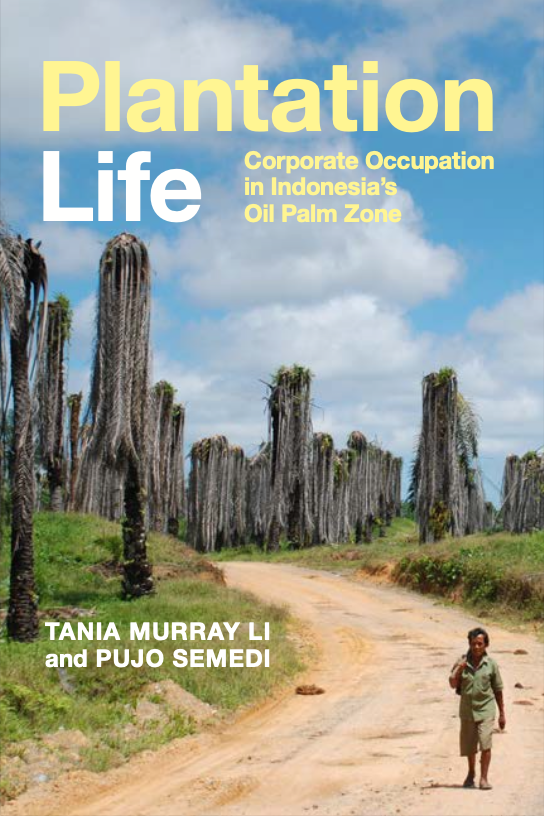
  20. Li, T. M., & Semedi, P. (2021). Plantation life: Corporate occupation in Indonesia’s oil palm zone. Duke University Press. https://www.dukeupress.edu/plantation-life
  21. Liu, F. H. M., Ganesan, V., & Smith, T. E. L. (2020). Contrasting communications of sustainability science in the media coverage of palm oil agriculture on tropical peatlands in Indonesia, Malaysia, and Singapore. Environmental Science & Policy, 114. https://www.researchgate.net/publication/343772443_Contrasting_communications_of_sustainability_science_in_the_media_coverage_of_palm_oil_agriculture_on_tropical_peatlands_in_Indonesia_Malaysia_and_Singapore
  1. Meemken, E. M., Barrett, C. B., Michelson, H. C., et al. (2021). Sustainability standards in global agrifood supply chains. Nature Food. https://doi.org/10.1038/s43016-021-00299-2
  2. Miles, T. (2019). Study in WHO journal likens palm oil lobbying to tobacco and alcohol industries. Reuters. https://www.reuters.com/article/idUSKCN1P21ZR/
  3. Nygaard, A. (2023). Is sustainable certification’s ability to combat greenwashing trustworthy? Frontiers in Sustainability, 4, Article 1188069. https://doi.org/10.3389/frsus.2023.1188069
  4. Oppong-Tawiah D, Webster J. Corporate Sustainability Communication as ‘Fake News’: Firms’ Greenwashing on Twitter. Sustainability. 2023; 15(8):6683. https://www.mdpi.com/2071-1050/15/8/6683
  5. Pabon, J. (2024). The great greenwashing: How brands, governments, and influencers are lying to you. Anansi International. https://www.vitalsource.com/products/the-great-greenwashing-john-pabon-v9781487012878
  6. Podnar, K., & Golob, U. (2024). Brands and activism: Ecosystem and paradoxes. Journal of Brand Management, 31, 95–107. https://link.springer.com/article/10.1057/s41262-024-00355-y
  7. Rainforest Action Network. (2019). Fifteen environmental NGOs demand that sustainable palm oil watchdog does its job. RAN. https://www.ran.org/press-releases/fifteen-environmental-ngos-demand-that-sustainable-palm-oil-watchdog-does-its-job/
  8. Renner, A., Zellweger, C., & Skinner, B. (2021). ‘Is there such a thing as sustainable palm oil? Satellite images show protected rainforest on fire’. Neue Zürcher Zeitung. https://www.nzz.ch/english/palm-oil-boom-threatens-protected-rainforest-in-indonesia-ld.1625490
  9. Saager, E. S., Iwamura, T., Jucker, T., & Murray, K. A. (2023). Deforestation for oil palm increases microclimate suitability for the development of the disease vector Aedes albopictus. Scientific Reports, 13(1), 9514. https://www.nature.com/articles/s41598-023-35452-6
  10. Southey, F. (2021). What do Millennials think of palm oil? Nestlé investigates. Food Navigator. https://www.foodnavigator.com/Article/2021/08/12/What-do-Millennials-think-of-palm-oil-Nestle-investigates
  11. Transparency International. (2023). Transparency international report: Corruption and corporate capture in Indonesia’s top 50 palm oil companies. Transparency International. https://palmoildetectives.com/2023/05/14/transparency-international-report-corruption-and-corporate-capture-in-indonesias-top-50-palm-oil-companies/
  12. Truth in Advertising. (2022). Companies accused of greenwashing. https://truthinadvertising.org/articles/companies-accused-greenwashing/
  13. Truth in Advertising. (n.d.). How causewashing deceives consumers. https://truthinadvertising.org/resource/how-causewashing-deceives-consumers/
  14. Tybout, A. M., & Calkins, T. (Eds.). (2019). Kellogg on Branding in a Hyper-Connected World. Kellogg School of Management, Northwestern University. https://www.wiley.com/en-au/Kellogg+on+Branding+in+a+Hyper-Connected+World-p-9781119533184
  15. Wicke, J. (2019). Sustainable palm oil or certified dispossession? NGOs within scalar struggles over the RSPO private governance standard. Bioeconomy & Inequalities: Working Paper No. 8. https://www.bioinequalities.uni-jena.de/sozbemedia/WorkingPaper8.pdf
  16. World Health Organisation. (2019). The palm oil industry and noncommunicable diseases. World Health Organisation Bulletin, 97, 118-128. https://pubmed.ncbi.nlm.nih.gov/30728618/
  17. World Rainforest Movement. (2021, November 22). Why the RSPO facilitates land grabs for palm oil. https://wrm.org.uy/articles-from-the-wrm-bulletin/section1/why-the-rspo-facilitates-land-grabs-for-palm-oil/
  18. Zuckerman, J. (2021). The Time Has Come to Rein In the Global Scourge of Palm Oil. Yale Environment 360, Yale School of Environment. https://e360.yale.edu/features/the-time-has-come-to-rein-in-the-global-scourge-of-palm-oil

Contribute to my Ko-Fi

Did you enjoy visiting this website?

Contribute to my kofi

Palm Oil Detectives is 100% self-funded

Palm Oil Detectives is completely self-funded by its creator. All hosting and website fees and investigations into brands are self-funded by the creator of this online movement. If you like what I am doing, you and would like me to help meet costs, please send Palm Oil Detectives a thanks on Ko-Fi.

Laughs, Cries and Deception: The Complex Lives of Birds

#Birds can certainly get very angry – and the owner of a galah or corella would be well advised not to get near this bird when the head feathers are raised — but birds can be joyful and playful, can get depressed and, as studies have shown, a neglectful or bare environment can even make them pessimistic.

Birds may feel for others (have empathy) and even console them, may have a sense of justice, may show deep affection for their partner and grieve for their loss. I witnessed the mate of a fatally injured tawny frogmouth not moving from the spot next to their dead partner for three days, and then dying on the fourth. 🌴🩸🧐 Be #vegan for them! ❌ #BoycottPalmOil #Boycott4Wildlife

July on the Northern Tableland, near Armidale in New South Wales, is usually the beginning of the breeding season and field observations start early.

I sat and watched in freezing temperatures. The sun was just rising above the horizon of this 1000m-high plateau when through binoculars I saw a young lone magpie, walking gingerly, literally tip-toeing, occasionally interrupted by little bouts of running and, unusually, heading straight for its territorial boundary.

In the last stretch to the border, the bird edged along a row of pine trees, staying low, and kept looking over its shoulder, especially when crossing the neighbour’s border. Shortly afterwards, a female was seen in his company.

Later, the male backtracked and, when far enough into his own territory, started foraging rather aimlessly as if nothing had happened.

What had I witnessed? Did this young male magpie understand that he was breaking several important magpie social rules and could face punishment for this transgression if caught? Did he have a sense of morality?

Science has traditionally shunned the idea of emotions in animals, not just for fear of anthropomorphism or over-interpretation, but also because there is a very long cultural history that played out a divide between mind and body and reason and emotions.

Reason, thinking and making judgements were stubbornly thought to be outside the capacity of animals. For a long time it was not believed that animals were even capable of feeling pain, let alone complex emotions. We now know that is far from the truth.

Birds with feelings

Pet owners have always known that their pets can be affectionate, sulky, jealous, sad, excited and deliberately naughty, as well as doing extraordinary things for their owners. The animals we know best in this regard are obviously dogs and cats.

Charles Darwin was the first to discuss emotions in animals in the mid-19th century. A century later, Niko Tinbergen addressed the vexing question of emotions.

Following on from Darwin, he identified “four Fs” as part of survival: fight, flee, fornicate and feed. These translate into basic feelings of fear, hunger and sexual drive – now called motivational states.

Tawny frogmouths are monogamous. cskk/Flickr, CC BY-NC-ND

But there is a lot more to bird emotions. Dangerous and horrible experiences are usually remembered. Memory helps survival. Modern urban birds have been shown to remember faces of people considered dangerous and threatening.

We now know that the bird brain is lateralised (each side of the brain controls a different set of functions) as in humans and other vertebrates. The right hemisphere expresses intense emotions (such as fear and attack). The left hemisphere has routine, considered responses and may inhibit some of the strong responses of the right hemisphere.

So birds are more similar to humans than had ever been thought, but with an important difference: birds are generally not aggressive without cause. Technically, aggression is an emotion that is dysfunctional, has no purpose and often even harms the individual displaying it.

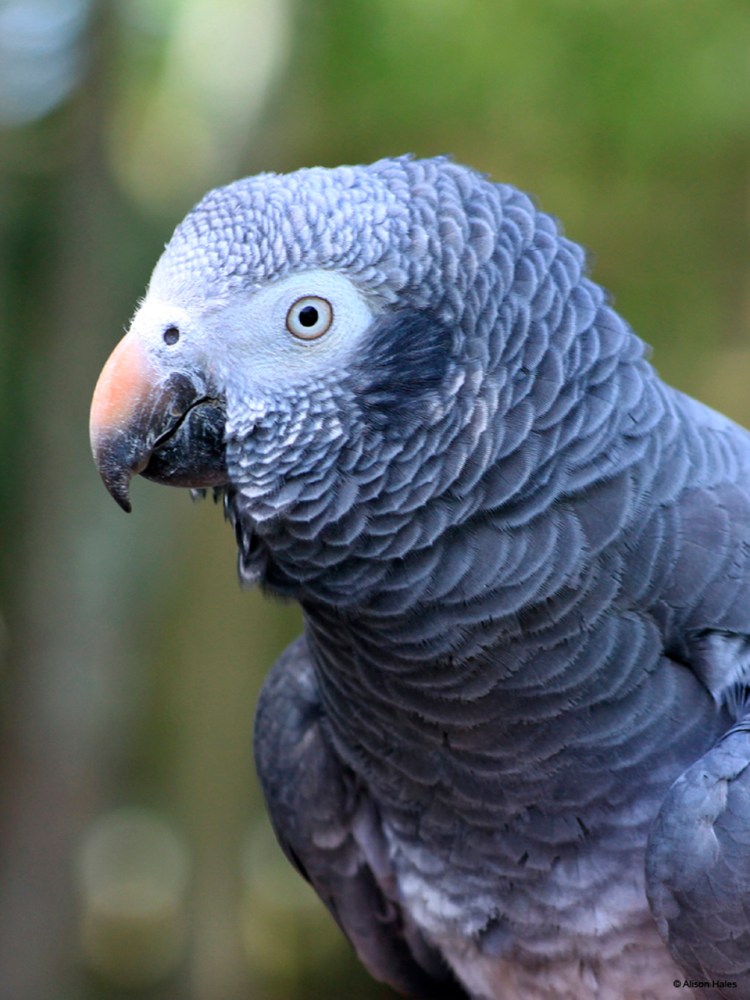
Timneh Parrot Psittacus timneh

Birds can certainly get very angry – and the owner of a galah or corella would be well advised not to get near this bird when the head feathers are raised — but birds can be joyful and playful, can get depressed and, as studies have shown, a neglectful or bare environment can even make them pessimistic.

Birds may feel for others (have empathy) and even console them, may have a sense of justice, may show deep affection for their partner and grieve for their loss. I witnessed the mate of a fatally injured tawny frogmouth not moving from the spot next to its dead partner for three days, and then dying on the fourth.

Social smarts

Australian native birds have an unusually high percentage of pair-bonding (over 90% of species) and the highest concentrations of cooperative species (relatives or siblings helping at the nest) anywhere in the world. Cockatoos bonding for life often have intense close partnerships, which are nurtured by constant grooming and attention to each other’s needs.

Such intense cohabitation of individuals, often for many years (how about 60 years of “marriage” in sulphur-crested cockatoos?), may also create frictions and dissatisfactions that require solutions to keep the pair or group together.

For instance, the lazy helper at the nest who only pretends to help in feeding, as happens among white-winged choughs, may get scolded by an adult. A group of apostlebirds building a mud nest together, transporting mud to the nest in relays, may spot an individual that is not pulling its weight.

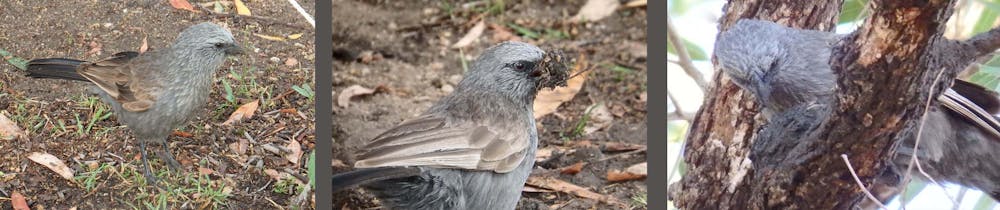
Apostlebirds breed in families, and all are expected to pull their weight. Gisela Kaplan, Author provided

I have witnessed on several occasions near Copeton Dam (in Inverell, NSW) apostlebirds become so outraged that they approach the individual with heightened calling and may even peck it until the intimidated individual falls back into line and does its share.

Empathy, altruism and consoling the injured or vanquished have all been observed in birds, thought to be the ultimate in consideration for another individual’s state of mind.

For instance, there are observations of dusky wood-swallows (belonging to the same family of birds as butcherbirds and magpies) in Western Australia’s Wheatbelt hassling a restless flycatcher with a larva in his beak, perched on a branch. One wood-swallow flew above the flycatcher, while the other simultaneously flew directly at it, snatched the larva from its beak while it was distracted by the other bird hovering overhead, and took it away. So who got the prize?

If all behaviour in animals is selfish, then the one who caught it should have gulped it down, but it did not. It gave it to the bird that had distracted the flycatcher. Perhaps the two birds reversed roles in the next, similar, situation. But it still meant overcoming the temptation to eat.

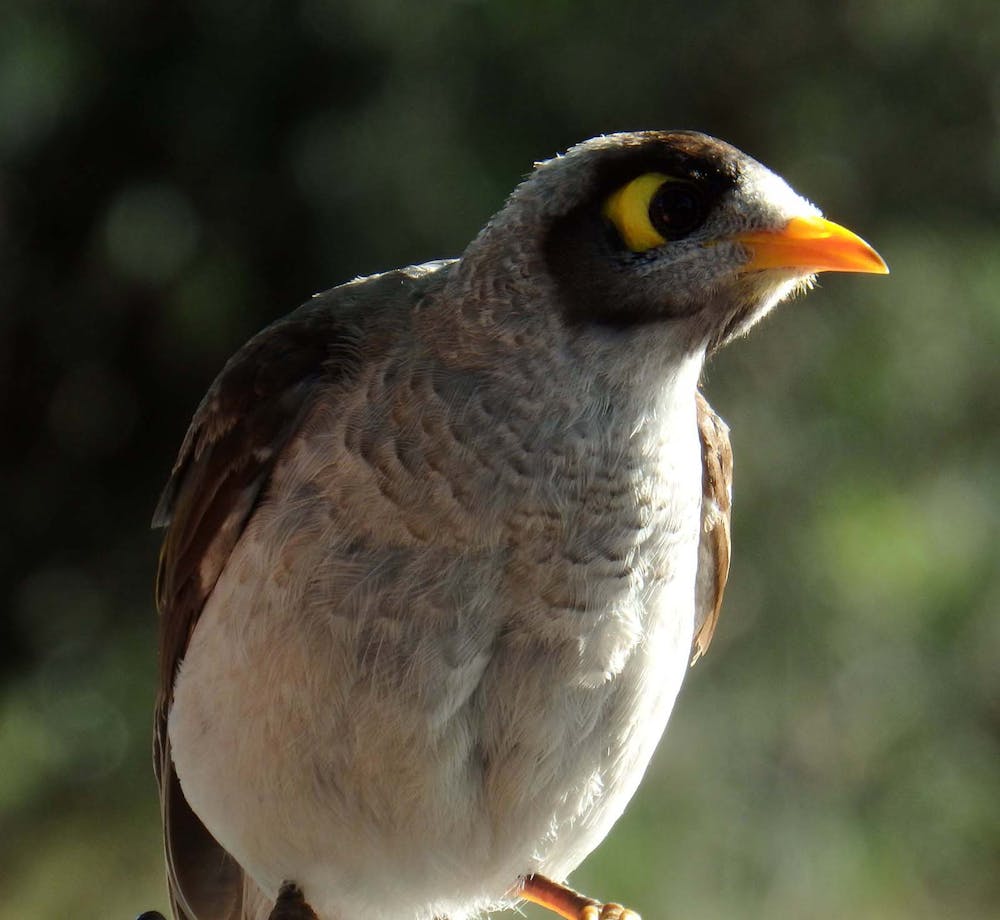
The noisy miner who defended a puppy. Gisela Kaplan, Author provided

A noisy miner, one of the cooperative honeyeaters, I had hand-raised grew up over several weeks in the company of very young ridgeback pups near the edge of a nature reserve in a NSW coastal area.

One pup was sleeping on the porch in the sun and I was some distance away. I was alerted by the alarm calls of the noisy miner and turned around to see it swooping right down to a lace monitor’s head – doing so over and over again. I ran as quickly as I could, by now also shouting once the risk to the pup was more than apparent.

When the monitor spotted me, it turned and fled. The noisy minor had risked its life to save the pup. At no other occasion did the bird attempt to swoop a lace monitor. Its response was very specific to this situation.

And, as I have been asked often, could birds have a sense of humour? Perhaps.

Our gallah, Philip, deeply affectionate (and jealous!) had learned the names of all our dogs and was such a good mimic of our voices that he could easily and effectively call the dogs to attention.

Imagine the picture: a bird less than a foot tall, standing on the floor and calling four massive Rhodesian ridgebacks to attention. Then, when he got them all in line in front of him, he walked away, swaying his head and even making little chuckling sounds.

The degree to which emotions and complex feelings for others were developed may well depend on social organisation. It may be that birds with long-term social bonds show more complex behaviour and brains than those whose associations are only fleeting.

What they get out of it is perhaps not debatable — more joy, more grief, but also a greater degree of safety and usually a longer life. There are clear benefits of sticking together in a difficult and fickle continent.


Gisela Kaplan, Professor of Animal Behaviour, University of New England This article is republished from The Conversation under a Creative Commons license. Read the original article.

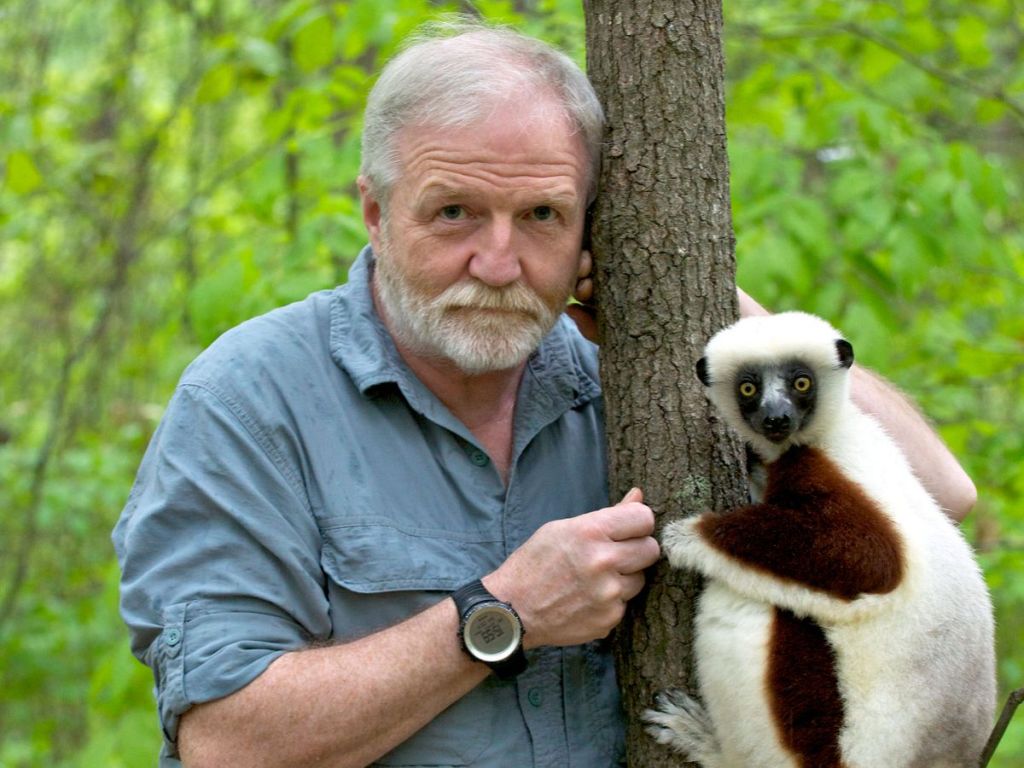
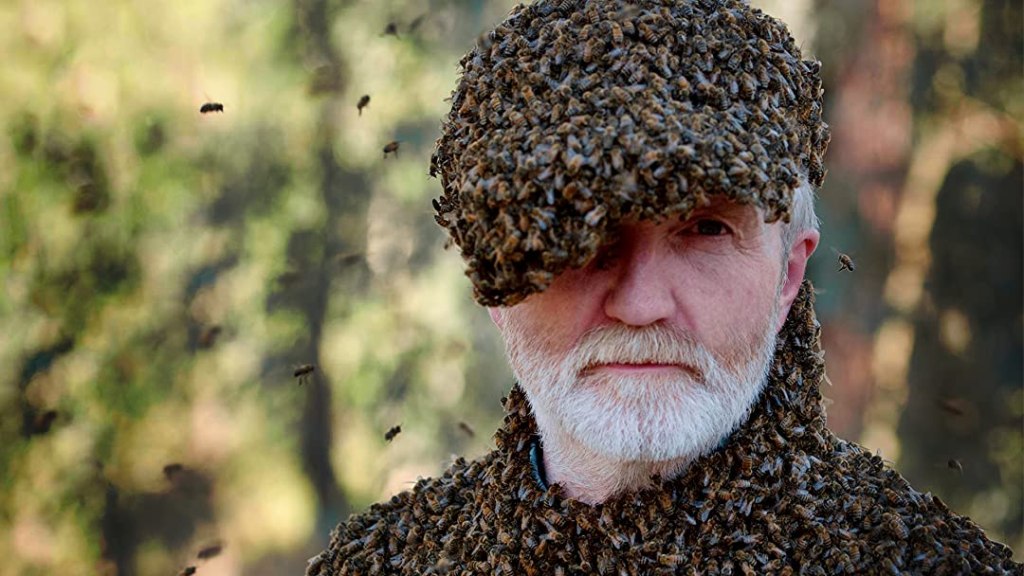
Zoologist and TV Presenter Dr George McGavin

Dr George McGavin: In His Own Words

Entomologist, Author, Academic, BBC TV Presenter, Conservationist


Bio: Dr George McGavin


Dr George McGavin FLS FRGS Hon. FSB Hon. FRES studied Zoology at Edinburgh University, followed by a PhD in entomology at Imperial College and the Natural History Museum in London. After 25 years as an academic at Oxford University he became an award-winning television presenter. George is an Honorary Research Associate of the Oxford University Museum of Natural History and an Honorary Principal Research Fellow at Imperial College. George is also a Fellow of the Linnean Society and the Royal Geographical Society, an Honorary Fellow of the Royal Society of Biology and an Honorary Life Fellow of the Royal Entomological Society. As well as his many TV documentaries, George has written numerous books on insects and other animals. In 2019 he became the President of the Dorset Wildlife Trust.

In his downtime, he enjoys walking in the windswept coasts of Dorset. He dearly hopes that the insects named after him will survive him.

Palm Oil Detectives is honoured to interview to Dr George McGavin about his fascinating work, environmental activism, the devastation of deforestation and why we should all boycott palm oil.

Awards: 

Afterlife: The Strange Science of Decay

  • (BBC): Grierson Awards: Winner Best Science Documentary 2012 
  • BAFTA: Winner Best Single Documentary 2012
  • Broadcast Digital Awards:  Winner Best Popular Factual Programme 2012
  • Banff World Media Festival: Rockie Award 2012.
  • British Association of British Science Writers: Best Scripted /edited television programme 2012

The Secret Life of Your House

  • Jackson Hole Wild: Winner Special Jury Award 2015

Oak Tree: Nature’s Greatest Survivor

  • Royal Television Society: Winner Best Science and Natural History Documentary 2016
  • Grierson Awards: Winner Best Science Documentary 2016

The Secret life of Landfill

  • Royal Television Society (Scotland Awards): Winner Best Science and Natural History Documentary 2019

“Ask yourself what’s more important, cheap biscuits and face cream? Or the survival of the most diverse, complex habitat on earth? I support the #Boycottpalmoil #Boycott4Wildlife movement” Broadcaster/ Entomologist @georgemcgavin.bsky.social https://palmoildetectives.com/2021/10/18/entomologist-academic-tv-presenter-dr-george-mcgavin-in-his-own-words/

TV and Radio 

BBC:

Life in the Undergrowth: Chief scientific consultant.

Expedition Borneo: Co-presenter.

Lost Land of the Jaguar: Co-presenter.

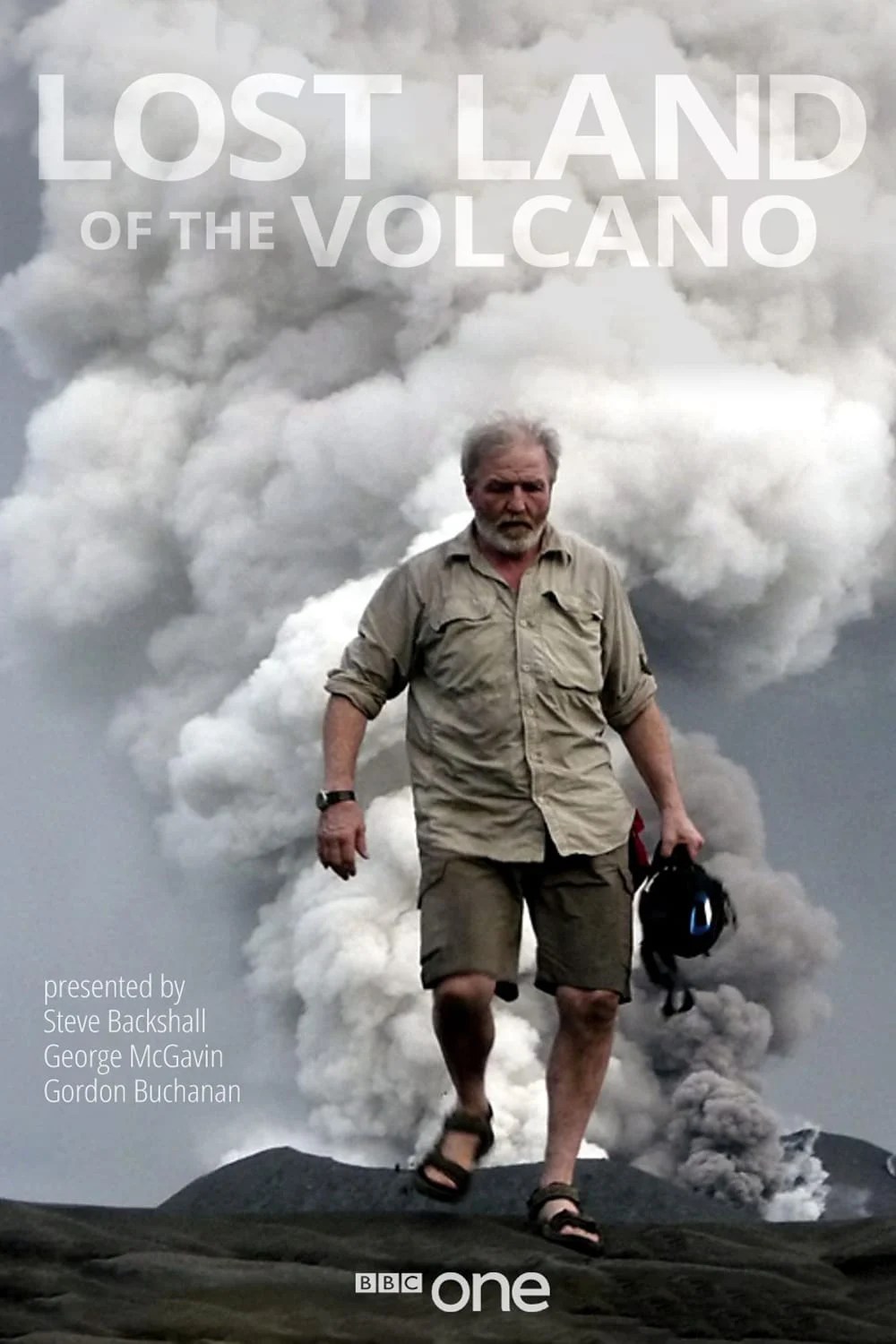
Lost Land of the Volcano: Co-presenter.

The Lost Land of the Tiger: Co-presenter

The Dark: nature’s night-time world: Co-presenter.

The One Show. Regular reporter /contributor (circa 100 short films)

Afterlife: the strange science of decay: Presenter.

Dissected: The incredible human hand and foot: Presenter.

Prehistoric Autopsy: Co-presenter.

Ultimate Swarms: Presenter.

Miniature Britain: Presenter.

Planet Ant: Presenter.

Monkey Planet: Presenter.

The Oak: Nature’s greatest survivor: Presenter.

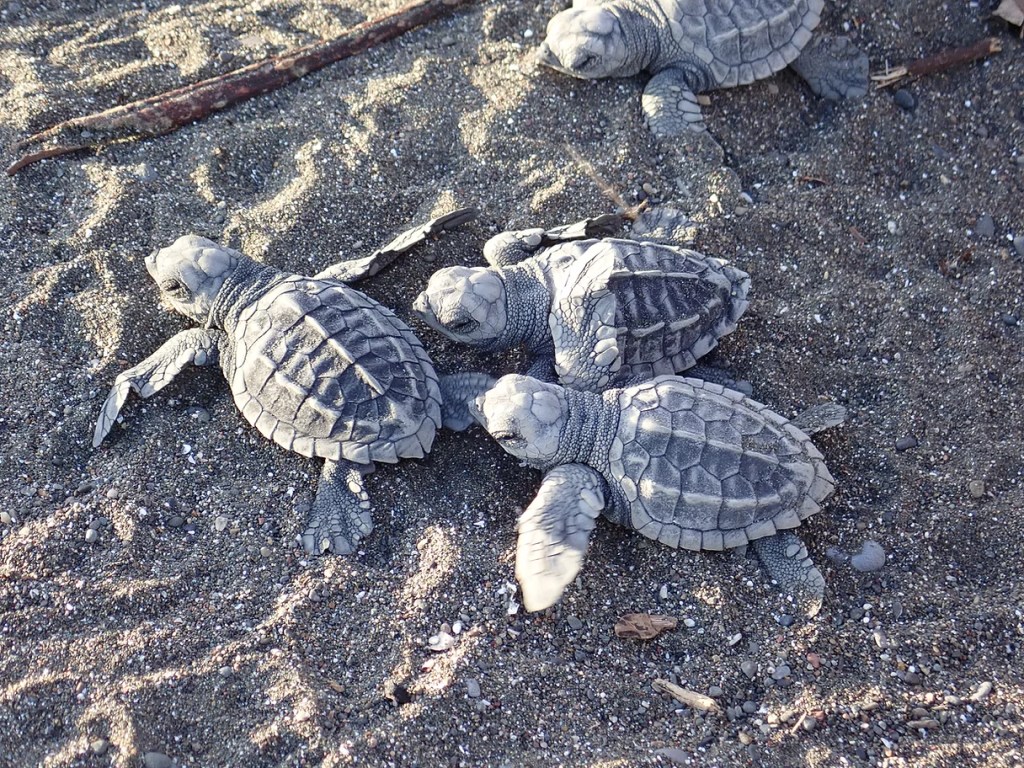
Nature’s Turtle Nursery: secrets from the nest: Presenter

The Secret Life of Landfill: a rubbish history: Co-presenter

A Year to save my Life: George McGavin and melanoma. Presenter

Ocean Autopsy: The secret story of or seas. Co-presenter

The Secret Science of Sewage: Co-presenter 

BBC Radio 

The Bee All and End All: Presenter (BBC World Service) 

The Etymology of Entomology: Presenter (Radio 4).

Desert Island Discs: Guest (Radio 4) 

For ITV

Infested: Consultant.

The Secret Life of your House: Presenter.

‘I don’t believe #palmoil can ever be #sustainable. There is an enormous amount of #greenwashing around this issue. I support the #Boycottpalmoil #Boycott4Wildlife movement’ @BBC presenter/entomologist @Georgecmcgavin

“I want everyone to stop buying products containing #palmoil. The whole industry, and many others like it, driven solely by desire to make money #Boycottpalmoil and #Boycott4Wildlife” @BBC presenter/Entomologist Dr George McGavin @Georgecmcgavin

“The bleating about sustainable growth is an absurdity. It’s not possible. We have a fixed pot of resources. Any degree of growth is ultimately unsustainable” @BBC presenter/entomologist @Georgecmcgavin #degrowth #Boycott4Wildlife

“#capitalism has a lot to answer for. We ship #soy #palmoil around the 🌍 to feed cattle. #Insecticides are marketed as #bee friendly! #greenwashing of #agriculture is madness #Boycottpalmoil #Boycott4Wildlife @georgecmcgavin @BBC presenter #entomologist

“Ask yourself what’s more important, cheap biscuits and face cream? Or the survival of the most diverse and complex habitat on earth? I support the #Boycottpalmoil #Boycott4Wildlife movement” @BBC presenter/entomologist @Georgecmcgavin

“If we keep treating the world like a factory – churning out cheap food we will destroy natural habitats, wild places, destroy magnificent #animals. We will head for the ultimate disaster” @georgecmcgavin @BBC Presenter #Boycottpalmoil #Boycott4Wildlife

“Local people are often victims, as they defend their territory so as not to be displaced by #palmoil. This is #Illegal #Indigenous #landgrabbing for so-called ‘sustainable’ #palmoil” @BBC presenter/entomologist @georgecmcgavin

My favourite documentary to present was The Lost Land of the Volcano series

It was the most remote and the most challenging shoot I’ve ever faced. Myself and the team filmed around Mount Bosavi in Papua New Guinea, a volcano that last erupted when early humans were leaving Africa to colonise the rest of the planet.

We recorded rare biodiversity and also uncovered new species. At the time of filming, logging was taking place 30 km away from the volcano. One of the expedition’s aims was to find evidence to support the case to protect the area.

Dr George McGavin

Dr George McGavin - private collection - abseiling

If you had of told me as a 14 year old boy that I would be doing what I’m doing now, I would never have believed you

I had a very bad stammer as a kid. It’s not something that can just be cured. You just get better at dealing with it. I still had difficulties with fluency into my 40’s. However, age, knowledge and confidence are wonderful things.

Photo credit: Mark McEwen

Teaching is in my blood

It’s about sharing the beauty and importance of the natural world with an audience.

My need to do this was strong enough to overcome the considerable difficulties I faced as a young person having a stammer.

TV presenting and teaching are very similar

It’s all about captivating the audience and getting information across to them in a compelling way. The only difference is simply that TV audiences are far bigger. I want all people to care about the natural world. After 25 years of ‘preaching to the converted’ at the university, I jumped at the chance to try and reach an audience perhaps less interested in animals and natural history.

Insects are vital to the survival of all other species of Earth, ourselves included.

Insects are the powerhouse and engine room behind the entire planet

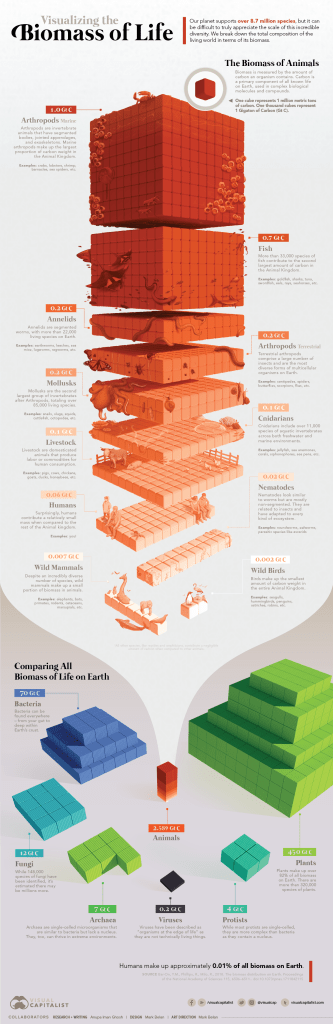
Insects are far more diverse and interesting than any vertebrate. Vertebrate animals make up less than 3% of all known species. The vast majority of species on Earth are invertebrates, largely unseen by humans and mistakenly considered to be less important. Most of these are arthropods: the insects, spiders and crustaceans. They are the major pollinators, predators, herbivores and recyclers, the food source for most species

Visualising the biomass of life by Mark Belan, Visual Capitalist. https://www.visualcapitalist.com/all-the-biomass-of-earth-in-one-graphic/

I am always rather puzzled as to why big animals seem to hog the limelight in the press and in the popular imagination.

I returned from a forest expedition in and around Mount Bosavi, an extinct volcano in the Southern Highland Province of Papua New Guinea. It is hard to estimate how many of the insects and spiders we collected will be new species!

Our group discovered at least 16 new species of frogs; 2 new species of lizards; 3 new species of fish; and one undescribed, endemic woolly giant rat.

Needless to say, it was the rat that caused quite a stir; on my return, the media were lining up to ask about it.


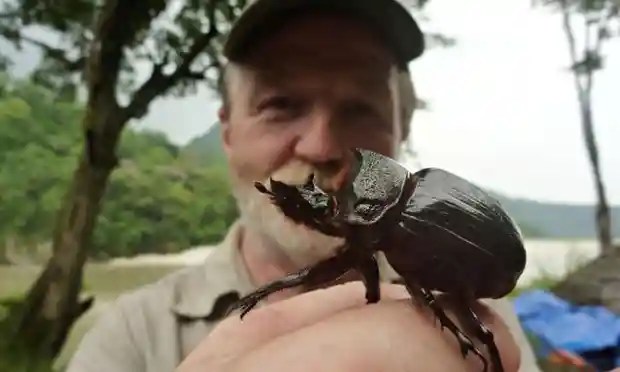
No interest in the wondrous jumping spiders, the weird beetles, or the funky flies we had gathered. All right, if pushed, I have to agree that the woolly giant rat was a pretty impressive beast and quite tame, having never seen human beings before, but what really excited me were the smaller creatures we encountered.

[Short Excerpt from Bug World: Myths and Marvels]

[Illustration: Visualising the Biomass of Life by Mark Belan, Visual Capitalist]

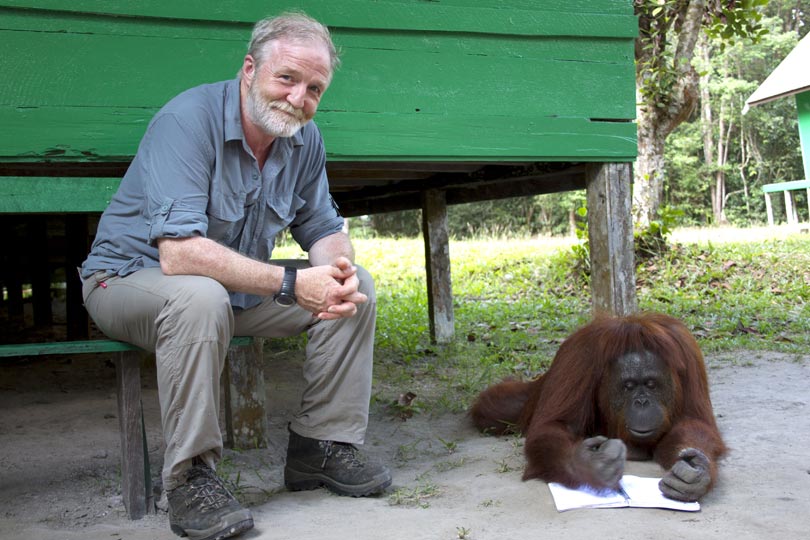
While filming the BBC series Monkey Planet in 2008, I fell in love with an orphaned orangutan named Dora

Photo credit: Claire Thompson

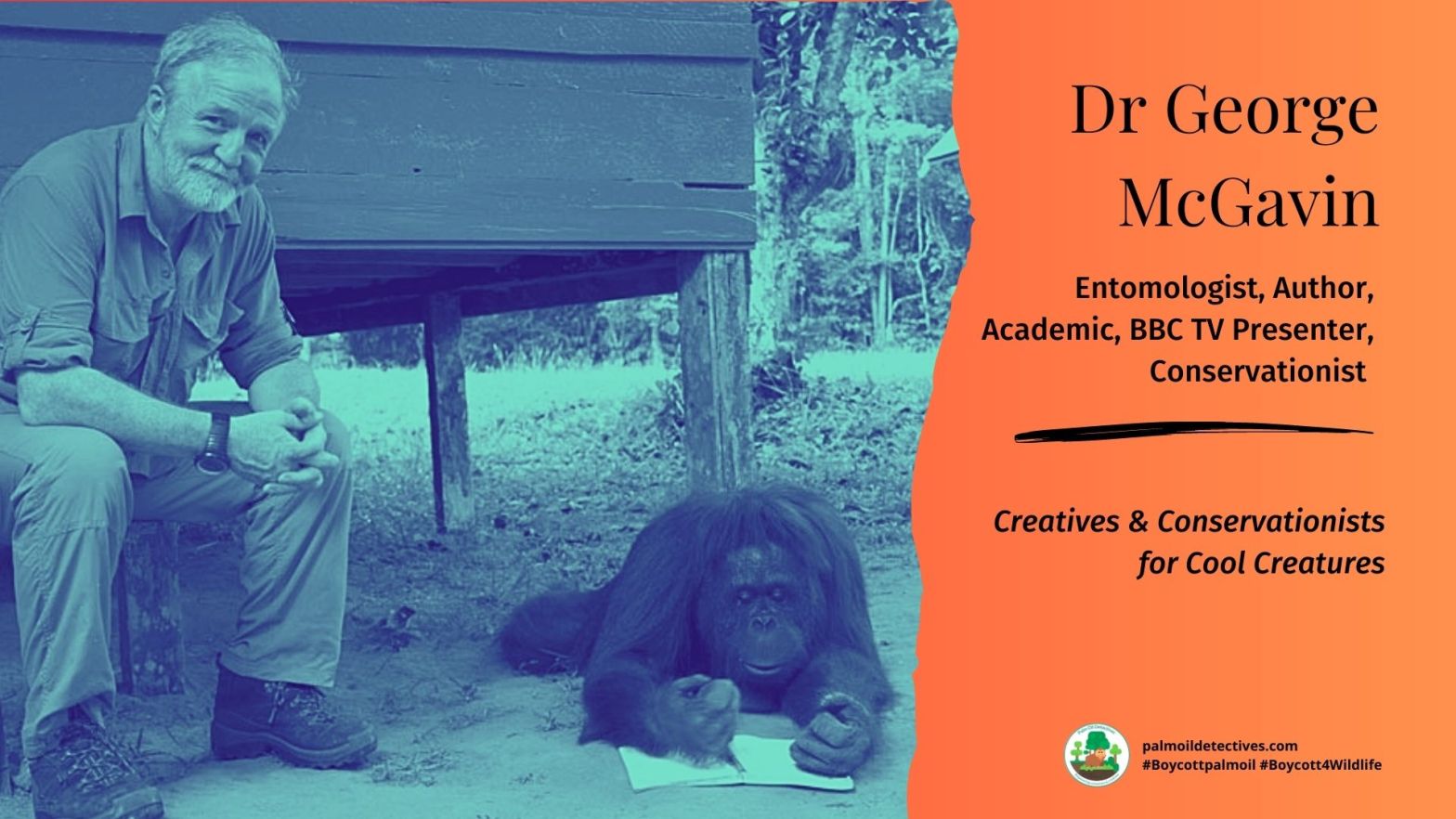
Dr George McGavin with Dora

Her mother had been killed and Dora had been a pet. She spent several years in a cage before she was rescued. When I met her, she was in the process of being rehabilitated.

In the wild, she would have learned how to live in the rainforest from her mother over many years. However, in the sanctuary she was taught by humans what to eat and how to survive in a few short years. After the experience of meeting Dora, she was destined to be relocated and released into an area of safe habitat.

Photo credit: Claire Thompson

I asked what Dora’s chances of survival might be. I was shocked to learn that it was a well under 50%. I hope she made it.

I’ve seen some fabulous species in the wild. Tigers, jaguars, sloths, anacondas. However, I don’t need to see them anymore. I just need to know that they’re all safe and that they will survive into the future.

~ Dr George McGavin

75% of terrestrial species (mostly insects) live in rainforests

What was 12-14% of tropical rainforests has been destroyed and now covers less than 6% of the Earth’s land surface. This deforestation is catastrophic and must be ended

At the rate they are being destroyed, most of the world’s rainforests will be lost or seriously degraded by the end of this century. We are on course to lose more than half of all extant species. It’s basic arithmetic.

I want everyone to stop buying products containing palm oil

The whole industry (and many others like it) is driven solely by the desire to make money

“I want everyone to stop buying products containing #palmoil. The whole industry, and many others like it, is driven solely by the desire to make money. #Boycottpalmoil and #Boycott4Wildlife” @BBC presenter/Entomologist Dr George McGavin @Georgecmcgavin

"Ask yourself what is more important...cheap biscuits and yet another type of face cream? "Or the survival of the most diverse and complex habitat on Earth?" Dr George McGavin

Ask yourself what is more important…cheap biscuits and yet another type of face cream? Or the survival of the most diverse and complex habitat on Earth?

Illustration: Jo Fredriks

I don’t believe palm oil can ever be sustainable. There is an enormous amount of greenwashing around this issue.

~ Dr George McGavin

EIA sustainable palm oil is a con

‘I don’t believe palm oil can ever be sustainable. There is an enormous amount of greenwashing around this issue. I support the #Boycottpalmoil #Boycott4Wildlife movement’ @Georgecmcgavin

‘Ask yourself what’s more important, cheap biscuits and facecream or the survival of the most diverse and complex habitat on earth? I support the #Boycottpalmoil #Boycott4Wildlife movement’ @Georgecmcgavin

Saving tropical forest is the one thing we should be doing do right now. Countries with tropical forest should be paid by the rest of the world for keeping it intact.

Dr George McGavin
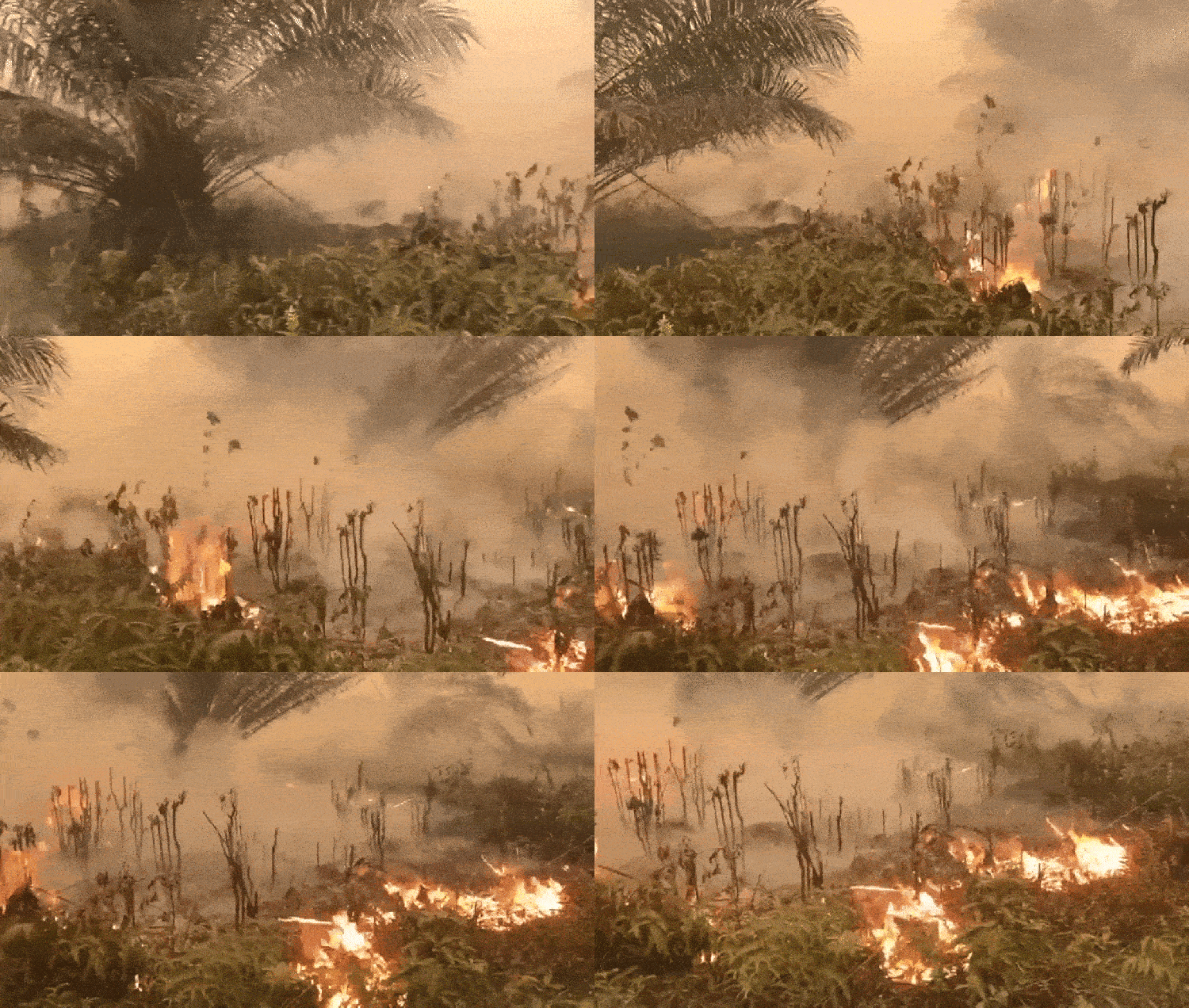
Craig Jones Wildlife Photography - Sumatran virgin rainforestsPalm oil plantation smoke GIF
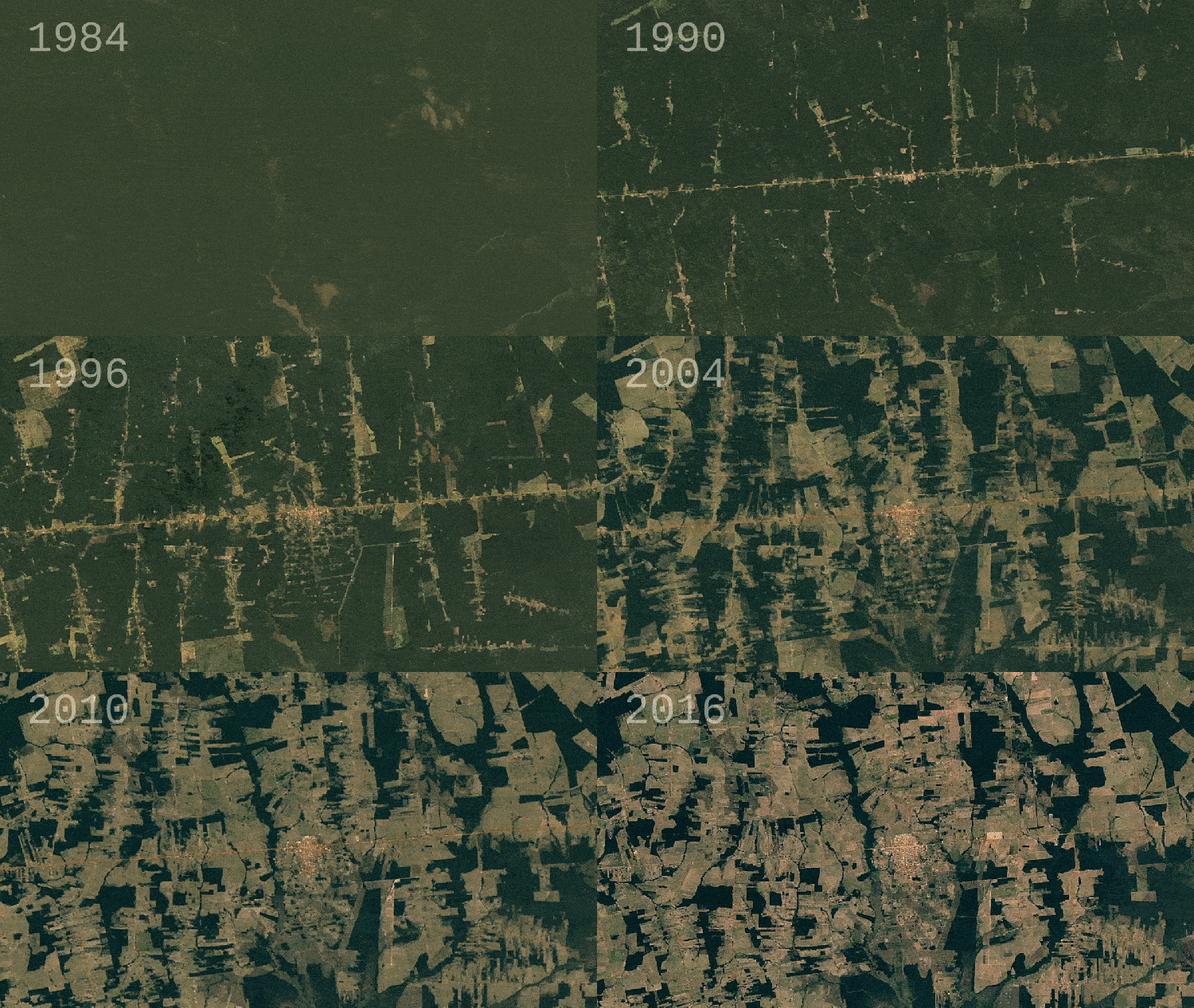
Before: A virgin tropical rainforest. After: a lifeless monoculture of palm oil as far as the eye can see.

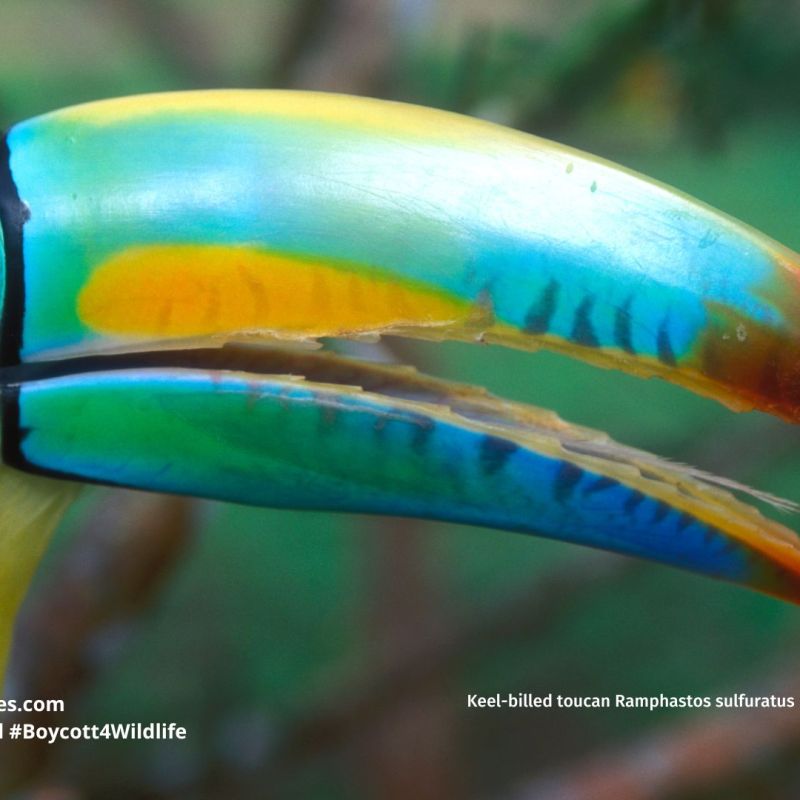
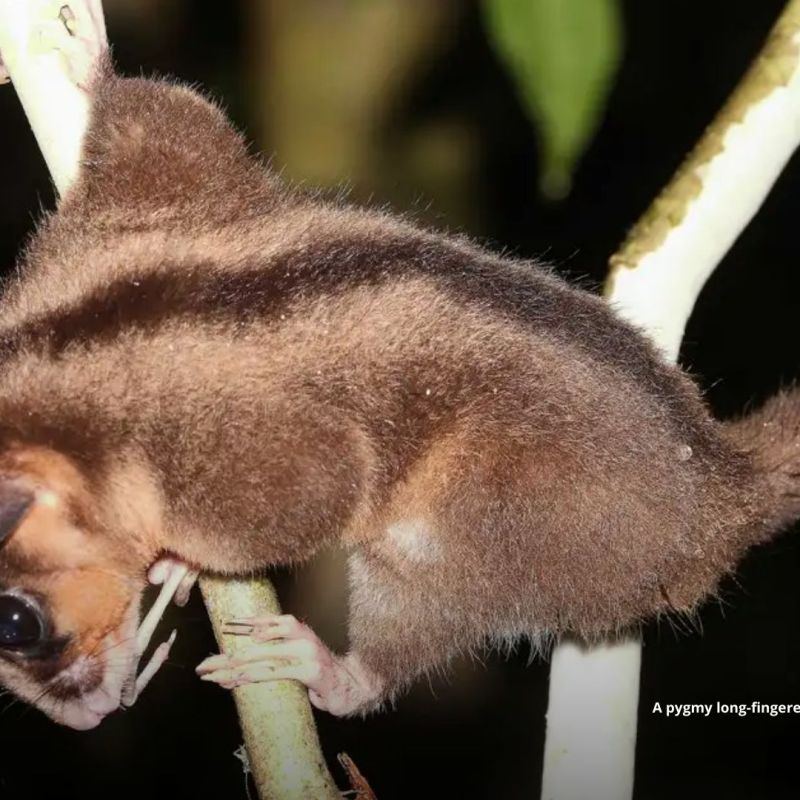
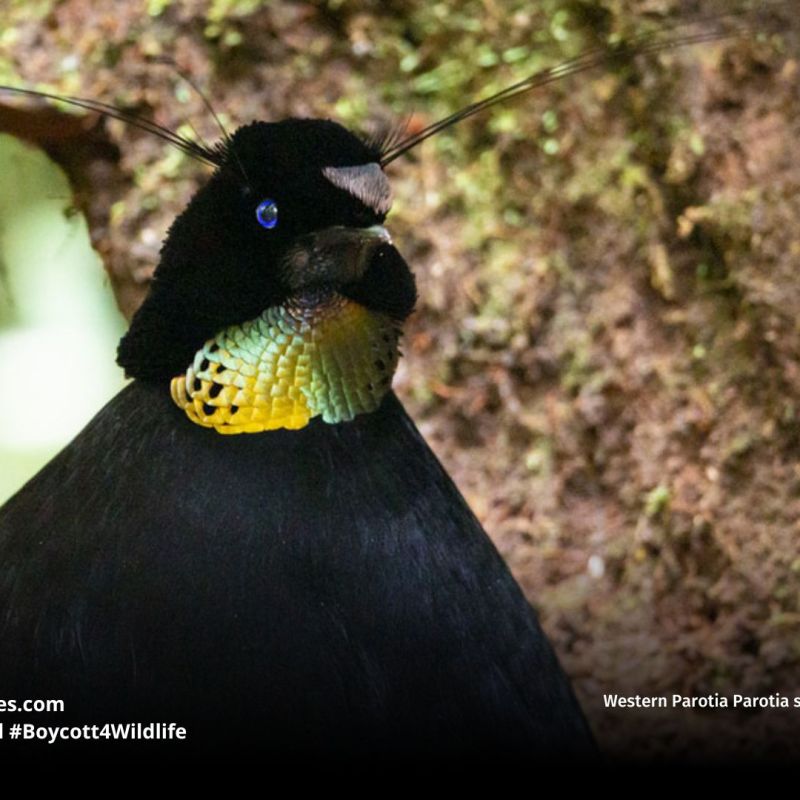
Here are a few of the 1000’s of animals disappearing forever due to out-of-control agriculture: palm oil, soy, timber, meat, cocoa, coffee…

I support the #Boycott4Wildlife

Photo credit: Johnny Rogers, BBC

Proper legislation would avoid the issue of consumers being fooled. I do not knowingly buy things with palm oil; however, manufacturers can use 200 or so names for palm oil to confuse consumers. This needs to change.

Local people are often victims, as they defend their territory so as not to be displaced by oil palm

Dr George McGavin

“Local people are often the victims, as they defend their territory so as not to be displaced by #palmoil. It’s #Illegal #Indigenous #landgrabbing for so-called ‘sustainable’ #palmoil #Boycottpalmoil #Boycott4Wildlif” @georgecmcgavin

Sustainable or ‘green growth’ is an absurdity

~ Dr George McGavin

The constant bleating about sustainable growth is an absurdity. It is not possible. It never was. We have a fixed pot of resources, a finite amount of stuff, any degree of growth is ultimately unsustainable.

Dr George McGavin

“The constant bleating about sustainable growth is an absurdity. It’s not possible. It never was. We have a fixed pot of resources. Any degree of growth is ultimately unsustainable” @Georgecmcgavin #degrowth #Boycott4Wildlife

Photo: Shutterstock

There are insane practices going on in agriculture that are destroying the earth

~ Dr George McGavin

I think out-of-control capitalism has a lot to answer for

Practices such as growing soy bean or palm kernel to ship half way around the world to feed cattle somewhere else. Or a 6,000 mile round journey in order to process and then sell fruit back to the region where it was grown. Or insecticides that are marketed as being “bee-friendly.” The greenwashing around these practices is just madness.

“Out of control #capitalism has a lot to answer for. We ship #soy and #palmoil to the other side of the world to feed cattle. #Insecticides are marketed as #bee friendly! The #greenwashing of #agriculture is madness. I support the #Boycottpalmoil #Boycott4Wildlife movement” @georgecmcgavin @BBC presenter #entomologist

All global brands seem to be doing is churning out endless stuff that consumers don’t really need

We have overcome all manner of diseases. We have glimpsed into the far reaches of the universe. We have delved deeply into the sub-atomic structures of matter.

We can rearrange the code of life, even make new forms of life. We have avoided wars recently. Yet what we now face is very different.

As long as we continue to treat the world like a factory – churning out cheaper and cheaper food – we will destroy natural habitats, destroy wild places and destroy magnificent animals. We will head for the ultimate disaster.

Dr George McGavin

“As long as we continue to treat the world like a factory – churning out cheap food – we will destroy natural habitats, wild places and destroy magnificent #animals. We will head for the ultimate disaster” @georgecmcgavin @BBC #Boycottpalmoil #Boycott4Wildlife

Measuring success according to GDP and economic growth is no longer a sensible plan at all

We are very smart animals, but we cannot see that there are limits to growth.

Politicians focus on short term solutions rather than long-term repercussions of what they are doing now

These law-makers and politicians know it all already. They just can’t bring themselves to do anything about it. They should be being proactive, but instead they are being reactive.

The bottom line is, the people in charge and also the majority of people out there, do not value the natural world enough – we love to take from it, but we do not give anything back. This has been the case for the past century since the industrial revolution and now we are going to reap the absolutely devastating storm.

Illustration: Sean Weston.

I can see why this happens. There is misinformation and doubt that is stoked in the traditional media and social media

The greenwashing fills people with doubt and causes indifference.

"However, there is an express train coming towards us. We can all see it, but we will doing nothing about it until it’s too late" ~ Dr George McGavin

Perhaps the science is wrong?

“Perhaps the climate and environmental disaster won’t really happen?

Perhaps something unexpected will save us?

“However, there is an express train coming towards us. We can all see it, but we will doing nothing about it until it’s too late”

~ Dr George McGavin

Illustration: Hourglass by Sean Weston

The ecological and climate threat is now bigger than anything that humans have ever faced in history

This cannot be emphasised enough. For politicians, it’s bigger than they can imagine. What will it take before we realise that we face a really huge existential threat? Politicians, industry lobby groups and the media need to stop being complicit in the greenwashing, focusing on ‘feel good fluff’ and ignoring of what is going on in our world. All of us need to stop burying our head in the sand and look, really look at what is going on. Yes it’s terrifying, but it’s reality.

Illustration: Deforestation by Sean Weston

“No western economy wants to jump in first to intervene. No country wants their economy to take the hit first.

“The fact is that the entire global economy will take a massive hit very soon, if we do not do something quickly.”

Illustration:: Deforestation by Sean Weston

Don’t imagine that industry lobbyists and those trying to make money from the current system will shut up shop and disappear – they won’t!

~ Dr George McGavin

Illustration: Animal Utopia by Hartmut Kiewert

Photography, Art: Dr George McGavin, Craig Jones, Jo Fredricks, PxFuel, Hartmut Kiewert, Sean Weston, BBC, Claire Thompson, Rupert Soskin, Mark McEwen, Johnny Rogers.

Words: Dr George McGavin.

I welcome you to connect with me, you can find me here on Twitter @georgecmcgavin

Join the #Boycott4Wildlife on supermarket brands causing palm oil deforestation

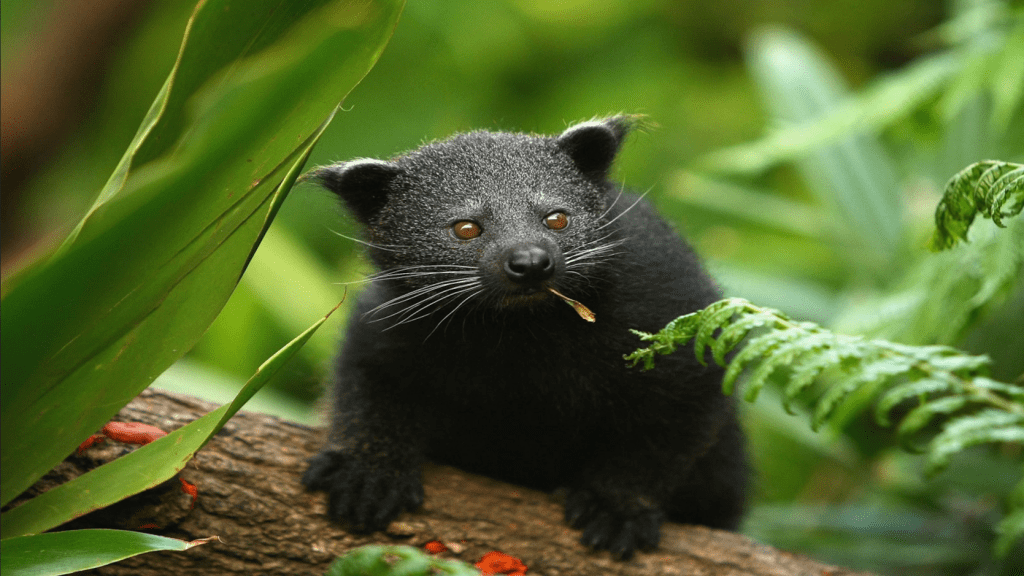
Binturong Arctictis binturong

Binturong Arctictis binturong

Extant: Bangladesh; Bhutan; Cambodia; China; India; Indonesia (Kalimantan, Jawa, Sumatera); Lao People’s Democratic Republic; Malaysia (Sarawak, Sabah, Peninsular Malaysia); Myanmar; Nepal; Philippines; Thailand; Vietnam

Presence Uncertain: Brunei Darussalam

Status: Vulnerable

You may smell a Binturong in an Asian forest before you see them. They give off the aroma of buttered popcorn or cheesy crisps due to a compound in their urine that they use to attract mates. The binturong, Arctictis binturong, is a fascinating and rare mammal who roam the dense rainforests of Southeast Asia. Often called the “bearcat” due to their looks, binturongs are neither bears nor cats, but are more closely related to civets. With their monkey-like prehensile tail, thick wiry fur, and a popcorn-like scent, these unique and irreplaceable creatures play vital roles as seed dispersers in S.E Asian forests, particularly for strangler figs (Ficus spp.), making them keystone species in their ecosystem.

Despite their ecological significance, the binturongs are now classed as Vulnerable. Populations have plummeted due to habitat destruction, particularly for palm oil deforestation; along with illegal hunting, exploitation for the coffee market and the illegal bushmeat and pet trade. Protecting the majestic binturong requires urgent action to safeguard their rainforest home. Fight for them every time you use your wallet! #BoycottPalmOil #Boycott4Wildlife

Habitat loss has been the predominant driver of decline of the Binturong’s southern (Sundaic) portion of the range, where a significant proportion of lowland habitats have been converted to other land-uses that do not support the species e.g. oil palm plantations.

IUCN red list

#Binturongs AKA Bearcats are not actually related to cats or bears. They smell of buttered popcorn and #vulnerable due to #palmoil #deforestation in SE #Asia 🇮🇩🇻🇳🇲🇾🇵🇭 Help them every time you #BoycottPalmOil 🌴🪔⛔️#Boycott4Wildlife @palmoildetect https://palmoildetectives.com/2021/10/16/binturong-arctictis-binturong/

#Binturongs and other #civets in SE #Asia are kept in cages for cruel #KopiLuwak #coffee 🤮☕️ Another threat is #palmoil #deforestation. Help end #AnimalCruelty for vulnerable Binturongs! #BoycottPalmOil 🌴🪔⛔️#Boycott4Wildlife @palmoildetect https://palmoildetectives.com/2021/10/16/binturong-arctictis-binturong/

Appearance and behaviour

Their expressive eyes, tufted ears, and long whiskers enhance their unique look, while their prehensile tail acts as a fifth limb, allowing them to deftly navigate treetops (Cambridge University Press, 2024)

Although the binturong is known colloquially as the ‘Bearcat’, the species isn’t related to cats or bears. They are small carnivorans belonging to the family Viverridae and they are related to palm civets.

The scent glands of the Binturong secrete a musk which some have likened to the aroma of cheesy crisps or buttered popcorn. This is due to a scent in their urine of 2-acetyl-1-pyrroline, a compound which they use to mark territory and signal their presence to other binturongs (National Geographic, 2024).

They possess a prehensile tail and are mainly tree-dwelling. Binturongs use their powerful limbs and tail to climb trees. They move slowly and deliberately but are capable climbers. Their diet consists mainly of fruit, particularly figs, but they also consume small mammals, birds, and insects, showcasing their omnivorous tendencies (Mongabay, 2016).

The species is heavy and stocky and can weigh up to 20 kilos. While more agile and smaller arboreal animal species can leap between trees, due to the Binturong’s heavy frame, they must descend to the ground to go from one tree to another.

There are no records of this species from within blocks of monoculture plantations such as palm oil or rubber. Habitat loss and degradation are major threats to the Binturong (Schreiber et al. 1989) as is fragmentation, particularly in those parts of the range where hunting is heavy.

Threats

IUCN Status: Vulnerable

The binturong (Arctictis binturong) faces multiple overlapping threats, including habitat destruction for palm oil and timber, hunting, illegal trade, and exploitation for commercial products. These threats, exacerbated by weak enforcement of conservation laws, are causing dramatic population declines across its range.

Illegal Wildlife and Pet Trade

Tragically, the binturong is heavily exploited across their range in Asia for their meat, skin, use in civet coffee production, and the pet trade. Recent research highlights alarming statistics on the trade of binturongs, revealing the following:

  • Online Trade: A study identified 594 advertisements offering over 720 live binturongs during the study period, with the majority (97.6%) appearing on Facebook (Springer, 2024). The trade primarily caters to the pet market, with most animals likely sourced illegally from the wild.
  • Seizures: Data from wildlife seizures revealed 103 live binturongs confiscated, further underscoring the prevalence of illegal hunting for this species despite existing wildlife protection laws (Springer, 2024).
  • Regulatory Challenges: Traders and buyers openly operate without fear of detection, highlighting weak enforcement and legislative gaps. Addressing these gaps, enhancing law enforcement, and prosecuting offenders are critical to halting the illegal trade of binturongs.
  • Online Platforms: The role of platforms like Facebook in facilitating illegal wildlife trade demands immediate attention. Establishing stringent regulations and accountability for online wildlife traders is vital to curbing this issue.

Palm Oil and Timber Deforestation:

  • Unsustainable logging and agricultural land conversion are rapidly depleting binturong habitats, particularly in Peninsular Malaysia and Sumatra (Cambridge University Press, 2024).
  • Palm oil plantations have destroyed vast tracts of rainforest in Indonesia, Malaysia, and Thailand, leading to habitat fragmentation and population isolation. Lowland rainforests, where binturongs thrive, are particularly vulnerable to clearance (IUCN, 2016).
  • Habitat destruction due to logging, palm oil plantations, and agricultural expansion is a leading threat to the binturong.
  • In Indonesia, 40% of forest loss between 2000–2012 occurred in protected areas, including national parks (Rode-Margano et al., 2014).
  • In mainland Southeast Asia, extensive deforestation has fragmented and degraded binturong habitats. In Thailand, large-scale deforestation has significantly reduced the species’ range (Chutipong et al., 2014).

Climate Change

A study by Abedin et al. (2025) warns that climate change could drastically reduce suitable habitats for the binturong. Currently, 26% of its habitat is suitable for survival, but projections show a 90% decline in suitability in the near future.

Current habitat patches are already highly fragmented, and future changes will exacerbate this isolation, leaving isolated populations even more vulnerable to extinction. The study highlights the urgent need for transboundary wildlife corridors across South and Southeast Asia to connect fragmented populations (Abedin et al., 2025).

Illegal Pet and Wildlife Trade

Binturongs are heavily exploited in the illegal wildlife trade for their meat, skins, and use in traditional medicine, as well as for the exotic pet trade:

  • Pet Trade: Binturongs are among the most frequently caged live carnivores displayed in markets in Laos. Over 97% of online pet trade advertisements for binturongs were found on Facebook during one study (Springer, 2024). Many animals sold in this trade are young, illegally captured from the wild.

Snaring and Opportunistic Hunting

Recent camera-trap surveys reveal that binturongs frequently descend to the ground, making them vulnerable to snares and traps. The increased use of snares has a devastating impact on ground-foraging species like the binturong, who are often caught unintentionally (Naniwadekar et al., 2013).

Isolated Populations

Historically considered relatively common, binturongs are now rare across most of their range. Camera-trap surveys indicate severe declines in Laos, Cambodia, and Vietnam due to habitat loss and hunting pressures (Willcox et al., 2014). The species is approaching national extinction in China due to rampant deforestation and opportunistic logging.

Exploitation for Products

Binturongs are exploited commercially for a variety of products:

Skin Trade: Their pelts are frequently found in markets in Laos and other parts of Southeast Asia.

Meat and Traditional Medicine: The species is hunted for food in countries like Laos and Vietnam, where its meat is considered a delicacy. Civet meat, including binturongs, is in high demand across China and Vietnam and the Philippines. In Northeast India, binturong meat is consumed in states like Nagaland and Assam as part of subsistence hunting practices.

Civet Coffee Exploitation: In Indonesia, binturongs and common palm civets are captured and kept in captivity to produce ‘kopi luwak’ or civet coffee, which is a popular but ethically repugnant practice and product involving extreme animal cruelty.

Take Action!

The dire combination of habitat loss, illegal trade, and hunting makes immediate conservation action essential to protect the binturong. Advocating for indigenous-led conservation and stricter enforcement of wildlife laws is crucial to secure its future. Use your wallet as a weapon and support #BoycottPalmOil and #Boycott4Wildlife.

Diet

Binturongs are frugivores, with a diet heavily reliant on figs (Ficus spp.). They also consume other fruits, leaves, eggs, small mammals, and carrion. Their role as seed dispersers is crucial for maintaining rainforest biodiversity, as they propagate seeds over large distances, ensuring the survival of many tree species (Britannica, 2024).

Reproduction and Mating

Binturongs exhibit delayed implantation, allowing females to time births with optimal environmental conditions. After a gestation period of approximately 92 days, females give birth to 1–3 cubs. Juveniles are dependent on their mothers for several months, during which they develop climbing and foraging skills (Mongabay, 2016).

Geographic Range

Binturongs inhabit tropical rainforests across Southeast Asia, including:

  • India: Northeastern states such as Assam and Arunachal Pradesh.
  • Indonesia: Lowland forests in Sumatra and Borneo.
  • Malaysia: Forest reserves in Peninsular Malaysia.
  • Philippines: Palawan Island.
  • Vietnam and Laos: Annamite Mountains and other forested regions.

FAQs

What are some facts about binturongs?

Binturongs are unique mammals that can smell like buttered popcorn or cheesy crispps, thanks to a chemical compound in their urine. They are crucial seed dispersers, particularly for strangler figs. Binturongs are also one of the few carnivores with a fully prehensile tail, aiding their arboreal lifestyle (Britannica, 2024).

What is the IUCN status of binturong?

The binturong is listed as Vulnerable on the IUCN Red List, with its population declining by over 30% in the last 30 years due to habitat destruction, poaching, and the illegal pet trade (IUCN, 2016).

How do binturongs help the environment?

Binturongs are keystone species in their ecosystems. By consuming and dispersing the seeds of many fruiting trees, particularly figs, they help regenerate rainforests and maintain biodiversity (Cambridge University Press, 2024).

How many binturongs are left in the world?

Exact population numbers are unknown, but surveys suggest densities as low as 10 individuals per 100 square kilometres in some regions, indicating a sharp population decline (IUCN, 2016).

You can support this beautiful animal

Support indigenous-led conservation and agroecology to protect binturongs and their rainforest habitats. Use your wallet as a weapon. #BoycottPalmOil #Boycott4Wildlife.

ABConservation is an organisation dedicately solely to the protection of Binturongs and they work to stop the illegal pet trade and ads on social media and much more. Find out more: ABConservation

Further Information

IUCN Rating vulnerable


Abedin, I., Mukherjee, T., Kim, A. R., Kim, H. W., Lee, S. R., & Kundu, S. (2025). Shifting shadows: Assessing the habitat and climate change response of binturong (Arctictis binturong) in the conservation landscape of the Asian continent. Ecological Informatics, 85, Article 102941. https://doi.org/10.1016/j.ecoinf.2024.102941

Britannica. (n.d.). Binturong. Retrieved from https://www.britannica.com/animal/binturong

Department of Natural Resources and Environment Tasmania. (n.d.). Binturong (Arctictis binturong): Species risk assessment. Retrieved from

Gomez, L., Shepherd, C.R. The illegal trade of binturongs in Indonesia (arctictis binturong). Discov Anim 1, 27 (2024). https://doi.org/10.1007/s44338-024-00029-8

Irawati Dwi Arini, D., Fitriari, U., & Fahmi Firdaus, M. (2024). Observation on Binturong (Arctictis binturong) behaviour and its conservation management practices at Semarang Zoo, Central Java. BIO Web of Conferences, 123, Article 01045. https://doi.org/10.1051/bioconf/202412301045

Honda, A., Amir, Z., Mendes, C. P., Moore, J. H., & Luskin, M. S. (2024). Binturong ecology and conservation in pristine, fragmented and degraded tropical forestsOryx58(2), 218–227. doi:10.1017/S0030605322001491

Nairn, C. (2016, October 13). What is a binturong? Almost Famous Animals. Asia. Retrieved from https://news.mongabay.com/2016/10/its-a-bear-its-a-cat-no-its-a-binturong-and-its-threatened/

ScienceDirect. (2024). Binturong habitat preferences and behavioural ecology. Retrieved from https://www.sciencedirect.com/science/article/pii/S1574954124004837

Wikipedia contributors. (n.d.). Binturong. Wikipedia. Retrieved from https://en.wikipedia.org/wiki/Binturong

Willcox, D.H.A., Chutipong, W., Gray, T.N.E., Cheyne, S., Semiadi, G., Rahman, H., Coudrat, C.N.Z., Jennings, A., Ghimirey, Y., Ross, J., Fredriksson, G. & Tilker, A. 2016. Arctictis binturong. The IUCN Red List of Threatened Species 2016: e.T41690A45217088. https://dx.doi.org/10.2305/IUCN.UK.2016-1.RLTS.T41690A45217088.en. Downloaded on 08 June 2021.


Contribute to palm oil detectives - black rhino in profile

How can I help the #Boycott4Wildlife?


Take Action in Five Ways

1. Join the #Boycott4Wildlife on social media and subscribe to stay in the loop: Share posts from this website to your own network on Twitter, Mastadon, Instagram, Facebook and Youtube using the hashtags #Boycottpalmoil #Boycott4Wildlife.

Join 3,176 other subscribers

2. Contribute stories: Academics, conservationists, scientists, indigenous rights advocates and animal rights advocates working to expose the corruption of the palm oil industry or to save animals can contribute stories to the website.

3. Supermarket sleuthing: Next time you’re in the supermarket, take photos of products containing palm oil. Share these to social media along with the hashtags to call out the greenwashing and ecocide of the brands who use palm oil. You can also take photos of palm oil free products and congratulate brands when they go palm oil free.

4. Take to the streets: Get in touch with Palm Oil Detectives to find out more.

5. Donate: Make a one-off or monthly donation to Palm Oil Detectives as a way of saying thank you and to help pay for ongoing running costs of the website and social media campaigns. Donate here

What is greenwashing?


Over the course of the 20th century, capitalism preserved its momentum by moulding the ordinary person into a consumer. Using advertising to encourage in people the ravenous hunger for purchasing more stuff and the accompanying feeling of hollowness and a need for more and more.


At the end of the 20th century, environmental problems began to arise from unchecked capitalist growth


Ever-expanding growth and the over-exploitation of land, water and animals continued at pace. Even despite its immense cost to animals, ecosystems and people in the developing world.

Even despite predictions by scientists that the world would be destroyed.

Out of-control global corporates needed strong storytelling and PR to support their continued exponential growth.

This insane need for economic/corporate growth gave rise to the ‘Green Growth’ and ‘Sustainability’ movements. The marketing and PR tactics employed to justify the continued growth of these brands and products despite their destruction, is known as:

Greenwashing

Original Tweet

Original Tweet

Original Tweet

https://twitter.com/RubenBrunsveld/status/1448552977665507330?s=20

Original Tweet

Original Tweet

Original Tweet

The origins of greenwashing can be found in the origins of consumerism, advertising and marketing itself

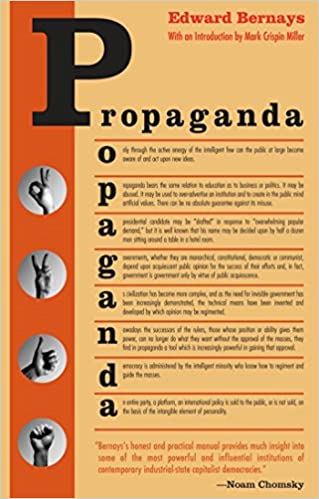
This is most powerfully illustrated by one of the original source about marketing from between the world wars by Edward Bernays, a landmark book called Propaganda published in 1928. This book would be instrumental for setting in train the agenda for economic growth in the West in the 20th Century.

Propaganda by Edward Bernays (1928)

“The conscious and intelligent manipulation of the organized habits and opinions of the masses is an important element in democratic society. Those who manipulate this unseen mechanism of society constitute an invisible government which is the true ruling power of our country.… It is they who pull the wires which control the public mind, who harness old social forces and contrive new ways to bind and guide the world”

Mass production is profitable only if its rhythm can be maintained—that is if it can continue to sell its product in steady or increasing quantity.… Today supply must actively seek to create its corresponding demand … [and] cannot afford to wait until the public asks for its product; it must maintain constant touch, through advertising and propaganda … to assure itself the continuous demand which alone will make its costly plant profitable.

‘Propaganda’ by Edward Bernays, 1928
Greenwashing is a reassuring lie to consumers

WHO considers marketing by the palm oil industry to be akin to tobacco and alcohol marketing

Marketing of palm oil does not occur in the traditional sense. Responding to a backlash against accusations of poor environmental and labour practices, the industry has sought to portray its products as sustainable, while highlighting the contribution to poverty alleviation.
There is also a mutual benefit for the palm oil and processed food industry, with the latter targeting advertisements for ultra-processed foods towards children (similar to efforts by the tobacco and alcohol industries in targeting children and adolescents) and the palm oil refining industry benefiting from the corresponding increase in sales of foods containing palm oil.

The palm oil industry and noncommunicable diseases, (2019),
Sowmya Kadandale, a Robert Martenb & Richard Smith.
World Health Organisation Bulletin.

A 2019 World Health Organisation (WHO) report into the palm oil industry and RSPO finds extensive greenwashing of palm oil deforestation and the murder of endangered animals (i.e. biodiversity loss)

WHO Bulletin on Palm Oil: Deforestation and Extinction
WHO Bulletin on Palm Oil: Air Pollution and Health

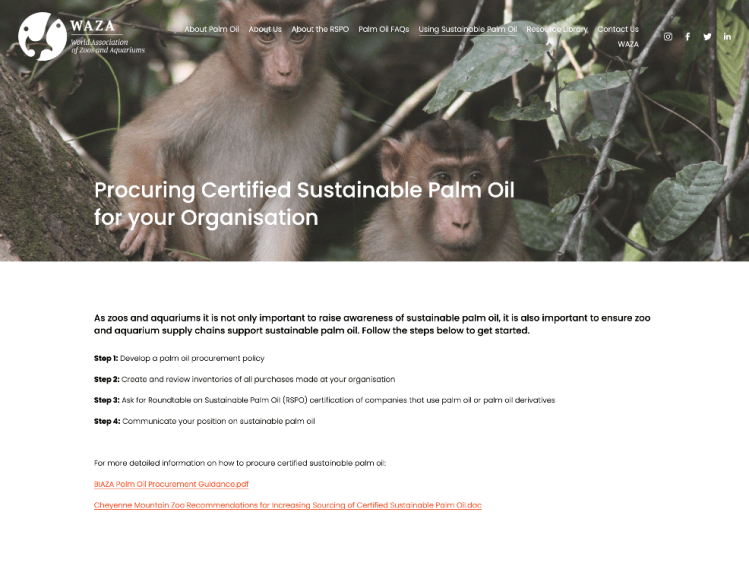
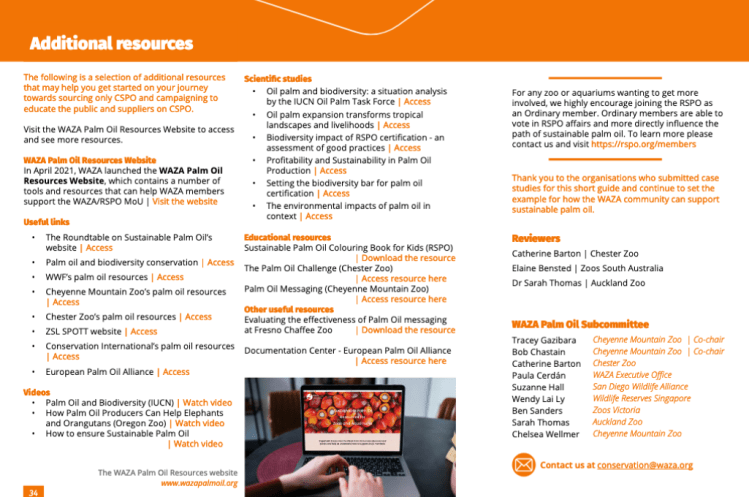
World Organisation of Zoos and Aquariums (WAZA) Guide for promoting sustainable palm oil

Sustainability is meaningless, it’s time for a new enlightenment

Effectively, sustainability became the main ingredient of a “having your cake and eating it” ideology. The environment, and its ecological systems, were deemed to be sustained while equally economic development could continue apace.

But if sustainable development had delivered on its promise, humanity would now not be facing the crisis we call climate change.

Greenwashing solves nothing.

What was, and is, actually needed is the opposite of what has been promoted in order to try to maintain the economic status quo.

Dr Toni Fry, Griffith University ‘Sustainability is meaningless, it’s time for a new enlightenment, The Conversation.

Research into how to influence voluntary standards using expert knowledge

“The ability of developing countries, especially small-scale actors within them, to shape standard setting and management to their advantage depends not only on overcoming important structural differences…but also on more subtle games. These include promoting the enrolment of one expert group or kind of expert knowledge over another, using specific formats of negotiation, and legitimating particular modes of engagement over others.”

Voluntary standards, expert knowledge and the governance of sustainability networks. (2013), Ponte, S. & Cheyns, E. Glob. Netw. 13, 459–477


The Vice President of the European Parliament Heidi Hautala does not trust the RSPO’s false and weak promise of “sustainable” palm oil

She replies to my conversation on Twitter to advise of this…

Heidi Hautala, Vice-President of the European Parliament and part of the the Human Rights and Democracy panel and Eco-Management and Audit Scheme (EMAS)

“No voluntary standards or industry schemes have done the job fully [of eliminating deforestation or human rights abuses]. That is why the game-changing EU CSDDD [Corporate Sustainability Due Diligence Directive] is mandatory. Certification is a useful tool but will not liberate the company from its duty of due diligence”

~ Heidi Hautala, Vice-President of the European Parliament and part of the the Human Rights and Democracy panel and Eco-Management and Audit Scheme (EMAS)

Is it possible to design an eco-label without greenwashing?

In his book ‘Beyond Greenwash’ Hamish Van Der Ven somewhat naively sets out to answer that question.

Naive because embedded within capitalism is the drive towards exponential growth and the ecosystems and resources of our planet are finite – which makes it naive to think that we can continue to labour under the same system, yet expect a different result.

Still Van Der Ven has some valid insights to share here about how a eco-label could theoretically be designed to be free from greenwashing.

An eco-label without greenwashing has yet to materialise. This is because our current economic system does not consider ‘value’ to include: human rights, animal rights, the beauty of unspoiled nature and forests left intact – the only way the current system quantifies ‘value’ is financial growth. The virtue-signalling about doing the right thing and improving human rights, animal rights, environmental sustainability is greenwashing. If businesses DID care, these issues would have been sorted. Instead, they provide consumers with empty words and promises.

Extract below from ‘What’s in a label? Separating credible eco-labels from “greenwash” – Corporate Knights, 2021

Is it transparent?

Dubious eco-labels keep everything offline or hidden behind pay walls; credible eco-labels make their information freely available online, including information around breaches of rules and regulations and their resolutions, governance and funding.

Is it independent?

  • Consumers and procurement professionals should be wary of self-awarded ecolabels. Instead seek out ecolabels from a credible third-party organisation.
  • There should also be independence between the organisation that sets the standard and the organization that audits compliance against its criteria. This is important for preventing a conflict of interest.
  • Standard-setters generally receive revenues based on how widely their eco-labels are used. An eco-labeling organization that checks compliance against its own standard has an incentive to overlook non-compliances and set a lower bar for achievement.

Is it inclusive?

Do all stakeholders get a say in decision-making? If an eco-label promotes sustainable coffee production, then it should involve coffee farmers, scientists, processers, NGOs, and community members (amongst others) in standard-setting.


10 Tactics of Sustainable Palm Oil Greenwashing


Greenwashing Tactic #1: Hidden Trade Off

When a brand makes token changes while continuing with deforestation, ecocide or human rights abuses in another part of their business – this is ‘Hidden Trade Off’

For example, Nestle talks up satellite monitoring to stop palm oil deforestation. Yet…

Read more

Greenwashing Tactic #3: Vagueness

Claiming a brand or commodity is ‘green’ or ‘sustainable’ based on broad generalisations, unclear language or vague statements Jump to section Greenwashing: Vagueness in Language Greenwashing: Vagueness in certification standards Reality: Auditing of RSPO a failure Quote: EIA: Who Watches…

Read more

Greenwashing Tactic #4: Fake Labels

Claiming a brand or commodity is green based on unreliable, ineffective endorsements or eco-labels such as the RSPO, Forest Stewardship Council (FSC) or FairTrade coffee and cocoa. Greenwashing: Fake Labels and fake certifications Ecolabels are designed to reassure consumers that…

Read more

Greenwashing Tactic #6: The Lesser of Two Evils

Claiming that a brand, commodity or industry is greener than others in the same category, in order to excuse ecocide, deforestation, human rights and animal rights abuses. Jump to section Greenwashing: Lesser of Two Evils: Palm Oil Uses Less Land…

Read more
10 Tactics of Sustainable Palm Oil Greenwashing - Summary

Explore the series

Research: Palm Oil Deforestation and its connection to retail brands

Join the #Boycott4Wildlife and fight greenwashing and deforestation by using your wallet as a weapon!

Further reading on palm oil ecocide, greenwashing and deceptive marketing

  1. A Brief History of Consumer Culture, Dr. Kerryn Higgs, The MIT Press Reader. https://thereader.mitpress.mit.edu/a-brief-history-of-consumer-culture/
  2. A Deluge of Double-Speak (2017), Jason Bagley. Truth in Advertising. https://truthinadvertising.org/blog/a-deluge-of-doublespeak/
  3. Aggarwal, P. (2011). Greenwashing: The darker side of CSR. Indian Journal of Applied Research, 4(3), 61-66. https://www.worldwidejournals.com/indian-journal-of-applied-research-(IJAR)/article/greenwashing-the-darker-side-of-csr/MzMxMQ==/?is=1
  4. Anti-Corporate Activism and Collusion: The Contentious Politics of Palm Oil Expansion in Indonesia, (2022). Ward Berenschot, et. al., Geoforum, Volume 131, 2022, https://doi.org/10.1016/j.geoforum.2022.03.002
  5. Armour, C. (2021). Green Clean. Company Director Magazine. https://www.aicd.com.au/regulatory-compliance/regulations/investigation/green-clean.html
  6. Balanced Growth (2020), In: Leal Filho W., Azul A.M., Brandli L., özuyar P.G., Wall T. (eds) Responsible Consumption and Production. Encyclopedia of the UN Sustainable Development Goals. Springer, Cham
  7. Berenschot, W., Hospes, O., & Afrizal, A. (2023). Unequal access to justice: An evaluation of RSPO’s capacity to resolve palm oil conflicts in Indonesia. Agriculture and Human Values, 40, 291-304. https://doi.org/10.1007/s10460-022-10360-z
  8. Carlson, K. M., Heilmayr, R., Gibbs, H. K., Noojipady, P., et al. (2018). Effect of oil palm sustainability certification on deforestation and fire in Indonesia. PNAS, 115(1), 121-126. https://doi.org/10.1073/pnas.1704728114
  9. Cazzolla Gatti, R., Liang, J., Velichevskaya, A., & Zhou, M. (2018). Sustainable palm oil may not be so sustainable. Science of The Total Environment, 652, 48-51. https://pubmed.ncbi.nlm.nih.gov/30359800/
  10. Changing Times Media. (2019). Roundtable on Sustainable Palm Oil is ‘greenwashing’ labelled products, environmental investigation agency says. Changing Times Media. https://changingtimes.media/2019/11/03/roundtable-on-sustainable-palm-oil-is-greenwashing-labelled-products-environmental-protection-agency-says/
  11. Client Earth: The Greenwashing Files. https://www.clientearth.org/projects/the-greenwashing-files/
  12. Commodifying sustainability: Development, nature and politics in the palm oil industry (2019). World Development, Volume 121, September 2019, Pages 218-228. https://ideas.repec.org/a/eee/wdevel/v121y2019icp218-228.html
  13. Contrasting communications of sustainability science in the media coverage of palm oil agriculture on tropical peatlands in Indonesia, Malaysia and Singapore (2020). Liu, F. H. M., Ganesan, V., Smith, T. E. L. Environmental Science & Policy, 114. https://www.researchgate.net/publication/343772443_Contrasting_communications_of_sustainability_science_in_the_media_coverage_of_palm_oil_agriculture_on_tropical_peatlands_in_Indonesia_Malaysia_and_Singapore
  14. Cosimo, L. H. E., Masiero, M., Mammadova, A., & Pettenella, D. (2024). Voluntary sustainability standards to cope with the new European Union regulation on deforestation-free products: A gap analysis. Forest Policy and Economics, 164, 103235. https://doi.org/10.1016/j.forpol.2024.103235
  15. Dalton, J. (2018). No such thing as sustainable palm oil – ‘certified’ can destroy even more wildlife, say scientists. The Independent. https://www.independent.co.uk/climate-change/news/palm-oil-sustainable-certified-plantations-orangutans-indonesia-southeast-asia-greenwashing-purdue-a8674681.html
  16. Davis, S. J., Alexander, K., Moreno-Cruz, J., et al. (2023). Food without agriculture. Nature Sustainability. https://www.nature.com/articles/s41893-023-01241-2
  17. EIA International. (2022). Will palm oil watchdog rid itself of deforestation or continue to pretend its products are sustainable? EIA International. https://eia-international.org/news/will-palm-oil-watchdog-rid-itself-of-deforestation-or-continue-to-pretend-its-products-are-sustainable/
  18. Environmental Investigation Agency. (2019). Palm oil watchdog’s sustainability guarantee is still a destructive con. EIA International. https://eia-international.org/news/palm-oil-watchdogs-sustainability-guarantee-is-still-a-destructive-con/
  19. Federal Trade Commission. (n.d.). Green Guides. https://www.ftc.gov/news-events/topics/truth-advertising/green-guides
  20. Fifteen environmental NGOs demand that sustainable palm oil watchdog does its job (2019). Rainforest Action Network. https://www.ran.org/press-releases/fifteen-environmental-ngos-demand-that-sustainable-palm-oil-watchdog-does-its-job/
  1. Friends of the Earth International. (2018). RSPO: 14 years of failure to eliminate violence and destruction from the industrial palm oil sector. Friends of the Earth International. https://www.foei.org/rspo-14-years-of-failure-to-eliminate-violence-and-destruction-from-the-industrial-palm-oil-sector/
  2. Lang, Chris and REDD Monitor. Sustainable palm oil? RSPO’s greenwashing and fraudulent audits exposed. The Ecologist. https://theecologist.org/2015/nov/19/sustainable-palm-oil-rspos-greenwashing-and-fraudulent-audits-exposed
  3. Gatti, L., Pizzetti, M., & Seele, P. (2021). Green lies and their effect on intention to invest. Journal of Business Research, 127, 376-387. https://doi.org/10.1016/j.jbusres.2021.01.028
  4. Global Witness. (2023). Amazon palm: Ecocide and human rights abuses. Global Witness. https://www.globalwitness.org/en/campaigns/environmental-activists/amazon-palm/
  5. Global Witness. (2021). The True Price of Palm Oil. Global Witness. https://www.globalwitness.org/en/campaigns/forests/true-price-palm-oil/
  6. Grain. (2021). Ten reasons why certification should not be promoted in the EU anti-deforestation regulation. Grain. https://grain.org/en/article/6856-ten-reasons-why-certification-should-not-be-promoted-in-the-eu-anti-deforestation-regulation
  7. Green Clean (2021). Armour, C. Company Director Magazine.
  8. Green marketing and the Australian Consumer Law (2011). Australian Competition and Consumer Commission. https://www.accc.gov.au/system/files/Green%20marketing%20and%20the%20ACL.pdf
  9. Greenwash and spin: palm oil lobby targets its critics (2011). Helan, A. Ecologist: Informed by Nature. https://theecologist.org/2011/jul/08/greenwash-and-spin-palm-oil-lobby-targets-its-critics
  10. Greenwashing: definition and examples. Selectra https://climate.selectra.com/en/environment/greenwashing#:~:text=Greenwashing%20is%20the%20practice%20of,its%20activities%20pollute%20the%20environment.
  11. Greenwashing of the Palm Oil Industry (2007). Mongabay. https://news.mongabay.com/2007/11/greenwashing-the-palm-oil-industry/
  12. Group Challenges Rainforest Alliance Earth-Friendly Seal of Approval (2015). Truth in Advertising. https://www.truthinadvertising.org/group-challenges-rainforest-alliance-earth-friendly-seal-of-approval
  13. Helan, A. (2011). Greenwash and spin: palm oil lobby targets its critics. Ecologist: Informed by Nature. https://theecologist.org/2011/feb/15/greenwash-and-spin-palm-oil-lobby-targets-its-critics
  14. Hewlett Packard. (2021). What is Greenwashing and How to Tell Which Companies are Truly Environmentally Responsible. Hewlett Packard. https://www.hp.com/us-en/shop/tech-takes/what-is-greenwashing-environmentally-responsible-companies
  15. Holzner, A., Rameli, N. I. A. M., Ruppert, N., & Widdig, A. (2024). Agricultural habitat use affects infant survivorship in an endangered macaque species. Current Biology. https://pubmed.ncbi.nlm.nih.gov/38194972/
  16. How Cause-washing Deceives Consumers (2021). Truth in Advertising. https://truthinadvertising.org/resource/how-causewashing-deceives-consumers/
  17. International Labour Organization. (2020). Forced labor in the palm oil industry. ILO. https://www.ilo.org/topics/forced-labour-modern-slavery-and-human-trafficking
  18. Jauernig, J., Uhl, M., & Valentinov, V. (2021). The ethics of corporate hypocrisy: An experimental approach. Futures, 129, 102757. https://doi.org/10.1016/j.futures.2021.102757
  19. Kirby, D. (2015). Sustainable Palm Oil? Who Knows, Thanks to Derelict Auditors. Take Part. https://www.yahoo.com/news/sustainable-palm-oil-knows-thanks-derelict-auditors-200643980.html
  20. Li, T. M., & Semedi, P. (2021). Plantation life: Corporate occupation in Indonesia’s oil palm zone. Duke University Press. https://www.dukeupress.edu/plantation-life
  21. Liu, F. H. M., Ganesan, V., & Smith, T. E. L. (2020). Contrasting communications of sustainability science in the media coverage of palm oil agriculture on tropical peatlands in Indonesia, Malaysia, and Singapore. Environmental Science & Policy, 114. https://www.researchgate.net/publication/343772443_Contrasting_communications_of_sustainability_science_in_the_media_coverage_of_palm_oil_agriculture_on_tropical_peatlands_in_Indonesia_Malaysia_and_Singapore
  1. Meemken, E. M., Barrett, C. B., Michelson, H. C., et al. (2021). Sustainability standards in global agrifood supply chains. Nature Food. https://doi.org/10.1038/s43016-021-00299-2
  2. Miles, T. (2019). Study in WHO journal likens palm oil lobbying to tobacco and alcohol industries. Reuters. https://www.reuters.com/article/idUSKCN1P21ZR/
  3. Nygaard, A. (2023). Is sustainable certification’s ability to combat greenwashing trustworthy? Frontiers in Sustainability, 4, Article 1188069. https://doi.org/10.3389/frsus.2023.1188069
  4. Oppong-Tawiah D, Webster J. Corporate Sustainability Communication as ‘Fake News’: Firms’ Greenwashing on Twitter. Sustainability. 2023; 15(8):6683. https://www.mdpi.com/2071-1050/15/8/6683
  5. Pabon, J. (2024). The great greenwashing: How brands, governments, and influencers are lying to you. Anansi International. https://www.vitalsource.com/products/the-great-greenwashing-john-pabon-v9781487012878
  6. Podnar, K., & Golob, U. (2024). Brands and activism: Ecosystem and paradoxes. Journal of Brand Management, 31, 95–107. https://link.springer.com/article/10.1057/s41262-024-00355-y
  7. Rainforest Action Network. (2019). Fifteen environmental NGOs demand that sustainable palm oil watchdog does its job. RAN. https://www.ran.org/press-releases/fifteen-environmental-ngos-demand-that-sustainable-palm-oil-watchdog-does-its-job/
  8. Renner, A., Zellweger, C., & Skinner, B. (2021). ‘Is there such a thing as sustainable palm oil? Satellite images show protected rainforest on fire’. Neue Zürcher Zeitung. https://www.nzz.ch/english/palm-oil-boom-threatens-protected-rainforest-in-indonesia-ld.1625490
  9. Saager, E. S., Iwamura, T., Jucker, T., & Murray, K. A. (2023). Deforestation for oil palm increases microclimate suitability for the development of the disease vector Aedes albopictus. Scientific Reports, 13(1), 9514. https://www.nature.com/articles/s41598-023-35452-6
  10. Southey, F. (2021). What do Millennials think of palm oil? Nestlé investigates. Food Navigator. https://www.foodnavigator.com/Article/2021/08/12/What-do-Millennials-think-of-palm-oil-Nestle-investigates
  11. Transparency International. (2023). Transparency international report: Corruption and corporate capture in Indonesia’s top 50 palm oil companies. Transparency International. https://palmoildetectives.com/2023/05/14/transparency-international-report-corruption-and-corporate-capture-in-indonesias-top-50-palm-oil-companies/
  12. Truth in Advertising. (2022). Companies accused of greenwashing. https://truthinadvertising.org/articles/companies-accused-greenwashing/
  13. Truth in Advertising. (n.d.). How causewashing deceives consumers. https://truthinadvertising.org/resource/how-causewashing-deceives-consumers/
  14. Tybout, A. M., & Calkins, T. (Eds.). (2019). Kellogg on Branding in a Hyper-Connected World. Kellogg School of Management, Northwestern University. https://www.wiley.com/en-au/Kellogg+on+Branding+in+a+Hyper-Connected+World-p-9781119533184
  15. Wicke, J. (2019). Sustainable palm oil or certified dispossession? NGOs within scalar struggles over the RSPO private governance standard. Bioeconomy & Inequalities: Working Paper No. 8. https://www.bioinequalities.uni-jena.de/sozbemedia/WorkingPaper8.pdf
  16. World Health Organisation. (2019). The palm oil industry and noncommunicable diseases. World Health Organisation Bulletin, 97, 118-128. https://pubmed.ncbi.nlm.nih.gov/30728618/
  17. World Rainforest Movement. (2021, November 22). Why the RSPO facilitates land grabs for palm oil. https://wrm.org.uy/articles-from-the-wrm-bulletin/section1/why-the-rspo-facilitates-land-grabs-for-palm-oil/
  18. Zuckerman, J. (2021). The Time Has Come to Rein In the Global Scourge of Palm Oil. Yale Environment 360, Yale School of Environment. https://e360.yale.edu/features/the-time-has-come-to-rein-in-the-global-scourge-of-palm-oil

Contribute to my Ko-Fi

Did you enjoy visiting this website?

Contribute to my kofi

Palm Oil Detectives is 100% self-funded

Palm Oil Detectives is completely self-funded by its creator. All hosting and website fees and investigations into brands are self-funded by the creator of this online movement. If you like what I am doing, you and would like me to help meet costs, please send Palm Oil Detectives a thanks on Ko-Fi.

The Orangutan with the golden hair by Setia Budhi

He’s a golden haired orangutan, at least that’s what the villagers called him….


Sumatran orangutan close up. Craig Jones Wildlife Photography

He is a male of the species of Pongo pygmaeus. This orangutan appears all the time on the slopes of the Müller Mountains, located 10,000 meters from the Mantikip Dayak village in the lush green heart of Borneo.

News spreads rapidly throughout the village of the presence of this magnificent creature with the golden hair.

Photo: Craig Jones Wildlife Photography


As a result, leaves and branches of the tree glisten with golden flashes of light. Not only that, plants such as Meranti trees, Balau Wood, Keruing and weeds catch the hairs and become woven in golden threads.


Craig Jones Wildlife Photography. A female orangutan at dawn in Sumatra

From his explorations of the jungle, the orangutan’s golden hair sticks to trees, leaves and tree branches


Large and small birds alight from branches drag along the orangutan’s golden hairs. Birds, flying low in the late afternoon flap their wings and the golden hairs drop gently into the river, turning this gold as well.

A little boy bathing in the river emerges with his body covered in golden threads. The village of Mantikip is cloaked in gold.


Golden threads of hair pile up in aquatic plants and drift along the rushing water of the river turning it gold. The orangutan with the golden hair shows himself in the forest, in the Kumpai plants, the gardens, river and the village.

[Illustration: Mienar]


Do you know the reason why the orangutan has golden hair? It is from the poisonous liquid that’s stuck to his body. This comes from palm oil mill run-off and waste on the south side of the Müller Mountains – this is the root cause.


Pollution run-off in an RSPO member palm oil plantation in Sumatra. Craig Jones Wildlife Photography

One day, indigenous people enter the grounds of the oil palm plantation to look for food. Word-of-mouth rapidly spreads throughout their community and soon many people enter the area looking for food. The entire population is afflicted by itching, rashes and fever. Some residents are so thirsty and desperate for water that they take water from the flowing river. They are later found dead in their homes.


"Dayak family, Central Kalimantan" by IndoMet in the Heart of Borneo is licensed under CC BY 2.0
“Dayak family, Central Kalimantan” by IndoMet in the Heart of Borneo is licensed under CC BY 2.0

A week later, word of the orangutan with the golden fur and the possible presence of toxic liquid from the factory’s waste reaches the ears of Freddy Kumbayang, director of the local palm oil mill.

He orders his staff to immediately leave the forest. He does not believe that waste leaking from his palm oil mill is the real reason for the poisoning of the local water supply.

In front of a small gathering of his staff and the local villagers, Kumbayang holds court and starts to speak.

“There must be something wrong,” he says angrily, “Our company is very clean and ethical, we would not be stupid like this. We have a zero tolerance policy on pollution! Disposing of waste into the forest means that we kill ourselves.”


Deforestation by Sean Weston https://seanweston.co.uk

“We work according to the standards of the world’s palm oil companies,” he adds loudly. “We are members of the RSPO. We are not to blame here!”

“Only uneducated and stupid people would say that toxic waste comes from our factory! We know that the natives in this area are easily swayed by the provocations of the townspeople.”

That same afternoon, Freddy Kumbayang and a few members of his staff go together into the mountains and forest to investigate the allegations in person.

Freddy Kumbayang and his team move along the slopes of the Müller Mountains. He orders his staff to fetch water flowing down the hillside. “Take some water samples here for lab analysis”, he says.


Later as darkness falls, the small group descend into the forest.

When they arrive at a small bridge over the river, they see golden threads dancing in the wind, twinkling on the surface of the leaves, caught at the river’s edge.


Female orangutan at dawn in the Sumatran jungle - Craig Jones Wildlife Photography

The golden-haired orangutan stares at the humans curiously from deep within the shadows. He waggles his hands and feet to shed his fur. Everything in the forest has turned golden in the evening light.


“For sure, this only happens on the surface of the leaves and twigs, so these trees are safe,” Kumbayang says.

“Let’s check in the forest” he says “Quickly! before the pollution report is caught on camera by journalists!” he orders his staff to walk into the deep darkness of the forest.

“Keep moving!” he barks. So they march deep into the west Kalimantan wilderness.

No one knows what became of the palm oil company group or what they discovered in the jungle. Perhaps they found hornbills, bats or found the orangutan with the golden hair?

A week after the incident, the SAR team find decomposing human bodies on the rocky slopes of the Müller Mountains. It’s the bodies of Freddy Kumbayang and his staff.


Pixabay

The Mantikip village, which originally numbered 125 people is whittled down to only seven people still alive.


PxFuel

One family never went into the forest and never touched the river water. Miraculously, they had an old well beside their home. The toxic liquid from the palm oil factory that destroyed the river and turned the orangutan’s hair golden did not seep into their water supply – they were the only people to survive.

An environmental report issued later showed that the orangutan’s fur was contaminated with palm oil mill waste.


The world looks on and sees with open eyes the horrendous cost to animals and indigenous people of this corrupt industry. The world condemns oil palm plantations to this day.


Written in Bakumpai Village Saturday 3 October 2021 by Dr Setia Budhi

Images/Art: Pixabay, Craig Jones Wildlife Photography, PxFuel, Mienar

Dedication: “In this forest valley, for you A…with love”

Dr Setia Budhi

This is a fictional story that mimics real life…


A 2021 report by Global Witness revealed workers on a palm oil plantation in Papua New Guinea died as a result of consuming contaminated water.

These palm oil plantations supply so-called ‘sustainable’ brands that use RSPO certified ‘sustainable’ palm oil, supposedly free of human rights abuses and destruction, but this is not the case. Here are the brands: Kelloggs, Hersheys, Nestle, Danone, PZ Cussons, AAK, Colgate-Palmolive, General Mills.

We reject the corruption and greenwashing of so-called ‘sustainable’ palm oil. We #Boycottpalmoil #Boycott4Wildlife

Dayak Indigenous Ethnographer Dr Setia Budhi: In His Own Words

“I’ve been doing ethnographic field research since early 2013, by visiting several villages of the Dayak Siang, Dayak Bakumpai and Dayak Oot Danum tribes. My field research is related to the Dayak peoples. How the exploitation of natural resources, modernisation and the depleted forests affects their ability to find food.”

— Dr Setia Budhi, Dayak Ethnographer, Academic, Writer, Conservationist, Indigenous Activist, Borneo


Dayak Indigenous Ethnographer Dr Setia Budhi

Dr Setia Budhi is a senior lecturer in Anthropology and Sociology at Universitas Lambung Mangkurat. He is an indigenous advocate, forest conservationist and a research specialist in Dayak ethnography in South, Central and East Kalimantan. He completed his PhD in 2010 at UKM Malaysia under the supervision of Prof. Awang Hasmadi Awang Moeis and Prof.…

Keep reading

Greenwashing Tactic 9: Partnerships, Sponsorships and Research Funding


Greenwashing Tactic: 

Partnerships, Sponsorships & Research Funding

Definition: Using corporate and NGO partnerships, sponsorships and research funding to give a commodity, an industry, ecolabel or company a ‘green' and 'eco-friendly' reputation

Greenwashing Tactic:

Partnerships, Sponsorships & Research Funding

Definition: Using corporate and NGO partnerships, sponsorships and research funding to give a commodity, an industry, ecolabel or company a ‘green’ and ‘eco-friendly’ reputation

Take action by sharing this


Jump to section

Orangutan Land Trust funded by rainforest destroying palm oil co. Kulim Malaysia Berhad

Orangutan Land Trust funded by Agropalma: during decades-long destruction of the Amazon for palm oil

Orangutan Land Trust and New Britain Palm Oil (NBPOL): Deep financial links


Greenwashing Partnership: Orangutan Land Trust, Ferrero & Chester Zoo

Greenwashing Partnership: WWF

Greenwashing Partnership: WAZA

Greenwashing Partnership: Chester Zoo & the RSPO

Greenwashing Partnership: Sustainable Palm Oil Cities

Greenwashing Partnership: Mobile apps

Greenwashing Research


Reality: Human rights abuses, land-grabbbing by RSPO members

Reality: Chester Zoo promoting “sustainable” palm oil and connected to slavery

Reality: RSPO 14 Years of Failure by Friends of the Earth and 100 other NGOs

Reality: Associated Press Investigation into RSPO members

Reality: Neue Zürcher Zeitung (NZZ) Investigation RSPO plantations on fire

Explore the Series

Further reading: greenwashing and deceptive marketing

Say thanks for this guide by donating to my Ko-Fi


Greenwashing through partnerships

Greenwashing occurs when private companies and global multinational corporations leverage the reputation of NGOs, researchers and ecolabels in order to greenwash their own murky and ambiguous reputation.

“A concern of [private corporations] is the absence of legitimacy, which can come with government action. Thus, private companies can choose to engage in partnerships with nongovernmental organizations (NGOs) for their actions to have a legitimacy framework.”

Isabelle Hayes, NGO Partnerships Providing Legitimacy to Private Environmental Governance, 42 Pace Env’t L. Rev 254 (2025) https://digitalcommons.pace.edu/pelr/vol42/iss2/2/


Orangutan Land Trust funded by rainforest destroying palm oil co. Kulim Malaysia Berhad

Orangutan Land Trust accepts a cheque for $500,000 for ‘worthy organisations on the ground’ from Kulim Malaysia Berhad, a palm oil company that is a corporate partner of Orangutan Land Trust as well and that has deforestation in their supply chain.

Michelle Desilets accepts cheque for 500k from Kulim
Kulim Malaysia Berhad provides Orangutan Land Trust with a $500,000 USD cheque.

BSI, a company that conducts audits for the RSPO is a corporate partner of Orangutan Land Trust. BSI approved the certification of another one of Orangutan Land Trust’s partners Kulim Malaysia Berhad recognising them as being ‘sustainable’ according to the RSPO

In 2015, Orangutan Land Trust listed Kulim Malaysia Berhad, a palm oil company as one of their corporate partners on their website.

Orangutan Land Trust Corporate Sponsors Partrners Oct 2015

“Responsible and committed companies like Kulim ensure that no orangutan habitat is affected by their operations while also supporting conservation efforts outside their concession areas,” said Michelle Desilets, Executive Director, Orangutan Land Trust.

Michelle Desilets, quoted in Merdeka, Sept 2015

World’s largest sovereign wealth fund drops Kulim Malaysia Berhad over deforestation’ – Mongabay

A few months later in March 2016, Norway’s Government Pension Fund Global (GPFG), which manages $828 billion worth of funds, revealed that they had dropped Kulim Malaysia Berhad from their investment portfolio because Kulim were involved in ‘severe environmental damage and ecocide’ ‘World’s largest sovereign wealth fund just dropped 11 companies over deforestation’ – Mongabay.

The HAZE Elimination Team Facebook group asked Michelle Desilets to reveal who specifically received the funds. She did not provide funding recipients. See thread on Facebook and news story in Indonesian.

A Facebook group called the HAZE action team posted this about Orangutan Land Trust accepting the cheque for 500K from Kulim, a palm oil company that later was dropped for fire and deforestation - click to read original post.
A Facebook group called the HAZE Action Team posted this about Orangutan Land Trust accepting the cheque for 500K from Kulim, a palm oil company that was disgraced in the same year for deforestation.

Again in 2019 on Twitter, Michelle Desilets was asked who received the money in Kalimantan. She did not answer. She has since been asked many times and only ever provided evasive answers about who exactly received the 500K from Kulim Malaysia Berhad

Original tweet link
Original tweet link

Orangutan Land Trust funded by Agropalma: during their decades-long destruction of the Amazon for palm oil

Orangutan Land Trust mentions fellow RSPO member Agropalma as being a sponsor and funder on their website and annual ACOP ( a report given to the RSPO) in 2014. Agropalma are listed on the OLT website until 2019.

“With Agropalma’s generous support, we can enable conservation activities in Indonesia and Malaysia that will not only help to protect the orangutan, but also all the biodiversity that shares its rainforest habitat”.

Michelle Desilets of Orangutan Land Trust, quoted in the 2015 Agropalma Sustainability Report and on the Agropalma website, their full sustainability report is here.

From 2014- 2022 Orangutan Land Trust promote Agropalma on Twitter and elsewhere as offering “sustainable” palm oil \

See original tweet
See original tweet
See original tweet
See original tweet
See original tweet

A report by the Palm Oil Innovation Group (POIG) on their website between 2014-2020 reveals that Agropalma have been paying Orangutan Land Trust 10,000 GBP per quarter. Read report

In 2022, Agropalma were the subject of a 2022 Global Witness report into the destruction of the Amazon rainforest and violence against indigenous land defenders. Read report

Between 2015 -2020, Agropalma were assessed by the RSPO’s Complaints Panel for human rights abuses. This panel includes Orangutan Land Trust’s Executive Director Michelle Desilets as a decision maker.

Between 2015 -2020, Agropalma were assessed by the RSPO's Complaints Panel for human rights abuses. This panel includes Orangutan Land Trust's Executive Director Michelle Desilets as a decision maker.

In 2020, the RSPO ruled in favour of Agropalma and against the human rights defenders and closed the case. Read letter


Orangutan Land Trust and New Britain Palm Oil (NBPOL): Deep financial links

There are deep financial and management links between the NGO Orangutan Land Trust, the RSPO, and palm oil company New Britain Palm Oil.

In 2012, in addition to receiving funds from Agropalma – Orangutan Land Trust received funds from palm oil company New Britain Palm Oil, while Michelle Desilets (and others) made decisions on the RSPO’s Complaints Panel about human rights cases related to New Britain Palm Oil. Read original document

In 2012 Michelle Desilets and Simon Lord went onto TV to spruik the benefits of the RSPO and sustainable palm oil together. See original

Concurrently from 2012-2017 Simon Lord was the Sustainability Manager for New Britain Palm Oil as well as being the registered Director of Orangutan Land Trust during the period where cash donations were made from New Britain Palm Oil to Orangutan Land Trust.

Greenwashing:

Orangutan Land Trust, Ferrero & Chester Zoo

Global brands and RSPO members Ferrero and Wilmar (linked to extensive human rights abuses and deforestation) work together with Chester Zoo, Orangutan Land Trust and the RSPO to promote sustainable palm oil

Political lobbying by Orangutan Land Trust, Ferrero and Chester Zoo means the UK government removes all tariffs on UK palm oil imports

In April 2023, Ferrero, Chester Zoo Orangutan Land Trust met with members of the UK Parliament. A few days later, UK MP Kemi Badenoch’s announced that the UK would be removing all tariffs on the import of palm oil. This move makes it straightforward for unchecked dirty palm oil to make its way into the UK, all of it directly linked to deforestation and human rights abuses. This shocking decision by the UK government was met with enormous opposition by media and environmental and human rights groups in the UK and all over the world.

Original tweet

Michelle Desilets of Orangutan Land Trust pushing “sustainable” palm oil at a Ferrero corporate event in 2016


Original Tweet
Original Tweet
Original Tweet
Original Tweet

Greenwashing:

World Wildlife Fund (WWF)


WWF provides an annual Palm Oil Scorecard which ranks supermarket brands (RSPO members) providing consumers with baseless reassurances of palm oil sustainability.


WWF’s Palm Oil Scorecard ranks RSPO members (supermarket brands) such as: Tesco, Nestle, Ferrero, Unilever, Pepsi, CocaCola, Hersheys, Colgate-Palmolive, L’Oreal, Avon, Johnson&Johnson, Mondelez, PZ Cussons, Mars. This score card omits deforestation, fires, human rights abuses, illegal landgrabbing, violence and ecocide caused by these same RSPO members, by using ‘green’ words and design.

A founding member of the RSPO, WWF adds legitimacy and is a well-known global conservation brand. Their mission of saving animals has been overtaken by corporate interests and the need for corporate funding.

Original Tweet
Original Tweet


Zoos around the world promote the use of RSPO ‘sustainable’ palm oil

Despite clear, long-term evidence of indigenous land-grabbing, human rights abuses, ecocide, violence and deforestation by RSPO members


Chester Zoo provides educational and marketing resources to the Zoo network. The RSPO members (supermarket brands) provide sponsorship and funding in exchange for the promotion of sustainable palm oil.

https://twitter.com/ActforWildlife/status/1093547007900295170?s=20

  • WAZA - Guide to Greenwashing in Zoos for sustainable palm oil
  • WAZA - Guide to Greenwashing in Zoos for sustainable palm oil
  • WAZA - Guide to Greenwashing in Zoos for sustainable palm oil
  • WAZA - Guide to Greenwashing in Zoos for sustainable palm oil

Greenwashing:

Chester Zoo & the RSPO push ‘sustainable’ palm oil in UK schools


Chester Zoo and the RSPO promote educational resources and marketing materials about ‘sustainable’ palm oil to children and teens across the UK


Original Tweet

This term, Year 6 have been studying deforestation and the need for sustainable palm oil in our everyday items. Our research of products, sustainable sources and the effect on wildlife culminated in a group being invited to deliver a presentation at @chesterzoo for @LearnatCZ

Originally tweeted by St Joseph’s Catholic Primary School (@stjosephsbh) on October 21, 2021.

  • Chester Zoo educational material about how 'sustainable' palm oil is the 'lesser of two evils'
  • Chester Zoo educational material about how 'sustainable' palm oil is the 'lesser of two evils'
  • Chester Zoo educational material, words and music to the song 'Palm Oil Conga' designed for small children.
  • Chester Zoo educational material, words and music to the song 'Palm Oil Conga' designed for small children.
  • Chester Zoo educational material, words and music to the song 'Palm Oil Conga' designed for small children.
  • Chester Zoo educational material, words and music to the song 'Palm Oil Conga' designed for small children.
  • Chester Zoo educational material about how 'sustainable' palm oil helps endangered species
  • One school's response to the call to join the 'Palm Oil Conga'
greenwashing RSPO

Greenwashing:

Sustainable Palm Oil Cities


Chester Zoo, Ferrero, Orangutan Land Trust and the RSPO push sustainable palm oil to city councils in the ‘Sustainable Palm Oil Cities’ initiative.


Original Tweet

Greenwashing:

Mobile apps are promoted by zoos and the RSPO to push sustainable palm oil


The Giki Earth, Cheyenne Mountain Zoo app and Impact Score App promote ‘sustainable’ palm oil to consumers, giving them the reassurances of ‘orangutan safe’ and ‘sustainable’ choices in the supermarket


Original Tweet
Original Tweet
Original Tweet
Original Tweet
Original Tweet
Original Tweet
Original Tweet

‘Orangutan Friendly’ recommendations in the Cheyenne Mountain Zoo app include all RSPO ‘certified sustainable’ members linked to deforestation, ecocode and human rights abuses for palm oil


Greenwashing:

Research that examines the RSPO’s ‘sustainability’ is funded by the RSPO and industry, i.e. global food companies

Researchers paid by the RSPO are doing research on the RSPO's effectiveness

Pictured: Dr Jennifer Lucey presents on findings of the SEnSOR programme @SensorProgramme via @SEARRP on Twitter

Original tweet

Original tweet

SEnSOR (Socially and Environmentally Sustainable Oil palm Research) is a research programme set-up to examine the environmental and social impact of the RSPO. However, as this photo from Twitter reveals, it is funded by the RSPO, along with the industry – meaning global supermarket brands and palm oil companies that are part of the RSPO. No specific mention of industry funding is present on any research papers, the university websites, the SEnSOR website or anywhere else.


The SEnSOR project receives funding from the RSPO but is still apparently able to release findings that are independent and critical of the certification scheme.

Funding relationships with the RSPO are left off the University of York’s website. There is no mention at all of palm oil research or of SEnSOR project on the University of Oxford’s website either.

Original tweet

In research published by the SEnSOR project, authors declare that they have done work for palm oil companies and/or the RSPO.


Ethics declaration: Meijaard, E., Brooks, T.M., Carlson, K.M. et al. The environmental impacts of palm oil in context. Nat. Plants 6, 1418–1426 (2020). https://doi.org/10.1038/s41477-020-00813-w


Research papers produced by the SEnSOR programme analysing the RSPO’s sustainability and effectiveness – paid for by the RSPO and industry


See detail of funding sources on the UKRI website and here.

  • Science for Policy paper by the SEnSOR project
  • Science for Policy paper by the SEnSOR project
  • Science for Policy paper by the SEnSOR project

The results of SEnSOR’s research studies reveal that RSPO certification is ineffective at stopping deforestation, loss of biodiversity and improving livelihoods of smallholder farmers. Read more.

Wilmar International : And Searrp Collaborate For Scientific Research In Forest Rehabilitation

04/18/2022 | 05:34am EDT

Wilmar and SEARRP have worked together since 2006 where the collaboration between both parties to support academic research has shed light on the impact and role of sustainably managed palm oil plantations in supporting and maintaining forest biodiversity in and around the plantations.

Among the key findings of the research were a proposed forest patch size that is viable for biodiversity conservation, the importance of forest quality to increase viability for conservation and the position of a conservation area in relation to other intact forest areas in the landscape.

The partnership had also culminated in a workshop organised in 2015 in Amsterdam, The Netherlands, entitled “Enhancing biodiversity conservation in the oil palm industry: Translating science into action”. Read more


These same researchers act as public campaigners and spokespeople for ‘sustainable’ palm oil


Original tweet

To be successful in avoiding biodiversity losses RSPO plantations need to demonstrate avoided deforestation, and reduced fragmentation with higher forest cover and connectivity within their concession areas.

The Potential for Oil Palm Landscapes to Support At-Risk Species

Original tweet

Dr Jennifer Lucey’s research, which is funded by the RSPO and industry sets out the minimum amount of rainforest that can be left over for endangered species by the palm oil industry.


Dr Eric Meijaard is the Chair of the IUCN Palm Oil Taskforce

He produces research about sustainable palm oil that is either ambiguous and inconclusive or positive about the effect that ‘sustainable’ palm oil plantations have on biodiversity and ecology. He publicly promotes the idea of sustainable palm oil, despite its links to ecocide, deforestation and human rights abuses associated with RSPO members (supermarket brands, palm oil traders and producers).

  • Eric Meijaard pushing sustainable palm oil - lesser of two evils
  • eric meijaard rspo conference
  • eric meijaard rspo conference

Reality

Human rights abuses, land-grabbbing by RSPO members

We find positive effects on prices and income from sale of certified products. However, we find no change in overall household income and assets for workers. The wages for workers are not higher in certified production.

Oya, C., Schaefer, F. & Skalidou, D. The effectiveness of agricultural certification in developing countries: a systematic review. World Dev. 112, 282–312 (2018).

We find that, while sustainability standards can help improve the sustainability of production processes in certain situations, they are insufficient to ensure food system sustainability at scale, nor do they advance equity objectives in agrifood supply chains.

Meemken, EM., Barrett, C.B., Michelson, H.C. et al. Sustainability standards in global agrifood supply chains. Nat Food (2021). https://doi.org/10.1038/s43016-021-00360-3

Chester Zoo: promoting “sustainable” palm oil and connected to slavery

Chester Zoo has a ‘Modern Slavery’ act on their website which prohibits slavery in their suppliers and partners. Yet they are a public partner of the RSPO, an industry certification scheme deeply embedded in ecocide, corruption, deforestation, human rights abuses. They also partner with Ferrero and receive funding from them – a global food company and RSPO member involved in slavery, deforestation and human rights abuses.

Yet Chester Zoo partners with and promotes RSPO members and receives funding from Ferrero, a global food company and RSPO member with links to child slavery and deforestation.

Chester Zoo's modern slavery act

A 2021 Investigation by Global Witness finds that palm oil companies in Papua New Guinea are alleged to have been involved in corruption, child labour, apparent tax evasion, deforestation, worker deaths and paying police to assault villagers.

The palm oil from these mills is used by RSPO members Colgate-Palmolive, Kelloggs, General Mills, Nestle, Hersheys, Danone, PZ Cussons – finds its way into our weekly supermarket shop.

A 2021 campaign by Sum of Us delivers 260,000 signatures on a petition to the US government to order Ferrero to stop sourcing palm oil.

Ferrero’s palm oil used in products like Ferrero Rocher and Nutella. Their palm oil is linked to child slavery, violence, human rights abuses and deforestation.

Deforestation in West Papua

RSPO: 14 years of failure to eliminate violence and destruction from the industrial palm oil sector

Friends of the Earth and 100 other human rights and environmental NGOS co-signed this letter in 2018

Letter

During its 14 years of existence, RSPO – the Roundtable on Sustainable Palm Oil – has failed to live up to its claim of “transforming” the industrial palm oil production sector into a so-called “sustainable” one. In reality, the RSPO has been used by the palm oil industry to greenwash corporate destruction and human rights abuses, while it continues to expand business, forest destruction and profits.

RSPO presents itself to the public with the slogan “transforming the markets to make sustainable palm oil the norm”. Palm oil has become the cheapest vegetable oil available on the global market, making it a popular choice among the group that dominates RSPO membership, big palm oil buyers.

They will do everything to secure a steady flow of cheap palm oil. They also know that the key to the corporate success story of producing “cheap” palm oil is a particular model of industrial production, with ever-increasing efficiency and productivity which in turn is achieved by:

  1. Planting on a large-scale and in monoculture, frequently through conversion of tropical biodiverse forests
  2. Using “high yielding” seedlings that demand large amounts of agrotoxics and abundant water.
  3. Squeezing cheap labour out of the smallest possible work force, employed in precarious conditions so that company costs are cut to a minimum
  4. Making significant up-front money from the tropical timber extracted from concessions, which is then used to finance plantation development or increase corporate profits.
  5. Grabbing land violently from local communities or by means of other arrangements with governments (including favourable tax regimes) to access land at the lowest possible cost.

Those living on the fertile land that the corporations choose to apply their industrial palm oil production model, pay a very high price.

Violence is intrinsic to this model:

  • violence and repression when communities resist the corporate take over of their land because they know that once their land is turned into monoculture oil palm plantations, their livelihoods will be destroyed, their land and forests invaded. In countless cases, deforestation caused by the expansion of this industry, has displaced communities or destroyed community livelihoods where
  • companies violate customary rights and take control of community land;
  • sexual violence and harassment against women in and around the plantations which often stays invisible because women find themselves without possibilities to demand that the perpetrators be prosecuted;
  • Child labour and precarious working conditions that go hand-in-hand with violation of workers’ rights;
  • working conditions can even be so bad as to amount to contemporary forms of slavery. This exploitative model of work grants companies more economic profits while allowing palm oil to remain a cheap product. That is why, neither them or their shareholders do anything to stop it.
  • exposure of workers, entire communities and forests, rivers, water springs, agricultural land and soils to the excessive application of agrotoxics;
  • depriving communities surrounded by industrial oil palm plantations of their food sovereignty when industrial oil palm plantations occupy land that communities need to grow food crops.

RSPO’s proclaimed vision of transforming the industrial oil palm sector is doomed to fail because the Roundtable’s certification principles promote this structural violent and destructive model.

The RSPO also fails to address the industry’s reliance on exclusive control of large and contingent areas of fertile land, as well as the industry’s growth paradigm which demands a continued expansion of corporate control over community land and violent land grabs.

None of RPSO’s eight certification principles suggests transforming this industry reliance on exclusive control over vast areas of land or the growth paradigm inherent to the model.


Industrial use of vegetable oils has doubled in the past 15 years, with palm oil being the cheapest. This massive increase of palm oil use in part explains the current expansion of industrial oil palm plantations, especially in Africa and Latin America, from the year 2000 onward, in addition to the existing vast plantations areas in Malaysia and Indonesia that also continue expanding.


On the ground, countless examples show that industrial oil palm plantations continue to be synonymous to violence and destruction for communities and forests. Communities’ experiences in the new industrial oil palm plantation frontiers, such as Gabon, Nigeria, Cameroon, Liberia, Sierra Leone, Peru, Honduras, Brazil, Colombia, Ecuador, are similar to past and ongoing community experiences in Indonesia and Malaysia.

RSPO creates a smokescreen that makes this violence invisible for consumers and financiers. Governments often fail to take regulatory action to stop the expansion of plantations and increasing demand of palm oil; they rely on RSPO to deliver an apparently sustainable flow of palm oil.

For example, in its public propaganda, RSPO claims it supports more than 100,000 small holders. But the profit from palm oil production is still disproportionally appropriated by the oil palm companies: in 2016, 88% of all certified palm oil came from corporate plantations and 99,6% of the production is corporate-controlled.


RSPO also claims that the principle of Free, Prior and Informed Consent (FPIC) is key among its own Principles and Criteria. The right to FPIC implies, among others, that if a community denies the establishment of this monoculture in its territory, operations cannot be carried out. Reality shows us, however, that despite this, many projects go ahead.

Concessions are often guaranteed long before the company reaches out to the affected communities. Under these circumstances, to say that FPIC is central to RSPO is bluntly false and disrespectful.

RSPO also argues that where conflicts with the plantation companies arise, communities can always use its complaint mechanism. However, the mechanism is complex and it rarely solves the problems that communities face and want to resolve.

This becomes particularly apparent in relation to land legacy conflicts where the mechanism is biased against communities. It allows companies to continue exploiting community land until courts have come to a decision. This approach encourages companies to sit out such conflicts and count on court proceedings dragging on, often over decades.


Another argument used by RSPO is that industrial oil palm plantations have lifted millions of people out of poverty. That claim is certainly questionable, even more so considering that there is also an important number of people who have been displaced over the past decades to make space for plantations.

Indigenous communities have in fact lost their fertile land, forests and rivers to oil palm plantations, adversely affecting their food, culture and local economies.


The RSPO promise of “transformation” has turned into a powerful greenwashing tool for corporations in the palm oil industry. RSPO grants this industry, which remains responsible for violent land grabbing, environmental destruction, pollution through excessive use of agrotoxics and destruction of peasant and indigenous livelihoods, a “sustainable” image.

What’s more, RSPO membership seems to suffice for investors and companies to be able to claim that they are “responsible” actors. This greenwash is particularly stunning, since being a member does not guarantee much change on the ground. Only recently, a company became RSPO member after it was found to deforest over 27.000 hectares of rainforest in Papua, Indonesia.


Certification is structurally dependent on the very same policies and regulation that have given rise to the host of environmental devastation and community land rights violations associated with oil palm plantations. These systemic governance issues are part of the destructive economic model, and embedded in state power.

For this reason, voluntary certification schemes cannot provide adequate protection for forests, community rights, food sovereignty and guarantee sustainability. Governments and financiers need to take responsibility to stop the destructive palm oil expansion that violates the rights of local communities and Indigenous Peoples.

As immediate steps, governments need to:

  • Put in place a moratorium on palm oil plantations expansion and use that as a breathing space to fix the policy frameworks;
  • Drastically reduce demand for palm oil: stop using food for fuel;
  • Strengthen and respect the rights of local communities and Indigenous Peoples to amongst others, self-determination and territorial control.
  • Promote agro-ecology and community control of their forests, which strengthens local incomes, livelihoods and food sovereignty, instead of advancing industrial agro-businesses.

Signatures

  • Aalamaram-NGOAcción Ecológica, Ecuador
  • ActionAid, France
  • AGAPAN
    Amics arbres
  • Arbres amics
  • Amis de la Terre France
  • ARAARBA (Asociación para la Recuperación del Bosque Autóctono)
  • Asociación Conservacionista YISKI, Costa Rica
    Asociación Gaia El Salvador
  • Association Congo Actif, Paris
  • Association Les Gens du Partage, Carrières-sous-Poissy
  • Association pour le développement des aires protégées, Swizterland
  • BASE IS
  • Bézu St Eloi
  • Boxberg OT Uhyst
  • Bread for all
  • Bruno Manser Fund
  • CADDECAE, Ecuador
  • Campaign to STOP GE Trees
  • CAP, Center for Advocacy Practices
  • Centar za životnu sredinu/ Friends of the Earth Bosnia and Herzegovina
  • CESTA – FOE El Salvador
  • CETRI – Centre tricontinental
  • Climate Change Kenya
  • Coalición de Tendencia Clasista. (CTC-VZLA)
  • Colectivo de Investigación y Acompañmiento Comunitario
  • Collectif pour la défense des terres malgaches – TANY, Madagascar
  • Community Forest Watch, Nigeria
  • Consumers Association of Penang
  • Corporate Europe Observatory
  • Cuttington University
  • Down to Earth Consult
  • El Campello
  • Environmental Resources Management and Social Issue Centre (ERMSIC) Cameroon
  • Environmental Rights Action/Friends of the Earth Nigeria
  • FASE ES , Brazil
  • Fédération romande des consommateurs
  • FENEV, (Femmes Environnement nature Entrepreneuriat Vert).
  • Focus on the Global South
  • Forum Ökologie & Papier, Germany
  • Friends of the Earth Ghana
  • Friends of the Earth International
  • GE Free NZ, New Zealand
  • Global Alliance against REDD
  • Global Justice Ecology Project
  • Global Info
  • Gobierno Territorial Autónomo de la Nación Wampís , Peru
  • GRAIN
  • Green Development Advocates (GDA)
  • CameroonGreystones, Ireland
  • Groupe International de Travail pour les Peuples Autochtones
    Grupo ETC
  • Grupo Guayubira, Uruguay
  • Instituto Mexicano de Gobernanza Medioambiental AC Instituto Mexicano de Gobernanza Medioambiental AC
  • Integrated Program for the Development of the Pygmy People (PIDP), DRC
  • Justica Ambiental
  • Justicia Paz e Integridad de la Creacion. Costa Rica
  • Kempityari
  • Latin Ambiente, http://www.latinambiente.org
  • Les gens du partage
  • LOYOLA SCHOOL OF THEOLOGY, MANILA
  • Maderas del Pueblo del Sureste, AC
  • Maiouri nature, Guyane
  • Mangrove Action Project
  • Milieudefensie – Friends of the Earth Netherlands
  • Movimento Amigos da Rua Gonçalo de Carvalho
  • Muyissi Environnement, Gabon
  • Nature-d-congo de la République du Congo
  • New Wind Association from Finland
  • NOAH-Friends of the Earth Denmark
  • Oakland Institute
  • OFRANEH, Honduras
  • Ole Siosiomaga Society Incorporated (OLSSI)
  • ONG OCEAN : Organisation Congolaise des Ecologistes et Amis de la Nature et sommes basés en RD Congo.
  • OPIROMA, Brazil
  • Otros Mundos A.C./Amigos de la Tierra México
  • Paramo Guerrrero Zipaquira
  • PROYECTO GRAN SIMIO (GAP/PGS-España)
  • Quercus – ANCN, Portugal
  • Radd (Reseau des Acteurs du Développement Durable) , Cameroon
  • Rainforest Foundation UK
  • Rainforest Relief
  • ReAct – Alliances Transnationales
  • RECOMA – Red latinoamericana contra los monocultivos de árboles
  • Red de Coordinacion en Biodiversidad , Çosta Rica
  • REFEB-Cote d’Ivoire
  • Rettet den Regenwald, Germany
  • ROBIN WOOD
  • Sahabat Alam Malaysia (Friends of the Earth Malaysia)
  • Salva la Selva
  • School of Democratic Economics, Indonesia
  • Serendipalm Company Limited
  • Sherpa , The Netherlands
  • SYNAPARCAM, Cameroon
  • The Corner House, UK
    Towards Equitable Sustainable Holistic Development
  • TRAFFED KIVU ,RD. CONGOUNIÓN UNIVERSAL DESARROLLO SOLIDARIO
    University of Sussex, UK
  • UTB ColombiaWatch Indonesia!
  • WESSA
    World Rainforest Movement
  • Youth Volunteers for the Environment Ghana

Associated Press investigation (2020) finds widespread violence, rape and slavery of women by RSPO members: Colgate-Palmolive, L’Oreal, Avon, Unilever, Johnson&Johnson, for palm oil that ends up in beauty brands


Dayak Indigenous Ethnographer Dr Setia Budhi: In His Own Words

“The expansion of oil palm plantations has created many detrimental environmental impacts, such as deforestation, loss of biodiversity, land conflicts, labour conflicts, and social conflicts around plantations.

“Environmental damage and social injustice were reasons why the global palm oil certification, the Roundtable on Sustainable Palm Oil (RSPO) was established.

“In practice, requirements for oil palm certifications are easily violated. Lots of things are problematic.”

Dr Setia Budhi, Dayak Ethnographer, In His Own Words.


Global corporates are responsible for the majority of palm oil production and deforestation risk, not smallholder farmers


The three biggest palm oil traders: Sinar Mas, Wilmar and Musim Mas – all RSPO members, also have the biggest deforestation risk. Deforestation goes against the RSPO’s rules.

Source: Insights: Indonesian Palm Oil. Trase Earth (2018)

  • The top five traders in Indonesia handled 75% of exports. The three biggest palm oil traders: Sinar Mas, Wilmar and Musim Mas also have the biggest deforestation risk of all RSPO members (deforestation goes against the RSPO's rules). [Source: Trase]
  • The top five traders in Indonesia handled 75% of exports. The three biggest palm oil traders: Sinar Mas, Wilmar and Musim Mas also have the biggest deforestation risk of all RSPO members (deforestation goes against the RSPO's rules). [Source: Trase]
Burning Questions – Credibility of sustainable palm oil still illusive - EIA
Burning Questions – Credibility of sustainable palm oil still illusive – Environmental Investigation Agency (2021)
Dying for a cookie: How Mondelez's Dirty Palm Oil is feeding the climate and extinction crisis by Greenpeace (2019)
Dying for a cookie: How Mondelez’s Dirty Palm Oil is feeding the climate and extinction crisis by Greenpeace (2019)
Who Watches the Watchmen Part 2: The continuing incompetence of the RSPO’s assurance systems (2019)
The RSPO: 14 Years of Failure by Friends of the Earth International and Co-signed by 100 Indigenous and Human Rights Organisations (2014)
Destruction Certified by Greenpeace 2021
Destruction Certified by Greenpeace (2021)
Trading Risks ADM and Bunge and failing land and environmental rights defenders in Indonesia (2021)
Keep the Forests Standing: Exposing Brands and Banks Driving Deforestation. Rainforest Action Network (2021)
Keep the Forests Standing: Exposing the brands driving deforestation – RAN (2020)
License to Clear Dark Side of Permitting in West Papua by Greenpeace (2021)
FMCG’s Zero-Deforestation Challenges and Growing Exposure to Reputational Risk. Chain Reaction Research (2020)
Plantation Life Corporate Occupation in Indonesia's Oil Palm Zone (2021)
Plantation Life Corporate Occupation in Indonesia’s Oil Palm Zone (2021)

Planet Palm: How Palm Oil Ended Up In Everything and Endangered the World by Jocelyn Zuckerman (2021)
Rethinking Dayak Identity Dr Setia Budhi
Adina Renner, Conradin Zellweger, Barnaby Skinner. ‘Is there such a thing as sustainable palm oil? Satellite images show protected rainforest on fire’. (May 2021) https://www.nzz.ch/english/palm-oil-boom-threatens-protected-rainforest-in-indonesia-ld.1625490
The True Price of Palm Oil: How global finance and household brands are fuelling deforestation, violence and human rights abuses in Papua New Guinea

Reality

Neue Zürcher Zeitung (NZZ) Investigation RSPO plantations on fire

Is there such a thing as sustainable palm oil? Satellite images show protected rainforest on fire – Neue Zürcher Zeitung (NZZ)

Certification had no causal impact on forest loss in peatlands or active fire detection rates.

Kimberly M. Carlson, Robert Heilmayr, Holly K. Gibbs, Praveen Noojipady et al. Effect of oil palm sustainability certification on deforestation and fire in Indonesia, PNAS January 2, 2018 115 (1) 121-126 https://doi.org/10.1073/pnas.1704728114

No significant difference was found between certified and non-certified plantations for any of the sustainability metrics investigated, however positive economic trends including greater fresh fruit bunch yields were revealed. To achieve intended outcomes, RSPO principles and criteria are in need of substantial improvement and rigorous enforcement.

Morgans, C. L. et al. Evaluating the effectiveness of palm oil certification in delivering multiple sustainability objectives. Environ. Res. Lett. 13, 064032 (2018).

The Neue Zuercher Zeitung used several cases to highlight where slash-and-burn techniques continue on RSPO-certified land, and where new plantations are threatening important ecosystems. These examples are representative of the huge gap between the need for environmental protection and the ever-increasing global demand for palm oil.

Adina Renner, Conradin Zellweger, Barnaby Skinner. ‘Is there such a thing as sustainable palm oil? Satellite images show protected rainforest on fire’. Neue Zürcher Zeitung (May 2021) (In English)

Swiss multinational Nestlé received hundreds of thousands of alerts of forest clearing near its palm oil suppliers in 2019 via satellite monitoring.

Nestlé identified over 1,000 cases of deforestation per day in palm oil areas. SwissInfo (2020).

Fire outbreaks in and around palm oil concessions (often starting from slash-and-burn fires to clear land for plantations).

Thousands of fire alerts recorded by Chain Reaction Research on RSPO member palm oil plantations

The top ten palm oil traders and refiners in Indonesia all had thousands of alerts for fires in their palm oil plantations – all are RSPO members

10 Tactics of Sustainable Palm Oil Greenwashing - Summary

Explore the series


Join the #Boycott4Wildlife

fight greenwashing and deforestation by using your wallet as a weapon!

Further reading on palm oil ecocide, greenwashing and deceptive marketing

  1. A Brief History of Consumer Culture, Dr. Kerryn Higgs, The MIT Press Reader. https://thereader.mitpress.mit.edu/a-brief-history-of-consumer-culture/
  2. A Deluge of Double-Speak (2017), Jason Bagley. Truth in Advertising. https://truthinadvertising.org/blog/a-deluge-of-doublespeak/
  3. Aggarwal, P. (2011). Greenwashing: The darker side of CSR. Indian Journal of Applied Research, 4(3), 61-66. https://www.worldwidejournals.com/indian-journal-of-applied-research-(IJAR)/article/greenwashing-the-darker-side-of-csr/MzMxMQ==/?is=1
  4. Anti-Corporate Activism and Collusion: The Contentious Politics of Palm Oil Expansion in Indonesia, (2022). Ward Berenschot, et. al., Geoforum, Volume 131, 2022, https://doi.org/10.1016/j.geoforum.2022.03.002
  5. Armour, C. (2021). Green Clean. Company Director Magazine. https://www.aicd.com.au/regulatory-compliance/regulations/investigation/green-clean.html
  6. Balanced Growth (2020), In: Leal Filho W., Azul A.M., Brandli L., özuyar P.G., Wall T. (eds) Responsible Consumption and Production. Encyclopedia of the UN Sustainable Development Goals. Springer, Cham
  7. Berenschot, W., Hospes, O., & Afrizal, A. (2023). Unequal access to justice: An evaluation of RSPO’s capacity to resolve palm oil conflicts in Indonesia. Agriculture and Human Values, 40, 291-304. https://doi.org/10.1007/s10460-022-10360-z
  8. Carlson, K. M., Heilmayr, R., Gibbs, H. K., Noojipady, P., et al. (2018). Effect of oil palm sustainability certification on deforestation and fire in Indonesia. PNAS, 115(1), 121-126. https://doi.org/10.1073/pnas.1704728114
  9. Cazzolla Gatti, R., Liang, J., Velichevskaya, A., & Zhou, M. (2018). Sustainable palm oil may not be so sustainable. Science of The Total Environment, 652, 48-51. https://pubmed.ncbi.nlm.nih.gov/30359800/
  10. Changing Times Media. (2019). Roundtable on Sustainable Palm Oil is ‘greenwashing’ labelled products, environmental investigation agency says. Changing Times Media. https://changingtimes.media/2019/11/03/roundtable-on-sustainable-palm-oil-is-greenwashing-labelled-products-environmental-protection-agency-says/
  11. Client Earth: The Greenwashing Files. https://www.clientearth.org/projects/the-greenwashing-files/
  12. Commodifying sustainability: Development, nature and politics in the palm oil industry (2019). World Development, Volume 121, September 2019, Pages 218-228. https://ideas.repec.org/a/eee/wdevel/v121y2019icp218-228.html
  13. Contrasting communications of sustainability science in the media coverage of palm oil agriculture on tropical peatlands in Indonesia, Malaysia and Singapore (2020). Liu, F. H. M., Ganesan, V., Smith, T. E. L. Environmental Science & Policy, 114. https://www.researchgate.net/publication/343772443_Contrasting_communications_of_sustainability_science_in_the_media_coverage_of_palm_oil_agriculture_on_tropical_peatlands_in_Indonesia_Malaysia_and_Singapore
  14. Cosimo, L. H. E., Masiero, M., Mammadova, A., & Pettenella, D. (2024). Voluntary sustainability standards to cope with the new European Union regulation on deforestation-free products: A gap analysis. Forest Policy and Economics, 164, 103235. https://doi.org/10.1016/j.forpol.2024.103235
  15. Dalton, J. (2018). No such thing as sustainable palm oil – ‘certified’ can destroy even more wildlife, say scientists. The Independent. https://www.independent.co.uk/climate-change/news/palm-oil-sustainable-certified-plantations-orangutans-indonesia-southeast-asia-greenwashing-purdue-a8674681.html
  16. Davis, S. J., Alexander, K., Moreno-Cruz, J., et al. (2023). Food without agriculture. Nature Sustainability. https://www.nature.com/articles/s41893-023-01241-2
  17. EIA International. (2022). Will palm oil watchdog rid itself of deforestation or continue to pretend its products are sustainable? EIA International. https://eia-international.org/news/will-palm-oil-watchdog-rid-itself-of-deforestation-or-continue-to-pretend-its-products-are-sustainable/
  18. Environmental Investigation Agency. (2019). Palm oil watchdog’s sustainability guarantee is still a destructive con. EIA International. https://eia-international.org/news/palm-oil-watchdogs-sustainability-guarantee-is-still-a-destructive-con/
  19. Federal Trade Commission. (n.d.). Green Guides. https://www.ftc.gov/news-events/topics/truth-advertising/green-guides
  20. Fifteen environmental NGOs demand that sustainable palm oil watchdog does its job (2019). Rainforest Action Network. https://www.ran.org/press-releases/fifteen-environmental-ngos-demand-that-sustainable-palm-oil-watchdog-does-its-job/
  1. Friends of the Earth International. (2018). RSPO: 14 years of failure to eliminate violence and destruction from the industrial palm oil sector. Friends of the Earth International. https://www.foei.org/rspo-14-years-of-failure-to-eliminate-violence-and-destruction-from-the-industrial-palm-oil-sector/
  2. Lang, Chris and REDD Monitor. Sustainable palm oil? RSPO’s greenwashing and fraudulent audits exposed. The Ecologist. https://theecologist.org/2015/nov/19/sustainable-palm-oil-rspos-greenwashing-and-fraudulent-audits-exposed
  3. Gatti, L., Pizzetti, M., & Seele, P. (2021). Green lies and their effect on intention to invest. Journal of Business Research, 127, 376-387. https://doi.org/10.1016/j.jbusres.2021.01.028
  4. Global Witness. (2023). Amazon palm: Ecocide and human rights abuses. Global Witness. https://www.globalwitness.org/en/campaigns/environmental-activists/amazon-palm/
  5. Global Witness. (2021). The True Price of Palm Oil. Global Witness. https://www.globalwitness.org/en/campaigns/forests/true-price-palm-oil/
  6. Grain. (2021). Ten reasons why certification should not be promoted in the EU anti-deforestation regulation. Grain. https://grain.org/en/article/6856-ten-reasons-why-certification-should-not-be-promoted-in-the-eu-anti-deforestation-regulation
  7. Green Clean (2021). Armour, C. Company Director Magazine.
  8. Green marketing and the Australian Consumer Law (2011). Australian Competition and Consumer Commission. https://www.accc.gov.au/system/files/Green%20marketing%20and%20the%20ACL.pdf
  9. Greenwash and spin: palm oil lobby targets its critics (2011). Helan, A. Ecologist: Informed by Nature. https://theecologist.org/2011/jul/08/greenwash-and-spin-palm-oil-lobby-targets-its-critics
  10. Greenwashing: definition and examples. Selectra https://climate.selectra.com/en/environment/greenwashing#:~:text=Greenwashing%20is%20the%20practice%20of,its%20activities%20pollute%20the%20environment.
  11. Greenwashing of the Palm Oil Industry (2007). Mongabay. https://news.mongabay.com/2007/11/greenwashing-the-palm-oil-industry/
  12. Group Challenges Rainforest Alliance Earth-Friendly Seal of Approval (2015). Truth in Advertising. https://www.truthinadvertising.org/group-challenges-rainforest-alliance-earth-friendly-seal-of-approval
  13. Helan, A. (2011). Greenwash and spin: palm oil lobby targets its critics. Ecologist: Informed by Nature. https://theecologist.org/2011/feb/15/greenwash-and-spin-palm-oil-lobby-targets-its-critics
  14. Hewlett Packard. (2021). What is Greenwashing and How to Tell Which Companies are Truly Environmentally Responsible. Hewlett Packard. https://www.hp.com/us-en/shop/tech-takes/what-is-greenwashing-environmentally-responsible-companies
  15. Holzner, A., Rameli, N. I. A. M., Ruppert, N., & Widdig, A. (2024). Agricultural habitat use affects infant survivorship in an endangered macaque species. Current Biology. https://pubmed.ncbi.nlm.nih.gov/38194972/
  16. How Cause-washing Deceives Consumers (2021). Truth in Advertising. https://truthinadvertising.org/resource/how-causewashing-deceives-consumers/
  17. International Labour Organization. (2020). Forced labor in the palm oil industry. ILO. https://www.ilo.org/topics/forced-labour-modern-slavery-and-human-trafficking
  18. Jauernig, J., Uhl, M., & Valentinov, V. (2021). The ethics of corporate hypocrisy: An experimental approach. Futures, 129, 102757. https://doi.org/10.1016/j.futures.2021.102757
  19. Kirby, D. (2015). Sustainable Palm Oil? Who Knows, Thanks to Derelict Auditors. Take Part. https://www.yahoo.com/news/sustainable-palm-oil-knows-thanks-derelict-auditors-200643980.html
  20. Li, T. M., & Semedi, P. (2021). Plantation life: Corporate occupation in Indonesia’s oil palm zone. Duke University Press. https://www.dukeupress.edu/plantation-life
  21. Liu, F. H. M., Ganesan, V., & Smith, T. E. L. (2020). Contrasting communications of sustainability science in the media coverage of palm oil agriculture on tropical peatlands in Indonesia, Malaysia, and Singapore. Environmental Science & Policy, 114. https://www.researchgate.net/publication/343772443_Contrasting_communications_of_sustainability_science_in_the_media_coverage_of_palm_oil_agriculture_on_tropical_peatlands_in_Indonesia_Malaysia_and_Singapore
  1. Meemken, E. M., Barrett, C. B., Michelson, H. C., et al. (2021). Sustainability standards in global agrifood supply chains. Nature Food. https://doi.org/10.1038/s43016-021-00299-2
  2. Miles, T. (2019). Study in WHO journal likens palm oil lobbying to tobacco and alcohol industries. Reuters. https://www.reuters.com/article/idUSKCN1P21ZR/
  3. Nygaard, A. (2023). Is sustainable certification’s ability to combat greenwashing trustworthy? Frontiers in Sustainability, 4, Article 1188069. https://doi.org/10.3389/frsus.2023.1188069
  4. Oppong-Tawiah D, Webster J. Corporate Sustainability Communication as ‘Fake News’: Firms’ Greenwashing on Twitter. Sustainability. 2023; 15(8):6683. https://www.mdpi.com/2071-1050/15/8/6683
  5. Pabon, J. (2024). The great greenwashing: How brands, governments, and influencers are lying to you. Anansi International. https://www.vitalsource.com/products/the-great-greenwashing-john-pabon-v9781487012878
  6. Podnar, K., & Golob, U. (2024). Brands and activism: Ecosystem and paradoxes. Journal of Brand Management, 31, 95–107. https://link.springer.com/article/10.1057/s41262-024-00355-y
  7. Rainforest Action Network. (2019). Fifteen environmental NGOs demand that sustainable palm oil watchdog does its job. RAN. https://www.ran.org/press-releases/fifteen-environmental-ngos-demand-that-sustainable-palm-oil-watchdog-does-its-job/
  8. Renner, A., Zellweger, C., & Skinner, B. (2021). ‘Is there such a thing as sustainable palm oil? Satellite images show protected rainforest on fire’. Neue Zürcher Zeitung. https://www.nzz.ch/english/palm-oil-boom-threatens-protected-rainforest-in-indonesia-ld.1625490
  9. Saager, E. S., Iwamura, T., Jucker, T., & Murray, K. A. (2023). Deforestation for oil palm increases microclimate suitability for the development of the disease vector Aedes albopictus. Scientific Reports, 13(1), 9514. https://www.nature.com/articles/s41598-023-35452-6
  10. Southey, F. (2021). What do Millennials think of palm oil? Nestlé investigates. Food Navigator. https://www.foodnavigator.com/Article/2021/08/12/What-do-Millennials-think-of-palm-oil-Nestle-investigates
  11. Transparency International. (2023). Transparency international report: Corruption and corporate capture in Indonesia’s top 50 palm oil companies. Transparency International. https://palmoildetectives.com/2023/05/14/transparency-international-report-corruption-and-corporate-capture-in-indonesias-top-50-palm-oil-companies/
  12. Truth in Advertising. (2022). Companies accused of greenwashing. https://truthinadvertising.org/articles/companies-accused-greenwashing/
  13. Truth in Advertising. (n.d.). How causewashing deceives consumers. https://truthinadvertising.org/resource/how-causewashing-deceives-consumers/
  14. Tybout, A. M., & Calkins, T. (Eds.). (2019). Kellogg on Branding in a Hyper-Connected World. Kellogg School of Management, Northwestern University. https://www.wiley.com/en-au/Kellogg+on+Branding+in+a+Hyper-Connected+World-p-9781119533184
  15. Wicke, J. (2019). Sustainable palm oil or certified dispossession? NGOs within scalar struggles over the RSPO private governance standard. Bioeconomy & Inequalities: Working Paper No. 8. https://www.bioinequalities.uni-jena.de/sozbemedia/WorkingPaper8.pdf
  16. World Health Organisation. (2019). The palm oil industry and noncommunicable diseases. World Health Organisation Bulletin, 97, 118-128. https://pubmed.ncbi.nlm.nih.gov/30728618/
  17. World Rainforest Movement. (2021, November 22). Why the RSPO facilitates land grabs for palm oil. https://wrm.org.uy/articles-from-the-wrm-bulletin/section1/why-the-rspo-facilitates-land-grabs-for-palm-oil/
  18. Zuckerman, J. (2021). The Time Has Come to Rein In the Global Scourge of Palm Oil. Yale Environment 360, Yale School of Environment. https://e360.yale.edu/features/the-time-has-come-to-rein-in-the-global-scourge-of-palm-oil

Contribute to my Ko-Fi

Did you enjoy visiting this website?

Contribute to my kofi

Palm Oil Detectives is 100% self-funded

Palm Oil Detectives is completely self-funded by its creator. All hosting and website fees and investigations into brands are self-funded by the creator of this online movement. If you like what I am doing, you and would like me to help meet costs, please send Palm Oil Detectives a thanks on Ko-Fi.

Greenwashing Tactic #3: Vagueness


Claiming a brand or commodity is ‘green’ or ‘sustainable’ based on broad generalisations, unclear language or vague statements


Vagueness

For example having vague requirements for certification schemes like the RSPO that are easily manipulated or exploited.


Share this insight on Twitter…

Greenwashing Tactic #3: Vagueness: Claiming a brand or commodity is green by using vague generalisations or by having vague guiding principles which are subject to corruption. We #Boycott4Wildlife #Boycottpalmoil #ResistGreenwashing


For 17 years, global retail brands/palm oil co’s have hidden behind the weak excuse of ‘nuance’, ‘complex problems need complex solutions’ in order to justify further #palmoil #deforestation. This is #greenwashing #Boycottpalmoil #Boycott4Wildlife

Jump to section


Greenwashing: Vagueness in Language

Greenwashing: Vagueness in certification standards


Reality: Auditing of RSPO a failure

Quote: EIA: Who Watches the Watchmen 2 (2019)

Quote: Greenpeace: Destruction Certified (2021)

Quote: EIA: Burning Questions the Credibility of Sustainable Palm Oil Still Elusive (2021)


Reports: Deforestation, Human Rights Abuses, Illegal Land-grabbing by RSPO members


Explore the Series


Join the #Boycott4Wildlife


Further Reading: Palm Oil, Greenwashing and Deceptive Marketing


Say thanks for this guide by donating to my Ko-Fi

Greenwashing: Vagueness in Language

Vagueness in language: ‘Complex problems require complex solutions’

Corporate-ese

Greenwashing: Vagueness in standards

A series of vague guiding principles govern members in the RSPO

This deliberately vague language makes it easier to exploit loopholes or ways of bending the rules to suit specific scenarios.

rspo_principles - 8 principles for growers - Vagueness in Language
Original training video where the screenshot was captured.

Reality: Auditing Failure

The RSPO fails to audit its own members adequately or to uphold their own vague and ill-defined voluntary standards, 17 years after the RSPO began


Reports, peer-reviewed research, OSINT, investigative journalism and books below from the past two decades have shown how the RSPO has failed to hold its members to account for human rights abuses, illegal indigenous landgrabbing, ecocide, violence and death, extinction, slavery and rape on certified sustainable palm oil plantations.


Environmental Investigation Agency (EIA)


“Non-adherence to the RSPO’s standards is systemic and widespread, and has led to ongoing land conflicts, labour abuses and destruction of forests.

“As the world approaches 2020 targets to halt deforestation, the RSPO needs to rapidly implement radical solutions to restore its credibility. We question whether the RSPO is willing and able to rectify its systemic failures – ultimately, voluntary certification is too limited by its voluntary nature.”

Who Watches the Watchmen Part 2: The continuing incompetence of the RSPO’s assurance systems (2019)


Changing Markets Foundation

Greenpeace Logo

“While RSPO is often referred to as the best scheme in the sector, it has several shortcomings; most notably it has not prevented human rights violations and it does not require GHG emissions reductions.”

— The False Promise of Certification (2018)

Greenpeace


Greenpeace Logo

“Implementation of [the RSPO’s] standards is often weak, with serious audit failures being reported, many members failing to meet the full range of membership requirements and grievances slow to be addressed.”

Destruction Certified by Greenpeace (2021)


Environmental Investigation Agency (EIA)


EIA logo

“Without assurance mechanisms that properly function, the RSPO has little credibility and its claims are hollow.

“RSPO companies have continued to be beset
by assurance issues in 2020. Associated Press notably reported on labour violations in Malaysia, including by RSPO members. These allegations included forced labour, the abuse of women and child labour, among others.”

Burning Questions – Credibility of sustainable palm oil still illusive – Environmental Investigation Agency (2021)

A 2019 World Health Organisation (WHO) report into the palm oil industry and RSPO finds extensive greenwashing of palm oil deforestation and the murder of endangered animals (i.e. biodiversity loss)

WHO Bulletin on Palm Oil: Deforestation and Extinction
WHO Bulletin on Palm Oil: Air Pollution and Health

Burning Questions – Credibility of sustainable palm oil still illusive - EIA
Burning Questions – Credibility of sustainable palm oil still illusive – Environmental Investigation Agency (2021)
Dying for a cookie: How Mondelez's Dirty Palm Oil is feeding the climate and extinction crisis by Greenpeace (2019)
Dying for a cookie: How Mondelez’s Dirty Palm Oil is feeding the climate and extinction crisis by Greenpeace (2019)
Who Watches the Watchmen Part 2: The continuing incompetence of the RSPO’s assurance systems (2019)
The RSPO: 14 Years of Failure by Friends of the Earth International and Co-signed by 100 Indigenous and Human Rights Organisations (2014)
Destruction Certified by Greenpeace 2021
Destruction Certified by Greenpeace (2021)
Trading Risks ADM and Bunge and failing land and environmental rights defenders in Indonesia (2021)
Keep the Forests Standing: Exposing Brands and Banks Driving Deforestation. Rainforest Action Network (2021)
Keep the Forests Standing: Exposing the brands driving deforestation – RAN (2020)
License to Clear Dark Side of Permitting in West Papua by Greenpeace (2021)
FMCG’s Zero-Deforestation Challenges and Growing Exposure to Reputational Risk. Chain Reaction Research (2020)
Plantation Life Corporate Occupation in Indonesia's Oil Palm Zone (2021)
Plantation Life Corporate Occupation in Indonesia’s Oil Palm Zone (2021)

Planet Palm: How Palm Oil Ended Up In Everything and Endangered the World by Jocelyn Zuckerman (2021)
Rethinking Dayak Identity Dr Setia Budhi
Adina Renner, Conradin Zellweger, Barnaby Skinner. ‘Is there such a thing as sustainable palm oil? Satellite images show protected rainforest on fire’. (May 2021) https://www.nzz.ch/english/palm-oil-boom-threatens-protected-rainforest-in-indonesia-ld.1625490
The True Price of Palm Oil: How global finance and household brands are fuelling deforestation, violence and human rights abuses in Papua New Guinea
10 Tactics of Sustainable Palm Oil Greenwashing - Summary

Explore the series

Join the #Boycott4Wildlife and fight deforestation, greenwashing and deceptive marketing by using your wallet as a weapon!

Further reading on palm oil ecocide, greenwashing and deceptive marketing

  1. A Brief History of Consumer Culture, Dr. Kerryn Higgs, The MIT Press Reader. https://thereader.mitpress.mit.edu/a-brief-history-of-consumer-culture/
  2. A Deluge of Double-Speak (2017), Jason Bagley. Truth in Advertising. https://truthinadvertising.org/blog/a-deluge-of-doublespeak/
  3. Aggarwal, P. (2011). Greenwashing: The darker side of CSR. Indian Journal of Applied Research, 4(3), 61-66. https://www.worldwidejournals.com/indian-journal-of-applied-research-(IJAR)/article/greenwashing-the-darker-side-of-csr/MzMxMQ==/?is=1
  4. Anti-Corporate Activism and Collusion: The Contentious Politics of Palm Oil Expansion in Indonesia, (2022). Ward Berenschot, et. al., Geoforum, Volume 131, 2022, https://doi.org/10.1016/j.geoforum.2022.03.002
  5. Armour, C. (2021). Green Clean. Company Director Magazine. https://www.aicd.com.au/regulatory-compliance/regulations/investigation/green-clean.html
  6. Balanced Growth (2020), In: Leal Filho W., Azul A.M., Brandli L., özuyar P.G., Wall T. (eds) Responsible Consumption and Production. Encyclopedia of the UN Sustainable Development Goals. Springer, Cham
  7. Berenschot, W., Hospes, O., & Afrizal, A. (2023). Unequal access to justice: An evaluation of RSPO’s capacity to resolve palm oil conflicts in Indonesia. Agriculture and Human Values, 40, 291-304. https://doi.org/10.1007/s10460-022-10360-z
  8. Carlson, K. M., Heilmayr, R., Gibbs, H. K., Noojipady, P., et al. (2018). Effect of oil palm sustainability certification on deforestation and fire in Indonesia. PNAS, 115(1), 121-126. https://doi.org/10.1073/pnas.1704728114
  9. Cazzolla Gatti, R., Liang, J., Velichevskaya, A., & Zhou, M. (2018). Sustainable palm oil may not be so sustainable. Science of The Total Environment, 652, 48-51. https://pubmed.ncbi.nlm.nih.gov/30359800/
  10. Changing Times Media. (2019). Roundtable on Sustainable Palm Oil is ‘greenwashing’ labelled products, environmental investigation agency says. Changing Times Media. https://changingtimes.media/2019/11/03/roundtable-on-sustainable-palm-oil-is-greenwashing-labelled-products-environmental-protection-agency-says/
  11. Client Earth: The Greenwashing Files. https://www.clientearth.org/projects/the-greenwashing-files/
  12. Commodifying sustainability: Development, nature and politics in the palm oil industry (2019). World Development, Volume 121, September 2019, Pages 218-228. https://ideas.repec.org/a/eee/wdevel/v121y2019icp218-228.html
  13. Contrasting communications of sustainability science in the media coverage of palm oil agriculture on tropical peatlands in Indonesia, Malaysia and Singapore (2020). Liu, F. H. M., Ganesan, V., Smith, T. E. L. Environmental Science & Policy, 114. https://www.researchgate.net/publication/343772443_Contrasting_communications_of_sustainability_science_in_the_media_coverage_of_palm_oil_agriculture_on_tropical_peatlands_in_Indonesia_Malaysia_and_Singapore
  14. Cosimo, L. H. E., Masiero, M., Mammadova, A., & Pettenella, D. (2024). Voluntary sustainability standards to cope with the new European Union regulation on deforestation-free products: A gap analysis. Forest Policy and Economics, 164, 103235. https://doi.org/10.1016/j.forpol.2024.103235
  15. Dalton, J. (2018). No such thing as sustainable palm oil – ‘certified’ can destroy even more wildlife, say scientists. The Independent. https://www.independent.co.uk/climate-change/news/palm-oil-sustainable-certified-plantations-orangutans-indonesia-southeast-asia-greenwashing-purdue-a8674681.html
  16. Davis, S. J., Alexander, K., Moreno-Cruz, J., et al. (2023). Food without agriculture. Nature Sustainability. https://www.nature.com/articles/s41893-023-01241-2
  17. EIA International. (2022). Will palm oil watchdog rid itself of deforestation or continue to pretend its products are sustainable? EIA International. https://eia-international.org/news/will-palm-oil-watchdog-rid-itself-of-deforestation-or-continue-to-pretend-its-products-are-sustainable/
  18. Environmental Investigation Agency. (2019). Palm oil watchdog’s sustainability guarantee is still a destructive con. EIA International. https://eia-international.org/news/palm-oil-watchdogs-sustainability-guarantee-is-still-a-destructive-con/
  19. Federal Trade Commission. (n.d.). Green Guides. https://www.ftc.gov/news-events/topics/truth-advertising/green-guides
  20. Fifteen environmental NGOs demand that sustainable palm oil watchdog does its job (2019). Rainforest Action Network. https://www.ran.org/press-releases/fifteen-environmental-ngos-demand-that-sustainable-palm-oil-watchdog-does-its-job/
  1. Friends of the Earth International. (2018). RSPO: 14 years of failure to eliminate violence and destruction from the industrial palm oil sector. Friends of the Earth International. https://www.foei.org/rspo-14-years-of-failure-to-eliminate-violence-and-destruction-from-the-industrial-palm-oil-sector/
  2. Lang, Chris and REDD Monitor. Sustainable palm oil? RSPO’s greenwashing and fraudulent audits exposed. The Ecologist. https://theecologist.org/2015/nov/19/sustainable-palm-oil-rspos-greenwashing-and-fraudulent-audits-exposed
  3. Gatti, L., Pizzetti, M., & Seele, P. (2021). Green lies and their effect on intention to invest. Journal of Business Research, 127, 376-387. https://doi.org/10.1016/j.jbusres.2021.01.028
  4. Global Witness. (2023). Amazon palm: Ecocide and human rights abuses. Global Witness. https://www.globalwitness.org/en/campaigns/environmental-activists/amazon-palm/
  5. Global Witness. (2021). The True Price of Palm Oil. Global Witness. https://www.globalwitness.org/en/campaigns/forests/true-price-palm-oil/
  6. Grain. (2021). Ten reasons why certification should not be promoted in the EU anti-deforestation regulation. Grain. https://grain.org/en/article/6856-ten-reasons-why-certification-should-not-be-promoted-in-the-eu-anti-deforestation-regulation
  7. Green Clean (2021). Armour, C. Company Director Magazine.
  8. Green marketing and the Australian Consumer Law (2011). Australian Competition and Consumer Commission. https://www.accc.gov.au/system/files/Green%20marketing%20and%20the%20ACL.pdf
  9. Greenwash and spin: palm oil lobby targets its critics (2011). Helan, A. Ecologist: Informed by Nature. https://theecologist.org/2011/jul/08/greenwash-and-spin-palm-oil-lobby-targets-its-critics
  10. Greenwashing: definition and examples. Selectra https://climate.selectra.com/en/environment/greenwashing#:~:text=Greenwashing%20is%20the%20practice%20of,its%20activities%20pollute%20the%20environment.
  11. Greenwashing of the Palm Oil Industry (2007). Mongabay. https://news.mongabay.com/2007/11/greenwashing-the-palm-oil-industry/
  12. Group Challenges Rainforest Alliance Earth-Friendly Seal of Approval (2015). Truth in Advertising. https://www.truthinadvertising.org/group-challenges-rainforest-alliance-earth-friendly-seal-of-approval
  13. Helan, A. (2011). Greenwash and spin: palm oil lobby targets its critics. Ecologist: Informed by Nature. https://theecologist.org/2011/feb/15/greenwash-and-spin-palm-oil-lobby-targets-its-critics
  14. Hewlett Packard. (2021). What is Greenwashing and How to Tell Which Companies are Truly Environmentally Responsible. Hewlett Packard. https://www.hp.com/us-en/shop/tech-takes/what-is-greenwashing-environmentally-responsible-companies
  15. Holzner, A., Rameli, N. I. A. M., Ruppert, N., & Widdig, A. (2024). Agricultural habitat use affects infant survivorship in an endangered macaque species. Current Biology. https://pubmed.ncbi.nlm.nih.gov/38194972/
  16. How Cause-washing Deceives Consumers (2021). Truth in Advertising. https://truthinadvertising.org/resource/how-causewashing-deceives-consumers/
  17. International Labour Organization. (2020). Forced labor in the palm oil industry. ILO. https://www.ilo.org/topics/forced-labour-modern-slavery-and-human-trafficking
  18. Jauernig, J., Uhl, M., & Valentinov, V. (2021). The ethics of corporate hypocrisy: An experimental approach. Futures, 129, 102757. https://doi.org/10.1016/j.futures.2021.102757
  19. Kirby, D. (2015). Sustainable Palm Oil? Who Knows, Thanks to Derelict Auditors. Take Part. https://www.yahoo.com/news/sustainable-palm-oil-knows-thanks-derelict-auditors-200643980.html
  20. Li, T. M., & Semedi, P. (2021). Plantation life: Corporate occupation in Indonesia’s oil palm zone. Duke University Press. https://www.dukeupress.edu/plantation-life
  21. Liu, F. H. M., Ganesan, V., & Smith, T. E. L. (2020). Contrasting communications of sustainability science in the media coverage of palm oil agriculture on tropical peatlands in Indonesia, Malaysia, and Singapore. Environmental Science & Policy, 114. https://www.researchgate.net/publication/343772443_Contrasting_communications_of_sustainability_science_in_the_media_coverage_of_palm_oil_agriculture_on_tropical_peatlands_in_Indonesia_Malaysia_and_Singapore
  1. Meemken, E. M., Barrett, C. B., Michelson, H. C., et al. (2021). Sustainability standards in global agrifood supply chains. Nature Food. https://doi.org/10.1038/s43016-021-00299-2
  2. Miles, T. (2019). Study in WHO journal likens palm oil lobbying to tobacco and alcohol industries. Reuters. https://www.reuters.com/article/idUSKCN1P21ZR/
  3. Nygaard, A. (2023). Is sustainable certification’s ability to combat greenwashing trustworthy? Frontiers in Sustainability, 4, Article 1188069. https://doi.org/10.3389/frsus.2023.1188069
  4. Oppong-Tawiah D, Webster J. Corporate Sustainability Communication as ‘Fake News’: Firms’ Greenwashing on Twitter. Sustainability. 2023; 15(8):6683. https://www.mdpi.com/2071-1050/15/8/6683
  5. Pabon, J. (2024). The great greenwashing: How brands, governments, and influencers are lying to you. Anansi International. https://www.vitalsource.com/products/the-great-greenwashing-john-pabon-v9781487012878
  6. Podnar, K., & Golob, U. (2024). Brands and activism: Ecosystem and paradoxes. Journal of Brand Management, 31, 95–107. https://link.springer.com/article/10.1057/s41262-024-00355-y
  7. Rainforest Action Network. (2019). Fifteen environmental NGOs demand that sustainable palm oil watchdog does its job. RAN. https://www.ran.org/press-releases/fifteen-environmental-ngos-demand-that-sustainable-palm-oil-watchdog-does-its-job/
  8. Renner, A., Zellweger, C., & Skinner, B. (2021). ‘Is there such a thing as sustainable palm oil? Satellite images show protected rainforest on fire’. Neue Zürcher Zeitung. https://www.nzz.ch/english/palm-oil-boom-threatens-protected-rainforest-in-indonesia-ld.1625490
  9. Saager, E. S., Iwamura, T., Jucker, T., & Murray, K. A. (2023). Deforestation for oil palm increases microclimate suitability for the development of the disease vector Aedes albopictus. Scientific Reports, 13(1), 9514. https://www.nature.com/articles/s41598-023-35452-6
  10. Southey, F. (2021). What do Millennials think of palm oil? Nestlé investigates. Food Navigator. https://www.foodnavigator.com/Article/2021/08/12/What-do-Millennials-think-of-palm-oil-Nestle-investigates
  11. Transparency International. (2023). Transparency international report: Corruption and corporate capture in Indonesia’s top 50 palm oil companies. Transparency International. https://palmoildetectives.com/2023/05/14/transparency-international-report-corruption-and-corporate-capture-in-indonesias-top-50-palm-oil-companies/
  12. Truth in Advertising. (2022). Companies accused of greenwashing. https://truthinadvertising.org/articles/companies-accused-greenwashing/
  13. Truth in Advertising. (n.d.). How causewashing deceives consumers. https://truthinadvertising.org/resource/how-causewashing-deceives-consumers/
  14. Tybout, A. M., & Calkins, T. (Eds.). (2019). Kellogg on Branding in a Hyper-Connected World. Kellogg School of Management, Northwestern University. https://www.wiley.com/en-au/Kellogg+on+Branding+in+a+Hyper-Connected+World-p-9781119533184
  15. Wicke, J. (2019). Sustainable palm oil or certified dispossession? NGOs within scalar struggles over the RSPO private governance standard. Bioeconomy & Inequalities: Working Paper No. 8. https://www.bioinequalities.uni-jena.de/sozbemedia/WorkingPaper8.pdf
  16. World Health Organisation. (2019). The palm oil industry and noncommunicable diseases. World Health Organisation Bulletin, 97, 118-128. https://pubmed.ncbi.nlm.nih.gov/30728618/
  17. World Rainforest Movement. (2021, November 22). Why the RSPO facilitates land grabs for palm oil. https://wrm.org.uy/articles-from-the-wrm-bulletin/section1/why-the-rspo-facilitates-land-grabs-for-palm-oil/
  18. Zuckerman, J. (2021). The Time Has Come to Rein In the Global Scourge of Palm Oil. Yale Environment 360, Yale School of Environment. https://e360.yale.edu/features/the-time-has-come-to-rein-in-the-global-scourge-of-palm-oil

Palm Oil Detectives is 100% self-funded

Palm Oil Detectives is completely self-funded by its creator. All hosting and website fees and investigations into brands are self-funded by the creator of this online movement. If you like what I am doing, you and would like me to help meet costs, please send Palm Oil Detectives a thanks on Ko-Fi.

Greenwashing Tactic #7: Lying


Telling outright lies over and over again to consumers until they are believed as truth


Greenwashing by Lying

Blatant lies that appear in advertising or on social media. The lie could be falsifying support from respected authorities or individuals on environmental issues. Or the lie could be research with ambiguous results being made to sound positive. Sometimes, it is a clear and obvious lie.


Tweet this…

#Greenwashing Tactic #7: Lying: Telling outright lies to #consumers until they are believed as truth. #palmoil lobbyists and global food companies lie about ‘sustainable’ #palmoil #Boycott4Wildlife #Boycottpalmoil #FightGreenwashing


Jump to section


Greenwashing: Endangered species

Reality: Endangered species


Greenwashing: Human rights, land-grabbing and livelihoods for workers

Reality: Human rights, land-grabbing and livelihoods for workers

An open letter from Friends of the Earth and 100 Human Rights NGOs


Greenwashing: Deforestation and fire

Greenwashing: Lies and denialism in the media

Reality: Deforestation and fire


Explore the Series


Further reading: greenwashing and deceptive marketing


Say thanks for this guide by donating to my Ko-Fi


Greenwashing:

RSPO certification protects endangered species living in tropical rainforests

RSPO marketing materials make grand claims that are not supported by any evidence at all.

The team from Chester Zoo encourage children to save endangered species by buying sustainable palm oil.

Lyrics: ‘We have a choice – and it’s sustainable palm oil’


Palm Oil Conga by Chester Zoo Learning

Michelle Desilets, Manager of Orangutan Land Trust explains in this video that ‘deforestation is prohibited by the RSPO’.

What she does not mention is that none of the RSPO’s members have actually stopped deforestation in the 17 years since it began.


Original tweet
Original tweet
Original tweet
Original tweet
Original tweet
Original tweet
Original tweet
Original tweet
Palm Oil Perspectives: Chester Zoo Learning

Reality: “Sustainable” Palm Oil does not stop biodiversity loss

In the Shadow of the Palms by Dr Sophie Chao

“In the plantation, the calls of birds and beasts are replaced by a deathly silence, which is particularly eerie in the glaring heat of the midday sun. Sounds of life are replaced by sounds of death—roaring bull-dozers, gnawing chainsaws, the crackle of illegal burning, and the rumble of overloaded trucks carrying oil palm fruit and timber.”.

~ Dr Sophie Chao. In the Shadow of the Palms, pp. 45.

Currently certified grower supply bases and concessions in Sumatra and Borneo are located in large mammal’s habitat and in areas that were biodiverse tropical forests less than 30 years ago. We suggest that certification schemes claim for the “sustainable” production of palm oil just because they neglect a very recent past of deforestation and habitat degradation.

Roberto Cazzolla Gatti, Alena Velichevskaya, Certified “sustainable” palm oil took the place of endangered Bornean and Sumatran large mammals habitat and tropical forests in the last 30 years, Science of The Total Environment, Vol 742, 2020,
https://doi.org/10.1016/j.scitotenv.2020.140712.

Oil palm plantations support much fewer species than do forests and often also fewer than other tree crops. Further negative impacts include habitat fragmentation and pollution, including greenhouse gas emissions.

Emily B. Fitzherbert, Matthew J. Struebig, Alexandra Morel, Finn Danielsen, Carsten A. Brühl, Paul F. Donald, Ben Phalan, How will oil palm expansion affect biodiversity?,
Trends in Ecology & Evolution, Vol 23, 2008, https://doi.org/10.1016/j.tree.2008.06.012.

We found that certified plantation concessions that are committed to deforestation-free production are limited in their ability to prevent further biodiversity loss, due to the past conversion of forest habitats to plantations. Concession holders can improve forest habitats through corridor development and other measures, which would mitigate, but not prevent, further biodiversity loss.


Hideyuki Kubo, Arief Darmawan, Hendarto, André Derek Mader,
The effect of agricultural certification schemes on biodiversity loss in the tropics,
Biological Conservation, Volume 261, 2021, https://doi.org/10.1016/j.biocon.2021.109243.

We uncover the global patterns of oil palm expansion and find that global oil palm expansion has a very high degree of potential conflict with local biodiversity. Globally, 99.9% of oil palm plantations overlapped with Conservation Priority Zones (CPZs) and oil palm plantations encroached on 231 protected areas.

Le Yu, Yue Cao, Yuqi Cheng, Qiang Zhao, Yidi Xu, Kasturi Kanniah, Hui Lu, Rui Yang & Peng Gong (2022) A study of the serious conflicts between oil palm expansion and biodiversity conservation using high-resolution remote sensing, Remote Sensing Letters, DOI: 10.1080/2150704X.2022.2063701

We found a high overlap between areas of high oil palm suitability and areas of high conservation priority for primates. Overall, we found only a few small areas where oil palm could be cultivated in Africa with a low impact on primates (3.3 Mha, including all areas suitable for oil palm). These results warn that, consistent with the dramatic effects of palm oil cultivation on biodiversity in Southeast Asia, reconciling a large-scale development of oil palm in Africa with primate conservation will be a great challenge.

Small room for compromise between oil palm cultivation and primate conservation in Africa
Giovanni Strona, Simon D. Stringer, Ghislain Vieilledent, et. al.
Proceedings of the National Academy of Sciences (2018), 115 (35) 8811-8816; DOI: 10.1073/pnas.1804775115

As of 2019, more than 60% of the palm oil plantations in the study area were in Key Biodiversity Areas. KBAs are sites that contribute significantly to the global persistence of biodiversity in terrestrial, freshwater and marine ecosystems. RSPO-certified plantations, comprising 63% of the total cultivated area assessed, did not produce a statistically significant reduction in deforestation and appear to be ineffective at reducing encroachment into ecologically sensitive areas in Guatemala.

Calli P. VanderWilde, Joshua P. Newell, Dimitrios Gounaridis, Benjamin P. Goldstein,
Deforestation, certification, and transnational palm oil supply chains: Linking Guatemala to global consumer markets, Journal of Environmental Management,
Volume 344, 2023. https://doi.org/10.1016/j.jenvman.2023.118505

There was no significant difference was found between certified and non-certified plantations for any of the sustainability metrics investigated, however positive economic trends including greater fresh fruit bunch yields were revealed. To achieve intended outcomes, RSPO principles and criteria are in need of substantial improvement and rigorous enforcement.

Morgans, C. L. et al. Evaluating the effectiveness of palm oil certification in delivering multiple sustainability objectives. Environ. Res. Lett. 13, 064032, 2018.

“The big message is that oil palm is bad for biodiversity, in every sense of the word — even when compared to damaged rainforests that are regenerating after earlier logging or clearing.”

Professor Bill Laurance, James Cook University. ‘Palm oil plantations are bad for wildlife great and small’. The Conversation.

We analyse consequences of the globally important land-use transformation from tropical forests to oil palm plantations. Species diversity, density and biomass of invertebrate communities suffer at least 45% decreases from rainforest to oil palm.

Barnes, A., Jochum, M., Mumme, S. et al. Consequences of tropical land use for multitrophic biodiversity and ecosystem functioning. Nat Commun 5, 5351 (2014). https://doi.org/10.1038/ncomms6351

Palm oil also poses a global risk for zoonotic diseases such as Covid-19

Taking into account the human population growth, we find that the increases in outbreaks of zoonotic and vector-borne diseases from 1990 to 2016 are linked with deforestation, mostly in tropical countries, and with reforestation, mostly in temperate countries. We also find that outbreaks of vector-borne diseases are associated with the increase in areas of palm oil plantations.

Outbreaks of Vector-Borne and Zoonotic Diseases Are Associated With Changes in Forest Cover and Oil Palm Expansion at Global Scale
(2021) Morand Serge, Lajaunie Claire, Frontiers in Veterinary Science. https://www.frontiersin.org/article/10.3389/fvets.2021.661063
DOI=10.3389/fvets.2021.661063

Is there such a thing as sustainable palm oil? Satellite images show protected rainforest on fire – Neue Zürcher Zeitung (NZZ)


Fire started within orangutan habitats and destroyed them – this was not investigated by the RSPO


The team used map data from @globalforests and @UMBaltimore, #sentinel2 images from @esa, concession boundaries from @RSPOtweets and #fire hotspot data (#VIIRS) from @NASAEarth.

Originally tweeted by Adina Renner (@adinarenner) on May 10, 2021.

Greenwashing

‘Europeans have destroyed their forests for agriculture, so why can’t we do the same in the tropics? Stopping our economic development is hypocrisy and colonialism’

Sustainable palm oil helps the livelihood of workers on RSPO certified palm oil plantations.

Research analysing media and social media messages around palm oil in Malaysia and Indonesia finds that palm oil lobbyists use an ‘Us’ Versus ‘Them’ narrative, in other words, they invoke colonial racism to justify continued deforestation and ecocide.

Four mutually complementary narratives were used by Indonesian and Malaysian media to construe denialism These denialist narratives appeal to a nationalist sentiment of ‘us’ – palm oil-producing developing countries – and ‘them’ – western developed countries producing research critical of the industry.

Liu, Felicia & Ganesan, Vignaa & Smith, Thomas. (2020). Contrasting communications of sustainability science in the media coverage of palm oil agriculture on tropical peatlands in Indonesia, Malaysia and Singapore. Environmental Science & Policy. 114. 162-169. 10.1016/j.envsci.2020.07.004.

We had the luck to be born into a developed country, I believe we need to acknowledge the right of lesser-developed countries to develop. We simply have no right to tell a country like Indonesia to forgo economic development, but we can help to steer that development in a sustainable direction.

Michelle Desilets, Director, Orangutan Land Trust. The Switch Report, 2014
indigenous-rights-and-realty-rspo-greenwashing-ad
RSPO advertisement from social media, with a focus on promoting better workers rights under certified palm oil.
An RSPO advertisement targeting the Indian market in 2021 by the RSPO showing supposed benefits for palm oil workers.

Social media messaging by palm oil lobbyists reflects a focus on ‘Us’: poor, palm oil producing nations, versus ‘Them’: the ‘greedy, already developed West.


Original tweet
Original tweet

Original tweet
Original tweet
Original tweet

https://twitter.com/CIFOR/status/1016759321701552133?s=20

Reality: Human rights abuses and landgrabbing are ongoing for “sustainable” palm oil

University of Michigan 2023 study: RSPO plantations do not reduce deforestation in Guatemala

A 2021 Investigation by Global Witness found that palm oil companies in Papua New Guinea are alleged to have been involved in corruption, child labour, tax evasion, deforestation, worker deaths and paying police to assault villagers.

The palm oil from these mills in Papua New Guinea is used by RSPO members Colgate-Palmolive, Kelloggs, General Mills, Nestle, Hersheys, Danone, PZ Cussons – finds its way into our weekly supermarket shop.


A 2019 World Health Organisation (WHO) report into the palm oil industry finds extensive greenwashing of human rights abuses

WHO Bulletin on Palm Oil: Deforestation and Extinction

Certified goods improve the price and income of sale for certified goods, but they do not advance equity, income or assets for workers


We identified 64 conflicts that involved RSPO member companies, of which 17 prompted communities to convey their grievances to the RSPO’s conflict resolution mechanism…We conclude that—on all counts—the conflict resolution mechanism is biased in favor of companies. The result of these biases is that the actual capacity of the RSPO’s mechanism to provide a meaningful remedy for rural communities’ grievances remains very limited. This unequal access to justice sustains conflicts between companies and communities over land.

Afrizal, A., Hospes, O., Berenschot, W. et al. Unequal access to justice: an evaluation of RSPO’s capacity to resolve palm oil conflicts in Indonesia. Agric Hum Values 40, 291–304 (2023). https://doi.org/10.1007/s10460-022-10360-z

We find positive effects on prices and income from sale of certified products. However, we find no change in overall household income and assets for workers. The wages for workers are not higher in certified production.

Oya, C., Schaefer, F. & Skalidou, D. The effectiveness of agricultural certification in developing countries: a systematic review. World Dev. 112, 282–312 (2018).

We find that, while sustainability standards can help improve the sustainability of production processes in certain situations, they are insufficient to ensure food system sustainability at scale, nor do they advance equity objectives in agrifood supply chains.

Meemken, EM., Barrett, C.B., Michelson, H.C. et al. Sustainability standards in global agrifood supply chains. Nat Food (2021). https://doi.org/10.1038/s43016-021-00360-3

Oil palm expansion is shaped by wider political economies and development policies.

Market-based development policies have favored large-scale over smallholder production.

Benefits from oil palm are unevenly distributed across rural population.

Violence across forest frontiers has fueled conflicts linked to oil palm.

Weak forest governance has led to significant deforestation by industrial plantations.

A. Castellanos-Navarrete, F. de Castro, P. Pacheco,
The impact of oil palm on rural livelihoods and tropical forest landscapes in Latin America, Journal of Rural Studies,
Volume 81, 2021, https://doi.org/10.1016/j.jrurstud.2020.10.047.

This article argues that the form of sustainability offered by certification schemes such as the RSPO fetishes the commodity palm oil in order to assuage critical consumer initiatives in the North. This technical-managerial solution is part of a larger project: the “post-political” climate politics regime (Swyngedouw) that attempts to “green” the status quo.

Commodifying sustainability: Development, nature and politics in the palm oil industry (2019) World Development
Volume 121, September 2019, Pages 218-228
  • The palm oil industry is neither sustainable nor a viable development model.
  • Certification represents a technical fix which neglects underlying dynamics of power, class, gender and accumulation.
  • The fetishised commodity ‘certified sustainable palm oil’ has no impact on the regional scale of expansion.
  • Working conditions in the plantations and mills entrench social inequality and poverty.

From: Commodifying sustainability: Development, nature and politics in the palm oil industry (2019) World Development
Volume 121, September 2019, Pages 218-228

Deforestation in West Papua
Deforestation - Craig Jones Wildlife Photography
Deforestation – Craig Jones Wildlife Photography

Deforestation for palm oil: the impact of increased heat on human health

477 villages throughout Kalimantan were surveyed about forest health benefits.

The most frequent answer was maintenance of cool local temperatures.

Perceptions were driven by deforestation and local temperature.

Results point to possible threat of heat impacts on health.

Policy should incorporate human health when considering land use.


Nicholas H. Wolff, Yuta J. Masuda, Erik Meijaard, Jessie A. Wells, Edward T. Game,
Impacts of tropical deforestation on local temperature and human well-being perceptions, Global Environmental Change, Volume 52, 2018, https://doi.org/10.1016/j.gloenvcha.2018.07.004.

The False Promise of Certification, Changing Markets (2018)

“While RSPO is often referred to as the best scheme in the sector, it
has several shortcomings; most notably, it allows the conversion of secondary forests and the draining
of peatlands, it has not prevented human rights violations and it does not require GHG emissions
reductions.

“In light of this, we call for action to reduce demand for palm oil, such as
ditching biofuels targets, as well as channelling new plantations into non-forested areas by putting in
place a strong moratorium on palm oil expansion to forests and peatlands. Most schemes in this sector
should be abolished in light of their failures on multiple fronts.”

— The False Promise of Certification (2018) Changing Markets

MSI’s (Multi-Stakeholder Initiatives including the RSPO and Rainforest Alliance) are inadequate in detecting human rights abuses and uphold standards


“MSIs put considerable emphasis on the standards that they set, but have not developed effective mechanisms for detecting abuses, enforcing compliance with those standards, or transparently disclosing levels of compliance. Despite the emergence of models that enable rights holders to legally enforce MSIs’ standards or to be actively engaged in monitoring companies for abuses, MSIs have not adopted them. By focusing on setting standards without adequately ensuring if members are following those standards, MSIs risk providing companies and governments with powerful reputational benefits despite the persistence of rights abuses.”

~ MSI Insight Report on Monitoring and Compliance in Multi-Stakeholder Initiatives (MSIs) like the RSPO (2020)
MSI Insight Report on Monitoring and Compliance in Multi-Stakeholder Initiatives (MSIs) like the RSPO (2020)
Papua New Guinea -landgrabbing for palm oil

The difficulty of addressing and resolving oil palm conflicts is due not only to the inadequacies of Indonesia’s legal framework regarding land and plantations but also to the way in which Indonesia’s informalized state institutions foster collusion between local power holders and palm oil companies. This collusion enables companies to evade regulation, suppress community protests and avoid engaging in constructive efforts to resolve conflicts. Furthermore, this collusion has made the available conflict resolution mechanisms largely ineffective.

Anti-Corporate Activism and Collusion: The Contentious Politics of Palm Oil Expansion in Indonesia, (2022). Ward Berenschot, et. al., Geoforum, Volume 131, 2022, https://doi.org/10.1016/j.geoforum.2022.03.002

Associated Press 2020 Report: Beauty Brands (RSPO members) L’Oreal, Colgate-Palmolive, Johnson& Johnson, Unilever linked to rape on palm oil plantations


Dayak Indigenous Ethnographer Dr Setia Budhi: In His Own Words

“The expansion of oil palm plantations has created many detrimental environmental impacts, including deforestation, loss of biodiversity, land conflicts, labour conflicts, and social conflicts around plantations.

“Environmental damage and social injustice were reasons why the global palm oil certification, the Roundtable on Sustainable Palm Oil (RSPO) was established.

“In practice, requirements for oil palm certifications are easily violated. Lots of things are problematic.”

Dr Setia Budhi, Dayak Ethnographer, In His Own Words.


Global corporates are responsible for the majority of palm oil production and deforestation risk, not smallholder farmers


The three biggest palm oil traders: Sinar Mas, Wilmar and Musim Mas – are founding members of the RSPO. They have the biggest deforestation risk of all other palm oil companies combined. Deforestation goes against the RSPO’s rules – yet these big companies do not lose their RSPO membership or face punishment.

Source: Insights: Indonesian Palm Oil. Trase Earth (2018)

  • The top five traders in Indonesia handled 75% of exports. The three biggest palm oil traders: Sinar Mas, Wilmar and Musim Mas also have the biggest deforestation risk of all RSPO members (deforestation goes against the RSPO's rules). [Source: Trase]
  • The top five traders in Indonesia handled 75% of exports. The three biggest palm oil traders: Sinar Mas, Wilmar and Musim Mas also have the biggest deforestation risk of all RSPO members (deforestation goes against the RSPO's rules). [Source: Trase]
Wilmar responsible for palm oil deforestation despite supposedly using "sustainable" palm oil.

Search the Environmental Justice Atlas for specific companies and their human rights abuses and land-grabbing record

Deforestation in West Papua

RSPO: 14 years of failure to eliminate violence and destruction from the industrial palm oil sector

Friends of the Earth and 100 other human rights and environmental NGOS co-signed this letter in 2018

Letter

During its 14 years of existence, RSPO – the Roundtable on Sustainable Palm Oil – has failed to live up to its claim of “transforming” the industrial palm oil production sector into a so-called “sustainable” one. In reality, the RSPO has been used by the palm oil industry to greenwash corporate destruction and human rights abuses, while it continues to expand business, forest destruction and profits.

RSPO presents itself to the public with the slogan “transforming the markets to make sustainable palm oil the norm”. Palm oil has become the cheapest vegetable oil available on the global market, making it a popular choice among the group that dominates RSPO membership, big palm oil buyers.

They will do everything to secure a steady flow of cheap palm oil. They also know that the key to the corporate success story of producing “cheap” palm oil is a particular model of industrial production, with ever-increasing efficiency and productivity which in turn is achieved by:

  1. Planting on a large-scale and in monoculture, frequently through conversion of tropical biodiverse forests
  2. Using “high yielding” seedlings that demand large amounts of agrotoxics and abundant water.
  3. Squeezing cheap labour out of the smallest possible work force, employed in precarious conditions so that company costs are cut to a minimum
  4. Making significant up-front money from the tropical timber extracted from concessions, which is then used to finance plantation development or increase corporate profits.
  5. Grabbing land violently from local communities or by means of other arrangements with governments (including favourable tax regimes) to access land at the lowest possible cost.

Those living on the fertile land that the corporations choose to apply their industrial palm oil production model, pay a very high price.

Violence is intrinsic to this model:

  • violence and repression when communities resist the corporate take over of their land because they know that once their land is turned into monoculture oil palm plantations, their livelihoods will be destroyed, their land and forests invaded. In countless cases, deforestation caused by the expansion of this industry, has displaced communities or destroyed community livelihoods where
  • companies violate customary rights and take control of community land;
  • sexual violence and harassment against women in and around the plantations which often stays invisible because women find themselves without possibilities to demand that the perpetrators be prosecuted;
  • Child labour and precarious working conditions that go hand-in-hand with violation of workers’ rights;
  • working conditions can even be so bad as to amount to contemporary forms of slavery. This exploitative model of work grants companies more economic profits while allowing palm oil to remain a cheap product. That is why, neither them or their shareholders do anything to stop it.
  • exposure of workers, entire communities and forests, rivers, water springs, agricultural land and soils to the excessive application of agrotoxics;
  • depriving communities surrounded by industrial oil palm plantations of their food sovereignty when industrial oil palm plantations occupy land that communities need to grow food crops.

RSPO’s proclaimed vision of transforming the industrial oil palm sector is doomed to fail because the Roundtable’s certification principles promote this structural violent and destructive model.

The RSPO also fails to address the industry’s reliance on exclusive control of large and contingent areas of fertile land, as well as the industry’s growth paradigm which demands a continued expansion of corporate control over community land and violent land grabs.

None of RPSO’s eight certification principles suggests transforming this industry reliance on exclusive control over vast areas of land or the growth paradigm inherent to the model.


Industrial use of vegetable oils has doubled in the past 15 years, with palm oil being the cheapest. This massive increase of palm oil use in part explains the current expansion of industrial oil palm plantations, especially in Africa and Latin America, from the year 2000 onward, in addition to the existing vast plantations areas in Malaysia and Indonesia that also continue expanding.


On the ground, countless examples show that industrial oil palm plantations continue to be synonymous to violence and destruction for communities and forests. Communities’ experiences in the new industrial oil palm plantation frontiers, such as Gabon, Nigeria, Cameroon, Liberia, Sierra Leone, Peru, Honduras, Brazil, Colombia, Ecuador, are similar to past and ongoing community experiences in Indonesia and Malaysia.

RSPO creates a smokescreen that makes this violence invisible for consumers and financiers. Governments often fail to take regulatory action to stop the expansion of plantations and increasing demand of palm oil; they rely on RSPO to deliver an apparently sustainable flow of palm oil.

For example, in its public propaganda, RSPO claims it supports more than 100,000 small holders. But the profit from palm oil production is still disproportionally appropriated by the oil palm companies: in 2016, 88% of all certified palm oil came from corporate plantations and 99,6% of the production is corporate-controlled.


RSPO also claims that the principle of Free, Prior and Informed Consent (FPIC) is key among its own Principles and Criteria. The right to FPIC implies, among others, that if a community denies the establishment of this monoculture in its territory, operations cannot be carried out. Reality shows us, however, that despite this, many projects go ahead.

Concessions are often guaranteed long before the company reaches out to the affected communities. Under these circumstances, to say that FPIC is central to RSPO is bluntly false and disrespectful.

RSPO also argues that where conflicts with the plantation companies arise, communities can always use its complaint mechanism. However, the mechanism is complex and it rarely solves the problems that communities face and want to resolve.

This becomes particularly apparent in relation to land legacy conflicts where the mechanism is biased against communities. It allows companies to continue exploiting community land until courts have come to a decision. This approach encourages companies to sit out such conflicts and count on court proceedings dragging on, often over decades.


Another argument used by RSPO is that industrial oil palm plantations have lifted millions of people out of poverty. That claim is certainly questionable, even more so considering that there is also an important number of people who have been displaced over the past decades to make space for plantations.

Indigenous communities have in fact lost their fertile land, forests and rivers to oil palm plantations, adversely affecting their food, culture and local economies.


The RSPO promise of “transformation” has turned into a powerful greenwashing tool for corporations in the palm oil industry. RSPO grants this industry, which remains responsible for violent land grabbing, environmental destruction, pollution through excessive use of agrotoxics and destruction of peasant and indigenous livelihoods, a “sustainable” image.

What’s more, RSPO membership seems to suffice for investors and companies to be able to claim that they are “responsible” actors. This greenwash is particularly stunning, since being a member does not guarantee much change on the ground. Only recently, a company became RSPO member after it was found to deforest over 27.000 hectares of rainforest in Papua, Indonesia.


Certification is structurally dependent on the very same policies and regulation that have given rise to the host of environmental devastation and community land rights violations associated with oil palm plantations. These systemic governance issues are part of the destructive economic model, and embedded in state power.

For this reason, voluntary certification schemes cannot provide adequate protection for forests, community rights, food sovereignty and guarantee sustainability. Governments and financiers need to take responsibility to stop the destructive palm oil expansion that violates the rights of local communities and Indigenous Peoples.

As immediate steps, governments need to:

  • Put in place a moratorium on palm oil plantations expansion and use that as a breathing space to fix the policy frameworks;
  • Drastically reduce demand for palm oil: stop using food for fuel;
  • Strengthen and respect the rights of local communities and Indigenous Peoples to amongst others, self-determination and territorial control.
  • Promote agro-ecology and community control of their forests, which strengthens local incomes, livelihoods and food sovereignty, instead of advancing industrial agro-businesses.

Signatures

  • Aalamaram-NGOAcción Ecológica, Ecuador
  • ActionAid, France
  • AGAPAN
    Amics arbres
  • Arbres amics
  • Amis de la Terre France
  • ARAARBA (Asociación para la Recuperación del Bosque Autóctono)
  • Asociación Conservacionista YISKI, Costa Rica
    Asociación Gaia El Salvador
  • Association Congo Actif, Paris
  • Association Les Gens du Partage, Carrières-sous-Poissy
  • Association pour le développement des aires protégées, Swizterland
  • BASE IS
  • Bézu St Eloi
  • Boxberg OT Uhyst
  • Bread for all
  • Bruno Manser Fund
  • CADDECAE, Ecuador
  • Campaign to STOP GE Trees
  • CAP, Center for Advocacy Practices
  • Centar za životnu sredinu/ Friends of the Earth Bosnia and Herzegovina
  • CESTA – FOE El Salvador
  • CETRI – Centre tricontinental
  • Climate Change Kenya
  • Coalición de Tendencia Clasista. (CTC-VZLA)
  • Colectivo de Investigación y Acompañmiento Comunitario
  • Collectif pour la défense des terres malgaches – TANY, Madagascar
  • Community Forest Watch, Nigeria
  • Consumers Association of Penang
  • Corporate Europe Observatory
  • Cuttington University
  • Down to Earth Consult
  • El Campello
  • Environmental Resources Management and Social Issue Centre (ERMSIC) Cameroon
  • Environmental Rights Action/Friends of the Earth Nigeria
  • FASE ES , Brazil
  • Fédération romande des consommateurs
  • FENEV, (Femmes Environnement nature Entrepreneuriat Vert).
  • Focus on the Global South
  • Forum Ökologie & Papier, Germany
  • Friends of the Earth Ghana
  • Friends of the Earth International
  • GE Free NZ, New Zealand
  • Global Alliance against REDD
  • Global Justice Ecology Project
  • Global Info
  • Gobierno Territorial Autónomo de la Nación Wampís , Peru
  • GRAIN
  • Green Development Advocates (GDA)
  • CameroonGreystones, Ireland
  • Groupe International de Travail pour les Peuples Autochtones
    Grupo ETC
  • Grupo Guayubira, Uruguay
  • Instituto Mexicano de Gobernanza Medioambiental AC Instituto Mexicano de Gobernanza Medioambiental AC
  • Integrated Program for the Development of the Pygmy People (PIDP), DRC
  • Justica Ambiental
  • Justicia Paz e Integridad de la Creacion. Costa Rica
  • Kempityari
  • Latin Ambiente, http://www.latinambiente.org
  • Les gens du partage
  • LOYOLA SCHOOL OF THEOLOGY, MANILA
  • Maderas del Pueblo del Sureste, AC
  • Maiouri nature, Guyane
  • Mangrove Action Project
  • Milieudefensie – Friends of the Earth Netherlands
  • Movimento Amigos da Rua Gonçalo de Carvalho
  • Muyissi Environnement, Gabon
  • Nature-d-congo de la République du Congo
  • New Wind Association from Finland
  • NOAH-Friends of the Earth Denmark
  • Oakland Institute
  • OFRANEH, Honduras
  • Ole Siosiomaga Society Incorporated (OLSSI)
  • ONG OCEAN : Organisation Congolaise des Ecologistes et Amis de la Nature et sommes basés en RD Congo.
  • OPIROMA, Brazil
  • Otros Mundos A.C./Amigos de la Tierra México
  • Paramo Guerrrero Zipaquira
  • PROYECTO GRAN SIMIO (GAP/PGS-España)
  • Quercus – ANCN, Portugal
  • Radd (Reseau des Acteurs du Développement Durable) , Cameroon
  • Rainforest Foundation UK
  • Rainforest Relief
  • ReAct – Alliances Transnationales
  • RECOMA – Red latinoamericana contra los monocultivos de árboles
  • Red de Coordinacion en Biodiversidad , Çosta Rica
  • REFEB-Cote d’Ivoire
  • Rettet den Regenwald, Germany
  • ROBIN WOOD
  • Sahabat Alam Malaysia (Friends of the Earth Malaysia)
  • Salva la Selva
  • School of Democratic Economics, Indonesia
  • Serendipalm Company Limited
  • Sherpa , The Netherlands
  • SYNAPARCAM, Cameroon
  • The Corner House, UK
    Towards Equitable Sustainable Holistic Development
  • TRAFFED KIVU ,RD. CONGOUNIÓN UNIVERSAL DESARROLLO SOLIDARIO
    University of Sussex, UK
  • UTB ColombiaWatch Indonesia!
  • WESSA
    World Rainforest Movement
  • Youth Volunteers for the Environment Ghana

Epidemics and rapacity of multinational companies in Liberia

Discussion Paper. The Centre for Economic Performance, London School of Economics. Release date: 12th March, 2022

Conclusion

This paper provides novel granular evidence on the interaction between the Ebola epidemic, deforestation, and palm oil plantations in Liberia. The palm oil multinationals, exploiting the health crisis, stepped up deforestation to increase output. The effect on deforestation is more severe in areas inhabited by politically unrepresented ethnic groups, characterized by a reduction in tree coverage by 6.5%.

We also document an increase of more than 125% in the likelihood of
fire events within concessions during the epidemic. This suggests that not only did the palm oil companies foster deforestation, but further that they used forest fires to do so. This is particularly harmful to the environment, and the smoke and the haze may have severe health consequences, apart from being a source of carbon dioxide.

This deforestation was accompanied by a 150% increase in the amount of land dedicated to cultivation.

This exploitative behaviour was highly profitable for palm oil companies, with a 1428% increase in the value of Liberian palm oil’s exports compared with the pre-Ebola period. Unfortunately, we cannot say the same for local people or the local environment.

Greenwashing

The RSPO prevents and stops deforestation and fires on palm oil plantations by its members

Original Tweet
Original tweet
Original tweet
Original tweet
Original tweet
Original Tweet
Original tweet
Original tweet
Original Tweet
Original tweet
Original tweet

Greenwashing

Lies and denialism in the media about the environmental impact of palm oil


Research into media coverage of the environmental impact of palm oil in Indonesia shows they deny it’s causing ecocide


We found that media reporting of the denialist narrative is more prevalent than that of the peer-reviewed science consensus-view that palm oil plantations on tropical peat could cause excessive greenhouse gas emissions and enhance the risk of fires.

Our article alerts to the continuation of unsustainable practices as justified by the media to the public, and that the prevalence of these denialist narratives constitute a significant obstacle in resolving pressing issues such as transboundary haze, biodiversity loss, and land-use change related greenhouse gas emissions in Southeast Asia.

Liu, Felicia & Ganesan, Vignaa & Smith, Thomas. (2020). Contrasting communications of sustainability science in the media coverage of palm oil agriculture on tropical peatlands in Indonesia, Malaysia and Singapore. Environmental Science & Policy. 114. 162-169. 10.1016/j.envsci.2020.07.004.
Original tweet
Original tweet

Indonesian President Joko Widodo’s administration has achieved four consecutive years of deforestation declines via land-use reforms and re-establishing a logging moratorium. This significant work culminated in 2020 when the country gained its lowest deforestation rates since monitoring began, reaching a 75% drop year-over-year.

Luana Stephen, Intelligent Living, September 1, 2021.

Tweet from Bart Van Assen, former lead auditor for the RSPO and HCV admitting that the main goal of the RSPO, FSC and other certification initiatives is not to prevent deforestation. (Bart has formerly used @palmoiltruther on Twitter but now changes between @Forest4Apes or @Apes4Forests depending on times when he attempts to conceal his identity).

Is there such a thing as sustainable palm oil? Satellite images show protected rainforest on fire – Neue Zürcher Zeitung (NZZ)

Certification had no causal impact on forest loss in peatlands or active fire detection rates.

Kimberly M. Carlson, Robert Heilmayr, Holly K. Gibbs, Praveen Noojipady et al. Effect of oil palm sustainability certification on deforestation and fire in Indonesia, PNAS January 2, 2018 115 (1) 121-126 https://doi.org/10.1073/pnas.1704728114

No significant difference was found between certified and non-certified plantations for any of the sustainability metrics investigated, however positive economic trends including greater fresh fruit bunch yields were revealed. To achieve intended outcomes, RSPO principles and criteria are in need of substantial improvement and rigorous enforcement.

Morgans, C. L. et al. Evaluating the effectiveness of palm oil certification in delivering multiple sustainability objectives. Environ. Res. Lett. 13, 064032 (2018).

The Neue Zuercher Zeitung used several cases to highlight where slash-and-burn techniques continue on RSPO-certified land, and where new plantations are threatening important ecosystems. These examples are representative of the huge gap between the need for environmental protection and the ever-increasing global demand for palm oil.

Adina Renner, Conradin Zellweger, Barnaby Skinner. ‘Is there such a thing as sustainable palm oil? Satellite images show protected rainforest on fire’. Neue Zürcher Zeitung (May 2021) (In English)

Swiss multinational Nestlé received hundreds of thousands of alerts of forest clearing near its palm oil suppliers in 2019 via satellite monitoring.

Nestlé identified over 1,000 cases of deforestation per day in palm oil areas. SwissInfo (2020).

Fire outbreaks in and around palm oil concessions (often starting from slash-and-burn fires to clear land for plantations).

Thousands of fire alerts were recorded by Chain Reaction Research on RSPO member palm oil plantations

The top ten palm oil traders and refiners in Indonesia all had thousands of alerts for fires in their palm oil plantations:

  • ADM
  • Unilever
  • Neste
  • Cargill
  • Bunge
  • Wilmar
  • Olam
  • AAK

all of these companies are RSPO members


A 2019 World Health Organisation (WHO) report into the palm oil industry and RSPO finds extensive greenwashing of palm oil deforestation and the murder of endangered animals (i.e. biodiversity loss)

WHO Bulletin on Palm Oil: Deforestation and Extinction
WHO Bulletin on Palm Oil: Air Pollution and Health

10 Tactics of Sustainable Palm Oil Greenwashing - Summary

Explore the series

Join the #Boycott4Wildlife and fight greenwashing and deforestation by using your wallet as a weapon!

Further reading on palm oil ecocide, greenwashing and deceptive marketing

  1. A Brief History of Consumer Culture, Dr. Kerryn Higgs, The MIT Press Reader. https://thereader.mitpress.mit.edu/a-brief-history-of-consumer-culture/
  2. A Deluge of Double-Speak (2017), Jason Bagley. Truth in Advertising. https://truthinadvertising.org/blog/a-deluge-of-doublespeak/
  3. Aggarwal, P. (2011). Greenwashing: The darker side of CSR. Indian Journal of Applied Research, 4(3), 61-66. https://www.worldwidejournals.com/indian-journal-of-applied-research-(IJAR)/article/greenwashing-the-darker-side-of-csr/MzMxMQ==/?is=1
  4. Anti-Corporate Activism and Collusion: The Contentious Politics of Palm Oil Expansion in Indonesia, (2022). Ward Berenschot, et. al., Geoforum, Volume 131, 2022, https://doi.org/10.1016/j.geoforum.2022.03.002
  5. Armour, C. (2021). Green Clean. Company Director Magazine. https://www.aicd.com.au/regulatory-compliance/regulations/investigation/green-clean.html
  6. Balanced Growth (2020), In: Leal Filho W., Azul A.M., Brandli L., özuyar P.G., Wall T. (eds) Responsible Consumption and Production. Encyclopedia of the UN Sustainable Development Goals. Springer, Cham
  7. Berenschot, W., Hospes, O., & Afrizal, A. (2023). Unequal access to justice: An evaluation of RSPO’s capacity to resolve palm oil conflicts in Indonesia. Agriculture and Human Values, 40, 291-304. https://doi.org/10.1007/s10460-022-10360-z
  8. Carlson, K. M., Heilmayr, R., Gibbs, H. K., Noojipady, P., et al. (2018). Effect of oil palm sustainability certification on deforestation and fire in Indonesia. PNAS, 115(1), 121-126. https://doi.org/10.1073/pnas.1704728114
  9. Cazzolla Gatti, R., Liang, J., Velichevskaya, A., & Zhou, M. (2018). Sustainable palm oil may not be so sustainable. Science of The Total Environment, 652, 48-51. https://pubmed.ncbi.nlm.nih.gov/30359800/
  10. Changing Times Media. (2019). Roundtable on Sustainable Palm Oil is ‘greenwashing’ labelled products, environmental investigation agency says. Changing Times Media. https://changingtimes.media/2019/11/03/roundtable-on-sustainable-palm-oil-is-greenwashing-labelled-products-environmental-protection-agency-says/
  11. Client Earth: The Greenwashing Files. https://www.clientearth.org/projects/the-greenwashing-files/
  12. Commodifying sustainability: Development, nature and politics in the palm oil industry (2019). World Development, Volume 121, September 2019, Pages 218-228. https://ideas.repec.org/a/eee/wdevel/v121y2019icp218-228.html
  13. Contrasting communications of sustainability science in the media coverage of palm oil agriculture on tropical peatlands in Indonesia, Malaysia and Singapore (2020). Liu, F. H. M., Ganesan, V., Smith, T. E. L. Environmental Science & Policy, 114. https://www.researchgate.net/publication/343772443_Contrasting_communications_of_sustainability_science_in_the_media_coverage_of_palm_oil_agriculture_on_tropical_peatlands_in_Indonesia_Malaysia_and_Singapore
  14. Cosimo, L. H. E., Masiero, M., Mammadova, A., & Pettenella, D. (2024). Voluntary sustainability standards to cope with the new European Union regulation on deforestation-free products: A gap analysis. Forest Policy and Economics, 164, 103235. https://doi.org/10.1016/j.forpol.2024.103235
  15. Dalton, J. (2018). No such thing as sustainable palm oil – ‘certified’ can destroy even more wildlife, say scientists. The Independent. https://www.independent.co.uk/climate-change/news/palm-oil-sustainable-certified-plantations-orangutans-indonesia-southeast-asia-greenwashing-purdue-a8674681.html
  16. Davis, S. J., Alexander, K., Moreno-Cruz, J., et al. (2023). Food without agriculture. Nature Sustainability. https://www.nature.com/articles/s41893-023-01241-2
  17. EIA International. (2022). Will palm oil watchdog rid itself of deforestation or continue to pretend its products are sustainable? EIA International. https://eia-international.org/news/will-palm-oil-watchdog-rid-itself-of-deforestation-or-continue-to-pretend-its-products-are-sustainable/
  18. Environmental Investigation Agency. (2019). Palm oil watchdog’s sustainability guarantee is still a destructive con. EIA International. https://eia-international.org/news/palm-oil-watchdogs-sustainability-guarantee-is-still-a-destructive-con/
  19. Federal Trade Commission. (n.d.). Green Guides. https://www.ftc.gov/news-events/topics/truth-advertising/green-guides
  20. Fifteen environmental NGOs demand that sustainable palm oil watchdog does its job (2019). Rainforest Action Network. https://www.ran.org/press-releases/fifteen-environmental-ngos-demand-that-sustainable-palm-oil-watchdog-does-its-job/
  1. Friends of the Earth International. (2018). RSPO: 14 years of failure to eliminate violence and destruction from the industrial palm oil sector. Friends of the Earth International. https://www.foei.org/rspo-14-years-of-failure-to-eliminate-violence-and-destruction-from-the-industrial-palm-oil-sector/
  2. Lang, Chris and REDD Monitor. Sustainable palm oil? RSPO’s greenwashing and fraudulent audits exposed. The Ecologist. https://theecologist.org/2015/nov/19/sustainable-palm-oil-rspos-greenwashing-and-fraudulent-audits-exposed
  3. Gatti, L., Pizzetti, M., & Seele, P. (2021). Green lies and their effect on intention to invest. Journal of Business Research, 127, 376-387. https://doi.org/10.1016/j.jbusres.2021.01.028
  4. Global Witness. (2023). Amazon palm: Ecocide and human rights abuses. Global Witness. https://www.globalwitness.org/en/campaigns/environmental-activists/amazon-palm/
  5. Global Witness. (2021). The True Price of Palm Oil. Global Witness. https://www.globalwitness.org/en/campaigns/forests/true-price-palm-oil/
  6. Grain. (2021). Ten reasons why certification should not be promoted in the EU anti-deforestation regulation. Grain. https://grain.org/en/article/6856-ten-reasons-why-certification-should-not-be-promoted-in-the-eu-anti-deforestation-regulation
  7. Green Clean (2021). Armour, C. Company Director Magazine.
  8. Green marketing and the Australian Consumer Law (2011). Australian Competition and Consumer Commission. https://www.accc.gov.au/system/files/Green%20marketing%20and%20the%20ACL.pdf
  9. Greenwash and spin: palm oil lobby targets its critics (2011). Helan, A. Ecologist: Informed by Nature. https://theecologist.org/2011/jul/08/greenwash-and-spin-palm-oil-lobby-targets-its-critics
  10. Greenwashing: definition and examples. Selectra https://climate.selectra.com/en/environment/greenwashing#:~:text=Greenwashing%20is%20the%20practice%20of,its%20activities%20pollute%20the%20environment.
  11. Greenwashing of the Palm Oil Industry (2007). Mongabay. https://news.mongabay.com/2007/11/greenwashing-the-palm-oil-industry/
  12. Group Challenges Rainforest Alliance Earth-Friendly Seal of Approval (2015). Truth in Advertising. https://www.truthinadvertising.org/group-challenges-rainforest-alliance-earth-friendly-seal-of-approval
  13. Helan, A. (2011). Greenwash and spin: palm oil lobby targets its critics. Ecologist: Informed by Nature. https://theecologist.org/2011/feb/15/greenwash-and-spin-palm-oil-lobby-targets-its-critics
  14. Hewlett Packard. (2021). What is Greenwashing and How to Tell Which Companies are Truly Environmentally Responsible. Hewlett Packard. https://www.hp.com/us-en/shop/tech-takes/what-is-greenwashing-environmentally-responsible-companies
  15. Holzner, A., Rameli, N. I. A. M., Ruppert, N., & Widdig, A. (2024). Agricultural habitat use affects infant survivorship in an endangered macaque species. Current Biology. https://pubmed.ncbi.nlm.nih.gov/38194972/
  16. How Cause-washing Deceives Consumers (2021). Truth in Advertising. https://truthinadvertising.org/resource/how-causewashing-deceives-consumers/
  17. International Labour Organization. (2020). Forced labor in the palm oil industry. ILO. https://www.ilo.org/topics/forced-labour-modern-slavery-and-human-trafficking
  18. Jauernig, J., Uhl, M., & Valentinov, V. (2021). The ethics of corporate hypocrisy: An experimental approach. Futures, 129, 102757. https://doi.org/10.1016/j.futures.2021.102757
  19. Kirby, D. (2015). Sustainable Palm Oil? Who Knows, Thanks to Derelict Auditors. Take Part. https://www.yahoo.com/news/sustainable-palm-oil-knows-thanks-derelict-auditors-200643980.html
  20. Li, T. M., & Semedi, P. (2021). Plantation life: Corporate occupation in Indonesia’s oil palm zone. Duke University Press. https://www.dukeupress.edu/plantation-life
  21. Liu, F. H. M., Ganesan, V., & Smith, T. E. L. (2020). Contrasting communications of sustainability science in the media coverage of palm oil agriculture on tropical peatlands in Indonesia, Malaysia, and Singapore. Environmental Science & Policy, 114. https://www.researchgate.net/publication/343772443_Contrasting_communications_of_sustainability_science_in_the_media_coverage_of_palm_oil_agriculture_on_tropical_peatlands_in_Indonesia_Malaysia_and_Singapore
  1. Meemken, E. M., Barrett, C. B., Michelson, H. C., et al. (2021). Sustainability standards in global agrifood supply chains. Nature Food. https://doi.org/10.1038/s43016-021-00299-2
  2. Miles, T. (2019). Study in WHO journal likens palm oil lobbying to tobacco and alcohol industries. Reuters. https://www.reuters.com/article/idUSKCN1P21ZR/
  3. Nygaard, A. (2023). Is sustainable certification’s ability to combat greenwashing trustworthy? Frontiers in Sustainability, 4, Article 1188069. https://doi.org/10.3389/frsus.2023.1188069
  4. Oppong-Tawiah D, Webster J. Corporate Sustainability Communication as ‘Fake News’: Firms’ Greenwashing on Twitter. Sustainability. 2023; 15(8):6683. https://www.mdpi.com/2071-1050/15/8/6683
  5. Pabon, J. (2024). The great greenwashing: How brands, governments, and influencers are lying to you. Anansi International. https://www.vitalsource.com/products/the-great-greenwashing-john-pabon-v9781487012878
  6. Podnar, K., & Golob, U. (2024). Brands and activism: Ecosystem and paradoxes. Journal of Brand Management, 31, 95–107. https://link.springer.com/article/10.1057/s41262-024-00355-y
  7. Rainforest Action Network. (2019). Fifteen environmental NGOs demand that sustainable palm oil watchdog does its job. RAN. https://www.ran.org/press-releases/fifteen-environmental-ngos-demand-that-sustainable-palm-oil-watchdog-does-its-job/
  8. Renner, A., Zellweger, C., & Skinner, B. (2021). ‘Is there such a thing as sustainable palm oil? Satellite images show protected rainforest on fire’. Neue Zürcher Zeitung. https://www.nzz.ch/english/palm-oil-boom-threatens-protected-rainforest-in-indonesia-ld.1625490
  9. Saager, E. S., Iwamura, T., Jucker, T., & Murray, K. A. (2023). Deforestation for oil palm increases microclimate suitability for the development of the disease vector Aedes albopictus. Scientific Reports, 13(1), 9514. https://www.nature.com/articles/s41598-023-35452-6
  10. Southey, F. (2021). What do Millennials think of palm oil? Nestlé investigates. Food Navigator. https://www.foodnavigator.com/Article/2021/08/12/What-do-Millennials-think-of-palm-oil-Nestle-investigates
  11. Transparency International. (2023). Transparency international report: Corruption and corporate capture in Indonesia’s top 50 palm oil companies. Transparency International. https://palmoildetectives.com/2023/05/14/transparency-international-report-corruption-and-corporate-capture-in-indonesias-top-50-palm-oil-companies/
  12. Truth in Advertising. (2022). Companies accused of greenwashing. https://truthinadvertising.org/articles/companies-accused-greenwashing/
  13. Truth in Advertising. (n.d.). How causewashing deceives consumers. https://truthinadvertising.org/resource/how-causewashing-deceives-consumers/
  14. Tybout, A. M., & Calkins, T. (Eds.). (2019). Kellogg on Branding in a Hyper-Connected World. Kellogg School of Management, Northwestern University. https://www.wiley.com/en-au/Kellogg+on+Branding+in+a+Hyper-Connected+World-p-9781119533184
  15. Wicke, J. (2019). Sustainable palm oil or certified dispossession? NGOs within scalar struggles over the RSPO private governance standard. Bioeconomy & Inequalities: Working Paper No. 8. https://www.bioinequalities.uni-jena.de/sozbemedia/WorkingPaper8.pdf
  16. World Health Organisation. (2019). The palm oil industry and noncommunicable diseases. World Health Organisation Bulletin, 97, 118-128. https://pubmed.ncbi.nlm.nih.gov/30728618/
  17. World Rainforest Movement. (2021, November 22). Why the RSPO facilitates land grabs for palm oil. https://wrm.org.uy/articles-from-the-wrm-bulletin/section1/why-the-rspo-facilitates-land-grabs-for-palm-oil/
  18. Zuckerman, J. (2021). The Time Has Come to Rein In the Global Scourge of Palm Oil. Yale Environment 360, Yale School of Environment. https://e360.yale.edu/features/the-time-has-come-to-rein-in-the-global-scourge-of-palm-oil

Contribute to my Ko-Fi

Did you enjoy visiting this website?

Contribute to my kofi

Palm Oil Detectives is 100% self-funded

Palm Oil Detectives is completely self-funded by its creator. All hosting and website fees and investigations into brands are self-funded by the creator of this online movement. If you like what I am doing, you and would like me to help meet costs, please send Palm Oil Detectives a thanks on Ko-Fi.

Santa Marta White-fronted Capuchin Cebus malitiosus

Santa Marta White-fronted Capuchin Cebus malitiosus

Red List Status: Endangered

Locations: Forests near the northwestern Sierra Nevada de Santa Marta, Magdalena and La Guajira regions, Colombia

The Santa Marta white-fronted capuchin greets dawn light with urgent calls and agile leaps through dense forest canopy, their dark brown coats glinting cinnamon in sun-flecks. They face intense pressure from expanding palm oil plantations and cattle ranching that strip ancestral forests and sever vital water sources. Their loss would echo through these biodiverse forests and the lives of Indigenous communities who steward them. Use your wallet as a weapon and #BoycottPalmOil #Boycott4Wildlife.

Appearance & Behaviour

They have slender bodies measuring about 45.7 cm head-to-body and 43.3 cm of semi-prehensile tail length (Red List, 2015). Their deep brown fur is contrasted by pale yellow shoulders and ochre-tawny underparts. They move with remarkable grace, vaulting on long limbs and using their semi-prehensile tail for balance. In groups up to 35 individuals, adult males tolerate each other within their troop yet fiercely defend against outsiders. All members perform branch-break displays—an unusual habit where even infants snap twigs to the forest floor, signalling social cohesion.

Threats

The Santa Marta white-fronted capuchin is threatened in Colombia by habitat loss and fragmentation due to cattle ranching and oil palm agro-industries. Pet trade may also pose imminent threats to wild populations of the Santa Marta white-fronted capuchin, especially in areas where tourism is widespread.

IUCN red list

Palm oil deforestation

Endangered status stems largely from widespread clearing of forest for palm oil, which replaces biodiverse canopy with monocultures, destroying food-stock trees and disrupting water cycles (Red List, 2015). Traditional seafaring and agroecological practices, vital to Indigenous sovereignty, are displaced as lands fall under unsustainable industrial palm oil.

Cattle ranching

Ranch expansion on the Sierra’s lower slopes fragments capuchin habitat and increases human–wildlife conflict. Grazing lands replace complex forest layers with invasive grasses, accelerating soil erosion and water loss crucial to these capuchins’ survival (Red List, 2015).

Diet

They forage for fruits, seeds, flowers, young leaves and invertebrates. Their omnivorous diet includes insects, larvae, eggs and occasional small vertebrates, supporting seed dispersal and pest control — ecological roles central to forest regeneration (Wikipedia, n.d.).

Mating & Reproduction

Females bear a single infant after an estimated 160-day gestation. Newborns initially cling to mothers’ shoulders, later shifting to their backs. Sexual maturity arrives around four years, when males disperse to seek new groups; females remain in natal troops, reinforcing matrilineal bonds. Group members share grooming and infant care, strengthening social networks (Wikipedia, n.d.).

Geographic Range

Today, Cebus malitiosus occupies fragmented patches of dry tropical, lowland and montane forests at 200–1,000 m elevation near Santa Marta’s northwestern base. Historical clearing for agriculture and palm oil has reduced their range to under 5,000 km², with key populations in Sierra Nevada de Santa Marta National Natural Park.

FAQs

What makes the Santa Marta white-fronted capuchin unique?

The Santa Marta white-fronted capuchin displays a rare group-wide branch-breaking behaviour, where even infants participate, reinforcing social bonds. They exhibit darker fur and less extensive pale areas than other white-fronted capuchins, adaptations to their montane habitat’s cooler microclimate (Red List, 2015).

Why are they endangered?

Their Endangered status results from habitat fragmentation by palm oil and cattle ranches, which uproot Indigenous agroecological stewards and degrade water-rich forests. Limited range and low reproductive rates exacerbate vulnerability to climate-driven droughts and forest fires (Red List, 2015).

Take Action!

Use your wallet as a weapon and #BoycottPalmOil #Boycott4Wildlife. Support indigenous-led agroecology to defend capuchin homelands.

Donate to help orphaned capuchins that are rescued from traffickers. At Merazonia Wildlife Sanctuary

Further Information

ICUN endangered logo

Link, A., Boubli, J. & Lynch Alfaro, J. 2020. Cebus malitiosus. The IUCN Red List of Threatened Species 2020: e.T4084A81282214. https://dx.doi.org/10.2305/IUCN.UK.2020-3.RLTS.T4084A81282214.en. Downloaded on 05 June 2021.

CITES. (n.d.). Appendices I, II and III [Database]. Convention on International Trade in Endangered Species of Wild Fauna and Flora. https://cites.org/eng/app/appendices.php

Wikipedia. (n.d.). Santa Marta white-fronted capuchin. Wikipedia. https://en.wikipedia.org/wiki/Santa_Marta_white-fronted_capuchin


Contribute to palm oil detectives - black rhino in profile

How can I help the #Boycott4Wildlife?


Take Action in Five Ways

1. Join the #Boycott4Wildlife on social media and subscribe to stay in the loop: Share posts from this website to your own network on Twitter, Mastadon, Instagram, Facebook and Youtube using the hashtags #Boycottpalmoil #Boycott4Wildlife.

Join 3,176 other subscribers

2. Contribute stories: Academics, conservationists, scientists, indigenous rights advocates and animal rights advocates working to expose the corruption of the palm oil industry or to save animals can contribute stories to the website.

3. Supermarket sleuthing: Next time you’re in the supermarket, take photos of products containing palm oil. Share these to social media along with the hashtags to call out the greenwashing and ecocide of the brands who use palm oil. You can also take photos of palm oil free products and congratulate brands when they go palm oil free.

4. Take to the streets: Get in touch with Palm Oil Detectives to find out more.

5. Donate: Make a one-off or monthly donation to Palm Oil Detectives as a way of saying thank you and to help pay for ongoing running costs of the website and social media campaigns. Donate here

Species Extinction: just how bad is it and why should we care?

This is arguably society’s biggest challenge, and arguably its biggest failure: the continuing loss of species from Earth. The massive impact we are having on the planet has firmly entrenched us in a period of our history commonly called the Anthropocene.

Background or “normal” rates of extinction vary through time but are typically in the order of one to two species per year. Current rates of extinction, however, are estimated to have reached 1000 to 10,000 times this rate. Help animals to survive when you shop and be #Vegan 🌿🍌🍇 #Boycottpalmoil 🌴🩸🤮☠️#Boycott4Wildlife

The passing of Lonesome George, the last Pinta Island Tortoise, is emblematic of the mass extinction of species the earth is currently experiencing. Flickr/A Davey

The state of extinction

We still have little idea of how many species exist on Earth. Only a fraction (~1.5 million of an estimated 5 million) have been formally described, and even fewer assessed for their conservation status. How do we conserve what we don’t know exists?

Forgotten Species on Palm Oil Detectives

These species have no known conservation actions in place and are silently disappearing before we can save them. Do something about it by boycotting supermarket brands linked to tropical deforestation. Join the #Boycott4Wildlife


If Earth were a house, it would be as though we had listed the contents of only one room, and even then were not aware of their true value, while simultaneously the house was being demolished.

It is important to note that extinction – the permanent loss of species – is a natural process that is counterpoint to speciation, the creation of new species through evolution.

Background or “normal” rates of extinction vary through time but are typically in the order of one to two species per year. Current rates of extinction, however, are estimated to have reached 1000 to 10,000 times this rate. Put bluntly, the annual species body count is no longer a mere handful, it’s an avalanche.

If you want to see a Japanese river otter, you’ll have to visit the museum. Hamura Municipal Zoo, Tokyo/Wikimedia Commons

There have been at least five episodes of mass extinctions in the past, during which anywhere from 60 to 96% of existing species became extinct. Indeed, 99% of all existing species that have ever existed are now extinct.

Volcanic eruptions and asteroid impacts are among the prime suspects as the cause of previous mass extinctions – including the oft-cited demise of the dinosaurs. Yes, extinctions, even mass extinctions, are not unprecedented. The difference this time is that humanity is the cause of the earth’s sixth mass extinction event, through such anthropogenic impacts as habitat loss and modification, the spread of invasive species and climate change.

Farewelling species

Some 875 species have been recorded as declining to extinction between 1500 and 2009 which, the observant will note, is entirely consistent with a background of extinction rate of 1-2 species per year. What, then, are the grounds for supposing that the current rate of extinction actually exceeds this value by such a huge margin?

The key phrase is “have been recorded”. As already discussed, the majority of species have not been identified or described. A reasonable supposition is that unrecognised species are lost at a rate comparable with that of known ones.


We now also have reasonable estimates of species diversity in particular habitats, such as insects in tropical forests. Our measures of the proportion of such habitats that have been destroyed therefore provide a good basis for estimating species loss. If these estimates are right, we are now living through a period where the rate of extinction is 1,000 to 10,000 times the background rate.

Delving deeper, the IUCN Red List of Threatened Species notes that 36% of the 47,677 species assessed are threatened with extinction, which represents 21% of mammals, 30% of amphibians, 12% of birds, 28% of reptiles, 37% of freshwater fishes, 70% of plants, and 35% of invertebrates.

More recently we have bid farewell to species such as the Baiji Dolphin, the Alaotra Grebe and the Japanese River Otter. And who could forget the passing of “Lonesome George”, the last individual Pinta Island Tortoise, who died on 24 June 2012? Closer to home, our most recent casualty was a small bat, the Christmas Island Pipistrelle.

There is one brighter note: a recent study by Fisher and Blomberg has shown that depending on species’ characteristics and other factors such as the places where they occur, remnant populations of some species may still turn up.

But an exclusive focus on extinction is inappropriate anyway, given that many surviving species are hanging on only by the barest of threads. The dire situation of Australia’s marsupials is stark evidence of this. Even iconic and once abundant species such as the Tasmanian Devil are now on the brink of oblivion.

Many species listed as critically endangered, like this leaf-scaled sea snake, are close to or already extinct. Hal Cogger

Deep in debt

A further sobering thought is encompassed in the concept of “extinction debt”. Recent studies in Europe have demonstrated that the species currently at highest risk of extinction most likely got that way because of human actions 50 to 100 years ago.

I’m sure many of us have driven on an Australian country road, admiring the grand old eucalypts that stand alone in the nearby paddocks – remnants of the pre-agricultural landscape. But you may also have noticed that under the big trees there are often no little trees. Hence, when the big trees die, as they inevitably will, there will be nothing to replace them.

If we want to avert extinctions from our legacies we will need to direct conservation efforts most into areas carrying the highest debts.

At our own peril

But why should it matter to us if we have a few less species? The simple answer is that we are connected to and deeply dependent on other species. From pollination of our crops by bees, to carbon storage by our forests, and even the bacteria in our mouths, we rely upon biodiversity for our very existence. We neglect this at our own peril. And of course there are equally justified arguments for keeping species based purely on their aesthetic and cultural importance, or for their own sake.

Doom-and-gloom predictions tend to paralyse us, rather than jolting us into action. So what can be done? There are wonderful examples of individuals and organisations working at both small and large scales to tackle and even sometimes turn back the tide of extinctions.

There are also some compelling personal approaches, such as that of Alejandro Frid who is writing a series of letters to his daughter as a way of confronting the issues of climate change and biodiversity loss. But what is urgently needed, of course, is radical change in society as a whole in the way it interacts with its environment.

Until then, my fellow ecologists and I must continue to work hard to sell our message and spread awareness of society’s biggest challenge.

Euan Ritchie, Lecturer in ecology, Deakin University This article is republished from The Conversation under a Creative Commons license. Read the original article.


Take Action in Five Ways

1. Join the #Boycott4Wildlife on social media and subscribe to stay in the loop: Share posts from this website to your own network on Twitter, Mastadon, Instagram, Facebook and Youtube using the hashtags #Boycottpalmoil #Boycott4Wildlife.

Join 3,176 other subscribers

2. Contribute stories: Academics, conservationists, scientists, indigenous rights advocates and animal rights advocates working to expose the corruption of the palm oil industry or to save animals can contribute stories to the website.

3. Supermarket sleuthing: Next time you’re in the supermarket, take photos of products containing palm oil. Share these to social media along with the hashtags to call out the greenwashing and ecocide of the brands who use palm oil. You can also take photos of palm oil free products and congratulate brands when they go palm oil free.

4. Take to the streets: Get in touch with Palm Oil Detectives to find out more.

5. Donate: Make a one-off or monthly donation to Palm Oil Detectives as a way of saying thank you and to help pay for ongoing running costs of the website and social media campaigns. Donate here

Sulawesi Hornbill Rhabdotorrhinus exarhatus

Sulawesi Hornbill Rhabdotorrhinus exarhatus

Vulnerable

Locations: Endemic to Sulawesi and nearby islands, Indonesia

The Sulawesi hornbill (Rhabdotorrhinus exarhatus) is a striking and large yellow and black bird endemic to Sulawesi, Indonesia. Known for their unique vocalisations and social nature, including communal shared breeding practices, these medium-sized hornbills are integral to the rainforest ecosystem, acting as crucial seed dispersers for many important tree species.

Sadly, the Sulawesi hornbill is classified as Vulnerable due to habitat destruction from logging, agriculture, and palm oil plantations, as well as poaching for the illegal pet trade. Protecting their remaining rainforest habitats is essential to ensuring their survival. Fight for their survival every time you shop. #BoycottPalmOil #Boycott4Wildlife

Striking yellow and black #Sulawesi #hornbills 🦜💌💚 are extremely social and nest in tree hollows with helper birds feeding them. They’re vulnerable from #palmoil #deforestation. Help them survive! #BoycottPalmOil 🌴🙊⛔️ #Boycott4Wildlife @palmoildetect https://palmoildetectives.com/2021/10/02/sulawesi-hornbill-rhabdotorrhinus-exarhatus/

Sulawesi #Hornbills are spectacular birds 🦜🫶💚 endemic to #Sulawesi #Indonesia, #vulnerable from #palmoil #deforestation #hunting and the #pettrade. Help them survive every time you shop #BoycottPalmOil 🌴🔥💀⛔️ #Boycott4Wildlife @palmoildetect https://palmoildetectives.com/2021/10/02/sulawesi-hornbill-rhabdotorrhinus-exarhatus/

Appearance and Behaviour

The Sulawesi hornbill Rhabdotorrhinus exarhatus is a medium-sized hornbill, measuring about 45 cm in length. Male hornbills are easily recognised by their predominantly black plumage accented by vibrant yellow feathers around their face and throat, giving them a striking appearance in the lush greenery of Sulawesi’s forests. This contrasts to female birds with all black feathers on their faces. Their sturdy, slightly curved bills are pale brown and red with prominent grooves, and their modest casque—a protuberance on the upper bill—adds to their distinctive profile.

Known for their lively and social nature, Sulawesi hornbills often produce a variety of vocalisations, including loud, bracing calls that carry through the dense forest. Their behaviour is equally captivating; these birds are playful and resourceful, using their powerful bills to grasp fruit, engage in social interactions, and navigate their arboreal habitat. Usually observed in pairs or small family groups, they are a charismatic presence in their native ecosystems.

These hornbills are known for their energetic behaviour, often moving through the canopy in search of fruit or insects. They are social birds, typically seen in pairs or small groups. Vocal and communicative, they produce loud and distinctive calls that echo through the forest.

The Sulawesi Hornbill is threatened with habitat destruction, with forest on Sulawesi being lost at a rate of 16.9% per ten years during 1985-1997; and 36.1% per ten years during 1997-2001 (based on D. A. Holmes in litt. 1999 and Kinnaird and O’Brien 2007). The species’s specialised breeding requirements (including a dependence on large trees) makes them particularly vulnerable to forest loss and degradation (e.g. Winarni and Jones 2012). Hunting, both for food and for keeping as pets, is also a serious threat (del Hoyo et al. 2001).

IUCN red list

Threats

IUCN Status: Vulnerable

Habitat Loss for timber and palm oil plantations:

  • Sulawesi hornbills have lost significant portions of their natural habitat to deforestation for logging, agriculture, and palm oil plantations. These activities not only destroy critical nesting sites but also reduce food availability.
  • Protected areas like Bogani Nani Wartabone National Park have faced encroachment, further limiting their habitat.

Hunting and Pet Trade:

  • Hornbills are hunted for their striking appearance and taken from the wild for the illegal pet trade. Poaching poses a significant threat, particularly to isolated populations.

Fragmented Populations:

  • Habitat fragmentation isolates populations, reducing genetic diversity and increasing vulnerability to environmental changes and human disturbances.

Take action against habitat destruction and illegal wildlife trade. Use your wallet as a weapon and #BoycottPalmOil #Boycott4Wildlife.

Geographic Range

An Indonesian endemic, the Sulawesi Hornbill is distributed in the tropical lowland, swamps and primary forests of Sulawesi and nearby islands, including Lembeh and Buton from sea level to altitude up to 1,100 metres. There are two subspecies of the Sulawesi Hornbill. The nominate subspecies, P. e. exarhatus, occurs in north Sulawesi, and P. e. sanfordi are found in central, east and south Sulawesi, Buton and Muna Island. However, habitat destruction has pushed them into increasingly fragmented and degraded forest patches.

Diet

Sulawesi hornbills are primarily frugivorous, with their diet consisting largely of figs and other fruits. They also consume insects and small vertebrates to supplement their nutrition. Their role as seed dispersers is vital for maintaining forest biodiversity. By feeding on fruit and dispersing seeds across vast distances, they facilitate forest regeneration and ensure the survival of numerous plant species.

Reproduction and Mating

The Sulawesi Hornbill is a social species who live in groups of up to 20 individuals. Only the dominant pair breeds, while the remaining members of the group act as helpers.

During the breeding season, Sulawesi hornbills exhibit unique nesting behaviour. Females seal themselves into tree cavities, leaving only a small slit for the male partner and other helper birds to pass food through. This process helps protect the eggs and chicks from predators. After an incubation period of 40–50 days, the chicks hatch and remain dependent on their parents for several months before fledging.

Their diet consists mainly of fruits, figs and insects. The female seals herself inside a tree hole to lay her eggs. During this time, the male and helpers provide food for the female and the young.

Take Action!

Help protect Sulawesi hornbills by supporting indigenous-led conservation efforts and boycotting products linked to deforestation, such as palm oil. Fight for their survival every time you shop. #BoycottPalmOil #Boycott4Wildlife

FAQ

What does the Sulawesi hornbill eat?

Sulawesi hornbills are predominantly frugivores, feeding mainly on figs and other forest fruits. They occasionally consume insects, small reptiles, or amphibians to supplement their diet. Their role as seed dispersers is crucial to forest health. By eating fruit and spreading seeds across their range, they contribute significantly to the regeneration of their rainforest habitat.

Which species of hornbill is most regularly sighted in Pulau Ubin and the main Singapore island?

While Sulawesi hornbills are endemic to Indonesia, other hornbill species, such as the Oriental pied hornbill (Anthracoceros albirostris), are commonly seen in Pulau Ubin and Singapore. Conservation efforts in these regions have led to the successful reintroduction of Oriental pied hornbills, making them a frequent sight in urban and semi-urban areas.

How to identify this species?

The Sulawesi Hornbill also known as the Sulawesi Tarictic Hornbill, Temminck’s hornbill or Sulawesi Dwarf Hornbill, is a relatively small, approximately 45 cm (18 in) long, black hornbill. The male has a yellow face and throat, and yellowish horn bill with black markings. The female has all-black plumage and a darker bill.

What sounds does the Sulawesi hornbill make?

Sulawesi hornbills are known for their loud and distinctive vocalisations, often described as an excited, bracing series of notes: “kerok-tee-kerok-tee-kerok-tee-tee…” These calls can last several seconds and are often heard as part of their territorial or mating displays. Their vocalisations echo through the forest, making them one of the more easily detectable species despite their elusive nature.

You can support this beautiful animal

There are no known conservation activities for this animal. Share out this post to social media and join the #BoycottPalmOil #Boycott4Wildlife on social media to raise awareness

Further Information

IUCN Rating vulnerable

BirdLife International. 2017. Rhabdotorrhinus exarhatus (amended version of 2016 assessment). The IUCN Red List of Threatened Species 2017: e.T22682504A117181682. https://dx.doi.org/10.2305/IUCN.UK.2017-3.RLTS.T22682504A117181682.en. Downloaded on 08 June 2021.

Birds of the World. (n.d.). Sulawesi hornbill. Birds of the World.

eBird. (n.d.). Sulawesi hornbill. eBird.

Hornbill Specialist Group. (n.d.). Sulawesi hornbill. IUCN Hornbill Specialist Group.


O’Brien, T. G. (2008). Behavioural ecology of the North Sulawesi Tarictic Hornbill (Penelopides exarhatus exarhatus) during the breeding season. Ibis, 139(1), 97–101. https://www.researchgate.net/publication/230482379_Behavioural_ecology_of_the_North_Sulawesi_Tarictic_Hornbill_Penelopides_exarhatus_exarhatus_during_the_breeding_season

Wikipedia


Contribute to palm oil detectives - black rhino in profile

How can I help the #Boycott4Wildlife?


Take Action in Five Ways

1. Join the #Boycott4Wildlife on social media and subscribe to stay in the loop: Share posts from this website to your own network on Twitter, Mastadon, Instagram, Facebook and Youtube using the hashtags #Boycottpalmoil #Boycott4Wildlife.

Join 3,176 other subscribers

2. Contribute stories: Academics, conservationists, scientists, indigenous rights advocates and animal rights advocates working to expose the corruption of the palm oil industry or to save animals can contribute stories to the website.

3. Supermarket sleuthing: Next time you’re in the supermarket, take photos of products containing palm oil. Share these to social media along with the hashtags to call out the greenwashing and ecocide of the brands who use palm oil. You can also take photos of palm oil free products and congratulate brands when they go palm oil free.

4. Take to the streets: Get in touch with Palm Oil Detectives to find out more.

5. Donate: Make a one-off or monthly donation to Palm Oil Detectives as a way of saying thank you and to help pay for ongoing running costs of the website and social media campaigns. Donate here

For primates, having a mother helps them learn social skills

Wild #bonobos, like other Great #Apes and humans, spend long childhoods with their mothers, learning the social skills they need to function as emotionally stable members of their community. But orphaned bonobos at sanctuaries don’t have that kind of upbringing. Can they still learn the skills they need to get by in bonobo society? A study by Zanna Clay and Frans de Waal in PNAS found that the mother-infant bond is vital in developing healthy social and emotional skills. Help these mighty and intelligent primates when you shop and #BoycottPalmOil #Boycott4Wildlife

A big step forward for understanding maternal care

Clay and de Waal did their work at Lola ya Bonobo in the Republic of Congo, which cares for bonobos orphaned by the illegal bushmeat trade.

There are mother-reared apes here, but also orphans who would have experienced the trauma of being torn (literally) from their dead mothers’ bodies, and seeing other members of their group slaughtered. And while they are raised by human surrogates, they lose that bond with their mother.

This forested sanctuary environment is a stark contrast to the laboratory where Harry Harlow and his team conducted early studies of maternal deprivation or “the nature of love” in Rhesus macaques (monkeys) in the 1950s.

Orphan bonobos at a Congo sanctuary don’t understand how to comfort others or themselves as well as those reared by their mums. Flickr/Princess Stand in the Rain

In a horrific set of experiments, the tiny monkeys were removed from their mothers only hours after birth, and given access to artificial inanimate substitute mothers made of hard “wire” or softer terry towelling and foam. If frightened, the tiny monkeys would run to the cloth mother, but not the wire mother.

One juvenile bonobo embraces another after the other lost a fight. Zanna Clay at Òlola ya Bonoboó

Not surprisingly, the monkeys in later years were psychologically damaged.

These studies reflect the poor understanding of maternal care and mental health even in humans in the 1940s and 1950s. Human orphanages or “foundling homes” at the time often provided little care, with no consistent caregiver or affection or attachment possible. Western child-rearing practices were often cold, detached and “hands-off” compared to today, where crying children are held and comforted.

How can we understand primates’ social development?

Three sets of behavioural data were analysed to investigate areas of social competence considered important in development of healthy humans or bonobos.

Thirty-six bonobo bystanders were included in the analysis: thirteen adults, eleven adolescents, six mother-reared juveniles and six orphan juveniles.

Responses to others’ distress were measured by recording instances when a bonobo bystander offered “affiliative consolation” (such as sitting close to, touching, grooming, playing, holding, patting) to a bonobo “victim” in distress (shown by screaming, whimpering, self-embracing). This distress usually happened after conflict or a tantrum.

Juvenile bystanders offered consolation more than either adults or adolescents, but the mother-reared youngsters were almost three times as likely to embrace or comfort a distressed friend or companion.

If a juvenile was within 3 metres of a “victim” needing comfort, the mother-reared juveniles tended to immediately approach and comfort, whereas the orphans’ immediate response was more avoidant – fleeing, moving away or screaming.

Overcoming self-distress was measured by seeing how long it took for “victim” bonobos to stop screaming and anxiously “self-scratching” after conflict. Although the orphans tended to scream for about 10 seconds (on average), the difference was not significantly different from mother-reared bonobos.

However, the orphan bonobos were about four times as likely to start screaming again (after stopping for 30 seconds or longer), and on average took more than 2 minutes to recover compared to about 30 seconds for the mother-reared juveniles.

To measure sustained play and friendships, researchers recorded the length of social bouts of play. Mother-reared juveniles spent twice as long playing with others as orphans did.

Mother-reared bonobos also initiated play with others twice as often as orphans, and had three times as many friends. This suggests that the mother-reared youngsters were more sociable and playful than orphaned bonobos.

Having a mother helps

In short, the mother-reared bonobos were more socially and emotionally “competent” than orphan bonobos.

The results were used to construct a “composite sociality index” to see if general social competence was related to how the bonobos dealt with their own distress or that of others. The index or “best-fitting model” to account for the results was that juveniles who were high on sociality were more likely to console others, especially if the “victim” was a friend.

After reviewing this article, I am rushing home to give my daughter a big hug and to send an email of support to friends and colleagues who work with orphaned Great Apes in sanctuaries such as the one described here, tirelessly campaigning to stop the organised illegal trafficking and trade of Great Apes.

Carla Litchfield, Lecturer, School of Psychology, Social Work and Social Policy, University of South Australia

This article is republished from The Conversation under a Creative Commons license. Read the original article.


Take Action in Five Ways

1. Join the #Boycott4Wildlife on social media and subscribe to stay in the loop: Share posts from this website to your own network on Twitter, Mastadon, Instagram, Facebook and Youtube using the hashtags #Boycottpalmoil #Boycott4Wildlife.

Join 3,176 other subscribers

2. Contribute stories: Academics, conservationists, scientists, indigenous rights advocates and animal rights advocates working to expose the corruption of the palm oil industry or to save animals can contribute stories to the website.

3. Supermarket sleuthing: Next time you’re in the supermarket, take photos of products containing palm oil. Share these to social media along with the hashtags to call out the greenwashing and ecocide of the brands who use palm oil. You can also take photos of palm oil free products and congratulate brands when they go palm oil free.

4. Take to the streets: Get in touch with Palm Oil Detectives to find out more.

5. Donate: Make a one-off or monthly donation to Palm Oil Detectives as a way of saying thank you and to help pay for ongoing running costs of the website and social media campaigns. Donate here

Pygmy Marmoset Cebuella niveiventris and Cebuella pygmaea

Pygmy Marmoset Cebuella niveiventris and Cebuella pygmaea

Red List Status:

  • Western pygmy marmoset (Cebuella pygmaea): Vulnerable (IUCN Red List, 2021)
  • Eastern pygmy marmoset (Cebuella niveiventris): Not formally assessed as a separate species by the Red List, but likely faces similar threats.

Locations:

  • Western pygmy marmoset: Northwestern Amazon Basin, including Colombia, Ecuador, Peru, Brazil (north of the Solimões/Amazon River)
  • Eastern pygmy marmoset: Southwestern Amazon Basin, including northeastern Peru, western Brazil (states of Amazonas and Acre), eastern Bolivia, and confirmed in Ecuador north of the Marañón River

The petite pygmy #marmoset, the world’s tiniest true #monkey, boasts a mix of brownish-gold, grey, and tawny fur. These little wonders, weighing just around 100 grams, communicate uniquely using chemical, vocal, and visual cues to ensure group safety and harmony. Although these #marmosets prefer river-edge forests and can adapt to secondary forests, their homes are under serious threat. Rampant #deforestation for #meat, #goldmining, and #palmoil cultivation are eroding their habitats, pushing the subspecies Cebuella niveiventris towards a “Vulnerable” status. The situation is dire, with an estimated 30% reduction in their population in just 18 years. Protect these delicate creatures and their home – use your wallet as a weapon, be #vegan, #BoycottPalmOil, and #Boycott4Wildlife.🌳🐒

Pygmy Marmosets are the world’s smallest monkeys and arguably one of the cutest 😍🧐🤓🐒🐵 #Vulnerable from #deforestation for #palmoil, rubber, timber and #meat. Resist and be #vegan #BoycottPalmOil #Boycott4Wildlife @palmoildetect https://palmoildetectives.com/2021/09/25/pygmy-marmoset-cebuella-niveiventris-and-cebuella-pygmaea/

Pygmy Marmosets pack a lot of personality into a tiny #monkey 🐒🐵! They’re #vulnerable from #palmoil #mining and #meat #deforestation in #SouthAmerica 😿 Help them survive be #vegan 🥕🍆🫑 #Boycottpalmoil 🌴☠️⛔️ #Boycott4Wildlife @palmoildetect https://palmoildetectives.com/2021/09/25/pygmy-marmoset-cebuella-niveiventris-and-cebuella-pygmaea/

Appearance and Behaviour

The pygmy marmoset is world’s smallest true monkey, with a head-body length ranging from 117 to 152 mm and a tail of 172 to 229 mm. The average adult body weight is just over 100 grams, with the only sexual dimorphism of females being a little heavier. Their fur colour is a mixture of brownish-gold, grey, and black on their backs and head and yellow, orange, and tawny on their underparts. Pygmy marmosets use special types of communication to give alerts and warning their family members. These include chemical, vocal, and visual types of communication. This is believed to serve to promote group cohesion and avoidance of other family groups.

Pygmy marmosets are highly social, living in small family groups of two to nine individuals, usually a monogamous breeding pair and their offspring. Their days are spent foraging, grooming, and communicating through a complex system of calls, gestures, and scent marking. The pygmy marmoset’s most distinctive behaviour is their gum-feeding: using sharp, chisel-like incisors, they gnaw holes in the bark of trees to stimulate the flow of sap, which they lap up with their agile tongues. This adaptation makes them one of the few primates specialised for a diet of tree exudates.

Threats

Pygmy Marmosets have undergone a population reduction suspected to be >30% over a three-generation period (18 years) due to a continuing decline in area, extent and quality of habitat from deforestation, mining, oil palm cultivation, settlements and other anthropogenic threats, and from hunting.

IUCN red list

Palm oil, meat, and soy deforestation

The western pygmy marmoset is classified as Vulnerable on the Red List, with habitat loss the primary threat to both species. Across the Amazon Basin, forests are being cleared for palm oil plantations, cattle ranching, and soy cultivation, especially in Brazil and Peru. These industrial-scale operations strip away the dense, multi-layered vegetation that pygmy marmosets depend on for food and shelter. The once-continuous canopy is reduced to isolated patches, forcing marmosets into ever-smaller territories and increasing competition for resources.

Logging and habitat fragmentation

Logging operations further fragment the remaining forest habitat of pygmy marmosets. Roads and clearings cut through the forest, severing the connections that marmosets rely on for movement and foraging. Fragmentation isolates populations, reducing genetic diversity and increasing vulnerability to disease and environmental change. In many areas, only small, isolated groups of marmosets remain, cut off from neighbouring populations by expanses of cleared land.

Hunting and capture for the illegal pet trade

Hunting for the illegal pet trade is a persistent threat to pygmy marmosets. Their small size and appealing appearance make them attractive targets for wildlife traffickers. Capturing marmosets often involves killing adult animals to obtain infants, tearing families apart and leaving young marmosets to suffer in captivity. The pet trade is a relentless pressure, fuelled by demand for exotic pets and the ongoing destruction of their natural habitat.

Gold mining and associated water and soil pollution

Gold mining operations in the Amazon release toxic mercury into rivers and soil, poisoning the rainforest and its non-human and human inhabitants. Gold mining exacts a devastating toll on ecosystems, indigenous peoples and wild animals for decades after it has taken place.

Climate change and associated food source shortages

Climate change adds further pressure, altering rainfall patterns and the availability of food resources and shelter. The pygmy marmoset’s world is becoming hotter, drier, and less predictable, with the forests they depend on shrinking year by year. Extreme weather events, such as floods and droughts, can destroy habitat and isolate populations even further.

Diet

Pygmy marmosets are gum-feeding specialists, or “gummivores,” with tree sap and gum making up the majority of their diet. Using their sharp, chisel-like incisors, they gnaw holes in the bark of trees to stimulate the flow of sap, which they lap up with their agile tongues. This adaptation allows them to exploit a food source that few other animals can access. In addition to tree exudates, pygmy marmosets also eat insects, nectar, and occasionally fruit, but these make up a much smaller part of their diet. Their feeding habits are closely tied to the health of the forest, and the loss of tree cover threatens their ability to find enough to eat.

Reproduction and Mating

Pygmy marmosets are monogamous, forming lifelong pair bonds within their family groups. Only the dominant female in the group breeds, typically producing twins twice a year after a gestation period of about four and a half months. The mother is the primary caregiver, nursing and grooming her young, while the father and other group members help carry and protect the infants. This cooperative parenting is essential for the survival of the young, as the forest is full of predators and other dangers. Offspring remain with their parents until they reach maturity, learning the skills they need to survive in the wild.

Geographic Range

The western pygmy marmoset (Cebuella pygmaea) is found in the northwestern Amazon Basin, including Colombia, Ecuador, Peru, and Brazil (north of the Solimões/Amazon River). The eastern pygmy marmoset (Cebuella niveiventris) inhabits the southwestern Amazon Basin, including northeastern Peru, western Brazil (states of Amazonas and Acre), eastern Bolivia, and has recently been confirmed in Ecuador north of the Marañón River. Both species prefer river-edge forests and dense undergrowth, rarely venturing more than 18 metres above the ground. Their historical range has contracted due to deforestation and human encroachment, and they are now restricted to the few remaining patches of suitable habitat.

FAQs

How many pygmy marmosets are left?

There are no precise population estimates for the eastern or western pygmy marmoset, but both species are believed to be declining due to habitat loss, hunting, and the illegal pet trade. The western pygmy marmoset is classified as Vulnerable on the Red List, with a population reduction of more than 30% projected over three generations. The eastern pygmy marmoset likely faces similar threats, though it has not been formally assessed as a separate species.

What are the characteristics of the pygmy marmoset?

Pygmy marmosets are the smallest monkeys in the world, with adults measuring just 12 to 16 centimetres in body length and weighing between 110 and 122 grams. They have soft, dense fur, sharp claws for climbing, and specialised incisors for gnawing tree bark to access sap. Pygmy marmosets are highly social, living in small family groups, and communicate through a complex system of calls, gestures, and scent marking. Their most distinctive behaviour is their gum-feeding, which makes them unique among primates.

Where do pygmy marmosets live?

Pygmy marmosets are found in the Amazon Basin of South America. The western pygmy marmoset inhabits the northwestern Amazon, including Colombia, Ecuador, Peru, and Brazil (north of the Solimões/Amazon River). The eastern pygmy marmoset lives in the southwestern Amazon, including northeastern Peru, western Brazil (states of Amazonas and Acre), eastern Bolivia, and has been confirmed in Ecuador north of the Marañón River. Both species prefer river-edge forests and dense undergrowth.

What are the threats to the survival of the pygmy marmoset?

The main threats to the survival of pygmy marmosets are habitat loss from palm oil plantations, cattle ranching, soy cultivation, and logging, as well as hunting for the illegal pet trade. Deforestation and fragmentation isolate populations, reducing genetic diversity and increasing vulnerability to disease and environmental change. Mining and climate change add further pressure, altering the availability of food and shelter. The pet trade is a persistent threat, fuelled by demand for exotic pets and the ongoing destruction of their natural habitat.

Do pygmy marmosets make good pets?

Pygmy marmosets do not make good pets. Captivity causes extreme stress, loneliness, and early death for these highly social, intelligent animals. The pet trade rips families apart and fuels extinction, as infants are stolen from their mothers and forced into unnatural, impoverished conditions. Protecting pygmy marmosets means rejecting the illegal pet trade and supporting their right to live wild and free in their forest home.

What is the lifespan of a pygmy marmoset?

Pygmy marmosets have an average lifespan of about 12 years in the wild, though this can be much shorter in captivity due to stress and inadequate care. Their survival is closely tied to the health of their forest home and the strength of their social bonds. The loss of habitat and the pressures of the pet trade make it increasingly difficult for pygmy marmosets to reach old age.

Take Action!

Use your wallet as a weapon and #BoycottPalmOil #Boycott4Wildlife. Support indigenous-led conservation and agroecology. Reject products linked to deforestation, mining, and the illegal wildlife trade. Adopt a #vegan lifestyle and #BoycottMeat to protect wild and farmed animals alike. Every choice matters—stand with the pygmy marmoset and defend the forests of the Amazon.

You can support this beautiful animal

There are no known conservation activities for this animal. Share out this post to social media and join the #BoycottPalmOil #Boycott4Wildlife on social media to raise awareness

Further Information

Merazonia wildlife rescue and sanctuary rehabilitate tamarins, some of the most trafficked animals in the world. Donate to them here

IUCN Rating vulnerable

Bossano, D., Sanmiguel, R., & de la Torre, S. (2024). Severe population decline of southern pygmy marmosets (Cebuella niveiventris) in a protected forest in Ecuador. Primate Conservation, 38, 15–21. https://research.usfq.edu.ec/en/publications/severe-population-decline-of-southern-pygmy-marmosets-cebuella-ni

de la Torre, S., Calouro, A.M., Wallace, R.B., Mollinedo, J.M., Messias, M.R. & Valença-Montenegro, M.M. 2021. Cebuella niveiventris (amended version of 2020 assessment). The IUCN Red List of Threatened Species 2021: e.T136865A191707236. https://dx.doi.org/10.2305/IUCN.UK.2021-1.RLTS.T136865A191707236.en. Downloaded on 06 June 2021.

de la Torre, S., Shanee, S., Palacios, E., Calouro, A.M., Messias, M.R. & Valença-Montenegro, M.M. 2021. Cebuella pygmaea (amended version of 2020 assessment). The IUCN Red List of Threatened Species 2021: e.T136926A191707442. https://dx.doi.org/10.2305/IUCN.UK.2021-1.RLTS.T136926A191707442.en. Downloaded on 06 June 2021.

Hawkins, E., & Papworth, S. (2022). Little evidence to support the risk–disturbance hypothesis as an explanation for responses to anthropogenic noise by pygmy marmosets (Cebuella niveiventris) at a tourism site in the Peruvian Amazon. International Journal of Primatology, 43(6), 1110–1132. https://www.ncbi.nlm.nih.gov/pmc/articles/PMC9438364/

International Union for Conservation of Nature (IUCN). (2021). Cebuella pygmaea. The IUCN Red List of Threatened Species 2021: e.T136926A200203263. https://dx.doi.org/10.2305/IUCN.UK.2021-2.RLTS.T136926A200203263.en

Wikipedia. (n.d.). Pygmy marmoset. https://en.wikipedia.org/wiki/Pygmy_marmoset

Wikipedia. (n.d.). Eastern pygmy marmoset. https://en.wikipedia.org/wiki/Eastern_pygmy_marmoset


Contribute to palm oil detectives - black rhino in profile

How can I help the #Boycott4Wildlife?


Take Action in Five Ways

1. Join the #Boycott4Wildlife on social media and subscribe to stay in the loop: Share posts from this website to your own network on Twitter, Mastadon, Instagram, Facebook and Youtube using the hashtags #Boycottpalmoil #Boycott4Wildlife.

Join 3,176 other subscribers

2. Contribute stories: Academics, conservationists, scientists, indigenous rights advocates and animal rights advocates working to expose the corruption of the palm oil industry or to save animals can contribute stories to the website.

3. Supermarket sleuthing: Next time you’re in the supermarket, take photos of products containing palm oil. Share these to social media along with the hashtags to call out the greenwashing and ecocide of the brands who use palm oil. You can also take photos of palm oil free products and congratulate brands when they go palm oil free.

4. Take to the streets: Get in touch with Palm Oil Detectives to find out more.

5. Donate: Make a one-off or monthly donation to Palm Oil Detectives as a way of saying thank you and to help pay for ongoing running costs of the website and social media campaigns. Donate here

Giant Anteater Myrmecophaga tridactyla

Giant Anteater Myrmecophaga tridactyla


The Giant Anteater is classed as Vulnerable due to widespread deforestation and #palmoil, soy, meat, sugarcane and gold mining across their range. They are often victims to frequent deliberate and accidentally lit fires in the Amazon. These gentle creatures are becoming increasingly rare. But there’s a lot of actions you can take. Make sure you #Boycottpalmoil #BoycottGold #Boycottmeat and #Boycott4Wildlife to help them every time you shop.


DYK Giant Anteaters walk on their knuckles to preserve their razor-sharp digging claws for hunting ants? They’re #vulnerable in #Brazil 🇧🇷 due to #gold #soy #palmoil and #meat #deforestation. Help them when you #Boycottpalmoil #Boycott4Wildlife! 🌿💚 https://wp.me/pcFhgU-1Cd

The Giant #Anteater looks like a Surrealist artist’s fever dream, but they are actually real and feature an ultra long tongue for suctioning #insects from #nests in #Brazil🇧🇷 Help them to survive when u #Boycottpalmoil #Boycott4Wildlife 😍 in supermarkets https://wp.me/pcFhgU-1Cd

Extant (resident): Argentina; Bolivia; Brazil; Colombia; Costa Rica; Ecuador; French Guiana; Guyana; Honduras; Nicaragua; Panama; Paraguay; Peru; Suriname; Venezuela

Possibly Extinct: Argentina; Belize; El Salvador; Guatemala; Uruguay

Vulnerable

Geographic Range

Giant Anteaters live in tropical moist forests, dry forests, savannas, and open grasslands. They’ve also been spotted in the Gran Chaco and timber plantations. Recent camera trap data suggest they might be more abundant in upland forests of the Brazilian Amazon than previously thought. These animals need large areas with forested patches to survive.

Appearance and unusual characteristics

Giant Anteaters have a striking and unforgettable appearance. They are covered in wiry, grey and brown fur with a distinctive black and white stripe running along their bodies. Their elongated snouts and long, sticky tongues are perfectly adapted for feeding on ants and termites. With their bushy tails and long, curved claws, they are supremely strange looking creatures, making them captivating to behold.

  • Sensitive Smell: Their sense of smell is about 40 times more sensitive than our own. This allows them to locate ants and termites, their primary food sources, which are often hidden underground or inside mounds. This also ensures that they can consume enough food to meet their dietary needs.
  • Low Body Temperature: They have a lower body temperature (91°F/32°C) compared to most mammals. This is likely related to their low-calorie diet of insects, which provides less energy compared to other food sources. By maintaining a lower body temperature, this helps them to conserve energy.
  • Walking on Knuckles: They walk on their knuckles in order to protect their large, sharp claws. These sharpened talons need to be kept razor sharp so that they can effectively break into ant and termite mounds.
  • Sleeping Habits: They sleep in a ball and cover themselves with their tails for camouflage and cooling down on hot tropical nights.

Diet

Giant Anteaters primarily feed on ants and termites. They use their long, sticky tongues to extract insects from nests, consuming up to 30,000 insects in a single day. They can also enjoy tucking into super-ripe, soft fruit like mangos and avocados.

Mating and reproduction

Giant Anteaters have a polygynous mating system, where males may mate with multiple females. Breeding can occur throughout the year, but the exact timing may vary based on environmental conditions. Giant Anteaters are mostly solitary animals. Each year, females give birth to a single baby after a gestation period of 171-184 days. Mothers carry their babies on their backs for about six months. In captivity, females can start reproducing at 18-22 months, with the oldest known mothers being 20-24 years old. In the wild, females reach sexual maturity around 2 years old, but data on their longevity and survival rates are limited. The generation length in the wild is estimated to be around 7 years.

Threats

Giant Anteaters face a number of serious human-related threats to their existence including:

  1. Massive deforestation for palm oil, soy, gold mining and meat: The Giant Anteater is at risk from habitat loss in parts of their range, and this is a significant threat to Central American populations in particular.
  2. Fires across their range: Where this species inhabits grassland habitats, they are particularly susceptible to fires.
  3. Sugar plantations and wildfires: In Brazil, burning of sugar cane plantations prior to their harvest leads to the death of significant numbers of giant anteaters due to severe burn injuries (F. Miranda pers. comm. 2013).
  4. Road accidents and incidents with dogs: Animals are sometimes killed on roads or by dogs. Giant anteaters are hunted for food throughout their distribution
  5. Human persecution: They are seen as pests and are hunted.
  6. The illegal pet trade: Some are taken an exploited for the illegal pet trade in some parts of their range.

You can support this beautiful animal

There are no known conservation activities for this animal. Share out this post to social media and join the #BoycottPalmOil #Boycott4Wildlife on social media to raise awareness

Further Information

IUCN Rating vulnerable

Miranda, F., Bertassoni, A. & Abba, A.M. 2014. Myrmecophaga tridactyla. The IUCN Red List of Threatened Species 2014: e.T14224A47441961. https://dx.doi.org/10.2305/IUCN.UK.2014-1.RLTS.T14224A47441961.en. Downloaded on 08 June 2021.


Contribute to palm oil detectives - black rhino in profile

How can I help the #Boycott4Wildlife?


Take Action in Five Ways

1. Join the #Boycott4Wildlife on social media and subscribe to stay in the loop: Share posts from this website to your own network on Twitter, Mastadon, Instagram, Facebook and Youtube using the hashtags #Boycottpalmoil #Boycott4Wildlife.

Join 3,176 other subscribers

2. Contribute stories: Academics, conservationists, scientists, indigenous rights advocates and animal rights advocates working to expose the corruption of the palm oil industry or to save animals can contribute stories to the website.

3. Supermarket sleuthing: Next time you’re in the supermarket, take photos of products containing palm oil. Share these to social media along with the hashtags to call out the greenwashing and ecocide of the brands who use palm oil. You can also take photos of palm oil free products and congratulate brands when they go palm oil free.

4. Take to the streets: Get in touch with Palm Oil Detectives to find out more.

5. Donate: Make a one-off or monthly donation to Palm Oil Detectives as a way of saying thank you and to help pay for ongoing running costs of the website and social media campaigns. Donate here

Palm Oil Free Sunscreens & Insect Repellent

Stay safe in the summer heat and be reassured that the sunscreen on your skin is not destroying rainforests for palm oil. Here’s a selection of palm oil free sunscreens and insect repellents. Many brands are being pressured to include a palm oil free alternative and consumer pressure is how we get them to listen to us! Take action every time you shop and #BoycottPalmOil #Boycott4Wildlife

Palm oil is NOT vegan

Did you know that palm oil is one of the world’s most destructive crops, as it can only be harvested in tropical rainforest and peatland landscapes where the highest concentration of endangered species live? The majority of palm oil and soy is fed to farm animals that people eat. This is why palm oil is an animal rights issue. And it is for these reasons that palm oil is NOT considered vegan by animal activists. It may be a plant-based substance, but it is NOT VEGAN. Brands like Nestle or McDonald’s claiming vegan status are simply greenwashing extinction and ecocide!

Fake tan

There are none that I have found yet, but if you know of a palm oil free fake tan or tanning lotion please let me know!

Find brands of palm oil free and vegan sunscreen:

Earth Turtle (Australia & New Zealand)

Ethical Consumer UK

ELuxe

Find over 400 additional palm oil free brands on the Biome website

Get brand changes in your inbox

Research: Boycotts Are Worthwhile and Effective

Despite sustained and vigorous attempts by corporate FMCG giants and industry certification schemes like RSPO, MSC and FSC to downplay the impact and effectiveness of consumer boycotts, it turns out that boycotts are worthwhile and drive social change. They force profit-first and greedy corporations to change their ways and do better. Participating in boycotts creates a tangible sense of empowerment and agency for consumer-citizens who want to participate in civil society in a meaningful way. Ideal for those who want to unsettle the status quo to improve the world, both as individuals and in collective groups.

Consumer #boycotts are aggressively attacked by whole industries and #greenwashing #ecolabels like #RSPO as being ineffective. Yet a strong body of evidence shows they galvanise social change and empower citizens #BoycottPalmOil 🌴🚫 #Boycott4Wildlife https://wp.me/pcFhgU-2aA

Cast as ‘rabble-rousers’ or ‘trouble-makers’, citizens who vote with their wallets and choose to #Boycott #palmoil and #meat are the vanguard protectors of our fragile future on earth! 🌿🫶 #Vegan #BoycottMeat #BoycottPalmOil🌴⛔️ #Boycott4Wildlife https://wp.me/pcFhgU-2aA

Over 4 years #Boycott4Wildlife’s 15,000+ advocates have consolidated their effectiveness on Twitter and altered the message on palm oil irrevocably during this time. In the process, the #Boycott4Wildlife global collective have educated people about the products they buy and the most environmentally damaging brands that hide behind the greenwashing veil “sustainable” palm oil.

Thanks to the collective efforts of all those in the movement, the idea of “sustainable” palm oil is now well-known to be a greenwashing fabrication by the palm oil industry itself. No supply chain members of the industry certification the RSPO have actually ceased deforestation for palm oil. In 2024, the RSPO further diluted their definition of deforestation and weakened their standard further. Read in-depth about this in a ten part series on “sustainable” palm oil greenwashing.

Research Insight:

Consumers have a negative view of palm oil and see it as driven by greed, corruption, profit and capitalism. Social media campaigns against palm oil are successful

The expansion of oil palm plantations is under intense public scrutiny as it causes tropical deforestation and biodiversity loss in Southeast Asia. Little is known regarding the international public’s perceptions of palm oil’s impacts on environmental issues. This study used a large dataset of 4260 online posts gleaned from YouTube and Reddit. Our major findings are: (1) the public has negative views on palm oil. Several drivers of environmental destruction are greed, corruption, profit, and capitalism; (2) social media campaigns against palm oil are highly successful. However, negative sentiments from consumers reveal ongoing institutional failures; (3) public opinion is polarized in terms of viewpoints on socioeconomics and the Roundtable on Sustainable Palm Oil; (4) global consumers’ response to boycott palm oil products and seek for other solutions are driven by corporations’ profit-driven malpractice and weak governmental legislation and governance.

This study is the first attempt to apply big data of social media accounts to analyze consumers’ perceptions of palm oil and its environmental impacts. It also proposes a predictive model for understanding factors and mechanisms of how social media applications can potentially stimulate and influence an international sustainability debate over palm oil.

Palm oil and its environmental impacts: A big data analytics study

Shasha Teng, Kok Wei Khong, Norbani Che Ha, Palm oil and its environmental impacts: A big data analytics study, Journal of Cleaner Production, Vol 274, 2020, https://doi.org/10.1016/j.jclepro.2020.122901.

Research Insight:

Power exercised from below based on dense social networks and drawing on legitimate cultural frames, can sustain actions, even in contact with powerful opponents

Figure 1. Three-dimensional matrix of social movement studies.

(Tarrow, 2011, p. 4). ‘When their actions are based on dense social networks and effective connective structures and draw on legitimate, action-oriented cultural frames, they can sustain actions even in contact with powerful opponents. in such cases – and only in such cases – we can speak of the presence of a social movement’ (Tarrow, 2011, p. 16). For the mobilization of individuals to contribute to collective action is largely based on shared beliefs and identification as well as social networks that foster connective structures and suggest suitable forms of political action.

Repression, resistance and lifestyle: charting (dis)connection and activism in times of accelerated capitalism (2020)

Anne Kaun & Emiliano Treré (2020) Repression, resistance and lifestyle: charting (dis)connection and activism in times of accelerated capitalism, Social Movement Studies, 19:5-6, 697-715, DOI: 10.1080/14742837.2018.1555752

Research Insight:

Hashtags and viral images are expressions of collective identity. Social media is a source of coherence and shared symbols, which people can turn to when looking for others in the movement

Hashtags and viral images are expressions of collective identification with political causes and organizations in the context of digital media. ‘Social media, as a language and a terrain of identification’, Gerbaudo argues, ‘becomes a source of coherence as shared symbols, a centripetal focus of attention, which participants can turn to when looking for other people in the movement’

Anne Kaun & Emiliano Treré (2020) Repression, resistance and lifestyle: charting (dis)connection and activism in times of accelerated capitalism, Social Movement Studies, 19:5-6, 697-715, DOI: 10.1080/14742837.2018.1555752

Anne Kaun & Emiliano Treré (2020) Repression, resistance and lifestyle: charting (dis)connection and activism in times of accelerated capitalism, Social Movement Studies, 19:5-6, 697-715, DOI: 10.1080/14742837.2018.1555752

Research Insight:

Large-scale individualised collective action is coordinated through digital technologies: Individuals are mobilised according to personal lifestyle issues, environmental protection, animal rights, workers rights and human rights

This article proposes a framework for understanding large-scale individualized collective action that is often coordinated through digital media technologies. Social fragmentation and the decline of group loyalties have given rise to an era of personalized politics in which individually expressive personal action frames displace collective action frames in many protest causes. This trend can be spotted in the rise of large-scale, rapidly forming political participation aimed at a variety of targets, ranging from parties and candidates, to corporations, brands, and transnational organizations. The group-based “identity politics” of the “new social movements” that arose after the 1960s still exist, but the recent period has seen more diverse mobilizations in which individuals are mobilized around personal lifestyle values to engage with multiple causes such as economic justice (fair trade, inequality, and development policies), environmental protection, and worker and human rights.

Bennett WL. The Personalization of Politics: Political Identity, Social Media, and Changing Patterns of Participation. The ANNALS of the American Academy of Political and Social Science. 2012;644(1):20-39. doi:10.1177/0002716212451428

Research Insight:

Individuals who boycott value minimalism, individuals who ‘buycott’ value hedonism

Consumers boycott companies that they deem to be irresponsible or they may deliberately buy from companies that they perceive to act responsibly (‘buycott’). Using a unique, representative sample of 1833 German consumers, this study reveals that the effects of environmental concerns and universalism on buycotting are amplified by hedonism, while the effects of social concern on buycotting and boycotting are attenuated by hedonism and simplicity, respectively. These results have far-reaching implications for organizations and policy planners who aim to change corporate behavior.

Under Which Conditions Are Consumers Ready to Boycott or Buycott? The Roles of Hedonism and Simplicity

Stefan Hoffmann, Ingo Balderjahn, Barbara Seegebarth, Robert Mai, Mathias Peyer,
Under Which Conditions Are Consumers Ready to Boycott or Buycott? The Roles of Hedonism and Simplicity, Ecological Economics, Vol 147, 2018, https://doi.org/10.1016/j.ecolecon.2018.01.004.

Research Insight:

Consumers pledge participation in boycotts for moral reasons and identify with the cause reflected by the boycott

Boycott pledgees explicitly express their desire for the target company to abolish its egregious behavior, their anger about the behavior in question, and their desire for punitive actions. Consumers pledge participation for moral reasons and identify with the cause reflected by the boycott. Boycott motivations also include the belief that consumers have the power to impact the boycott target’s bottom line and/or behavior as well as the belief that the boycott will succeed in forcing the target to cease its egregious behavior.

What motivates consumers to participate in boycotts: Lessons from the ongoing Canadian seafood boycott

Karin Braunsberger, Brian Buckler, What motivates consumers to participate in boycotts: Lessons from the ongoing Canadian seafood boycott, Journal of Business Research, Vol 64, Issue 1, 2011, https://doi.org/10.1016/j.jbusres.2009.12.008.

Research Insight:

Consumers avoid brands when the brand is incongruent with the individual’s identity, or when the consumers values, beliefs clash with the brand, or the brand has a negative impact on society

There are three types of brand avoidance: experiential, identity and moral brand avoidance. Experiential brand avoidance occurs because of negative first hand consumption experiences that lead to unmet expectations. Identity avoidance develops when the brand image is symbolically incongruent with the individual’s identity. Moral avoidance arises when the consumer’s ideological beliefs clash with certain brand values or associations, particularly when the consumer is concerned about the negative impact of a brand on society.

Anti-consumption and brand avoidance

Michael S.W. Lee, Judith Motion, Denise Conroy, Anti-consumption and brand avoidance, Journal of Business Research, Vol 62, 2009, https://doi.org/10.1016/j.jbusres.2008.01.024.

Research Insight:

Brand hate is linked to negative word-of-mouth, online and offline complaining and non-repurchase intention

Findings reveal that brand hate causes offline negative word-of-mouth, online complaining, and non-repurchase intention. A mediated path was identified, which starts from brand hate and ends with non-repurchase intention through online complaining and offline negative word-of-mouth.

Brand hate and non-repurchase intention: A service context perspective in a cross-channel setting,

Ilaria Curina, Barbara Francioni, Sabrina M. Hegner, Marco Cioppi, Brand hate and non-repurchase intention: A service context perspective in a cross-channel setting, Journal of Retailing and Consumer Services, Vol 54, 2020, https://doi.org/10.1016/j.jretconser.2019.102031.

Insight:

Boycotts hit corporations where it hurts – their reputation and market share. Globally, some of the most impressive environmental achievements have come via boycotts.

~ Prof Bill Laurance, James Cook University.

Campaigns and boycotts get the attention of these large corporations, because they hit them where it hurts: their reputation and market share.

Globally, some of the most impressive environmental achievements have come via boycotts, or at least the threat of them.

Across the globe, boycotts have helped to rein in predatory behaviour by timber, oil palm, soy, seafood and other corporations.

Professor Bill Laurance, James Cook University, ‘Boycotts are a crucial weapon to fight environment-harming firms’,The Conversation (2014).

Further reading

(2017) A Deluge of Double-Speak. Jason Bagley. Truth in Advertising. https://www.truthinadvertising.org/a-deluge-of-doublespeak/

(2020) Balanced Growth. In: Leal Filho W., Azul A.M., Brandli L., özuyar P.G., Wall T. (eds) Responsible Consumption and Production. Encyclopedia of the UN Sustainable Development Goals. Springer, Cham. https://doi.org/10.1007/978-3-319-95726-5_300007

Client Earth: The Greenwashing Files: https://www.clientearth.org/the-greenwashing-files

(2021) Earth Day 2021: Companies Accused of Greenwashing. Truth in Advertising. https://www.truthinadvertising.org/six-companies-accused-greenwashing/

Effect of oil palm sustainability certification on deforestation and fire in Indonesia, Kimberly M. Carlson, Robert Heilmayr, Holly K. Gibbs, Praveen Noojipady et al. PNAS January 2, 2018 115 (1) 121-126 https://doi.org/10.1073/pnas.1704728114

(2019) Fifteen environmental NGOs demand that sustainable palm oil watchdog does its job. Media release. Rainforest Action Network. https://www.ran.org/press-releases/fifteen-environmental-ngos-demand-that-sustainable-palm-oil-watchdog-does-its-job/

(2011) Greenwash and spin: palm oil lobby targets its critics, Alex Helan. Ecologist: Informed by Nature. https://theecologist.org/2011/jul/08/greenwash-and-spin-palm-oil-lobby-targets-its-critics

(2011) Green marketing and the Australian Consumer Law. Australian Competition and Consumer Commission. https://www.accc.gov.au/publications/green-marketing-and-the-australian-consumer-law

Greenwashing: definition and examples, Selectra: https://climate.selectra.com/en/environment/greenwashing

(2011) Greenwashing: The Darker Side Of CSR. Priyanka Aggarwal, Shri Ram College of Commerce (University of Delhi). Indian Journal of Applied Research 4(3):61-66 DOI:10.15373/2249555X/MAR2014/20 https://www.researchgate.net/publication/275755662_Greenwashing_The_Darker_Side_Of_CSr

(2021) Green Clean. Cathy Armour (Commissioner, Australian Securities & Investments Commission). Company Director Magazine. https://aicd.companydirectors.com.au/membership/company-director-magazine/2021-back-editions/july/the-regulator

(2015) Group Challenges Rainforest Alliance Earth-Friendly Seal of Approval. Truth in Advertising. https://www.truthinadvertising.org/group-challenges-rainforest-alliance-eco-friendly-seal-of-approval/

(2021) How Cause-washing Deceives Consumers. Truth in Advertising https://www.truthinadvertising.org/how-causewashing-deceives-consumers/

(2019) Kellogg on Branding in a Hyper-Connected World Alice M. Tybout (Editor-in-Chief), Tim Calkins (Editor-in-Chief), Kellogg School of Management, Northwestern University. https://www.wiley.com/WileyCDA/WileyTitle/productCd-111953318X,descCd-buy.html

(2020) No such thing as ‘sustainable’ palm oil, says Indonesian youth activist. Michael Taylor. Thomson Reuters Foundation. https://www.reuters.com/article/indonesia-climate-activist-trfn-idUSKBN28I2MP

(2018) No such thing as sustainable palm oil – ‘certified’ can destroy even more wildlife, say scientists. Jane Dalton. The Independent. https://www.independent.co.uk/climate-change/news/palm-oil-sustainable-certified-plantations-orangutans-indonesia-southeast-asia-greenwashing-purdue-a8674681.html

(2019) Palm oil watchdog’s sustainability guarantee is still a destructive con. Environmental Investigation Agency. https://eia-international.org/news/palm-oil-watchdogs-sustainability-guarantee-is-still-a-destructive-con/

(2020) Quorn advert that claimed its food could ‘help reduce carbon footprint’ ruled misleading. Sophie Gallagher. The Independent. https://www.independent.co.uk/life-style/food-and-drink/quorn-advert-claimed-its-food-could-reduce-consumer-s-carbon-footprint-ruled-misleading-b696403.html

(2019) Roundtable on Sustainable Palm Oil is ‘greenwashing’ labelled products, environmental investigation agency says. Annette Gartland. Changing Times Media. https://changingtimes.media/2019/11/03/roundtable-on-sustainable-palm-oil-is-greenwashing-labelled-products-environmental-protection-agency-says/

(2018) RSPO: 14 years of failure to eliminate violence and destruction from the industrial palm oil sector. Friends of the Earth International. https://www.foei.org/news/rspo-violence-destruction

(2019) Study in WHO journal likens palm oil lobbying to tobacco and alcohol industries. Tom Miles. Reuters https://www.reuters.com/article/us-health-palmoil-idUSKCN1P21ZT

The palm oil industry and noncommunicable diseases. Sowmya Kadandale,a Robert Martenb & Richard Smith. World Health Organisation Bulletin 2019;97:118–128| doi: http://dx.doi.org/10.2471/BLT.18.220434

(2018) Roberto Cazzolla Gatti, Jingjing Liang, Alena Velichevskaya, Mo Zhou, Sustainable palm oil may not be so sustainable, Science of The Total Environment, Volume 652, 2019, Pages 48-51, ISSN 0048-9697, https://doi.org/10.1016/j.scitotenv.2018.10.222.

Truth in Advertising: Green Guides and Environmentally Friendly Products. Federal Trade Commission: Protecting America’s Consumers. https://www.ftc.gov/news-events/media-resources/truth-advertising/green-guides

(2021) The Time Has Come to Rein In the Global Scourge of Palm Oil. Jocelyn Zuckerman. Yale Environment 360, Yale School of Environment. https://e360.yale.edu/features/the-time-has-come-to-rein-in-the-global-scourge-of-palm-oil

(2021) What is Greenwashing and How to Tell Which Companies are Truly Environmentally Responsible, Hewlett Packard, July 2021 https://www.hp.com/us-en/shop/tech-takes/what-is-greenwashing-environmentally-responsible-companies

(2021) ‘What do Millennials think of palm oil? Nestlé investigates’ Flora Southey. Food Navigator. https://www.foodnavigator.com/Article/2021/08/12/What-do-Millennials-think-of-palm-oil-Nestle-investigates

Join the #Boycott4Wildlife and fight deforestation by using your wallet as a weapon!

Greenwashing Tactic 8: Design & Words


Using design principles and greenwashing language in order to trigger emotional and unconscious responses in consumers


Design & Words

Using subliminal design principles and greenwashing language that signals ‘greenness’ to consumers


Share this insight on Twitter…

#Greenwashing Tactic #8: #Design and #Words: Using subliminal #design principles and #greenwashing #language to convey ‘greenness’ to #consumers. We #Boycott4Wildlife #Boycottpalmoil #FightGreenwashing


Jump to section


Greenwashing: Design Principles

Greenwashing Design Example: Palm Done Right

Greenwashing Design Example: WWF Palm Oil Scorecard 2021


Greenwashing with Words: Vegan Versus Plant-Based

Greenwashing with Words: Destructive Global Brands Claiming to be Vegan

What is Veganism?

Greenwashing with Words and Phrases that Signal ‘Greenness’


Explore the Series


Further reading: greenwashing and deceptive marketing


Say thanks for this guide by donating to my Ko-Fi


Greenwashing: Design Principles

Some examples of design principles that signal ‘greenness’ in advertising

Hand-drawn typography and fonts.

Pastel colours or blue and green hues.

Hand-drawn or vintage and nostalgic animals and children illustrations in packaging and advertising design that bring to mind children’s books.

Happy, uplifting and nostalgic music.

Visual storytelling involving nature.

  • Greenwashing example - words and design, lying
  • Greenwashing example - words and design
  • Greenwashing Example - Design and Words, Lying, RSPO

Green clothing, natural ambient noise and reassuring happy colours set the scene for storytelling by Palm Done Right


Dr Jennifer Lucy’s research, which is funded by the RSPO and industry sets out the minimum amount of rainforest that can be left over for endangered species by the palm oil industry.


Forest-inspired pie charts and hand-drawn icons tell the story of RSPO members in the 2021 WWF Palm Oil Scorecard


The WWF scorecard ranks RSPO member supermarket brands according to whether or not they have stopped with deforestation or other corrupt practices.

The WWF scorecard uses phrases like:

“9% of respondents have a deforestation and conversion free commitment.”

“88% of respondents have a human rights commitment”


What this means in reality…is absolutely nothing.


The most critical information is not included on the WWF Palm Oil Scorecard


That NONE of these supermarket brands (RSPO members) have ceased deforestation, land-grabbing, human rights abuses for palm oil. Instead, consumers are lulled into reassurances to purchase by the green, forest-inspired pie charts and positive, reassuring phrases.


Greenwashing with Words

Vegan Versus Plant-Based


Global brands are now claiming ‘eco-friendly’ status by saying that their products are vegan. This is despite these same brands causing global ecocide for palm oil, putting at risk thousands of endangered species


This hijacking of the vegan label is deeply problematic for many vegans. They are all too aware of the devastation of palm oil on rainforest ecosystems and endangered forest species. Most environmentally aware vegans DO NOT agree that palm oil is vegan. The definition of veganism is not only if an ingredient is ‘plant-based.’


Veganism is the strong rejection of all cruelty, death and slavery of animals. Palm oil is a global scourge to all tropical animal species – it is therefore NOT VEGAN.


Greenwashing with Words

Destructive Global Brands Claiming to be Vegan

The Body Shop: An RSPO member that uses so-called ‘sustainable’ palm oil, the Body Shop is able to persuade consumers of its green eco-friendly nature with the aid of forest-themed hand-drawn illustrations. Via Twitter

Nestle’s Vegan Kitkat: The world’s biggest consumer food brand has not suddenly become ‘green’. They continue with human rights abuses, deforestation, illegal landgrabbing for palm oil. However, claiming ‘Vegan’ status is a way to label themselves as green.

L’Oreal: is another brand cashing in on the vegan trend. By filling their cosmetics, hair care and skincare ranges with palm oil they claim vegan status. Via Twitter

Nestle Wunda drink: Nestle, one of the world’s most notorious brands linked to global ecocide and destruction, can now claim vegan status, despite causing ecocide for palm oil, soy and other ingredients. Via Twitter

Palm oil is plant-based, so why isn’t it vegan?

Endorsement of palm oil as a vegan ingredient is both lazy and greedy on behalf of vegan organisations like Peta and the Vegan Society. These animal organisations receive sponsorship funding from corporates to endorse products containing palm oil. This ignores the immense global damage of palm oil. For any serious animal activist and vegan – veganism means more than a product being simply plant-based.

Veganism is:

A philosophy and a consumer lifestyle of avoidance of brands and products where these brands or products cause harm to animals. This harm could be:

  • Animal murder for human consumption.
  • The enslavement of animals for the benefit of humans.
  • Cruelty, violence or murder of animals for human entertainment or sport.
  • Animal testing or experimentation that benefits humans.
  • The destruction of rainforests where the highest concentration of endangered species live, for palm oil, meat, soy or other commodities in order to create consumer products.

True veganism is a philosophy that respects and appreciates all ecosystems and the lives of non-human beings within them. It does not make excuses for ecocide and animal extinction, just for the sake of cheap supermarket goods.

Greenwashing

Words and Phrases that Signal ‘Greenness


These words trigger automatic, emotional and unconscious responses in consumers. Language works effortlessly in conjunction with greenwashing design to hit the right emotional buttons and to have a positive and rewarding emotional effect on consumers’ minds


10 Tactics of Sustainable Palm Oil Greenwashing - Summary

Explore the series

Join the #Boycott4Wildlife and fight palm oil deforestation and greenwashing by using your wallet as a weapon!

Further reading on palm oil ecocide, greenwashing and deceptive marketing

  1. A Brief History of Consumer Culture, Dr. Kerryn Higgs, The MIT Press Reader. https://thereader.mitpress.mit.edu/a-brief-history-of-consumer-culture/
  2. A Deluge of Double-Speak (2017), Jason Bagley. Truth in Advertising. https://truthinadvertising.org/blog/a-deluge-of-doublespeak/
  3. Aggarwal, P. (2011). Greenwashing: The darker side of CSR. Indian Journal of Applied Research, 4(3), 61-66. https://www.worldwidejournals.com/indian-journal-of-applied-research-(IJAR)/article/greenwashing-the-darker-side-of-csr/MzMxMQ==/?is=1
  4. Anti-Corporate Activism and Collusion: The Contentious Politics of Palm Oil Expansion in Indonesia, (2022). Ward Berenschot, et. al., Geoforum, Volume 131, 2022, https://doi.org/10.1016/j.geoforum.2022.03.002
  5. Armour, C. (2021). Green Clean. Company Director Magazine. https://www.aicd.com.au/regulatory-compliance/regulations/investigation/green-clean.html
  6. Balanced Growth (2020), In: Leal Filho W., Azul A.M., Brandli L., özuyar P.G., Wall T. (eds) Responsible Consumption and Production. Encyclopedia of the UN Sustainable Development Goals. Springer, Cham
  7. Berenschot, W., Hospes, O., & Afrizal, A. (2023). Unequal access to justice: An evaluation of RSPO’s capacity to resolve palm oil conflicts in Indonesia. Agriculture and Human Values, 40, 291-304. https://doi.org/10.1007/s10460-022-10360-z
  8. Carlson, K. M., Heilmayr, R., Gibbs, H. K., Noojipady, P., et al. (2018). Effect of oil palm sustainability certification on deforestation and fire in Indonesia. PNAS, 115(1), 121-126. https://doi.org/10.1073/pnas.1704728114
  9. Cazzolla Gatti, R., Liang, J., Velichevskaya, A., & Zhou, M. (2018). Sustainable palm oil may not be so sustainable. Science of The Total Environment, 652, 48-51. https://pubmed.ncbi.nlm.nih.gov/30359800/
  10. Changing Times Media. (2019). Roundtable on Sustainable Palm Oil is ‘greenwashing’ labelled products, environmental investigation agency says. Changing Times Media. https://changingtimes.media/2019/11/03/roundtable-on-sustainable-palm-oil-is-greenwashing-labelled-products-environmental-protection-agency-says/
  11. Client Earth: The Greenwashing Files. https://www.clientearth.org/projects/the-greenwashing-files/
  12. Commodifying sustainability: Development, nature and politics in the palm oil industry (2019). World Development, Volume 121, September 2019, Pages 218-228. https://ideas.repec.org/a/eee/wdevel/v121y2019icp218-228.html
  13. Contrasting communications of sustainability science in the media coverage of palm oil agriculture on tropical peatlands in Indonesia, Malaysia and Singapore (2020). Liu, F. H. M., Ganesan, V., Smith, T. E. L. Environmental Science & Policy, 114. https://www.researchgate.net/publication/343772443_Contrasting_communications_of_sustainability_science_in_the_media_coverage_of_palm_oil_agriculture_on_tropical_peatlands_in_Indonesia_Malaysia_and_Singapore
  14. Cosimo, L. H. E., Masiero, M., Mammadova, A., & Pettenella, D. (2024). Voluntary sustainability standards to cope with the new European Union regulation on deforestation-free products: A gap analysis. Forest Policy and Economics, 164, 103235. https://doi.org/10.1016/j.forpol.2024.103235
  15. Dalton, J. (2018). No such thing as sustainable palm oil – ‘certified’ can destroy even more wildlife, say scientists. The Independent. https://www.independent.co.uk/climate-change/news/palm-oil-sustainable-certified-plantations-orangutans-indonesia-southeast-asia-greenwashing-purdue-a8674681.html
  16. Davis, S. J., Alexander, K., Moreno-Cruz, J., et al. (2023). Food without agriculture. Nature Sustainability. https://www.nature.com/articles/s41893-023-01241-2
  17. EIA International. (2022). Will palm oil watchdog rid itself of deforestation or continue to pretend its products are sustainable? EIA International. https://eia-international.org/news/will-palm-oil-watchdog-rid-itself-of-deforestation-or-continue-to-pretend-its-products-are-sustainable/
  18. Environmental Investigation Agency. (2019). Palm oil watchdog’s sustainability guarantee is still a destructive con. EIA International. https://eia-international.org/news/palm-oil-watchdogs-sustainability-guarantee-is-still-a-destructive-con/
  19. Federal Trade Commission. (n.d.). Green Guides. https://www.ftc.gov/news-events/topics/truth-advertising/green-guides
  20. Fifteen environmental NGOs demand that sustainable palm oil watchdog does its job (2019). Rainforest Action Network. https://www.ran.org/press-releases/fifteen-environmental-ngos-demand-that-sustainable-palm-oil-watchdog-does-its-job/
  1. Friends of the Earth International. (2018). RSPO: 14 years of failure to eliminate violence and destruction from the industrial palm oil sector. Friends of the Earth International. https://www.foei.org/rspo-14-years-of-failure-to-eliminate-violence-and-destruction-from-the-industrial-palm-oil-sector/
  2. Lang, Chris and REDD Monitor. Sustainable palm oil? RSPO’s greenwashing and fraudulent audits exposed. The Ecologist. https://theecologist.org/2015/nov/19/sustainable-palm-oil-rspos-greenwashing-and-fraudulent-audits-exposed
  3. Gatti, L., Pizzetti, M., & Seele, P. (2021). Green lies and their effect on intention to invest. Journal of Business Research, 127, 376-387. https://doi.org/10.1016/j.jbusres.2021.01.028
  4. Global Witness. (2023). Amazon palm: Ecocide and human rights abuses. Global Witness. https://www.globalwitness.org/en/campaigns/environmental-activists/amazon-palm/
  5. Global Witness. (2021). The True Price of Palm Oil. Global Witness. https://www.globalwitness.org/en/campaigns/forests/true-price-palm-oil/
  6. Grain. (2021). Ten reasons why certification should not be promoted in the EU anti-deforestation regulation. Grain. https://grain.org/en/article/6856-ten-reasons-why-certification-should-not-be-promoted-in-the-eu-anti-deforestation-regulation
  7. Green Clean (2021). Armour, C. Company Director Magazine.
  8. Green marketing and the Australian Consumer Law (2011). Australian Competition and Consumer Commission. https://www.accc.gov.au/system/files/Green%20marketing%20and%20the%20ACL.pdf
  9. Greenwash and spin: palm oil lobby targets its critics (2011). Helan, A. Ecologist: Informed by Nature. https://theecologist.org/2011/jul/08/greenwash-and-spin-palm-oil-lobby-targets-its-critics
  10. Greenwashing: definition and examples. Selectra https://climate.selectra.com/en/environment/greenwashing#:~:text=Greenwashing%20is%20the%20practice%20of,its%20activities%20pollute%20the%20environment.
  11. Greenwashing of the Palm Oil Industry (2007). Mongabay. https://news.mongabay.com/2007/11/greenwashing-the-palm-oil-industry/
  12. Group Challenges Rainforest Alliance Earth-Friendly Seal of Approval (2015). Truth in Advertising. https://www.truthinadvertising.org/group-challenges-rainforest-alliance-earth-friendly-seal-of-approval
  13. Helan, A. (2011). Greenwash and spin: palm oil lobby targets its critics. Ecologist: Informed by Nature. https://theecologist.org/2011/feb/15/greenwash-and-spin-palm-oil-lobby-targets-its-critics
  14. Hewlett Packard. (2021). What is Greenwashing and How to Tell Which Companies are Truly Environmentally Responsible. Hewlett Packard. https://www.hp.com/us-en/shop/tech-takes/what-is-greenwashing-environmentally-responsible-companies
  15. Holzner, A., Rameli, N. I. A. M., Ruppert, N., & Widdig, A. (2024). Agricultural habitat use affects infant survivorship in an endangered macaque species. Current Biology. https://pubmed.ncbi.nlm.nih.gov/38194972/
  16. How Cause-washing Deceives Consumers (2021). Truth in Advertising. https://truthinadvertising.org/resource/how-causewashing-deceives-consumers/
  17. International Labour Organization. (2020). Forced labor in the palm oil industry. ILO. https://www.ilo.org/topics/forced-labour-modern-slavery-and-human-trafficking
  18. Jauernig, J., Uhl, M., & Valentinov, V. (2021). The ethics of corporate hypocrisy: An experimental approach. Futures, 129, 102757. https://doi.org/10.1016/j.futures.2021.102757
  19. Kirby, D. (2015). Sustainable Palm Oil? Who Knows, Thanks to Derelict Auditors. Take Part. https://www.yahoo.com/news/sustainable-palm-oil-knows-thanks-derelict-auditors-200643980.html
  20. Li, T. M., & Semedi, P. (2021). Plantation life: Corporate occupation in Indonesia’s oil palm zone. Duke University Press. https://www.dukeupress.edu/plantation-life
  21. Liu, F. H. M., Ganesan, V., & Smith, T. E. L. (2020). Contrasting communications of sustainability science in the media coverage of palm oil agriculture on tropical peatlands in Indonesia, Malaysia, and Singapore. Environmental Science & Policy, 114. https://www.researchgate.net/publication/343772443_Contrasting_communications_of_sustainability_science_in_the_media_coverage_of_palm_oil_agriculture_on_tropical_peatlands_in_Indonesia_Malaysia_and_Singapore
  1. Meemken, E. M., Barrett, C. B., Michelson, H. C., et al. (2021). Sustainability standards in global agrifood supply chains. Nature Food. https://doi.org/10.1038/s43016-021-00299-2
  2. Miles, T. (2019). Study in WHO journal likens palm oil lobbying to tobacco and alcohol industries. Reuters. https://www.reuters.com/article/idUSKCN1P21ZR/
  3. Nygaard, A. (2023). Is sustainable certification’s ability to combat greenwashing trustworthy? Frontiers in Sustainability, 4, Article 1188069. https://doi.org/10.3389/frsus.2023.1188069
  4. Oppong-Tawiah D, Webster J. Corporate Sustainability Communication as ‘Fake News’: Firms’ Greenwashing on Twitter. Sustainability. 2023; 15(8):6683. https://www.mdpi.com/2071-1050/15/8/6683
  5. Pabon, J. (2024). The great greenwashing: How brands, governments, and influencers are lying to you. Anansi International. https://www.vitalsource.com/products/the-great-greenwashing-john-pabon-v9781487012878
  6. Podnar, K., & Golob, U. (2024). Brands and activism: Ecosystem and paradoxes. Journal of Brand Management, 31, 95–107. https://link.springer.com/article/10.1057/s41262-024-00355-y
  7. Rainforest Action Network. (2019). Fifteen environmental NGOs demand that sustainable palm oil watchdog does its job. RAN. https://www.ran.org/press-releases/fifteen-environmental-ngos-demand-that-sustainable-palm-oil-watchdog-does-its-job/
  8. Renner, A., Zellweger, C., & Skinner, B. (2021). ‘Is there such a thing as sustainable palm oil? Satellite images show protected rainforest on fire’. Neue Zürcher Zeitung. https://www.nzz.ch/english/palm-oil-boom-threatens-protected-rainforest-in-indonesia-ld.1625490
  9. Saager, E. S., Iwamura, T., Jucker, T., & Murray, K. A. (2023). Deforestation for oil palm increases microclimate suitability for the development of the disease vector Aedes albopictus. Scientific Reports, 13(1), 9514. https://www.nature.com/articles/s41598-023-35452-6
  10. Southey, F. (2021). What do Millennials think of palm oil? Nestlé investigates. Food Navigator. https://www.foodnavigator.com/Article/2021/08/12/What-do-Millennials-think-of-palm-oil-Nestle-investigates
  11. Transparency International. (2023). Transparency international report: Corruption and corporate capture in Indonesia’s top 50 palm oil companies. Transparency International. https://palmoildetectives.com/2023/05/14/transparency-international-report-corruption-and-corporate-capture-in-indonesias-top-50-palm-oil-companies/
  12. Truth in Advertising. (2022). Companies accused of greenwashing. https://truthinadvertising.org/articles/companies-accused-greenwashing/
  13. Truth in Advertising. (n.d.). How causewashing deceives consumers. https://truthinadvertising.org/resource/how-causewashing-deceives-consumers/
  14. Tybout, A. M., & Calkins, T. (Eds.). (2019). Kellogg on Branding in a Hyper-Connected World. Kellogg School of Management, Northwestern University. https://www.wiley.com/en-au/Kellogg+on+Branding+in+a+Hyper-Connected+World-p-9781119533184
  15. Wicke, J. (2019). Sustainable palm oil or certified dispossession? NGOs within scalar struggles over the RSPO private governance standard. Bioeconomy & Inequalities: Working Paper No. 8. https://www.bioinequalities.uni-jena.de/sozbemedia/WorkingPaper8.pdf
  16. World Health Organisation. (2019). The palm oil industry and noncommunicable diseases. World Health Organisation Bulletin, 97, 118-128. https://pubmed.ncbi.nlm.nih.gov/30728618/
  17. World Rainforest Movement. (2021, November 22). Why the RSPO facilitates land grabs for palm oil. https://wrm.org.uy/articles-from-the-wrm-bulletin/section1/why-the-rspo-facilitates-land-grabs-for-palm-oil/
  18. Zuckerman, J. (2021). The Time Has Come to Rein In the Global Scourge of Palm Oil. Yale Environment 360, Yale School of Environment. https://e360.yale.edu/features/the-time-has-come-to-rein-in-the-global-scourge-of-palm-oil

Contribute to my Ko-Fi

Did you enjoy visiting this website?

Contribute to my kofi

Palm Oil Detectives is 100% self-funded

Palm Oil Detectives is completely self-funded by its creator. All hosting and website fees and investigations into brands are self-funded by the creator of this online movement. If you like what I am doing, you and would like me to help meet costs, please send Palm Oil Detectives a thanks on Ko-Fi.

African Forest Elephant Loxodonta cyclotis

African Forest Elephant Loxodonta cyclotis

Location: Central and West Africa – Guineo-Congolian tropical forests, including Cameroon, Gabon, Republic of Congo, Democratic Republic of Congo, and surrounding regions.

IUCN Status: Critically Endangered

The African Forest #Elephant is a Critically Endangered species found in the dense #rainforests of Central and #WestAfrica. They are smaller than their savanna relatives, with straighter tusks and rounder ears, uniquely adapted to their forested habitat. As ecosystem engineers, these elephants play a crucial role in maintaining Afrotropical forests by dispersing seeds and mitigating against climate change by shaping forest composition. However, relentless #poaching for ivory, habitat destruction due to #palmoil, #cocoa and #tobacco agriculture, and human-elephant conflict have decimated their population. Recent studies have shown that African Forest Elephants’ movement patterns vary significantly between individuals, with some elephants exploring vast distances while others remain in small home ranges. This variation poses unique challenges for conservation efforts. Resist and fight for their survival each time you shop, be #vegan and #BoycottPalmOil #Boycott4Wildlife.

African Forest #Elephants are ecosystem engineers fighting #ClimateChange in #WestAfrica. Yet #poaching and #palmoil #deforestation have rendered them critically endangered 😿🐘 Help them and be #vegan #BoycottPalmOil 🌴⛔️ #Boycott4Wildlife @palmoildetect https://palmoildetectives.com/2021/09/11/african-forest-elephant-loxodonta-cyclotis/

Supremely intelligent and sensitive African Forest #Elephants 🐘🩶 face several grave threats, incl. #PalmOil #Deforestation and #poaching in #Gabon 🇬🇦 #Congo 🇨🇩 #WestAfrica. Fight for them when you #BoycottPalmOil 🌴🔥🧐⛔️ #Boycott4Wildlife @palmoildetect https://palmoildetectives.com/2021/09/11/african-forest-elephant-loxodonta-cyclotis/

Rapid land use change, including palm oil plantations across their range is driving the direct loss and fragmentation of habitat, is an increasing threat to African elephants across their range.

IUCN red list

Appearance and Behaviour

African Forest Elephants are smaller than their savanna counterparts, with a shoulder height of 2 to 3 metres. They have a more compact build, rounded ears, and long, narrow tusks that point downward, (Gobush et al., 2021). Their grey skin is often darker due to the humid rainforest environment. They live in small, matriarchal family groups and display remarkable individual variation in movement behaviours. Some elephants, known as “explorers,” travel vast distances, while others, the “idlers,” remain within confined home ranges. These behavioural differences complicate conservation efforts, as strategies must account for their diverse space-use needs.

These elephants are highly intelligent and social, living in small, matriarchal family groups that navigate the rainforest together. Their deep infrasonic rumbles travel through the ground, allowing communication over vast distances, even in the thickest jungle. Recent research has revealed that their vocalisations have a structure akin to human syntax—complex combinations of calls used to convey intricate meanings (Hedwig & Kohlberg, 2024).

Other research has found that the foraging, seed dispersal and exploration of African Forest Elephants helps to mitigate African forests against climate change. A 2019 study from the Ndoki Forest in the Republic of Congo (ROC) and LuiKotale in the Democratic Republic of Congo (DRC) estimated that if elephants were removed from these sites, the loss of their forest-shaping food preferences would reduce the forest’s carbon capture by 7%.

Diet

Forest Elephants are frugivorous and play an irreplaceable role as seed dispersers, particularly for large fruiting trees. They are responsible for spreading the seeds of over 41 timber species, including Bobgunnia fistuloides (pao rosa), a tree prized for its high-value wood (Blake et al., 2009; Campos-Arceiz & Blake, 2011). Without these elephants, the rainforest’s ability to regenerate and store carbon would be drastically diminished.

Reproduction and Mating

With a gestation period of 22 months—the longest of any land mammal—female African Forest elephants give birth only once every four to six years (Gobush et al., 2021). Due to their slow reproductive rate, population recovery is incredibly difficult, making conservation efforts even more urgent. Calves remain under their mother’s care for over a decade, learning crucial survival skills in the rainforest.

Geographic Range

African Forest Elephants roam vast home ranges, some spanning over 2,000 km² (Beirne et al., 2021). Their movements are largely dictated by fruiting cycles, water availability, and human encroachment. A recent study found that they exhibit remarkable individual variation in movement patterns—some acting as ‘explorers,’ roaming far and wide, while others remain within familiar territories (Beirne et al., 2021). Roads and logging concessions disrupt these traditional routes, forcing elephants into human settlements and escalating conflict.

Threats

  • Illegal Wildlife Trade and Poaching: The illegal and criminal trade in elephant ivory continues to drive rampant poaching. Despite international bans, demand remains high in black markets (Wittemyer et al., 2014; Maisels et al., 2013).
  • Palm Oil Agriculture Expansion: Forests are being obliterated for palm oil, cocoa, tobacco and rubber plantations, erasing habitat at an alarming rate (Scalbert et al., 2022).
  • Logging, Mining, and Infrastructure Expansion: The development of roads and infrastructure for timber and mining grants poachers greater access to once-inaccessible forest areas (Beirne et al., 2021).
  • Human-Elephant Conflict: Shrinking forests push elephants into farmland, leading to fatal clashes with farmers trying to protect their crops (Ngama et al., 2016).
  • Climate Change: Disruptions in rainfall patterns and fruiting cycles impact the food supply of African Forest Elephants, forcing them into riskier migration routes where they can come into contact with poachers or conflict with farmers.
  • Slow Reproduction Rate: African Forest Elephants have a long gestation periods and high calf mortality, their populations cannot recover quickly from losses.

Elephants and Language: Call Combinations and Syntax

Groundbreaking research has revealed that African Forest Elephants use complex call combinations, akin to human syntax, to communicate in high-stakes situations (Hedwig & Kohlberg, 2024). Their vocal repertoire includes:

  • Low-frequency rumbles: Used to coordinate movements and social interactions. These deep sounds can travel several kilometres through dense rainforest.
  • Broadband roars: Express distress, urgency, or aggression, particularly in response to predators or conflict.
  • Combined calls: When rumbles and roars are merged, they create new meanings. These combinations are more frequently used in competitive situations, suggesting that elephants alter their vocal signals to convey specific messages in dangerous or high-emotion contexts.

African Forest Elephants and Timber Concessions

Timber and palm oil concessions now cover vast portions of forest elephant habitat, with little understanding of how these logging operations impact elephant populations (Scalbert et al., 2022). While elephants can persist in selectively logged forests, they require large, undisturbed areas to sustain viable populations. Key findings include:

  • African Forest Elephants regenerate forests: By dispersing seeds of high-carbon tree species, they facilitate the regrowth of timber species, making their role essential for maintaining the economic value of these forests.
  • Logging alters movement patterns: While some elephants adapt to fragmented landscapes, others are displaced, forced into human-dominated areas where they are at greater risk of poaching and conflict.
  • Forest loss drives ecological collapse: Without elephants maintaining seed dispersal, many commercially valuable trees may struggle to regenerate, ultimately degrading the timber industry’s long-term viability.

You can support this beautiful animal

Sheldrick Wildlife

Virunga National Park

Africa Conservation Foundation

Traffic

Further Information

iucn-rating-critically-endangered

Beirne, C., Houslay, T. M., Morkel, P., Clark, C. J., Fay, M., Okouyi, J., White, L. J. T., & Poulsen, J. R. (2021). African forest elephant movements depend on time scale and individual behavior. Scientific Reports, 11, 12634. https://www.nature.com/articles/s41598-021-91627-z

Gobush, K.S., Edwards, C.T.T, Maisels, F., Wittemyer, G., Balfour, D. & Taylor, R.D. 2021. Loxodonta cyclotis. The IUCN Red List of Threatened Species 2021: e.T181007989A181019888. https://dx.doi.org/10.2305/IUCN.UK.2021-1.RLTS.T181007989A181019888.en. Downloaded on 08 June 2021.

Hedwig, D., & Kohlberg, A. (2024). Call combination in African forest elephants Loxodonta cyclotis. PLOS ONE. https://doi.org/10.1371/journal.pone.0299656

Scalbert, M., Vermeulen, C., Breuer, T., & Doucet, J. L. (2022). The challenging coexistence of forest elephants Loxodonta cyclotis and timber concessions in central Africa. Mammal Review, 52(3), 501–518. https://doi.org/10.1111/mam.12305


Contribute to palm oil detectives - black rhino in profile

How can I help the #Boycott4Wildlife?


Take Action in Five Ways

1. Join the #Boycott4Wildlife on social media and subscribe to stay in the loop: Share posts from this website to your own network on Twitter, Mastadon, Instagram, Facebook and Youtube using the hashtags #Boycottpalmoil #Boycott4Wildlife.

Join 3,176 other subscribers

2. Contribute stories: Academics, conservationists, scientists, indigenous rights advocates and animal rights advocates working to expose the corruption of the palm oil industry or to save animals can contribute stories to the website.

3. Supermarket sleuthing: Next time you’re in the supermarket, take photos of products containing palm oil. Share these to social media along with the hashtags to call out the greenwashing and ecocide of the brands who use palm oil. You can also take photos of palm oil free products and congratulate brands when they go palm oil free.

4. Take to the streets: Get in touch with Palm Oil Detectives to find out more.

5. Donate: Make a one-off or monthly donation to Palm Oil Detectives as a way of saying thank you and to help pay for ongoing running costs of the website and social media campaigns. Donate here

Dayak Indigenous Ethnographer Dr Setia Budhi

Dr Setia Budhi: In His Own Words

Dayak Ethnographer, Senior Lecturer, Indigenous Advocate, Rainforest Conservationist in Borneo


Bio: Dr Setia Budhi

Dr Setia Budhi is a senior lecturer in Anthropology and Sociology at Universitas Lambung Mangkurat. He is an indigenous advocate, forest conservationist and a research specialist in Dayak ethnography in South, Central and East Kalimantan. He completed his PhD in 2010 at UKM Malaysia under the supervision of Prof. Awang Hasmadi Awang Moeis and Prof. Aishah Bt Mohamed. He now serves as Head of the Sociology Department and a member of the Indonesian Anthropology Association of South Kalimantan-Indonesia.

His research relates to the Dayak people and impact of socio-cultural changes, exploitation of natural resources and modernisation on their lives. In particular, he investigates how the depletion of the forest affects the availability of food sources for Indigenous Dayak peoples.


‘I support the #Boycottpalmoil #Boycott4Wildlife because so far, all brands in the @RSPOtweets have been linked to #deforestation. We should replace those brands with ones that have nothing to do with #palmoil’ @setiabudhi18

‘Before #palmoil there was almost never #conflict over #land. Over 2 decades there’s been 345 conflicts between #Dayak and #palmoil companies in #Borneo. I support the #Boycott4wildlife #Boycottpalmoil movement’ @setiabudhi18

‘So far, indigenous peoples have not benefited from the development of the palmoil industry’ Dr Setia Budhi @setiabudhi18 Dayak Ethnographer #Boycott4wildlife #Boycottpalmoil

‘The expansion of #palmoil has created detrimental environmental impacts: #deforestation, loss of #biodiversity, #landgrabbing human rights abuses’ Setia Budhi @setiabudhi18 Dayak Ethnographer #Boycott4wildlife #Boycottpalmoil

‘#Palmoil causes the loss of forests where indigenous people obtain food via hunting and medicine. I support the #Boycott4wildlife #Boycottpalmoil movement’ @setiabudhi18 Dayak Ethnographer

‘Many methods have been tried before, yet #palmoil #deforestation continues to become more of a massive problem. I think the #Boycottpalmoil #Boycott4Wildlife sends a strong message to big food companies’ @setiabudhi18 #Boycott4wildlife #Boycottpalmoil

My research focuses on the indigenous Dayak peoples of South, Central and Eastern Kalimantan

Photo: Dayak man, Kalimantan. PxFuel.

I’ve been doing ethnographic field research since early 2013, by visiting several villages of the Dayak Siang, Dayak Bakumpai and Dayak Oot Danum tribes. My field research is related to the Dayak peoples. How the exploitation of natural resources, modernisation and the depleted forests affects their ability to find food.

dr setia budhi

“I wanted to know if the younger Dayak generation were still familiar with Dayak cultural life”

In particular, how the Dayak people of the Upper Barito River responded to the extinction of animal species, depletion of forests and the impact of mining and oil palm companies. Were they still connected to the ancestral tradition of using rainforest herbs for medicine? I interviewed the traditional head known as the Damang.

[Pictured] Dr Setia Budhi

“I have watched the forests here thin out and for some time, the logs in the Barito River are pulled to the river’s mouth in South Kalimantan by large timber companies, does it include Barito Pacific Timber?”

~ Dr Setia Budhi

Dayak communities make beautiful rattan and Ayaman Purun handicrafts and have been farming peatland rice for hundreds of years and fishing along the Barito river.

“The forest is where our rattan grows and propagates. If the trees in the forest are cut down, our rattan will be exhausted. If there is no rattan, we don’t know how we will make a living to make a living, our children need to go to school.

“We have a well where we keep fish. In the dry season, we take fish from the well. Now the wells where fish are stored have been evicted by oil palm plantations”

Respondents to Dr Budhi’s research.

The Barito river

This is inland from Kalimantan with dozens of different ethnicities and languages. For the journey during Ramadan in 2021, I recorded many events, one of them was the Sovereignty of Indigenous Peoples.

Originally tweeted by Dr.Setia Budhi @BerukHutan @Ethnographer (@setiabudhi18) on May 14, 2021.

One of a rainforest tree’s functions is as a Barbershop! – Don’t cut down trees!

Originally tweeted by Dr.Setia Budhi @BerukHutan @Ethnographer (@setiabudhi18) on August 17, 2021.

The Forest is the father, land is the mother and rivers are blood

“That’s the spirituality of most Dayak people in Kalimantan. They understand the interdependent nature of everything in nature.”

~ Dr Setia Budhi

Photo: Craig Jones Wildlife Photography

The land is mother – where they plant fruit, vegetables and grains for their families. The soil is mother where trees grow and develop.

On these trees they harvest an abundance of creeping rattan for medicine, food and crafts.

The forest has a ritual function, a medicinal function and a family protection function.

Just compare these pictures…

Originally tweeted by Dr.Setia Budhi @BerukHutan @Ethnographer (@setiabudhi18) on July 27, 2021.

The Batang Garing symbol means to live in harmony with life

The Batang Garing Tree or the Tree of Life in Central Kalimantan is a symbol of collective identity, togetherness and is used in rituals by the Ngaju Dayak community. It’s also part of the spirituality of the Kaharingan religion.

Human beings are not fragments. Our deepest identity and social status is to be as one with the rhythm of nature

~ Dr Setia Budhi

Photo: Wrinkled Hornbill of Borneo by Steve Wilson. CC Licence

In the forest gaps, indigenous Dayak farmers plant rice;

If there is no rice, then there is no ceremony;

if there is no ceremony, then they lose their religion.

A Banjarese woman, grows beans, pumpkins and spinach and later sells them to buy sugar, tea and soap, She is a farmer on peatland. (ethnographic study in a peat village July 2021).

Originally tweeted by Dr.Setia Budhi @BerukHutan @Ethnographer (@setiabudhi18) on July 24, 2021.

Local people are often often victims, as they defend their territory so as not to be displaced by oil palm

The expansion of oil palm has a massive impact on the lives of indigenous peoples


Before the existence of oil palm, there was almost never any conflict over land…

Since the palm oil industry expanded, in two decades there have been 345 conflicts between local people and palm oil companies in Borneo around the development and management of palm oil plantations. From an economic and individual perspective, this conflict is detrimental to local communities.

‘Before #palmoil there was almost never #conflict over #land. Over 2 decades there’s been 345 conflicts between #Dayak and #palmoil companies in #Borneo. I support the #Boycott4wildlife #Boycottpalmoil movement’ #landrights @setiabudhi18

Apakah akhir dari sebuah skenario bahwa Hutan dan Masayarakat Adat di Kalimantan ini akan dijadikan tempat berwisata ? dan jikalau itu maka orang Dayak akan menjadi “transmigran” di tanahnya sendiri?

Will this be used as a tourist spot? and if so, then will the Dayaks become “transmigrants” in their own land?

The most common complaint, according to reports relate to the way the company obtained (or did not obtain) approval from local communities of land acquisition

Palm oil causes the loss of forests where indigenous people obtain food via hunting and medicine. It is the loss of sacred places that have immense cultural value for indigenous Papuans.

There is an erosion of customary values of kinship and mutual cooperation, because nowadays everything is measured by money

Women don’t want their land to be sold, they know once their land is gone, their children won’t live tomorrow

I asked these students to draw what they thought of the earth. So they drew trees, houses, ricefields, mountains and the sea.

Originally tweeted by Dr.Setia Budhi @BerukHutan @Ethnographer (@setiabudhi18) on August 22, 2021.

The weaving culture of women is fading and is being replaced by the cultural influence of oil palm plantations

Ulap Doyo is a weaving art by the Benuaq in Tanjung Isuy East Kalimantan. It’s called Doyo because the main ingredients are strong Doyo leaves that are woven together as a yarn. When the forest changed to palm oil, the Dayak lost their weaving culture.

Originally tweeted by Dr.Setia Budhi @BerukHutan @Ethnographer (@setiabudhi18) on August 27, 2021.

The women have lost their forest where they take daily necessities for cultural purposes. For weaving from leaves, tree bark, rattan, bamboo and other swamp plants.

Photo: Dayak men, Kalimantan. PxFuel

“So far, indigenous peoples have not benefited from the development of the palm oil industry”

~ Dr Setia Budhi

There was a promise by the palm oil industry to improve the lives of indigenous peoples through plasma plantations. However, in practice plasma plantations have not had a positive impact on their lives.

Image: Dayak man, PxFuel.

The expansion of industrial land in the long term overrides Indigenous land

Field studies show that in the beginning, the community benefits from the development of the oil palm industry in terms of employment, the formation of cooperatives, and plasma schemes. However, later on, once the indigenous community become aware of the threat, they do not get anything from the palm oil companies.

I don’t believe the RSPO has a positive impact on deforestation or land-grabbing

Photo: Craig Jones Photography, the aftermath of industrial-scale destruction of a rainforest in Sumatra

The expansion of oil palm plantations has created many detrimental environmental impacts, such as deforestation, loss of biodiversity, land conflicts, labour conflicts, and social conflicts around plantations.

Dr Setia Budhi

Environmental damage and social injustice were reasons why the global palm oil certification, the Roundtable on Sustainable Palm Oil (RSPO) was established. There was also a rival certificate established in Indonesia in 2009: Indonesian Sustainable Palm Oil (ISPO).

In practice, requirements for oil palm certifications are easily violated

Lots of things are problematic. Often location permits are issued by the central and local governments and they neglect important social responsibilities to indigenous peoples.


Many methods have been tried before, yet deforestation continues to get more and more massive problem. I think brand boycotts send a very clear message to big food companies

dr setia budhi

I support the #Boycott4Wildlife

So far, all brands that are members of the RSPO have been linked to deforestation. The important thing is, we actually replace those brands with ones that have nothing to do with palm oil.

Dr Setia Budhi

There must be a stronger way to voice the interests of indigenous peoples and the dangers of rainforest threats for them!

‘I support the #Boycottpalmoil #Boycott4Wildlife because so far, all brands in the @RSPOtweets have been linked to #deforestation. We should replace those brands with ones that have nothing to do with #palmoil’ @setiabudhi18

Most palm oil deforestation risk in Indonesia is concentrated on Kalimantan

[Source: Trase Insights]

Most palm oil deforestation risk in Indonesia is concentrated on Kalimantan
Most palm oil deforestation risk in Indonesia is concentrated on Kalimantan [Source: Trase Insights 2018]

Fire and destruction of orangutan habitat in RSPO palm oil plantations in Sumatra (May 2021)

The growing demand for #PalmOil threatens Indonesia’s rainforests – with #satellite images & data @ConradinZ, @BarJack and I analysed plantations with the RSPO label to see if they hold their promise of sustainability. We looked at three common issues 👇🛰️

https://www.nzz.ch/international/nachhaltiges-palmoel-bedroht-regenwald-indonesien-ld.1610359

1) Fire outbreaks in and around palm oil concessions (often starting from slash-and-burn fires to clear land for plantations).

2) Concession that stand on former peat forests (and are thus more fire-prone).

3) The clearing of primary rainforests for new plantations.

We used #map data provided by @globalforests and @UMBaltimore, #sentinel2 images from @esa, concession boundaries from @RSPOtweets and #fire hotspot data (#VIIRS) from @NASAEarth. Oh the wonders of #OpenData #OSINT.

Read the entire article

The problem & potential of #ecolabels in 3 images: The left concession detains fires from outside thanks to mandatory fire management. On the right concession, the fire starts within and destroys orang-utan habitats. The fire was not investigated by RPSO. #SWIR #satellite 🛰️

Originally tweeted by Adina Renner (@adinarenner) on May 10, 2021.

The rainforests of Kalimantan and Papua rank 3rd largest in the world – we are very proud of this. This region’s rainforests are decreasing by millions of hectares per year for investment purposes…

Oil palm plants need pesticides. And the effect of pesticides kills fireflies Photuris lucicrescens

We have lost the light and the story of romantic night

When “forest” is defined solely on the basis of tree cover – this puts rainforests, animals and indigenous peoples in jeopardy

We use the word “forest” to describe a wide variety of situations

This leads to excuses for the environment being destroyed. These practices give rise to a false sense of accomplishment when the forests that are reported to cover substantial parts of the tropical landscape hardly resemble “old growth”.

A winged seed sower of the rainforest: Megabat Acerodon jubatus, a giant flying fox.
A winged seed sower of the rainforest: Megabat Acerodon jubatus, a giant flying fox. Originally tweeted by Dr.Setia Budhi @BerukHutan @Ethnographer (@setiabudhi18) on August 24, 2021.

Hornbill species are present in every traditional Dayak ritual

They are a regional symbol in Balinese Dayak dances. Almost all places in Borneo, Malaysia and Brunei revere the hornbill as a special bird. Even the logo at my university where I teach is a hornbill!

As they fly around, these hornbills disperse seeds of the fruit they eat around 100 kilometres away.

There are many species of hornbill found only in Borneo

Originally tweeted by Dr.Setia Budhi @BerukHutan @Ethnographer (@setiabudhi18) on July 31, 2021.

They are a regional symbol in Balinese Dayak dances. Almost all places in Borneo, Malaysia and Brunei revere the hornbill as a special bird. Even the logo at my university where I teach is a hornbill!

As they fly around, these hornbills disperse seeds of the fruit they eat around 100 kilometres away.

Hornbills are underappreciated workers and unpaid farmers helping to expand the majestic forests of Kalimantan!

I’m deeply sad that these Hornbills are likely to go extinct from deforestation

Their breeding grounds in the forest are getting thinner by the day! Hunting for hornbills is still happening despite them being declared as protected species. We should all love hornbills as forest farmers who work voluntarily and unpaid.

I like seeing Proboscis monkeys because it’s a sign that the rainforest is still in a good condition

The proboscis monkey is in danger of extinction

I’m head of the proboscis monkey community on Sebuku, a small island in Southeast Kalimantan. The Proboscis Monkey Nasalis larvatus is endemic to coastal areas of rivers and mangroves. They have many names in different regions and are known as Bangkatan in Brunei.

Proboscis monkeys give birth only once per season and this gestation lasts about 166 days. Newborns have a blue face and sparse almost black fur. At the age of 3 to 4 months there is a change in colour which indicates their maturity to adulthood.

Their peat forest home is starting to narrow as the mangroves are being cut down, causing the proboscis monkey colonies to be pushed out.

Most woodpecker species live in forests or woodland habitats, but I’ve never seen them in palm oil plantations

Woodpeckers are part of the family Picidae, that also includes the piculets, wrynecks, and sapsuckers. Members of this family are found worldwide.

Originally tweeted by Dr.Setia Budhi @BerukHutan @Ethnographer (@setiabudhi18) on August 27, 2021.

It is the people who live in the tropics who will determine the fate of rainforests

~ Dr Setia Budhi

Photos: Craig Jones Wildlife Photography

Global campaigns may go a long way in slowing the rate of loss of natural tropical forests, but in the end it is the people living in the tropics who will determine the fate of these forests.

Photos: Craig Jones Wildlife Photography

Menjadi Petani (bahasa Dayak Ngaju “Malan”), hidup damai dan berkah. Tanam sendiri, penen sendiri dan yang penting tidak ada Korupsi.

Be a farmer (Dayak Ngaju “Malan”), live in peace and blessings. Plant yourself, harvest yourself and most importantly there is no corruption.

Originally tweeted by Dr.Setia Budhi @BerukHutan @Ethnographer (@setiabudhi18) on July 7, 2021.

In Indonesia, a forest functions simply as a mode of investment and production

Together we can gain insights from people working in economics, geography, sociology and political science. Tropical forest conservation should remain an interdisciplinary and multi-scale endeavour.

Indonesia is rich with natural foods such as sago and tubers. However the government’s food security program: indigenous food sources continue to be destroyed.

Dr Setia Budhi

The full range of forest users must be considered in the policy-making process, which should be developed and implemented with the involvement of indigenous activists.

Cempedak Artocarpus integer is a rainforest fruit in Borneo

The supermarket should provide natural foods for indigenous peoples

Sago, cinnamon, palm sugar, and root foods. Not preservative filled, unhealthy convenience foods.

Corporate Social Responsibility (CSR) programs by palm oil companies are not just about distributing rice, sugar, coffee, cooking oil, instant noodles to indigenous people

Existing CSR programs were generally conceived to centralise the community around an oil palm area, not to empower the community with cultural knowledge.

Dr Setia Budhi

Palm oil companies should instead study the knowledge and culture of local people, their local wisdom. Companies should not ignore social hierarchies. Instead they should invite indigenous peoples to sit together to build agency and autonomy in their own ways and for their own environmental and cultural priorities.

A great CSR program should empower the indigenous community to enrich their indigenous traditions

Here are some examples:

  • Establishing forest areas to restore important cultural functions with endemic plants.
  • Mobilising and educating indigenous youth to protect against the extinction of traditional medicine.
  • The promotion of natural forest-based jobs.
  • Programs that protect local people’s food so that they can obtain this from the forest and rivers, in a sustained, long-term manner.

In my observation, there are phases to conflicts between Indigenous people and palm oil companies…

Photo: Dayak Longhouse, PxFuel.

1. Location and plantation permits

The permit issued by the central government and local government often differs from the physical land area. Instead, the land on the permit overlaps with land managed by the indigenous community long before the plantation permit was issued.

Photo: Craig Jones Wildlife Photography.

2. Plasma Plantation development

This cooperation is not balanced, so the community is often disadvantaged in this agreement. The land set aside for the community for plasma plantations is also included in the Business Use Rights (Hak Guna Usaha) document.

Plasma smallholders are farmers who took part in the Plasma Transmigration Program (Perkebunan Inti Rakyat, also known as PIR-Trans), set up by the Indonesian government in 1987. Under the scheme, villagers from rural parts of Indonesia were relocated to oil palm growing areas and given two hectares of land to farm, as well as another 0.5 ha for their housing and food crops.
The plasma farmers were partnered with a local company which provided employment while the land was prepared, and after four years the oil palms were ready for harvesting.
The plasma farmers agree to sell their produce to the company at a price set by the government.

Asian Agri: Indonesia’s Plasma Farmer Scheme Explained (2018)

3. Plasma plantation promises

Oil palm companies are often not strategic in their development of plasma plantations. Commonly these are located far from farmers’ homes making them hard to access. The plasma plantation will have inappropriate and less fertile land with poor seedlings and a small number of plants set aside for plasma plantations.

As consumers, we can all do our part to help keep the forests standing


Take Action in Five Ways

1. Join the #Boycott4Wildlife on social media and subscribe to stay in the loop: Share posts from this website to your own network on Twitter, Mastadon, Instagram, Facebook and Youtube using the hashtags #Boycottpalmoil #Boycott4Wildlife.

Join 3,176 other subscribers

2. Contribute stories: Academics, conservationists, scientists, indigenous rights advocates and animal rights advocates working to expose the corruption of the palm oil industry or to save animals can contribute stories to the website.

3. Supermarket sleuthing: Next time you’re in the supermarket, take photos of products containing palm oil. Share these to social media along with the hashtags to call out the greenwashing and ecocide of the brands who use palm oil. You can also take photos of palm oil free products and congratulate brands when they go palm oil free.

4. Take to the streets: Get in touch with Palm Oil Detectives to find out more.

5. Donate: Make a one-off or monthly donation to Palm Oil Detectives as a way of saying thank you and to help pay for ongoing running costs of the website and social media campaigns. Donate here

You can find and follow me on Twitter if you wish @Setiabudhi18

Photography, Art: Craig Jones, Jo Fredricks, Dr Setia Budhi, PxFuel.

Words: Dr Setia Budhi

Further reading

Budhi, Setia. (2020). Corporate Social Responsibility and Social Entrepreneurs. Komojoyo Press. ISBN: 978-602-6723-75-8

Budhi, Setia & Al Syahrin, M. (2020). Rethinking Dayak Identity. Publisher: Komojoyo Press. ISBN: 9786026723741

Budhi, Setia & Sosiologi, Studi. (2020). Farmer Education Program.

Budhi, Setia. (2020). Kinship and Customary Law The Ngaju Dayak of Indonesian Borneo : Memories of European Anthropology.

Budhi, Setia. (2018). Two Window and One Rivers The Possibility of Dayak Meratus People in Capitalist Society. Australian Journal of Basic and Applied Sciences. 12. 90-93. 10.22587/ajbas.2018.12.8.17.

Budhi, Setia. (2018). Rain, River and Religion A Study of Negotiating Identity of Bakumpai People in Kalimantan, Indonesia. Australian Journal of Basic and Applied Sciences. 12. 26-30. 10.22587/ajbas.2018.12.9.4.

Budhi, Setia. (2015). Bugis Pagatan: Migration, Adaptation and Identity. International Journal of Humanities and Social Science. 20. 71-78. 10.9790/0837-20517178.

Gaveau, DLA, Locatelli, B, Salim, MA, yaen, H, Pacheco, P, Sheil, D. Rise and fall of forest loss and industrial plantations in Borneo (2000-2017). Conservation Letters. 2019; 12:e12622. https://doi.org/10.1111/conl.12622


Join the #Boycott4Wildlife on supermarket brands causing palm oil deforestation

Greenwashing Tactic #5: Irrelevance and Deflection

Claiming a brand, commodity or industry is green based on irrelevant information. A common greenwashing tactic is to shift the conversation towards an irrelevant issue that deflects from the environmental issue at hand.

Jump to section


Greenwashing: Irrelevant Topics


Greenwashing: Colonial Racism


Reality: RSPO Certification Doesn’t Stop Deforestation, Human Rights Abuses etc.

RSPO 14 Years of Failure to Eliminate Violence and Destruction from the Industrial Palm Oil Sector

Quote: Greenpeace: Destruction Certified (2021)

Research: Certification is a weak tool for sustainability


Explore the Series


Join the #Boycott4Wildlife


Further Reading: Palm Oil, Greenwashing and Deceptive Marketing


Say thanks for this guide by donating to my Ko-Fi

Greenwashing: Irrelevant Topics

Palm oil lobbyists steer people’s online conversations away from criticising sustainable palm oil or calling for a boycott of palm oil, towards other topics that are irrelevant

RSPO Lobbyists such as Bart Van Assen, Michelle Desilets and Jane Griffiths of Orangutan Land Trust often combine this tactic with abuse and harassment. This is done to intimidate individuals and stop them spreading awareness about the corruption of so-called ‘sustainable’ palm oil.

Greenwashing: Colonial Racism

Palm oil lobbyists divert consumers’ attention away from exposing the corruption of ‘sustainable’ palm oil.

They do this by claiming that people from wealthy nations want to halt the growth of palm oil in developing nations and that this is unfair and a form of ‘colonial racism’

The gist of this argument is:

‘Europeans have destroyed their forests for agriculture, so why can’t we do the same in the tropics? Stopping our economic development is hypocrisy and colonialism’

Research analysing media and social media messages around palm oil in Malaysia and Indonesia finds that palm oil lobbyists use an ‘Us’ Versus ‘Them’ narrative, in other words, they invoke colonial racism.

Four mutually complementary narratives were used by Indonesian and Malaysian media to construe denialism, which closely resemble the four climate denialist narratives identified by Elsasser and Dunlap (2013). These denialist narratives draw heavily upon information advocated by divergent knowledge communities (Goldstein 2016) and appeal to a nationalist sentiment of ‘us’ – palm oil-producing developing countries – and ‘them’ – western developed countries producing research critical of the industry.

Liu, Felicia & Ganesan, Vignaa & Smith, Thomas. (2020). Contrasting communications of sustainability science in the media coverage of palm oil agriculture on tropical peatlands in Indonesia, Malaysia and Singapore. Environmental Science & Policy. 114. 162-169. 10.1016/j.envsci.2020.07.004.

We had the luck to be born into a developed country, I believe we need to acknowledge the right of lesser-developed countries to develop. We simply have no right to tell a country like Indonesia to forgo economic development, but we can help to steer that development in a sustainable direction.

Michelle Desilets, Director, Orangutan Land Trust. The Switch Report, 2014
A Dayak woman weaves pandan in a traditional longhouse

Reality

RSPO palm oil certification has not improved worker’s incomes and has not stopped human rights abuses, violence, slavery or illegal indigenous land-grabbing, since the RSPO’s inception 17 years ago

Global Witness October 2021 Report: Violence and death for palm oil connected to household supermarket brands (RSPO members)

“One palm oil firm, Rimbunan Hijau, [Papua New Guinea] negligently ignored repeated and avoidable worker deaths and injuries on palm oil plantations, with at least 11 workers and the child of one worker losing their lives over an eight-year period.
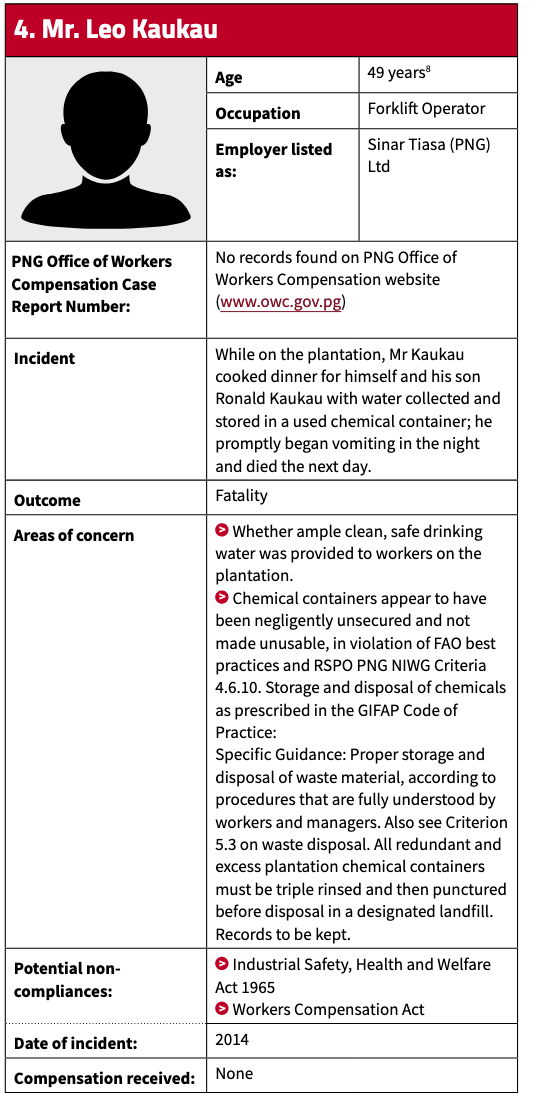
Papua New Guinea -landgrabbing for palm oil

“Tainted palm oil from Papua New Guinea plantations was sold to household name brands, all of them RSPO members including Kellogg’s, Nestlé, Colgate, Danone, Hershey’s and PZ Cussons and Reckitt Benckiser”

The true price of palm oil: How global finance funds deforestation, violence and human rights abuses in Papua New Guinea – Global Witness, 2021

Deforestation in West Papua

RSPO: 14 years of failure to eliminate violence and destruction from the industrial palm oil sector

Friends of the Earth and 100 other human rights and environmental NGOS co-signed this letter in 2018

Letter

During its 14 years of existence, RSPO – the Roundtable on Sustainable Palm Oil – has failed to live up to its claim of “transforming” the industrial palm oil production sector into a so-called “sustainable” one. In reality, the RSPO has been used by the palm oil industry to greenwash corporate destruction and human rights abuses, while it continues to expand business, forest destruction and profits.

RSPO presents itself to the public with the slogan “transforming the markets to make sustainable palm oil the norm”. Palm oil has become the cheapest vegetable oil available on the global market, making it a popular choice among the group that dominates RSPO membership, big palm oil buyers.

They will do everything to secure a steady flow of cheap palm oil. They also know that the key to the corporate success story of producing “cheap” palm oil is a particular model of industrial production, with ever-increasing efficiency and productivity which in turn is achieved by:

  1. Planting on a large-scale and in monoculture, frequently through conversion of tropical biodiverse forests
  2. Using “high yielding” seedlings that demand large amounts of agrotoxics and abundant water.
  3. Squeezing cheap labour out of the smallest possible work force, employed in precarious conditions so that company costs are cut to a minimum
  4. Making significant up-front money from the tropical timber extracted from concessions, which is then used to finance plantation development or increase corporate profits.
  5. Grabbing land violently from local communities or by means of other arrangements with governments (including favourable tax regimes) to access land at the lowest possible cost.

Those living on the fertile land that the corporations choose to apply their industrial palm oil production model, pay a very high price.

Violence is intrinsic to this model:

  • violence and repression when communities resist the corporate take over of their land because they know that once their land is turned into monoculture oil palm plantations, their livelihoods will be destroyed, their land and forests invaded. In countless cases, deforestation caused by the expansion of this industry, has displaced communities or destroyed community livelihoods where
  • companies violate customary rights and take control of community land;
  • sexual violence and harassment against women in and around the plantations which often stays invisible because women find themselves without possibilities to demand that the perpetrators be prosecuted;
  • Child labour and precarious working conditions that go hand-in-hand with violation of workers’ rights;
  • working conditions can even be so bad as to amount to contemporary forms of slavery. This exploitative model of work grants companies more economic profits while allowing palm oil to remain a cheap product. That is why, neither them or their shareholders do anything to stop it.
  • exposure of workers, entire communities and forests, rivers, water springs, agricultural land and soils to the excessive application of agrotoxics;
  • depriving communities surrounded by industrial oil palm plantations of their food sovereignty when industrial oil palm plantations occupy land that communities need to grow food crops.

RSPO’s proclaimed vision of transforming the industrial oil palm sector is doomed to fail because the Roundtable’s certification principles promote this structural violent and destructive model.

The RSPO also fails to address the industry’s reliance on exclusive control of large and contingent areas of fertile land, as well as the industry’s growth paradigm which demands a continued expansion of corporate control over community land and violent land grabs.

None of RPSO’s eight certification principles suggests transforming this industry reliance on exclusive control over vast areas of land or the growth paradigm inherent to the model.


Industrial use of vegetable oils has doubled in the past 15 years, with palm oil being the cheapest. This massive increase of palm oil use in part explains the current expansion of industrial oil palm plantations, especially in Africa and Latin America, from the year 2000 onward, in addition to the existing vast plantations areas in Malaysia and Indonesia that also continue expanding.


On the ground, countless examples show that industrial oil palm plantations continue to be synonymous to violence and destruction for communities and forests. Communities’ experiences in the new industrial oil palm plantation frontiers, such as Gabon, Nigeria, Cameroon, Liberia, Sierra Leone, Peru, Honduras, Brazil, Colombia, Ecuador, are similar to past and ongoing community experiences in Indonesia and Malaysia.

RSPO creates a smokescreen that makes this violence invisible for consumers and financiers. Governments often fail to take regulatory action to stop the expansion of plantations and increasing demand of palm oil; they rely on RSPO to deliver an apparently sustainable flow of palm oil.

For example, in its public propaganda, RSPO claims it supports more than 100,000 small holders. But the profit from palm oil production is still disproportionally appropriated by the oil palm companies: in 2016, 88% of all certified palm oil came from corporate plantations and 99,6% of the production is corporate-controlled.


RSPO also claims that the principle of Free, Prior and Informed Consent (FPIC) is key among its own Principles and Criteria. The right to FPIC implies, among others, that if a community denies the establishment of this monoculture in its territory, operations cannot be carried out. Reality shows us, however, that despite this, many projects go ahead.

Concessions are often guaranteed long before the company reaches out to the affected communities. Under these circumstances, to say that FPIC is central to RSPO is bluntly false and disrespectful.

RSPO also argues that where conflicts with the plantation companies arise, communities can always use its complaint mechanism. However, the mechanism is complex and it rarely solves the problems that communities face and want to resolve.

This becomes particularly apparent in relation to land legacy conflicts where the mechanism is biased against communities. It allows companies to continue exploiting community land until courts have come to a decision. This approach encourages companies to sit out such conflicts and count on court proceedings dragging on, often over decades.


Another argument used by RSPO is that industrial oil palm plantations have lifted millions of people out of poverty. That claim is certainly questionable, even more so considering that there is also an important number of people who have been displaced over the past decades to make space for plantations.

Indigenous communities have in fact lost their fertile land, forests and rivers to oil palm plantations, adversely affecting their food, culture and local economies.


The RSPO promise of “transformation” has turned into a powerful greenwashing tool for corporations in the palm oil industry. RSPO grants this industry, which remains responsible for violent land grabbing, environmental destruction, pollution through excessive use of agrotoxics and destruction of peasant and indigenous livelihoods, a “sustainable” image.

What’s more, RSPO membership seems to suffice for investors and companies to be able to claim that they are “responsible” actors. This greenwash is particularly stunning, since being a member does not guarantee much change on the ground. Only recently, a company became RSPO member after it was found to deforest over 27.000 hectares of rainforest in Papua, Indonesia.


Certification is structurally dependent on the very same policies and regulation that have given rise to the host of environmental devastation and community land rights violations associated with oil palm plantations. These systemic governance issues are part of the destructive economic model, and embedded in state power.

For this reason, voluntary certification schemes cannot provide adequate protection for forests, community rights, food sovereignty and guarantee sustainability. Governments and financiers need to take responsibility to stop the destructive palm oil expansion that violates the rights of local communities and Indigenous Peoples.

As immediate steps, governments need to:

  • Put in place a moratorium on palm oil plantations expansion and use that as a breathing space to fix the policy frameworks;
  • Drastically reduce demand for palm oil: stop using food for fuel;
  • Strengthen and respect the rights of local communities and Indigenous Peoples to amongst others, self-determination and territorial control.
  • Promote agro-ecology and community control of their forests, which strengthens local incomes, livelihoods and food sovereignty, instead of advancing industrial agro-businesses.

Signatures

  • Aalamaram-NGOAcción Ecológica, Ecuador
  • ActionAid, France
  • AGAPAN
    Amics arbres
  • Arbres amics
  • Amis de la Terre France
  • ARAARBA (Asociación para la Recuperación del Bosque Autóctono)
  • Asociación Conservacionista YISKI, Costa Rica
    Asociación Gaia El Salvador
  • Association Congo Actif, Paris
  • Association Les Gens du Partage, Carrières-sous-Poissy
  • Association pour le développement des aires protégées, Swizterland
  • BASE IS
  • Bézu St Eloi
  • Boxberg OT Uhyst
  • Bread for all
  • Bruno Manser Fund
  • CADDECAE, Ecuador
  • Campaign to STOP GE Trees
  • CAP, Center for Advocacy Practices
  • Centar za životnu sredinu/ Friends of the Earth Bosnia and Herzegovina
  • CESTA – FOE El Salvador
  • CETRI – Centre tricontinental
  • Climate Change Kenya
  • Coalición de Tendencia Clasista. (CTC-VZLA)
  • Colectivo de Investigación y Acompañmiento Comunitario
  • Collectif pour la défense des terres malgaches – TANY, Madagascar
  • Community Forest Watch, Nigeria
  • Consumers Association of Penang
  • Corporate Europe Observatory
  • Cuttington University
  • Down to Earth Consult
  • El Campello
  • Environmental Resources Management and Social Issue Centre (ERMSIC) Cameroon
  • Environmental Rights Action/Friends of the Earth Nigeria
  • FASE ES , Brazil
  • Fédération romande des consommateurs
  • FENEV, (Femmes Environnement nature Entrepreneuriat Vert).
  • Focus on the Global South
  • Forum Ökologie & Papier, Germany
  • Friends of the Earth Ghana
  • Friends of the Earth International
  • GE Free NZ, New Zealand
  • Global Alliance against REDD
  • Global Justice Ecology Project
  • Global Info
  • Gobierno Territorial Autónomo de la Nación Wampís , Peru
  • GRAIN
  • Green Development Advocates (GDA)
  • CameroonGreystones, Ireland
  • Groupe International de Travail pour les Peuples Autochtones
    Grupo ETC
  • Grupo Guayubira, Uruguay
  • Instituto Mexicano de Gobernanza Medioambiental AC Instituto Mexicano de Gobernanza Medioambiental AC
  • Integrated Program for the Development of the Pygmy People (PIDP), DRC
  • Justica Ambiental
  • Justicia Paz e Integridad de la Creacion. Costa Rica
  • Kempityari
  • Latin Ambiente, http://www.latinambiente.org
  • Les gens du partage
  • LOYOLA SCHOOL OF THEOLOGY, MANILA
  • Maderas del Pueblo del Sureste, AC
  • Maiouri nature, Guyane
  • Mangrove Action Project
  • Milieudefensie – Friends of the Earth Netherlands
  • Movimento Amigos da Rua Gonçalo de Carvalho
  • Muyissi Environnement, Gabon
  • Nature-d-congo de la République du Congo
  • New Wind Association from Finland
  • NOAH-Friends of the Earth Denmark
  • Oakland Institute
  • OFRANEH, Honduras
  • Ole Siosiomaga Society Incorporated (OLSSI)
  • ONG OCEAN : Organisation Congolaise des Ecologistes et Amis de la Nature et sommes basés en RD Congo.
  • OPIROMA, Brazil
  • Otros Mundos A.C./Amigos de la Tierra México
  • Paramo Guerrrero Zipaquira
  • PROYECTO GRAN SIMIO (GAP/PGS-España)
  • Quercus – ANCN, Portugal
  • Radd (Reseau des Acteurs du Développement Durable) , Cameroon
  • Rainforest Foundation UK
  • Rainforest Relief
  • ReAct – Alliances Transnationales
  • RECOMA – Red latinoamericana contra los monocultivos de árboles
  • Red de Coordinacion en Biodiversidad , Çosta Rica
  • REFEB-Cote d’Ivoire
  • Rettet den Regenwald, Germany
  • ROBIN WOOD
  • Sahabat Alam Malaysia (Friends of the Earth Malaysia)
  • Salva la Selva
  • School of Democratic Economics, Indonesia
  • Serendipalm Company Limited
  • Sherpa , The Netherlands
  • SYNAPARCAM, Cameroon
  • The Corner House, UK
    Towards Equitable Sustainable Holistic Development
  • TRAFFED KIVU ,RD. CONGOUNIÓN UNIVERSAL DESARROLLO SOLIDARIO
    University of Sussex, UK
  • UTB ColombiaWatch Indonesia!
  • WESSA
    World Rainforest Movement
  • Youth Volunteers for the Environment Ghana

Certification is a weak tool to address global forest and ecosystem destruction.
By improving the image of forest and ecosystem risk commodities and so stimulating demand, certification risks actually increasing the harm caused by the expansion of commodity production.
Certification schemes end up greenwashing products linked to deforestation, ecosystem destruction and rights abuses.

Greenpeace: destruction certified
Destruction Certified by Greenpeace 2021

We find positive effects on prices and income from sale of certified products. However, we find no change in overall household income and assets for workers. The wages for workers are not higher in certified production.

Oya, C., Schaefer, F. & Skalidou, D. The effectiveness of agricultural certification in developing countries: a systematic review. World Dev. 112, 282–312 (2018).

We find that, while sustainability standards can help improve the sustainability of production processes in certain situations, they are insufficient to ensure food system sustainability at scale, nor do they advance equity objectives in agrifood supply chains.

Meemken, EM., Barrett, C.B., Michelson, H.C. et al. Sustainability standards in global agrifood supply chains. Nat Food (2021). https://doi.org/10.1038/s43016-021-00360-3

Join the #Boycott4Wildlife and fight deforestation and greenwashing by using your wallet as a weapon!

Further reading on palm oil ecocide, greenwashing and deceptive marketing

  1. A Brief History of Consumer Culture, Dr. Kerryn Higgs, The MIT Press Reader. https://thereader.mitpress.mit.edu/a-brief-history-of-consumer-culture/
  2. A Deluge of Double-Speak (2017), Jason Bagley. Truth in Advertising. https://truthinadvertising.org/blog/a-deluge-of-doublespeak/
  3. Aggarwal, P. (2011). Greenwashing: The darker side of CSR. Indian Journal of Applied Research, 4(3), 61-66. https://www.worldwidejournals.com/indian-journal-of-applied-research-(IJAR)/article/greenwashing-the-darker-side-of-csr/MzMxMQ==/?is=1
  4. Anti-Corporate Activism and Collusion: The Contentious Politics of Palm Oil Expansion in Indonesia, (2022). Ward Berenschot, et. al., Geoforum, Volume 131, 2022, https://doi.org/10.1016/j.geoforum.2022.03.002
  5. Armour, C. (2021). Green Clean. Company Director Magazine. https://www.aicd.com.au/regulatory-compliance/regulations/investigation/green-clean.html
  6. Balanced Growth (2020), In: Leal Filho W., Azul A.M., Brandli L., özuyar P.G., Wall T. (eds) Responsible Consumption and Production. Encyclopedia of the UN Sustainable Development Goals. Springer, Cham
  7. Berenschot, W., Hospes, O., & Afrizal, A. (2023). Unequal access to justice: An evaluation of RSPO’s capacity to resolve palm oil conflicts in Indonesia. Agriculture and Human Values, 40, 291-304. https://doi.org/10.1007/s10460-022-10360-z
  8. Carlson, K. M., Heilmayr, R., Gibbs, H. K., Noojipady, P., et al. (2018). Effect of oil palm sustainability certification on deforestation and fire in Indonesia. PNAS, 115(1), 121-126. https://doi.org/10.1073/pnas.1704728114
  9. Cazzolla Gatti, R., Liang, J., Velichevskaya, A., & Zhou, M. (2018). Sustainable palm oil may not be so sustainable. Science of The Total Environment, 652, 48-51. https://pubmed.ncbi.nlm.nih.gov/30359800/
  10. Changing Times Media. (2019). Roundtable on Sustainable Palm Oil is ‘greenwashing’ labelled products, environmental investigation agency says. Changing Times Media. https://changingtimes.media/2019/11/03/roundtable-on-sustainable-palm-oil-is-greenwashing-labelled-products-environmental-protection-agency-says/
  11. Client Earth: The Greenwashing Files. https://www.clientearth.org/projects/the-greenwashing-files/
  12. Commodifying sustainability: Development, nature and politics in the palm oil industry (2019). World Development, Volume 121, September 2019, Pages 218-228. https://ideas.repec.org/a/eee/wdevel/v121y2019icp218-228.html
  13. Contrasting communications of sustainability science in the media coverage of palm oil agriculture on tropical peatlands in Indonesia, Malaysia and Singapore (2020). Liu, F. H. M., Ganesan, V., Smith, T. E. L. Environmental Science & Policy, 114. https://www.researchgate.net/publication/343772443_Contrasting_communications_of_sustainability_science_in_the_media_coverage_of_palm_oil_agriculture_on_tropical_peatlands_in_Indonesia_Malaysia_and_Singapore
  14. Cosimo, L. H. E., Masiero, M., Mammadova, A., & Pettenella, D. (2024). Voluntary sustainability standards to cope with the new European Union regulation on deforestation-free products: A gap analysis. Forest Policy and Economics, 164, 103235. https://doi.org/10.1016/j.forpol.2024.103235
  15. Dalton, J. (2018). No such thing as sustainable palm oil – ‘certified’ can destroy even more wildlife, say scientists. The Independent. https://www.independent.co.uk/climate-change/news/palm-oil-sustainable-certified-plantations-orangutans-indonesia-southeast-asia-greenwashing-purdue-a8674681.html
  16. Davis, S. J., Alexander, K., Moreno-Cruz, J., et al. (2023). Food without agriculture. Nature Sustainability. https://www.nature.com/articles/s41893-023-01241-2
  17. EIA International. (2022). Will palm oil watchdog rid itself of deforestation or continue to pretend its products are sustainable? EIA International. https://eia-international.org/news/will-palm-oil-watchdog-rid-itself-of-deforestation-or-continue-to-pretend-its-products-are-sustainable/
  18. Environmental Investigation Agency. (2019). Palm oil watchdog’s sustainability guarantee is still a destructive con. EIA International. https://eia-international.org/news/palm-oil-watchdogs-sustainability-guarantee-is-still-a-destructive-con/
  19. Federal Trade Commission. (n.d.). Green Guides. https://www.ftc.gov/news-events/topics/truth-advertising/green-guides
  20. Fifteen environmental NGOs demand that sustainable palm oil watchdog does its job (2019). Rainforest Action Network. https://www.ran.org/press-releases/fifteen-environmental-ngos-demand-that-sustainable-palm-oil-watchdog-does-its-job/
  1. Friends of the Earth International. (2018). RSPO: 14 years of failure to eliminate violence and destruction from the industrial palm oil sector. Friends of the Earth International. https://www.foei.org/rspo-14-years-of-failure-to-eliminate-violence-and-destruction-from-the-industrial-palm-oil-sector/
  2. Lang, Chris and REDD Monitor. Sustainable palm oil? RSPO’s greenwashing and fraudulent audits exposed. The Ecologist. https://theecologist.org/2015/nov/19/sustainable-palm-oil-rspos-greenwashing-and-fraudulent-audits-exposed
  3. Gatti, L., Pizzetti, M., & Seele, P. (2021). Green lies and their effect on intention to invest. Journal of Business Research, 127, 376-387. https://doi.org/10.1016/j.jbusres.2021.01.028
  4. Global Witness. (2023). Amazon palm: Ecocide and human rights abuses. Global Witness. https://www.globalwitness.org/en/campaigns/environmental-activists/amazon-palm/
  5. Global Witness. (2021). The True Price of Palm Oil. Global Witness. https://www.globalwitness.org/en/campaigns/forests/true-price-palm-oil/
  6. Grain. (2021). Ten reasons why certification should not be promoted in the EU anti-deforestation regulation. Grain. https://grain.org/en/article/6856-ten-reasons-why-certification-should-not-be-promoted-in-the-eu-anti-deforestation-regulation
  7. Green Clean (2021). Armour, C. Company Director Magazine.
  8. Green marketing and the Australian Consumer Law (2011). Australian Competition and Consumer Commission. https://www.accc.gov.au/system/files/Green%20marketing%20and%20the%20ACL.pdf
  9. Greenwash and spin: palm oil lobby targets its critics (2011). Helan, A. Ecologist: Informed by Nature. https://theecologist.org/2011/jul/08/greenwash-and-spin-palm-oil-lobby-targets-its-critics
  10. Greenwashing: definition and examples. Selectra https://climate.selectra.com/en/environment/greenwashing#:~:text=Greenwashing%20is%20the%20practice%20of,its%20activities%20pollute%20the%20environment.
  11. Greenwashing of the Palm Oil Industry (2007). Mongabay. https://news.mongabay.com/2007/11/greenwashing-the-palm-oil-industry/
  12. Group Challenges Rainforest Alliance Earth-Friendly Seal of Approval (2015). Truth in Advertising. https://www.truthinadvertising.org/group-challenges-rainforest-alliance-earth-friendly-seal-of-approval
  13. Helan, A. (2011). Greenwash and spin: palm oil lobby targets its critics. Ecologist: Informed by Nature. https://theecologist.org/2011/feb/15/greenwash-and-spin-palm-oil-lobby-targets-its-critics
  14. Hewlett Packard. (2021). What is Greenwashing and How to Tell Which Companies are Truly Environmentally Responsible. Hewlett Packard. https://www.hp.com/us-en/shop/tech-takes/what-is-greenwashing-environmentally-responsible-companies
  15. Holzner, A., Rameli, N. I. A. M., Ruppert, N., & Widdig, A. (2024). Agricultural habitat use affects infant survivorship in an endangered macaque species. Current Biology. https://pubmed.ncbi.nlm.nih.gov/38194972/
  16. How Cause-washing Deceives Consumers (2021). Truth in Advertising. https://truthinadvertising.org/resource/how-causewashing-deceives-consumers/
  17. International Labour Organization. (2020). Forced labor in the palm oil industry. ILO. https://www.ilo.org/topics/forced-labour-modern-slavery-and-human-trafficking
  18. Jauernig, J., Uhl, M., & Valentinov, V. (2021). The ethics of corporate hypocrisy: An experimental approach. Futures, 129, 102757. https://doi.org/10.1016/j.futures.2021.102757
  19. Kirby, D. (2015). Sustainable Palm Oil? Who Knows, Thanks to Derelict Auditors. Take Part. https://www.yahoo.com/news/sustainable-palm-oil-knows-thanks-derelict-auditors-200643980.html
  20. Li, T. M., & Semedi, P. (2021). Plantation life: Corporate occupation in Indonesia’s oil palm zone. Duke University Press. https://www.dukeupress.edu/plantation-life
  21. Liu, F. H. M., Ganesan, V., & Smith, T. E. L. (2020). Contrasting communications of sustainability science in the media coverage of palm oil agriculture on tropical peatlands in Indonesia, Malaysia, and Singapore. Environmental Science & Policy, 114. https://www.researchgate.net/publication/343772443_Contrasting_communications_of_sustainability_science_in_the_media_coverage_of_palm_oil_agriculture_on_tropical_peatlands_in_Indonesia_Malaysia_and_Singapore
  1. Meemken, E. M., Barrett, C. B., Michelson, H. C., et al. (2021). Sustainability standards in global agrifood supply chains. Nature Food. https://doi.org/10.1038/s43016-021-00299-2
  2. Miles, T. (2019). Study in WHO journal likens palm oil lobbying to tobacco and alcohol industries. Reuters. https://www.reuters.com/article/idUSKCN1P21ZR/
  3. Nygaard, A. (2023). Is sustainable certification’s ability to combat greenwashing trustworthy? Frontiers in Sustainability, 4, Article 1188069. https://doi.org/10.3389/frsus.2023.1188069
  4. Oppong-Tawiah D, Webster J. Corporate Sustainability Communication as ‘Fake News’: Firms’ Greenwashing on Twitter. Sustainability. 2023; 15(8):6683. https://www.mdpi.com/2071-1050/15/8/6683
  5. Pabon, J. (2024). The great greenwashing: How brands, governments, and influencers are lying to you. Anansi International. https://www.vitalsource.com/products/the-great-greenwashing-john-pabon-v9781487012878
  6. Podnar, K., & Golob, U. (2024). Brands and activism: Ecosystem and paradoxes. Journal of Brand Management, 31, 95–107. https://link.springer.com/article/10.1057/s41262-024-00355-y
  7. Rainforest Action Network. (2019). Fifteen environmental NGOs demand that sustainable palm oil watchdog does its job. RAN. https://www.ran.org/press-releases/fifteen-environmental-ngos-demand-that-sustainable-palm-oil-watchdog-does-its-job/
  8. Renner, A., Zellweger, C., & Skinner, B. (2021). ‘Is there such a thing as sustainable palm oil? Satellite images show protected rainforest on fire’. Neue Zürcher Zeitung. https://www.nzz.ch/english/palm-oil-boom-threatens-protected-rainforest-in-indonesia-ld.1625490
  9. Saager, E. S., Iwamura, T., Jucker, T., & Murray, K. A. (2023). Deforestation for oil palm increases microclimate suitability for the development of the disease vector Aedes albopictus. Scientific Reports, 13(1), 9514. https://www.nature.com/articles/s41598-023-35452-6
  10. Southey, F. (2021). What do Millennials think of palm oil? Nestlé investigates. Food Navigator. https://www.foodnavigator.com/Article/2021/08/12/What-do-Millennials-think-of-palm-oil-Nestle-investigates
  11. Transparency International. (2023). Transparency international report: Corruption and corporate capture in Indonesia’s top 50 palm oil companies. Transparency International. https://palmoildetectives.com/2023/05/14/transparency-international-report-corruption-and-corporate-capture-in-indonesias-top-50-palm-oil-companies/
  12. Truth in Advertising. (2022). Companies accused of greenwashing. https://truthinadvertising.org/articles/companies-accused-greenwashing/
  13. Truth in Advertising. (n.d.). How causewashing deceives consumers. https://truthinadvertising.org/resource/how-causewashing-deceives-consumers/
  14. Tybout, A. M., & Calkins, T. (Eds.). (2019). Kellogg on Branding in a Hyper-Connected World. Kellogg School of Management, Northwestern University. https://www.wiley.com/en-au/Kellogg+on+Branding+in+a+Hyper-Connected+World-p-9781119533184
  15. Wicke, J. (2019). Sustainable palm oil or certified dispossession? NGOs within scalar struggles over the RSPO private governance standard. Bioeconomy & Inequalities: Working Paper No. 8. https://www.bioinequalities.uni-jena.de/sozbemedia/WorkingPaper8.pdf
  16. World Health Organisation. (2019). The palm oil industry and noncommunicable diseases. World Health Organisation Bulletin, 97, 118-128. https://pubmed.ncbi.nlm.nih.gov/30728618/
  17. World Rainforest Movement. (2021, November 22). Why the RSPO facilitates land grabs for palm oil. https://wrm.org.uy/articles-from-the-wrm-bulletin/section1/why-the-rspo-facilitates-land-grabs-for-palm-oil/
  18. Zuckerman, J. (2021). The Time Has Come to Rein In the Global Scourge of Palm Oil. Yale Environment 360, Yale School of Environment. https://e360.yale.edu/features/the-time-has-come-to-rein-in-the-global-scourge-of-palm-oil

Contribute to my Ko-Fi

Did you enjoy visiting this website?

Contribute to my kofi

Palm Oil Detectives is 100% self-funded

Palm Oil Detectives is completely self-funded by its creator. All hosting and website fees and investigations into brands are self-funded by the creator of this online movement. If you like what I am doing, you and would like me to help meet costs, please send Palm Oil Detectives a thanks on Ko-Fi.


Africa’s rainforests are different. Why it matters that they’re protected

Around 2 million km² of #Africa is covered by tropical #rainforests. They are second only in extent to those in #Amazonia, which cover around 6 million km². Rainforests are home to vast numbers of species of #primates #birds #insects and more. For example, the world’s tropical rainforests are estimated to be home to at least 40,000 tree species, with up to 6,000 in African forests. Protect all rainforests before it’s too late, every time you shop use your wallet as a weapon and be #Vegan #BoycottPalmOil #Boyott4Wildlife

African rainforests are poorly studied compared to those in Amazonia and South East Asia. And the continent’s rainforests are being lost to deforestation at a rate of 0.3% every year. This is slower than in Amazonia (estimated to be 0.5% per year in Brazil) and South East Asia (1% in Indonesia).

But greater losses are likely in the future if palm oil production, driven by growing global demand, expand. Another major threat is logging which is also on the rise.

Help for African rainforests may come from an unexpected source: international policies to tackle climate change.

The world’s tropical forests store 250 billion tonnes of carbon. If global temperature increases are to be kept well below 2°C this carbon needs to be kept locked away in trees rather than released into the atmosphere. Because of this, incentives to conserve forests for their carbon were officially recognised at the Paris climate summit in 2015. Examples include the United Nations REDD+ policy framework.

But our research into the relationship between the amount of carbon forests store and their biodiversity produced two interesting findings. The first suggests that carbon focused approaches like REDD+ will miss many forests with high biodiversity. This is because the forests that store the most carbon are not necessarily home to the most species.

The second is that Africa’s rainforests have unique characteristics. In particular, we found that they store more carbon than those in the Amazon. This makes designing policies that protect them all the more important, and more complex.

Tree diversity and carbon storage

At first glance, incentives to protect forests for their carbon should also benefit biodiversity. This is because they encourage more forests to be protected. But protecting one area often diverts threats to other areas. So, protecting some forests for their carbon could increase human pressure on others. It’s therefore crucial to know the relationship between biodiversity and carbon storage to assess whether carbon-focused conservation will also protect the most biodiverse forests. That’s what we set out to research.

Africa’s rainforests have unique characteristics that distinguish them from forests elsewhere. Sophie Fauset

Previous studies have found that ecosystem functions like carbon storage increase with biodiversity. So, it may be expected that the forests with the most tree species also have the most carbon. But it’s unknown whether this positive effect of biodiversity would be evident in high-diversity tropical forests.

To see how carbon and biodiversity were related in mature tropical forests we – a team of 115 scientists from 22 countries – surveyed 360 plots situated across the lowland rainforests of South America, Africa and Asia. In each 1 hectare (100 by 100 m) plot we identified and measured the diameter of every tree. From here, we could estimate the amount of carbon the forest stored.

GIF - before and after a rainforest is cut down for palm oil
GIF – before and after a rainforest is cut down for palm oil

Surprisingly, we found that tree diversity and carbon storage were completely unrelated, even after we accounted for the effect of climate and soil.

The absence of a relationship between tree diversity and carbon storage means that strategies like REDD+ – that only promote the conservation of forests with the most carbon – will miss some high diversity forests.

That’s not to say that carbon-focused conservation isn’t still important. Conserving forests for their carbon will be vital to reducing the amount the planet warms, and programmes like REDD+ are needed if this is to happen.

But our results indicate that biodiversity has to be explicitly considered when planning protected areas, and not just assumed to automatically benefit from carbon-focused conservation.

Unique characteristics

Our results also contribute to the growing understanding that African rainforests are unique. For example, they store more carbon than those in the Amazon. On average, a hectare of African rainforest stores 183 tonnes of carbon compared to 140 tonnes in the same area of Amazonian rainforest – but do so with 170 fewer trees per hectare.

The extra carbon in African forests comes from trees being larger; the average diameter of a tree in an African rainforest is 1.5 times larger than that of a tree in the Amazon. Trees in African rainforests are also taller than their Amazonian counterparts.

African forests also have fewer tree species than tropical forests in other continents. If you were to identify 300 trees in an African forest you would find, on average, 65 species, compared to 109 species in the Amazon and 120 species in South East Asia. This low diversity may partly be a legacy of past climate, with dry periods in the past wiping out species that require wet conditions all year round.

African rainforests are still important centres of biodiversity despite having fewer tree species than other rainforests. Forests need to be protected to safeguard both the huge number of species that live in them and the vast amounts of carbon they store.

Our results show that it’s not safe to assume that protecting one of these will automatically protect the other. Instead, both biodiversity and carbon need to be considered when planning how to protect Africa’s rainforests.

Martin Sullivan, Postdoctoral researcher, School of Geography, University of Leeds; Oliver Phillips, Professor of Tropical Ecology, University of Leeds, and Simon Lewis, Professor of Global Change Science at University of Leeds and, UCL

This article is republished from The Conversation under a Creative Commons license. Read the original article.


Take Action in Five Ways

1. Join the #Boycott4Wildlife on social media and subscribe to stay in the loop: Share posts from this website to your own network on Twitter, Mastadon, Instagram, Facebook and Youtube using the hashtags #Boycottpalmoil #Boycott4Wildlife.

Join 3,176 other subscribers

2. Contribute stories: Academics, conservationists, scientists, indigenous rights advocates and animal rights advocates working to expose the corruption of the palm oil industry or to save animals can contribute stories to the website.

3. Supermarket sleuthing: Next time you’re in the supermarket, take photos of products containing palm oil. Share these to social media along with the hashtags to call out the greenwashing and ecocide of the brands who use palm oil. You can also take photos of palm oil free products and congratulate brands when they go palm oil free.

4. Take to the streets: Get in touch with Palm Oil Detectives to find out more.

5. Donate: Make a one-off or monthly donation to Palm Oil Detectives as a way of saying thank you and to help pay for ongoing running costs of the website and social media campaigns. Donate here

Black Bearded Saki Chiropotes satanas

Black Bearded Saki Chiropotes satanas

Red List Status: Endangered

Locations: North-eastern Amazon, Brazil (specifically from the Tocantins River in Pará east to around the Grajaú River in Maranhão)

Beneath the towering canopy of the Amazon’s north-eastern forests, the Black Bearded Saki moves with quiet purpose, their distinctive shaggy beard and robust body a testament to their resilience in a world under siege. The air is thick with the scent of damp earth and the distant calls of unseen creatures, but the forest is changing—#roads, #dams, and #agriculture are carving scars across the landscape, fragmenting the Black Bearded Saki’s ancestral home. The black bearded saki’s survival is threatened by relentless deforestation and hunting, their fate bound to the fate of the forest—fight for their survival every time you shop #BoycottPalmOil #Boycott4Wildlife.

Appearance and Behaviour

Black bearded sakis are medium-sized primates, their bodies draped in thick, dark fur and their faces framed by a distinctive, flowing beard. Adults typically measure around 50 centimetres in length, with a tail nearly as long as their body, and weigh between 2.5 and 3.5 kilograms. Their robust build and strong limbs allow them to move with surprising agility through the upper canopy, where they spend most of their lives. The black bearded saki’s most remarkable feature is their powerful jaw and specialised teeth, which enable them to crack open the hard shells of unripe fruits to reach the nutritious seeds inside. This adaptation makes them one of the most efficient seed predators and seed dispersers in the Amazon, and their foraging habits play a vital role in shaping the forest ecosystem.

Black bearded sakis live in groups of up to 40 individuals, though smaller groups are more common. They are highly social, with strong bonds between group members, and communicate through a variety of vocalisations, including chirps, whistles, and alarm calls. Their days are spent foraging, resting, and moving through the canopy, rarely descending to the forest floor. The black bearded saki’s presence is often marked by the sound of falling fruit and the rustle of leaves as they leap from branch to branch.

Threats

The greatest risks for the future survival of the Black Bearded Saki, also known as the Black Cuxiú are the loss and fragmentation of their habitat and hunting pressure.

IUCN Red list

Palm oil, meat, and soy deforestation

The black bearded saki is classified as Endangered on the Red List, with the loss and fragmentation of their forest habitat the primary threat to their survival. In the north-eastern Amazon, large-scale infrastructure projects—such as highways and the Tucurúi Dam—have destroyed vast tracts of forest, while smaller-scale logging and agriculture continue to fragment the remaining habitat. The forest, once a living, breathing entity, is being replaced by roads, fields, and settlements, leaving only isolated patches where the black bearded saki can survive. This fragmentation isolates populations, reduces genetic diversity, and increases the risk of disease and local extinction. The black bearded saki’s ability to adapt to habitat loss is limited, and their long-term survival depends on the protection and restoration of connected forest landscapes.

Hunting and poaching

Hunting for bushmeat is a persistent threat to the black bearded saki, with individuals targeted for their meat and, in some cases, their tails, which are used as dusters. The influx of people into previously uninhabited areas of the Amazon has increased hunting pressure, and the loss of habitat makes sakis more vulnerable to capture. Hunting disrupts social groups, reduces population numbers, and threatens the genetic health of remaining populations. The black bearded saki is already locally extinct in much of its original range, and continued hunting could push them closer to extinction.

Habitat fragmentation and climate change

The fragmentation of the Amazon’s forests has profound effects on the black bearded saki. Small, isolated forest patches limit the availability of food and mates, and groups living in these fragments often show reduced movement and vocalisation, as well as increased resting. Population densities in small fragments can increase, leading to higher rates of disease and parasite transmission. Climate change adds further pressure, altering rainfall patterns and the availability of key food sources. The black bearded saki’s world is becoming hotter, drier, and less predictable, with the forests they depend on shrinking year by year.
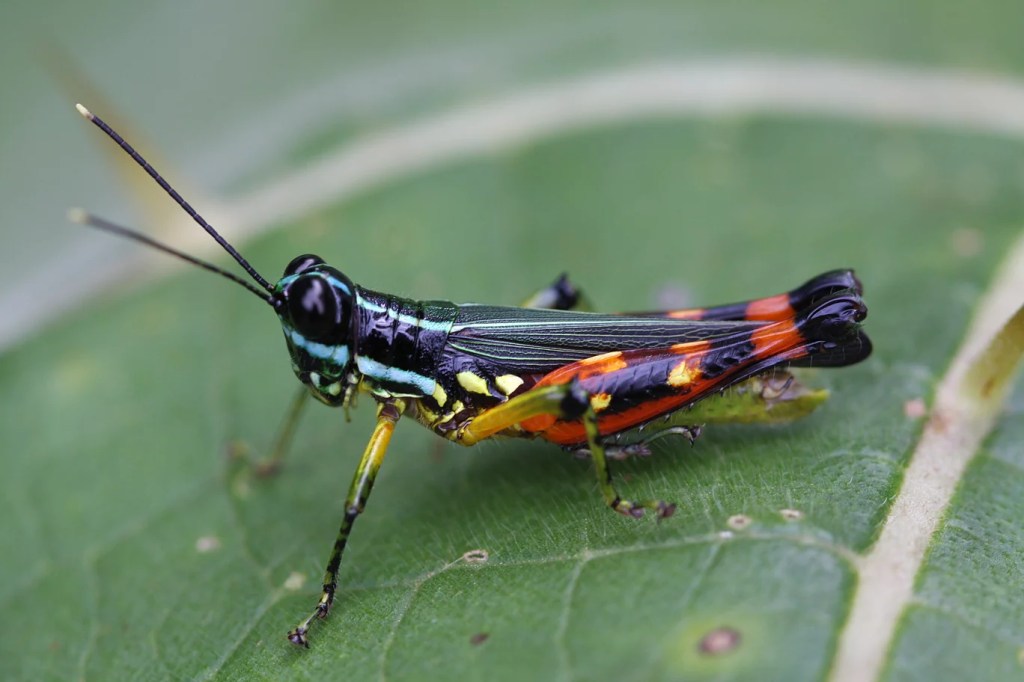
Diet

Black bearded sakis are among the most specialised seed dispersers in the Amazon, with seeds making up the majority of their diet. They spend at least 75% of their feeding time consuming seeds from more than 50 different fruit species, using their powerful jaws and specialised teeth to crack open hard-shelled fruits that few other animals can access. Their diet also includes ripe fruit, flowers, leaf stalks, and arthropods such as caterpillars, termites, and gall wasps. The black bearded saki’s foraging habits are closely tied to the seasonal availability of fruit, with peak feeding activity during the rainy season when many trees are fruiting. Their role as seed predators helps shape the composition of the forest, and their ability to exploit hard-shelled fruits gives them a unique niche in the ecosystem.

Reproduction and Mating

Little is known about the reproductive habits of black bearded sakis in the wild, but observations in captivity and from related species suggest that births occur at the beginning of the rainy season, typically in December or January. Gestation is estimated to last four to five months, and females give birth to a single infant. The mother is the primary caregiver, nursing and carrying her young until the infant is weaned at around three months of age. After weaning, infants remain close to their mothers for protection, and strong social bonds within the group help ensure the survival of young sakis. The reproductive success of black bearded sakis is closely tied to the availability of food and the stability of their forest home.

Geographic Range

The black bearded saki is endemic to the far eastern Amazon in Brazil, with a range restricted to a relatively small region from the Tocantins River in Pará east to around the Grajaú River in Maranhão. They inhabit primary terra firme forests and, occasionally, regenerating forests, rarely descending to the forest floor. The natural home range of a black bearded saki group can vary from 200 to 250 hectares, but habitat loss and fragmentation have reduced the size and connectivity of these ranges. The black bearded saki is already locally extinct in much of its original range, and the remaining populations are increasingly isolated and vulnerable.

FAQs

How many black bearded sakis are left?

Estimates suggest that fewer than 2,500 mature black bearded sakis remain in the wild, with populations continuing to decline due to habitat loss, fragmentation, and hunting. The species is already locally extinct in much of its original range, and the remaining individuals are scattered across increasingly isolated forest fragments.

What are the characteristics of the black bearded saki?

The black bearded saki is a medium-sized primate with thick, dark fur and a distinctive, flowing beard. Adults typically measure around 50 centimetres in length, with a tail nearly as long as their body, and weigh between 2.5 and 3.5 kilograms. They are highly specialised seed predators, with powerful jaws and unique dentition that allow them to crack open hard-shelled fruits. Black bearded sakis live in social groups, communicate through a variety of vocalisations, and spend most of their lives in the upper canopy.

What do black bearded saki eat?

Black bearded sakis are highly specialised seed predators, with seeds making up the vast majority of their diet. They spend at least 75% of their feeding time consuming seeds from more than 50 different fruit species, using their robust jaws and specialised teeth to crack open hard-shelled fruits that many other animals cannot access. Their diet also includes fleshy fruits and, to a lesser extent, insects. They are particularly fond of plants from the Sapotaceae, Lecythidaceae, and Chrysobalanaceae families. This dietary flexibility allows black bearded sakis to adapt to changing forest conditions, but their reliance on certain tree species makes them vulnerable to habitat loss and selective logging.

Is the black bearded saki a monkey?

Yes, the black bearded saki is a monkey—specifically, a New World monkey native to the Amazon rainforest. Unlike apes, monkeys have tails, and the black bearded saki’s long, muscular tail helps them balance as they move through the trees. They are part of the bearded saki group, known for their robust build, thick fur, and specialised feeding habits.

What are the main threats to the survival of the black bearded saki?

The main threats to the survival of the black bearded saki are habitat loss and fragmentation caused by infrastructure projects, logging, and agriculture, as well as hunting for bushmeat. The loss of forest isolates populations, reduces genetic diversity, and increases the risk of disease and local extinction. Hunting further reduces population numbers and disrupts social groups.

How does habitat fragmentation affect the black bearded saki?

Habitat fragmentation isolates black bearded saki groups, reducing the availability of food and mates and increasing the risk of disease. Groups living in small, isolated forest patches often show reduced movement and vocalisation, as well as increased resting. Population densities in small fragments can increase, leading to higher rates of disease and parasite transmission. The black bearded saki’s ability to adapt to habitat loss is limited, and their long-term survival depends on the protection and restoration of connected forest landscapes.

Do black bearded sakis make good pets?

Black bearded sakis do not make good pets. Captivity causes extreme stress, loneliness, and early death for these highly social, intelligent primates. The pet trade and hunting for bushmeat rip families apart and fuel extinction, as infants are stolen from their mothers and forced into unnatural, impoverished conditions. Protecting black bearded sakis means rejecting the illegal pet trade and supporting their right to live wild and free in their forest home.

Where do bearded sakis live?

Bearded sakis, including the black bearded saki, are endemic to the Amazon rainforest in South America. The black bearded saki specifically inhabits a small region in north-eastern Brazil, from the Tocantins River in Pará east to the Grajaú River in Maranhão. They prefer primary tropical rainforests with dense, continuous canopies, which provide safety from predators and abundant food sources. Their natural home ranges can vary from 200 to 250 hectares, but habitat fragmentation has dramatically reduced the size and connectivity of these ranges. Today, black bearded sakis are found only in scattered forest fragments, making their survival increasingly precarious.

What is the lifespan of a black bearded saki?

The lifespan of the black bearded saki is estimated to be up to 18 years in the wild, with sexual maturity typically reached at around 4 years of age. Females usually give birth every two years, and the long interval between births suggests a relatively slow reproductive rate. Closely related bearded saki species have been known to live up to 20 years in the wild, though specific data for the black bearded saki remains limited. Their longevity is closely tied to the quality and continuity of their forest habitat, with threats such as habitat destruction and hunting potentially reducing average lifespans in fragmented environments

Take Action!

Use your wallet as a weapon and #BoycottPalmOil #Boycott4Wildlife. Support indigenous-led conservation and agroecology. Reject products linked to deforestation, mining, and the illegal wildlife trade. Adopt a #vegan lifestyle and #BoycottMeat to protect wild and farmed animals alike. Every choice matters—stand with the black bearded saki and defend the forests of the Amazon.

You can support this beautiful animal

There are no known conservation activities for this animal. Share out this post to social media and join the #BoycottPalmOil #Boycott4Wildlife on social media to raise awareness

Further Information

ICUN endangered logo

Boubli, J. P., de Lima, E. M., Silva, M. N. F., & Silva Júnior, J. S. (2009). Bearded sakis in south-eastern Amazonia—back from the brink? Oryx, 43(2), 283–288. https://www.cambridge.org/core/journals/oryx/article/bearded-sakis-in-southeastern-amazoniaback-from-the-brink/703BC0853B02C2FB8017AD73EDA6BAB8

Neprimateconservancy.org. (n.d.). Black Bearded Saki, Chiropotes satanas. https://neprimateconservancy.org/black-bearded-saki/

Port-Carvalho, M., Muniz, C.C., Fialho, M.S., Alonso, A.C., Jerusalinsky, L. & Veiga, L.M. 2021. Chiropotes satanas (amended version of 2020 assessment). The IUCN Red List of Threatened Species 2021: e.T39956A191704509. https://dx.doi.org/10.2305/IUCN.UK.2021-1.RLTS.T39956A191704509.en. Downloaded on 05 June 2021.

van Roosmalen, M. G. M., Mittermeier, R. A., & Fleagle, J. G. (1988). Diet of the northern bearded saki (Chiropotes satanas chiropotes): A neotropical seed predator. American Journal of Primatology, 14(1), 11–35. https://doi.org/10.1002/ajp.1350140103

Veiga, L. M., & Ferrari, S. F. (2007). Conservation status of the black-bearded saki Chiropotes satanas in Maranhão, Brazil. International Journal of Primatology, 28(2), 347–358. https://doi.org/10.1007/s10764-007-9146-6

Wikipedia. (n.d.). Black bearded saki. https://en.wikipedia.org/wiki/Black_bearded_saki


Contribute to palm oil detectives - black rhino in profile

How can I help the #Boycott4Wildlife?


Take Action in Five Ways

1. Join the #Boycott4Wildlife on social media and subscribe to stay in the loop: Share posts from this website to your own network on Twitter, Mastadon, Instagram, Facebook and Youtube using the hashtags #Boycottpalmoil #Boycott4Wildlife.

Join 3,176 other subscribers

2. Contribute stories: Academics, conservationists, scientists, indigenous rights advocates and animal rights advocates working to expose the corruption of the palm oil industry or to save animals can contribute stories to the website.

3. Supermarket sleuthing: Next time you’re in the supermarket, take photos of products containing palm oil. Share these to social media along with the hashtags to call out the greenwashing and ecocide of the brands who use palm oil. You can also take photos of palm oil free products and congratulate brands when they go palm oil free.

4. Take to the streets: Get in touch with Palm Oil Detectives to find out more.

5. Donate: Make a one-off or monthly donation to Palm Oil Detectives as a way of saying thank you and to help pay for ongoing running costs of the website and social media campaigns. Donate here

Why join the #Boycott4Wildlife?

According to a 2021 survey by Nestle of 1001 people, 17% of millennial shoppers (25-45 years old) completely avoid palm oil in the supermarket. 25% said that they actively check to see if products contain palmoil.

As a generation, we now have the opportunity to push our local communities and our children away from harmful palm oil towards buying products from local, small-scale businesses with small local supply chains.

We have the opportunity to rethink the out-of-control global food industry and using our wallet as a weapon to fight deforestation, greenwashing and illegal land-grabbing of rainforests from Indigenous peoples. On a personal basis, we have the ability to foster a healthier relationship to the things we buy – because the things we buy are destroying our planet!

The solution to the problem of palm oil is to get global brands to drop it completely because despite promises of WWF and The RSPO, after 18 years, the certification has failed to stop deforestation, many organisations have called the RSPO out for corruption and greenwashing. Palm oil, certified or not – is still destroying rainforests and sending thousands of rare and beautiful animals extinct, displacing Indigenous people and spewing massive plumes of Co2 into the atmosphere.

Industrial agriculture for other ingredients is doing exactly the same thing as palm oil – certification for these ingredients is also a greenwashing lie. So the #Boycott4Wildlife includes global supermarket brands that are causing tropical deforestation and Indigenous land-grabbing for soy, meat, palm oil, cocoa and any other ingredients.

Pledge your support now to the #Boycott4Wildlife

← Back

Thank you for your response. ✨

Thank you for supporting the global movement towards the #Boycott4Wildlife and a new Steady State Economics model of looking after our planet.

A #Boycott4Wildlife is a #boycott on out-of-control industrial agriculture causing #deforestation for #soy #palmoil #meat #cocoa #coffee. Learn how to use your wallet as a weapon and hold corporate #greed to account.

What’s the alternative?


New economic models such as Donut Economics and the Centre of the Advancement of the Steady State Economy (CASSE) offer hope and show a new way for industrial agriculture, the energy sector and other major polluting industries that is closely aligned to living in harmony and balance with ecosystems, animals, Indigenous peoples and with the finite, limited resources that we have on our planet. Learn more about this model here.

Economic growth” (GDP growth) encourages wasteful overconsumption. This adds to economic throughput and is considered good for the economy- boosting GDP. In a steady state economy, people consume enough to meet their needs and lead meaningful, joyful lives without undermining the life-support systems of the planet.

martin tye, director, Australian Regional Communities Division- CASSE

Wildlife Vet Dr Richard K Ssuna

Dr Richard K Ssuna: In His Own Words

Wildlife and Domestic Animal Vet, Conservationist, Animal Advocate


Bio: Dr Richard K. Ssuna

Dr Richard K. Ssuna has been caring for (wild and domesticated) animals as a Veterinarian for over 20 years. In the past he’s worked for the Uganda Society for the Protection and Care of Animals (USPCA), the Jane Goodall Institute and Chimpanzee Sanctuary, Wildlife Conservation Trust on Ngamba Island Chimpanzee Sanctuary and the Lilongwe Wildlife Centre. Dr Ssuna also established the Lilongwe Society and Protection of Animals (LSPCA) and also worked as the technical advisor for the Second Chance Chimpanzee Refuge in Liberia. He is currently the Founder of All Creatures Animal Welfare Trust in Malawi, Lesotho and Uganda.

Over the years, Dr Ssuna has received many awards for animal welfare, and veterinary practice including:

  • The William Wilberforce Award in 2012.
  • The Africa Animal Advocate Award by Humane Society International (HSI) in 2014.
  • Special Recognition for Outstanding Leadership for Ngamba Island in 2018.
  • World Animal Day Ambassador for Malawi.

Along with a veterinary degree, Dr Ssuna holds a Masters of Science in Wild Animal Health (Royal Veterinary College, University of London) and a Masters of International Animal Welfare Ethics & Law (Royal School of Veterinary Studies, University of Edinburgh).

Dr Ssuna is an absolute inspiration to animal lovers and conservationists all over the world. It is an honour to showcase his work and stories on Palm Oil Detectives.

Respected #wildlife and #pet #vet @RichardSsuna talks about @africacreatures saving #animals in #Uganda #Lesotho #Malawi and also #palmoil #landgrabbing #animalrights and the #Boycott4Wildlife #Africa

Respected #wildlife and #pet #vet @RichardSsuna talks about @africacreatures saving #animals in #Uganda #Lesotho #Malawi and also #palmoil #landgrabbing #animalrights and the #Boycott4Wildlife #Africa

‘Foreign #palmoil companies (RSPO members) have claimed the Kalangala Islands, Uganda for #palmoil. The locals have lost their food sources. I support the #Boycottpalmoil #Boycott4Wildlife’ #Wildlife and #Pet Vet @RichardSsuna

“In my view product certifications like @RSPOtweets when their operations adversely affect people, they are designed to cover-up an already messed-up industry.” #Wildlife #vet @RichardSsuna #Boycottpalmoil #Boycott4Wildlife

The public has been hoodwinked into believing that @RSPOtweets #palmoil #certification equates to a sustainable product and as result, companies fetch even more cash for it” #Wildlife #vet @RichardSsuna #Boycottpalmoil #Boycott4Wildlife

‘Please support All Creatures Animal Welfare Trust so we can help domestic and wild animals’ #wildlife and #pet #vet @RichardSsuna of @africacreatures #Boycott4Wildlife


Chimps are very curious and they pay attention to detail

This is how it all started many years ago! Here I am examining one of the baby chimps at a sanctuary. Did you know that chimps appreciate veterinary care? Via Dr Richard Ssuna on Twitter

The beauty with being a wildlife-vet, is that you get to treat all sorts of animals

This leopard developed arthritis from a previous injury. This was her annual general health check. #Wildlife #Animals #AnimalWelfare #Africa @TheWildlifeHost @bigcatscom @Lupita_Nyongo

Originally tweeted by Richard Ssuna (@RichardSsuna) on August 16, 2021.

I used to be the Field Programs Officer and Veterinarian for the Jane Goodall Institute

This project was located in the richly forested areas of Bushenyi (Kalinzu) Hoima (Bulindi, Kitooba, Kaisotonya), Masindi and Kibaale (Kanyanchu).

dr richard ssuna

My organisation All Creatures Animal Welfare helps to keep animals and communities safe…

All Creatures was initially set up in Lilongwe in Malawi in 2016, we now have new sites in Lesotho and Uganda

We specialise in:

  • Mass rabies vaccinations: Rabies is a critical public health concern in Africa and has severe animal welfare and human health consequences.
  • Animal kindness education: We teach in schools and communities about the connection between animal welfare, environmental protection and human wellbeing.
  • Community Veterinary Services: Our free vet services including spaying and neutering, surgery and wildlife interventions.
  • Saving animals from disasters: Animals are often forgotten in natural disasters and pandemics and we are well equipped to save distressed and abandoned animals.
  • Animal Rescue Centre: We have a shelter in Lilongwe and care for abandoned and neglected dogs and other animals.
A dog getting a rabies vaccination - Dr Richard Ssuna

“We have successfully vaccinated 75% of all dogs against rabies in Mzuzu, and vaccinated and sterilised more than 80% dogs in Chintenche, Northern Malawi.”

When Malawi was hit with floods in 2019, we rescued, treated and vaccinated many animals

Photo: The Conversation Arjan van de Merwe/UNDP/Flickr


“We have rescued and treated many different species wildlife, for example: Vervet Monkeys, Bush Babies, Common Duikers and Olive Baboons.”

All Creatures Animal Welfare Trust was set up to care not only for domestic pets, but wildlife too…

This has unfortunately been difficult to implement due to funding and the insurmountable challenges of animal welfare issues for domestic animals. You can help us to help more animals by donating…

Photo by Dalida Innes Wildlife Photography

I helped to rescue baby chimps who have lost their mothers to traps laid by cocoa farmers in Kitooba

I’ve seen first-hand the poaching of baby chimps and the destruction of chimp habitat for cocoa while I was working at The Jane Goodall Institute

~ Dr Richard Ssuna

Indiscriminate traps were usually intended for bush pigs and yellow baboons and laid by local farmers. They are a common affliction to wild chimp populations in West Uganda. The chimps use private forest patches as movement corridors to access their natural habitats. This below was Masindi, 20 years ago!

Originally tweeted by Richard Ssuna (@RichardSsuna) on August 12, 2021.

The other culprit was British American Tobacco

They invested heavily in communities and tobacco farmers planted on deforested forest patches! Both activities adversely affected chimps, as their travel routes through community forests were cut off and some small unviable groups were isolated in small forest fragments.


Globally, deforestation of equatorial forests for palm oil has affected carbon sinks and has resulted in more global warming

~ Dr Richard Ssuna

Kalangala Islands, Uganda

“Foreign companies and RSPO members have claimed the land for palm oil. The local inhabitants of the island suffered from the brute destruction of the island’s forests and their loss of livelihood and food sources.

“This can easily be extrapolated to inform similar misdeeds elsewhere on the African continent. This also affected peoples livelihoods and many of these people became landless.”


The Kalangala Islands are a renowned birders destination. Now, with forest destruction, this pristine bird-haven has been adversely affected and destabilised. All in the interest of a few greedy businessmen!

~ Dr Richard Ssuna

virgin forest in Uganda https://www.pxfuel.com/en/free-photo-xfzmlResearch: Palm Oil Deforestation and its connection to retail brands
[Before] Forested area in Uganda, PxFuel. [After] Fire on a palm oil plantation, Greenpeace.

The global impact of palm oil on various facets of our lives is immoral

Palm oil is driven primarily by greed and profit at the expense of both mankind, the animal kingdom and our planet.

Before the bulldozers came, Magdalena Nakamya harvested coffee, cassava, avocado and jackfruit on her three-hectare (seven-acre) plot on Kalangala, an island in Lake Victoria.

But on a July morning in 2011, Nakamya, 64, awoke to find yellow machines churning up her land and razing the crops she had grown in a bid to make way for palm oil plantations.

Farmers evicted from their land by RSPO member Wilmar in the Kalangala Islands on Lake Victoria

“No one came to talk to me before they destroyed my crops,” says Nakamya. “I heard that some people were given money, but I didn’t receive anything.”

Read more: The Guardian UK


Landgrabbing for palm oil in Uganda by ‘If Not Us Then Who?’

In my view all or most product certifications especially whose operations adversely affect people, are designed to cover-up an already messed-up palm oil industry.

Dr Richard Ssuna

“In my view product certifications like @RSPOtweets when their operations adversely affect people, they are designed to cover-up an already messed-up industry.” #Wildlife #vet @RichardSsuna #Boycottpalmoil #Boycott4Wildlife

Read more: Friends of the Earth and ‘If Not Us, Then Who?’

I think the real hope sits with governments

The political will of governments – provided they are not compromised by kickbacks or other financial interests from global brands, provides the best opportunity to address this problem of deforestation for food, at least on a national level.

“In a real sense, the public has been hoodwinked into believing that a palm oil certification equates to a more sustainable product and as result, companies fetch even more cash for it”

~ Dr Richard Ssuna


The public has been hoodwinked into believing that @RSPOtweets #palmoil #certification equates to a sustainable product and as result, companies fetch even more cash for it” #Wildlife #vet @RichardSsuna #Boycottpalmoil #Boycott4Wildlife

In ten years there will be no more African animals. All gone. Extinct. The window for transformation of our food system is closing rapidly!

Four things consumers can do to stop deforestation for food ingredients…

1. Raise awareness of brands that are using greenwashing to sell products and are destroying the environment and causing tropical deforestation or emptying our oceans.

2. Consume alternative products, made locally and not coming from deforestation.

3. Publicly condemn these brands causing deforestation, whenever and wherever there is a platform, with family and friends and even on social media.

4. Make reference to this issue and to the #Boycott4Wildlife movement, whenever any adverse climatic changes are suffered as a result of deforestation for food.


Please support All Creatures Animal Welfare Trust so we can help domestic and wild animals

We have faced insurmountable challenges in recent years. Your donation will support us to help more animals


Join the #Boycott4Wildlife on supermarket brands causing palm oil deforestation

Join the #Boycott4Wildlife on supermarket brands causing palm oil deforestation

Temminck’s Pangolin Smutsia temminckii

Temminck’s Pangolin Smutsia temminckii

Vulnerable

Extant (resident): Angola; Botswana; Burundi; Central African Republic; Chad; Ethiopia; Kenya; Malawi; Mozambique; Namibia; Rwanda; South Africa; South Sudan; Sudan; Tanzania, United Republic of; Uganda; Zambia; Zimbabwe

Possibly Extant (resident): Congo

Possibly Extinct: Eswatini

The Temminck’s pangolin Smutsia temminckii is remarkable mammal. They are the second largest of the pangolin species and are reported to weigh between 12.5kg and 21 kilograms. They’re famous for their armour-like keratinous scales and their unique ability to curl into a protective ball when threatened. These elusive creatures are found in the savannahs and woodlands of sub-Saharan Africa and are essential to their ecosystem, controlling insect populations. The word pangolin comes from the Malay word “pengguling” meaning something that rolls up. Owing to their secretive nature and low densities, little is known about the pangolin. The species is killed primarily for Chinese medicine, even though their keratin scales have no medicinal value. All pangolins face a grave threat from trafficking for their meat and scales. Tragically, they are one of the most illegally traded mammals in the world.

Despite their ecological and cultural importance, Temminck’s pangolins are increasingly threatened by habitat destruction and illegal wildlife trade. Habitat loss from palm oil, cocoa and coffee agricultural expansion and mining further compounds their decline. Protect these unique creatures by boycotting palm oil and supporting strong anti-trafficking initiatives. #BoycottPalmOil #Boycott4Wildlife

The Temminck’s #pangolin is #vulnerable in Tanzania 🇹🇿 #Congo 🇨🇩 #Uganda 🇺🇬 from #poaching for their scales and meat along with #palmoil 🌴🤮 #tobacco 🚬🚭#deforestation. Help them survive when you #BoycottPalmOil 🌴🔥⛔️#Boycott4Wildlife @palmoildetect https://palmoildetectives.com/2021/08/21/temmincks-pangolin-smutsia-temminckii/

Remarkable, secretive and gentle Temminck #Pangolins are living Poké Balls, who curl into a ball when threatened. They’re #vulnerable from the illegal #wildlife trade #palmoil and more. Help them #BoycottPalmOil 🌴🙊🔥☠️⛔️ #Boycott4Wildlife @palmoildetect https://palmoildetectives.com/2021/08/21/temmincks-pangolin-smutsia-temminckii/

Species of pangolin are the most trafficked species in the world. Although deforestation is another major threat. The range of the Temminck’s Pangolins are increasingly threatened by shifting agriculture, small-holder farming and agro-industry farming. These farming practices are directly impacting pangolins through habitat loss and alteration, while the increased human presence in these previously undisturbed areas is resulting in increased levels of poaching.

IUCN Red List

Appearance and Behaviour

Temminck’s pangolins are medium-sized mammals with an average weight of 7–12 kg and a total length of approximately 90 cm, including their tail. Their overlapping, golden-brown scales, made of keratin (the same material as human fingernails), are a defining feature. These scales provide formidable protection against predators, allowing pangolins to roll into an impenetrable ball when threatened.

They are primarily nocturnal, foraging at night for ants and termites using their acute sense of smell. Their long, sticky tongues can extend deep into termite mounds, while their sharp claws are used to tear open nests. They exhibit a distinctive bipedal gait, walking on their hind legs while keeping their forelimbs off the ground.

A 2014 study revealed that Temminck’s pangolins exhibit home ranges that vary significantly based on habitat type, with individuals travelling several kilometres in search of food. This makes habitat loss and fragmentation particularly detrimental to their survival.


Threats

IUCN Status: Vulnerable

Temminck’s Pangolin Smutsia temminckii threats

Illegal Wildlife Trade:

Temminck’s pangolins are heavily trafficked for their scales and meat, particularly for use in traditional Chinese medicine. Research indicates that their scales are wrongly believed to have healing properties, fuelling a devastating global black market.

Palm oil, tobacco and mining deforestation:

Agricultural expansion for palm oil, meat, tobacco and other commodities as well as mining destroys the habitats pangolins rely on. The savannahs and woodlands they inhabit are increasingly converted for human use.

Bycatch and Accidental Capture:

The 2014 study on anthropogenic threats found that Temminck’s pangolins are frequently killed accidentally in snares set for other wildlife. This unintended bycatch adds to their declining populations.

Climate Change:

Altered rainfall patterns and rising temperatures due to climate change, disrupt termite and ant populations, leading to reduced food availability for pangolins.

Low Reproductive Rates:

With only one offspring per year, Temminck’s pangolins are particularly vulnerable to population declines, as they cannot replenish their population quickly.

Geographic Range

Temminck’s pangolins inhabit sub-Saharan Africa, with populations found in South Africa, Namibia, Angola, Botswana, Zimbabwe, Mozambique, and Zambia. They thrive in savannahs and woodlands, favouring areas with abundant ant and termite populations.

Studies indicate their preference for regions with sandy soils, which make burrowing easier, and their dependence on undisturbed habitats highlights the critical need for protected areas. However, human activities increasingly encroach on these regions, limiting their available range.

Diet

Temminck’s pangolins are specialised insectivores, feeding almost exclusively on ants and termites. They consume millions of insects annually, making them essential for regulating insect populations and maintaining ecological balance.

Their foraging behaviour is influenced by the availability of prey, with pangolins often targeting specific ant and termite species. The destruction of termite mounds through land clearing and agriculture severely impacts their food sources, leading to nutritional stress.

Reproduction and Mating

Reproductive rates in Temminck’s pangolins are low, with females typically giving birth to a single offspring per year. After a gestation period of approximately 140 days, mothers care for their young by carrying them on their tails or backs. They often use the burrows of other animals including aardvarks and aardwolves.

The young pangolins’ soft scales harden within a few days of birth, providing protection. Maternal care is critical during the early months, as juveniles depend on their mothers for food and safety. Males do not participate in rearing the young, and populations are highly sensitive to poaching due to their slow reproductive cycles.

Human Perceptions of Temminck’s Pangolins

Temminck’s pangolins hold mixed perceptions among humans. A 2014 review of anthropogenic threats highlighted cultural beliefs in southern Africa where pangolins are revered as symbols of luck and rain. In contrast, others view them as commodities, hunted for their scales and meat.

The study also revealed that many rural communities are unaware of pangolins’ ecological importance in controlling insect populations. Conservation efforts are increasingly focused on educating these communities about the role pangolins play in maintaining ecosystem balance, with the goal of fostering coexistence and reducing poaching and exploitation.

Take Action!

Help protect Temminck’s pangolins by supporting organisations working to combat illegal wildlife trade and habitat destruction. Boycott palm oil and raise awareness of their plight. Use your voice to fight for their survival and ensure future generations can marvel at these extraordinary creatures. #BoycottPalmOil #Boycott4Wildlife

Temminck’s Pangolin Smutsia temminckii threats

Support this beautiful animal

Save Pangolins

Traffic

Environmental Investigation Agency (EIA)

Further Information

IUCN Rating vulnerable

Pangolin Specialist Group. (n.d.). Temminck’s Pangolin. IUCN Pangolin Specialist Group.

Pietersen, D., Jansen, R. & Connelly, E. 2019. Smutsia temminckii. The IUCN Red List of Threatened Species 2019: e.T12765A123585768. https://dx.doi.org/10.2305/IUCN.UK.2019-3.RLTS.T12765A123585768.en. Downloaded on 06 June 2021.


Pietersen, D., Jansen, R., Swart, J., Panaino, W., Kotze, A., Rankin, P., & Nebe, B. (2020). Temminck’s Pangolin (Smutsia temminckii). In Pangolins: Science, Society and Conservation. Biodiversity of the World: Conservation from Genes to Landscapes, 175–193.


Pietersen, D., McKechnie, A. E., & Jansen, R. (2014). A Review of the Anthropogenic Threats Faced by Temminck’s Ground Pangolin, Smutsia temminckii, in Southern Africa. South African Journal of Wildlife Research, 44(2), 167–178.


Sabashau, K., Utete, B., Madlamoto, D., Ngwenya, N., & Madamombe, H. (2024). Ecology, Status, and Distribution of Temminck’s Pangolin (Smutsia temminckii) in Hwange National Park. Wildlife Letters, 2(17–22).


Contribute to palm oil detectives - black rhino in profile

How can I help the #Boycott4Wildlife?


Take Action in Five Ways

1. Join the #Boycott4Wildlife on social media and subscribe to stay in the loop: Share posts from this website to your own network on Twitter, Mastadon, Instagram, Facebook and Youtube using the hashtags #Boycottpalmoil #Boycott4Wildlife.

Join 3,176 other subscribers

2. Contribute stories: Academics, conservationists, scientists, indigenous rights advocates and animal rights advocates working to expose the corruption of the palm oil industry or to save animals can contribute stories to the website.

3. Supermarket sleuthing: Next time you’re in the supermarket, take photos of products containing palm oil. Share these to social media along with the hashtags to call out the greenwashing and ecocide of the brands who use palm oil. You can also take photos of palm oil free products and congratulate brands when they go palm oil free.

4. Take to the streets: Get in touch with Palm Oil Detectives to find out more.

5. Donate: Make a one-off or monthly donation to Palm Oil Detectives as a way of saying thank you and to help pay for ongoing running costs of the website and social media campaigns. Donate here

Demand for meat is driving deforestation in Brazil – changing the soy industry could stop it

For many people, soy as a commodity has a pretty innocuous reputation thanks to its association with vegan food and meat alternatives. However don’t be fooled – crops of this pale legume are behind much of Brazil’s epidemic of deforestation. Much more #soy is fed to farm animals that people eat than is used in vegan food. Since 2000, #Brazil has doubled its total area of soy plantation to 36 million hectares and become the world’s largest producer. This expansion has erased vast swathes of forest and other habitats in some of the country’s most biodiverse regions. Soy, along with palm oil and meat deforestation are the biggest land-hungry commodities in South America and threaten the world’s largest rainforest biosphere. Help fight against this ecocide every time you shop, be #vegan #BoycottPalmOil #Boycott4Wildlife

About 75% of the soy produced globally is used as animal feed, and a large proportion of soy imported to Europe goes to chicken and pig farms. As a result, the future of the rainforest and savannas of Brazil – not to mention the biodiversity and carbon storage they support – depends on the contents of dinner tables worldwide.

The connection between meat, soy and palm oil deforestation might be invisible to consumers, but that link is well known by those in the business of producing and trading both products. Together with colleagues, we investigated this supply chain to find out what’s preventing businesses from halting habitat destruction in the Cerrado of Brazil, a tropical savanna where soy agriculture is making inroads.

Two trucks on a motorway pass pastures.
Trucks transporting soy pass denuded land in Brazil. Paralaxis/Shutterstock

A lucrative industry

The savannas of the Cerrado surround the westerly borders of the Amazon rainforest. Much of the ongoing deforestation and habitat clearing here is legal – landholders are permitted to deforest up to 80% of their land for agriculture. Clearly, solving this problem isn’t a matter of weeding out offenders.

When we spoke with a local association of soy producers, they said that regulation compels them to reserve between 20% and 35% of the Cerrado for nature, but that it’s hard to achieve. Asking them to improve on this without compensation would apparently only elicit complaints, and could make landholders more likely to clear habitats from their property while the law still allowed them.

Making demands on Brazilian producers to stop deforesting their land because it troubles European consumers evoked Brazil’s colonial past, some argued, and threatened their rights. Soy is seen as a path to national development. Any rules imposed from abroad that threaten this are likely to make matters worse.

The Amazon rainforest meets soybean fields in Mato Grosso, Brazil. Paralaxis/Shutterstock

Why not compensate people in the Cerrado for producing soy without deforestation? Well, it’s not clear who should pay for it. Separating deforestation-free soy from other products would increase the cost for companies sourcing and exporting the soy.

While European retailers sign agreements to end deforestation in their supply chains, implementing them depends on producers and traders cooperating. Retailers argue that passing the cost onto consumers by increasing the price of products like pork is a dead end too. Soy’s role in the meat industry is unfamiliar to most people browsing supermarket aisles, so how can consumers be convinced to pay more for a sustainable product they might not understand the benefit of?

A tropical savanna habitat with shrubs and trees.
The Cerrado features tropical savanna replete with wildlife. Angela Guerrero, Author provided

Growing soy on deforested land is a very profitable business for those involved, from land speculators looking for cheaper plots at the forest frontier, to the growers and distributors of soy, to the banks financing it. The indigenous communities displaced by expanding farmland are the clear losers. If they fight back, they might be killed.

Such a lucrative business can only be made sustainable if there is a financial case for it. Right now, there isn’t. Soy producers are well organised with political clout, and they demand equal partnership in the transition to sustainability, rather than having green rules imposed on them.

A row of caged hens peck at feed from a trough.
Much of the chicken sold in European markets was fed on Brazilian soy. BG-Studio/Shutterstock

Global cooperation for local solutions

Commodities pass between countries and markets in a dense web of exchanges. Data tools are getting better at separating these to reveal the companies and consumer countries linked to deforestation. This recently helped France to reject Brazilian soy, a move which increases pressure on Jair Bolsonaro’s government but might mean producers simply supply other markets with lower standards.

Helping soy producers comply with national laws, such as preserving habitats on at least 20% of their property, could help build trust between producers and the people and organisations demanding deforestation-free soy.

This might not sound very ambitious, but even small improvements have been difficult in Brazilian soy agriculture. The Bolsonaro government has slashed the budget for environmental inspectors and signalled to some producers that it’s reluctant to enforce national laws. Supporting partnerships between national and state government, and local and international organisations who want to uphold Brazil’s own standard could create the necessary trust for enabling bigger changes.

A vast green soybean crop under a blue sky.
Brazil is now the world’s largest producer of soy. Angela Guerrero., Author provided

Another option is encouraging farmers to produce on degraded land, rather than seek to convert new forest. Research shows that the amount of land where forest has been cleared could be used to double current soy production. But growing crops on degraded land is actually more expensive than starting it on forested land.

This is where international initiatives can help. The UN Environment Programme and other partners have launched the Responsible Commodities Facility to provide low-interest credit lines to Brazilian soy and corn farmers who commit to using degraded pasture and avoid clearing forests and native grassland for agriculture.

Solutions like this require people in Europe to think beyond their needs – a juicy chicken leg produced without the guilt of deforestation – to consider the values and priorities of people who work to put that chicken on the table in the first place.

Angela Guerrero, Postdoctoral Researcher in Environmental Governance, Stockholm University and Malika Virah-Sawmy, Visiting Scientist, Humboldt University of Berlin

This article is republished from The Conversation under a Creative Commons license. Read the original article.


Northern Tiger Cat (Oncilla) Leopardus tigrinus

Northern Tiger Cat (Oncilla) Leopardus tigrinus

Vulnerable

Extant: Bolivia; Brazil; Colombia; Costa Rica; Ecuador; French Guiana; Guyana; Panama; Peru; Suriname; Venezuela.

Presence Uncertain: Nicaragua

The northern tiger cat, also known as the oncilla Leopardus tigrinus, is a captivating small wild cat native to Central and South America. Distinguished by their striking, leopard-like coat marked with dark rosettes and a sleek, agile body, this elusive feline is a master of stealth and survival in the dense forests and grasslands they inhabit.

The northern tiger cat is a tiny predator, weighing only 1.5–3 kg, yet they play a significant role in maintaining ecological balance as a keystone predator. These solitary creatures, though mostly ground-dwelling, are adept climbers. They communicate through purring as kittens and have a unique “gurgle” as adults. Their habitats range from the semi-arid Caatinga to the Andean cloud forests. Tragically, this species is classified as Vulnerable, with populations declining due to habitat destruction for palm oil, soy, meat and mining, poaching, and habitat fragmentation. Indigenous-led conservation efforts are vital to protect their remaining habitats. #BoycottPalmOil #Boycott4Wildlife

The beautiful and elegant #Oncilla is a #wildcat 🐱 found in #SouthAmerica. They are #vulnerable due to #deforestation for #gold and #palmoil 🌴⛔️ and are hunted for their fur 😭 #Boycottpalmoil #Boycott4Wildlife #BoycottGold4Yanomami @palmoildetect https://palmoildetectives.com/2021/08/14/northern-tiger-cat-oncilla-leopardus-tigrinus/

The #Oncilla is a small wild #cat found in Central and #SouthAmerica. They are #vulnerable from #soy #meat #palmoil #deforestation. Resist and help them, be #vegan 🥦🍅🥒 and #Boycottpalmoil 🌴🪔⛔️#Boycott4Wildlife @palmoildetect https://palmoildetectives.com/2021/08/14/northern-tiger-cat-oncilla-leopardus-tigrinus/

By and large, the greatest threat to these wild cats is the rampant rate of habitat loss, fragmentation and isolation. In the Andes cloud forests deforestation is mostly due to conversion to agriculture but also includes palm oil, hydroelectric dams, urban sprawl and road building (Payán and Gonzalez-Maya 2011, CI 2012).

IUCN Red list

Appearance and Behaviour

Northern Tiger Cats also known as the Oncillas are often mistaken for other South American small wild cat species such as margays or ocelots. Although oncillas are smaller, they otherwise look very similar to these species, oncillas are more slender and have larger ears.

Oncillas are among the smallest wild cat species, with a body length of 38–59 cm and a long, bushy tail measuring up to 42 cm. Their fur is typically a tawny or yellowish-brown colour adorned with bold rosettes and spots, providing excellent camouflage in their forested habitats. Their large eyes are adapted for nocturnal hunting, making them highly effective at navigating and hunting in low-light conditions.

During the breeding season pairs are sometimes seen, but they are considered as highly solitary animals. Although they are primarily terrestrial, they can climb well. Young kittens purr, while adults make a short and rhythmic “gurgle” sound.

Known for their solitary and elusive nature, these cats are skilled climbers and can often be found resting or hunting in trees. However, they are also proficient terrestrial hunters, using their keen senses and stealth to ambush prey. Northern tiger cats are highly territorial and communicate through scent marking and vocalisations, although encounters between individuals are rare outside of mating.

Threats

IUCN Status: Vulnerable

Northern Tiger Cat (Oncilla) Leopardus tigrinus threats

Deforestation and Habitat Loss:

The primary threat to northern tiger cats is the destruction and fragmentation of their forest habitats due to timber logging, palm oil, soy and meat agriculture, and urban expansion. Palm oil plantations and cattle ranching are significant drivers of deforestation across their range.

Illegal poaching and the illegal pet trade:

Oncillas were once heavily exploited for the fur trade decades ago, following the decline of the Ocelot trade (Payan and Trujillo 2006). Although international trade ceased, there is still some localised illegal hunting, usually for the domestic market.

Oncillas are often caught in snares set for other animals or killed for their beautiful pelts, which are sold in illegal wildlife trade markets. In some cases they are captured and sold into the illegal pet trade.

Human-Wildlife Conflict:

In some areas, these cats are persecuted and killed by farmers who view them as a threat to poultry or livestock.

Climate Change:

Altered rainfall patterns and rising temperatures caused by climate change are shrinking their habitat range and affecting prey availability.

Urgent conservation measures, including habitat protection and restoration, as well as indigenous-led agroecological practices, are critical for their survival.

Geographic Range

Oncillas are found in a broad range of habitats, from the lowland semi-arid Caatinga to cloud forests in the Andes. In Costa Rica the species is almost entirely confined to montane forests along the flanks of volcanoes and other high mountains from 1,000 m up to the treeline (paramo) and occupy cloud forest and high elevation elfin forests (J. Schipper pers. comm.). The Northern Tiger Cat is a poorly known small-sized (2.4 kg) solitary felid, with an average litter size of 1.12 kittens (1–4)
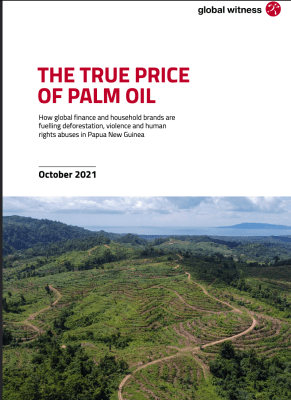
Diet

Northern tiger cats are carnivorous and primarily hunt small mammals, birds, reptiles, and insects. Oncillas are mainly nocturnal but in areas like Caatinga, where their diet primarily consists of diurnal lizards, these animals are more prone to be active in the daytime. They are opportunistic feeders, preying on whatever is most abundant in their environment. Their small size allows them to target prey that larger predators cannot, making them a vital part of the ecosystem as they help regulate populations of smaller animals.

Reproduction and Mating

Northern tiger cats are solitary animals, coming together only during the mating season. Females typically give birth to one or two kittens after a gestation period of 74–76 days. The young are dependent on their mothers for the first few months, learning essential hunting and survival skills before becoming independent.

Take Action!

Help protect northern tiger cats by supporting indigenous-led conservation efforts and advocating for stronger protections against deforestation. Use your wallet as a weapon and choose products free from palm oil. #BoycottPalmOil #Boycott4Wildlife

FAQ

What do northern tiger cats eat?

Northern tiger cats are obligate carnivores with a diet that consists of small mammals such as rodents, birds, reptiles, and insects. They are opportunistic hunters, preying on whatever is most readily available in their environment. Their ability to hunt both in trees and on the ground allows them to exploit a wide variety of food sources, which is crucial in fragmented habitats.

In areas where prey populations are declining due to habitat destruction, northern tiger cats face additional challenges in finding sufficient food. Conservation efforts that protect their prey species are essential for the survival of these elusive predators.

How many northern tiger cats are left in the world?

Precise population estimates are difficult due to the northern tiger cat’s elusive nature, but it is believed that fewer than 10,000 mature individuals remain in the wild. Populations are fragmented and continue to decline due to habitat destruction, poaching, and climate change.

Surveys conducted in key habitats, such as the Atlantic Forest in Brazil and other protected areas, show alarming declines in their numbers. Increased habitat protection and the establishment of wildlife corridors are urgently needed to ensure their survival.

What is the difference between an oncilla and a domesticated house cat?

Northern tiger cats (Leopardus tigrinus), or oncillas, resemble domestic cats in size but differ significantly in behaviour and adaptations. Oncillas are wild predators with leopard-like spots, slender bodies, and large eyes suited for nocturnal hunting. They are highly specialised hunters and climbers, adapted for survival in dense forests.

Unlike house cats, oncillas are solitary and elusive, avoiding human contact. Their diet consists exclusively of wild prey, and they play a crucial role in maintaining ecosystem balance by controlling populations of small animals.

Why are northern tiger cats endangered?

The northern tiger cat is classified as Vulnerable due to ongoing habitat destruction and fragmentation caused by logging, agriculture, and urbanisation. The expansion of palm oil plantations and cattle ranches has significantly reduced their range, isolating populations and limiting gene flow.

Additionally, they are threatened by illegal wildlife trade, roadkill, and persecution by humans who mistakenly view them as pests. Climate change further exacerbates these threats by altering their habitat and prey availability. Addressing these challenges requires urgent conservation action, including habitat protection and indigenous-led conservation initiatives.

You can support this beautiful animal

Merazonia wildlife rescue and sanctuary

International Society for Endangered Cats (ISEC) Canada
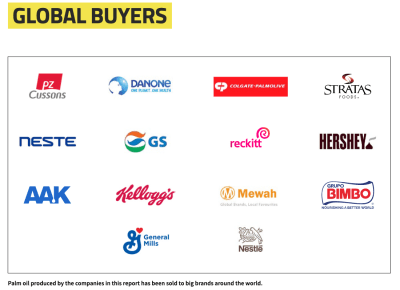
Costa Rica Wildlife Foundation

The Central American Oncilla Project

Further Information

IUCN Rating vulnerable

Inaturalist. (n.d.). Leopardus tigrinus. iNaturalist.

Oliveira, T., Lima, B. C., Rosales, L. A. F., & Pereira, R. S. (2020). A refined population and conservation assessment of the elusive and endangered northern tiger cat (Leopardus tigrinus) in its key worldwide conservation area in Brazil. Global Ecology and Conservation, 22(5), e00927. https://doi.org/10.1016/j.gecco.2020.e00927

Payan, E. & de Oliveira, T. 2016. Leopardus tigrinus. The IUCN Red List of Threatened Species 2016: e.T54012637A50653881. https://dx.doi.org/10.2305/IUCN.UK.2016-2.RLTS.T54012637A50653881.en. Downloaded on 07 June 2021.

Wildcat Conservation. (n.d.). Northern Tiger Cat. Wildcat Conservation Alliance.

World Land Trust. (n.d.). Northern Oncilla.


Contribute to palm oil detectives - black rhino in profile

How can I help the #Boycott4Wildlife?


Take Action in Five Ways

1. Join the #Boycott4Wildlife on social media and subscribe to stay in the loop: Share posts from this website to your own network on Twitter, Mastadon, Instagram, Facebook and Youtube using the hashtags #Boycottpalmoil #Boycott4Wildlife.

Join 3,176 other subscribers

2. Contribute stories: Academics, conservationists, scientists, indigenous rights advocates and animal rights advocates working to expose the corruption of the palm oil industry or to save animals can contribute stories to the website.

3. Supermarket sleuthing: Next time you’re in the supermarket, take photos of products containing palm oil. Share these to social media along with the hashtags to call out the greenwashing and ecocide of the brands who use palm oil. You can also take photos of palm oil free products and congratulate brands when they go palm oil free.

4. Take to the streets: Get in touch with Palm Oil Detectives to find out more.

5. Donate: Make a one-off or monthly donation to Palm Oil Detectives as a way of saying thank you and to help pay for ongoing running costs of the website and social media campaigns. Donate here

Black-Throated monitor Varanus albigularis microstictus

Black-Throated monitor Varanus albigularis microstictus

Data Deficient

Tanzania

The Black-Throated Monitor is a mighty and large lizard reaching over 2 metres long. They are threatened by agriculture deforestation and #hunting for their leather and meat in Tanzania, Africa. Help them every time you shop and #Boycottpalmoil #Boycott4Wildlife

The Black-Throated Monitor is a mighty lizard 🦎💚 reaching over 2 metres long in #Tanzania 🇹🇿 Threatened by #agriculture #deforestation and #hunting for the #leather trade in #Tanzania #Africa. Help them and #Boycott4Wildlife 🌴🪔🧐⛔️ @palmoildetect https://palmoildetectives.com/2021/08/07/black-throated-monitor-varanus-albigularis-microstictus/

The Black-throated Monitor, also known as the Rock Monitor Varanus albigularis is a species of monitor lizard in the family Varanidae. The species is endemic to Central, East, and southern Africa and live in Tanzania. Black-throated Monitors are usually a dark gray-brown with yellowish or white markings, and can reach up to 2.1 m in total length (including tail) and weigh more than 27 kilos. They are the largest of the four subspecies of rock monitor, V. Albigularis.

Monitors are periodically killed from the wild for various reasons, which can include for the leather and pet trade, and also as food by native human populations. An additional threat is non-timber crops and agroforestry.

IUCN red list

In captivity, Black Throated Monitors eat whole prey, such as mice, rats, snakes, lizards, freshwater mollusks, small birds, large roaches, crustaceans, fish, and eggs. They will commonly accept cat and dog food, which is not acceptable as a staple diet due to an improper nutrient profile and high caloric content. In the wild, they will eat anything that they can catch.

Presently, all of the 58 or more species of monitors are classified by the Convention on International Trade in Endangered Species of Wild Fauna and Flora (CITES) as at least Appendix II, which indicates that they are considered potentially threatened and could become vulnerable if trade in these lizards is not regulated. Some monitor species have been or still are classified as Appendix I (endangered).

The ruthless exploitation of many monitor species is very likely causing their populations to decline, and because the population dynamics for monitor species are largely unknown, it is impossible to say just how many individuals can be safely harvested from wild populations without seriously affecting their long-term sustainability.

You can support this beautiful animal

There are no known conservation activities for this animal. Share out this post to social media and join the #BoycottPalmOil #Boycott4Wildlife on social media to raise awareness

Further Information

Reptiles Magazine

Wikipedia


Contribute to palm oil detectives - black rhino in profile

How can I help the #Boycott4Wildlife?


Take Action in Five Ways

1. Join the #Boycott4Wildlife on social media and subscribe to stay in the loop: Share posts from this website to your own network on Twitter, Mastadon, Instagram, Facebook and Youtube using the hashtags #Boycottpalmoil #Boycott4Wildlife.

Join 3,176 other subscribers

2. Contribute stories: Academics, conservationists, scientists, indigenous rights advocates and animal rights advocates working to expose the corruption of the palm oil industry or to save animals can contribute stories to the website.

3. Supermarket sleuthing: Next time you’re in the supermarket, take photos of products containing palm oil. Share these to social media along with the hashtags to call out the greenwashing and ecocide of the brands who use palm oil. You can also take photos of palm oil free products and congratulate brands when they go palm oil free.

4. Take to the streets: Get in touch with Palm Oil Detectives to find out more.

5. Donate: Make a one-off or monthly donation to Palm Oil Detectives as a way of saying thank you and to help pay for ongoing running costs of the website and social media campaigns. Donate here

A global juggling act: feeding the world, saving species

Our planet is on the precipice of a sixth mass extinction event. But unlike the five previous mass extinctions, this one is man-made: a global biodiversity crisis in which species are disappearing three to 12 times faster than the “normal” rate of extinction. A massive driver of this extinction is how humans eat. Be #Vegan for the animals #BoycottPalmOil #Boycott4Wildlife

Australia is not immune from this crisis. In fact, we are in the thick of it: approximately half of all global extinctions of mammals in the last 200 years have been in Australia – more than any other country.

The fundamental driver behind this biodiversity crisis is the unprecedented success of a single species – humans – to manipulate and alter the environment (including moving other species around) to serve its needs.

Can we feed the world and stop deforestation? Depends what's for dinner

A key cause of this biodiversity crisis is agriculture. While it has enabled humans to prosper and occupy all corners of the globe, it has also been the most profound agent of ecological change in the history of life on Earth.

But, we have to eat, right?

As our global population barrels towards 9 billion, can we fulfil our moral obligation to feed and clothe humanity equitably? And can we do so while avoiding a biodiversity catastrophe?

A study published last week in the prestigious journal Science (by ecologists from the University of Cambridge) used data from India and Ghana to contrast two potential approaches to this problem:

  • “Land sparing” is where conservation reserves are set aside for biodiversity protection with food grown intensively on the remaining land.
  • “Land sharing” is where biodiversity conservation and food production happen on the same land.

The researchers found that more species of trees and birds survive under “land sparing” than “land sharing”.

These results are not surprising because (as a general principle) biodiversity and agriculture don’t mix.

Some generalist “hardy” species – such as magpies and galahs – may persist and even thrive in agricultural landscapes but most indigenous species are “losers”.

The Cambridge research suggests the best way to avoid a massive biodiversity collapse is to conserve as many species as possible in reserves. The remaining land should then be dedicated to higher-yield farming.

But the solution is not that straightforward.

Can we save all species? Should we try? How much land do we need to protect to conserve species? Where should those reserves be located in the landscape? Is a dichotomy between conservation reserves and agriculture really helpful?

Even in “frontier” landscapes where virgin habitat is being converted into farmland, decisions about how much land to spare and where to spare it are more often influenced by human needs than ecological considerations.

The Australian dimension

So how do we do things here in Australia?

Well, we have a world-class network of parks and nature reserves, with nearly 13% of our land mass in the national reserve system. These reserves are essential for protecting ecosystems and the species they support.

Yet there are thousands of species officially listed as threatened and many more in precipitous decline that have not yet made it on to threatened species lists.
Further additions to the reserve system are necessary to prevent species extinctions, with targets ranging from 15-35% of the landscape.

Thankfully, there are now many players in this field, with Indigenous Protected Areas and non-government organisations (such as Bush Heritage Australia and the Australian Wildlife Conservancy) sharing the load.

But conservation reserves alone will rarely be enough to ensure the survival of all species.

This is because, traditionally, the reserve system has been made up of “left-overs” – the least arable areas that were not suitable for farming or forestry.

The most productive ecosystems (such as riverine floodplains and flats, grasslands and lowland woodlands) are also the most depleted, least protected and most endangered.

So, if the priority in “land sparing” is on agricultural yield, and the “best” parts of the landscape are devoted to agriculture, it is likely to disadvantage a whole suite of species dependent on those depleted ecosystems.

A blurry line

The trade-off between conservation and production is rarely clear-cut.

In intensively farmed landscapes, typical of much of eastern, southern and south-western Australia, the last remaining fragments of native vegetation are often small, isolated and degraded.

These fragments may not be large enough, good enough or sufficiently connected to support viable populations of many species. We require a more sophisticated approach to managing biodiversity in these landscapes.

A landscape mosaic is one such approach.

In this approach the landscape is viewed as a mosaic containing patches of differing habitat quality.

By recognising the variability in conservation and agricultural value of different patches of the landscape, a mix of land uses can be applied across the mosaic:

  • patches with high conservation value can be reserved solely for biodiversity conservation;
  • patches with medium conservation value can provide habitat for a different suite of species while co-existing with low intensity agriculture;
  • patches with low conservation value can be farmed productively and intensively.

The mosaic approach emphasises connectivity through the landscape and interactions across patch boundaries.

This approach may be applied to large expanses of arid and northern Australia. These are areas which have been grazed but where native vegetation remains largely intact.

Here, we must turn our attention to managing threatening processes such as fire regimes, invasive species and grazing. While this is best achieved through conservation reserves, it is not entirely incompatible with farming.

But ultimately, the greatest threat to producing enough food for our increasing population is unlikely to come from biodiversity conservation.

Instead it will come from urbanisation (especially at the margins of rural cities), mining (case in point: recent land-use conflicts in the Liverpool Plains and Bacchus Marsh) and climate change.

Can we save nature and feed the world? We have no choice but to try.

We can begin by recognising the complexity of landscapes and the need for nature to have space to live, survive and evolve.

For another view on land sharing and land sparing, read “Food vs fauna: can we have our biodiversity and eat too?

Jim Radford, PhD; Honorary Fellow, Deakin University

This article is republished from The Conversation under a Creative Commons license. Read the original article.


More tips from Palm Oil Detectives